Creating a Last Will and Testament is a crucial step in ensuring that your wishes are honored after your passing. In Oregon, this legal document allows you to specify how your assets will be distributed, who will care for your minor children, and who will execute your estate. The form typically includes important sections such as the identification of beneficiaries, the appointment of an executor, and provisions for guardianship. By clearly outlining your intentions, you help to minimize potential disputes among family members and provide clarity during a difficult time. Understanding the requirements and components of the Oregon Last Will and Testament form is essential for anyone looking to secure their legacy and protect their loved ones. With careful consideration and planning, you can create a will that reflects your values and desires.
Oregon Last Will and Testament
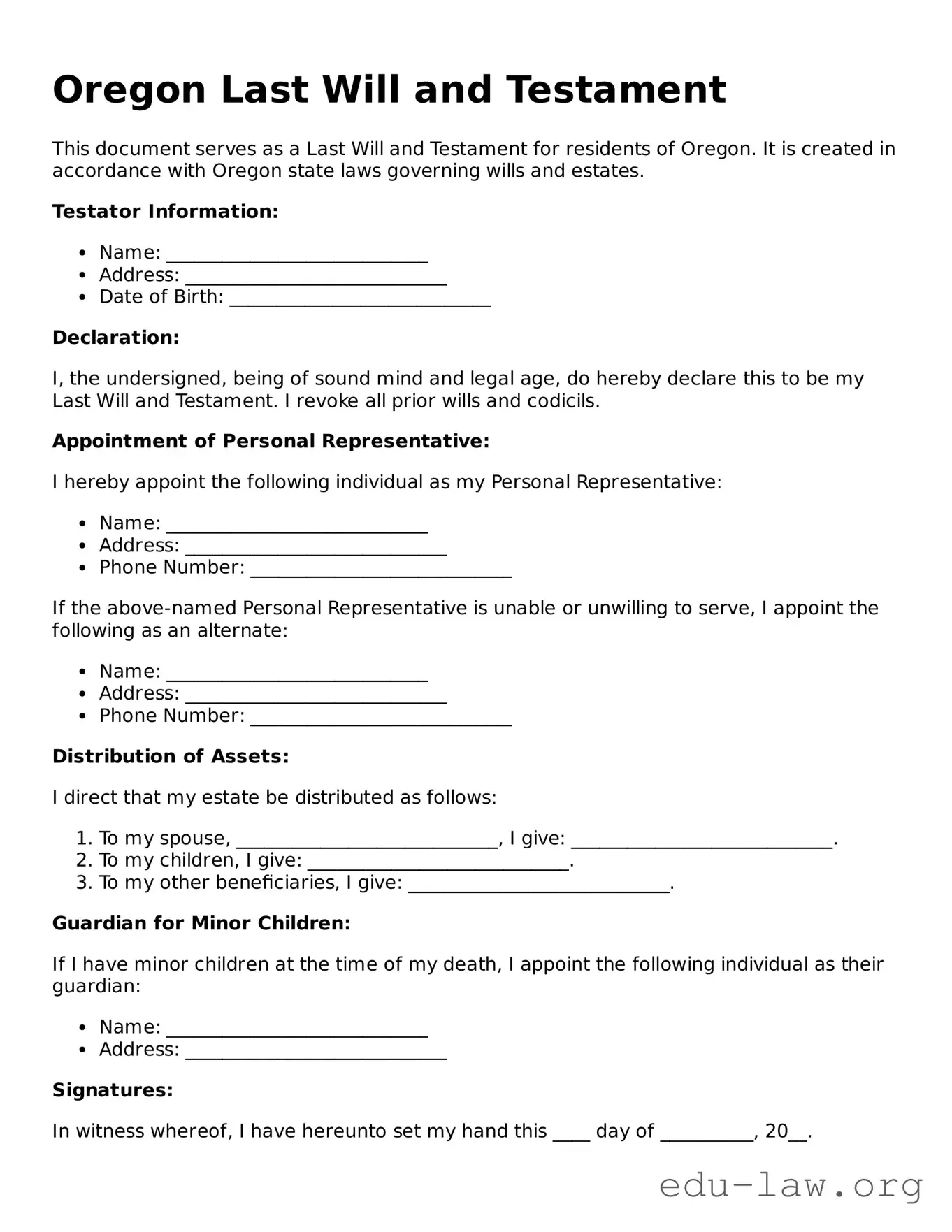
This document serves as a Last Will and Testament for residents of Oregon. It is created in accordance with Oregon state laws governing wills and estates.
Testator Information:
Declaration:
I, the undersigned, being of sound mind and legal age, do hereby declare this to be my Last Will and Testament. I revoke all prior wills and codicils.
Appointment of Personal Representative:
I hereby appoint the following individual as my Personal Representative:
If the above-named Personal Representative is unable or unwilling to serve, I appoint the following as an alternate:
Distribution of Assets:
I direct that my estate be distributed as follows:
Guardian for Minor Children:
If I have minor children at the time of my death, I appoint the following individual as their guardian:
Signatures:
In witness whereof, I have hereunto set my hand this ____ day of __________, 20__.
______________________________
Signature of Testator
Witnesses:
We, the undersigned witnesses, hereby declare that the Testator signed this Last Will and Testament in our presence and that we are not beneficiaries under this Will.
| Fact Name | Details |
|---|---|
| Governing Law | The Oregon Last Will and Testament is governed by Oregon Revised Statutes, Chapter 112. |
| Age Requirement | To create a valid will in Oregon, the testator must be at least 18 years old. |
| Witnesses | Oregon law requires that a will be signed by at least two witnesses who are present at the same time. |
| Signature Requirement | The testator must sign the will at the end of the document, or someone else can sign it in their presence and at their request. |
| Revocation | A will can be revoked by creating a new will or by physically destroying the existing will with the intent to revoke it. |
| Self-Proving Wills | Oregon allows for self-proving wills, which can simplify the probate process by affirming the validity of the will without requiring witness testimony. |
| Holographic Wills | Oregon recognizes holographic wills, which are handwritten and do not require witnesses, provided they are signed by the testator. |
Filling out the Oregon Last Will and Testament form is an important step in ensuring your wishes are honored after you pass away. Once completed, this document will need to be signed and witnessed to be valid. Here are the steps to guide you through the process of filling out the form.
What is a Last Will and Testament in Oregon?
A Last Will and Testament is a legal document that outlines how a person's assets and affairs should be handled after their death. In Oregon, this document allows individuals to specify their wishes regarding the distribution of their property, the care of minor children, and the appointment of an executor to manage the estate. It serves to ensure that a person's intentions are honored and can help prevent disputes among surviving family members.
Who can create a Last Will and Testament in Oregon?
In Oregon, any adult who is at least 18 years old and of sound mind can create a Last Will and Testament. This means that the individual must understand the nature of the document and its implications. Minors and those deemed mentally incapacitated are not eligible to create a valid will.
Do I need a lawyer to create a Last Will and Testament in Oregon?
No, it is not necessary to hire a lawyer to create a Last Will and Testament in Oregon. Individuals can draft their own will using templates or forms available online. However, consulting with a lawyer can be beneficial, especially for those with complex estates or specific wishes. A lawyer can help ensure that the will complies with state laws and accurately reflects the individual's intentions.
What are the requirements for a valid will in Oregon?
To be valid in Oregon, a Last Will and Testament must be in writing, signed by the testator (the person making the will), and witnessed by at least two individuals. These witnesses must be at least 18 years old and cannot be beneficiaries of the will. Additionally, the will should clearly express the testator's intentions regarding the distribution of their property.
Can I change or revoke my Last Will and Testament in Oregon?
Yes, individuals can change or revoke their Last Will and Testament at any time while they are still alive and mentally competent. This can be done by creating a new will that explicitly revokes the previous one or by physically destroying the old will. It is important to ensure that any changes are made in accordance with Oregon law to avoid confusion or disputes later.
What happens if I die without a will in Oregon?
If a person dies without a will, they are considered to have died "intestate." In this case, Oregon law determines how their assets will be distributed. Typically, the estate will be divided among surviving relatives according to a specific hierarchy, which may not align with the deceased's wishes. This can lead to complications and disputes among family members.
How can I ensure my Last Will and Testament is followed?
To ensure that your Last Will and Testament is followed, it is essential to communicate your wishes clearly to your loved ones and the appointed executor. Choosing a reliable executor who understands your intentions can also help. Additionally, keeping the will in a safe place and informing key individuals about its location can prevent misunderstandings after your passing.
Is a handwritten will valid in Oregon?
Yes, a handwritten will, also known as a holographic will, can be valid in Oregon as long as it meets certain criteria. The entire will must be in the handwriting of the testator, and it must clearly express their intentions. However, it is advisable to follow the formal requirements of a typed will to avoid potential challenges in probate court.
Not clearly identifying the testator. It's crucial to include your full legal name and address. Omitting this information can lead to confusion about who the will belongs to.
Failing to list beneficiaries correctly. Ensure that you include the full names and relationships of all beneficiaries. Incomplete or vague information can create disputes.
Not specifying what each beneficiary will receive. Clearly outline the assets or amounts designated for each beneficiary to avoid ambiguity.
Overlooking the need for witnesses. Oregon requires at least two witnesses to sign the will. Failing to have witnesses can render the will invalid.
Not dating the will. A date is essential to establish the will's validity and to indicate that it is the most current version.
Neglecting to revoke previous wills. If you have made prior wills, explicitly state that they are revoked to prevent any confusion or conflict.
Using ambiguous language. Clear and precise language is key. Avoid vague terms that can be interpreted in multiple ways.
Not considering tax implications. Some people forget to think about estate taxes and how they might affect the distribution of assets.
Failing to review and update the will regularly. Life changes, such as marriage, divorce, or the birth of children, may necessitate updates to the will.
When preparing a Last Will and Testament in Oregon, several other documents may complement your estate planning. Each of these forms serves a specific purpose, ensuring your wishes are clearly outlined and legally recognized.
Using these forms in conjunction with your Last Will and Testament can help ensure that your wishes are clearly communicated and legally upheld. Proper estate planning provides peace of mind for you and your loved ones.
The Oregon Last Will and Testament is similar to a Living Will, which outlines a person's wishes regarding medical treatment in the event they become incapacitated. While a Last Will and Testament focuses on the distribution of assets after death, a Living Will addresses healthcare decisions. It provides guidance to family members and medical professionals about the individual's preferences for life-sustaining treatment. Both documents serve to express personal wishes, but they apply to different situations—one for after death and the other for critical health scenarios during life.
Another document that shares similarities with the Oregon Last Will and Testament is a Durable Power of Attorney. This legal document allows someone to make financial and legal decisions on behalf of another person if they are unable to do so themselves. Like a Last Will, it is designed to protect an individual’s interests, but it comes into play while the person is still alive. The Durable Power of Attorney can ensure that financial matters are handled according to the individual's wishes, just as a will ensures the distribution of assets after death.
A Trust Agreement also resembles the Oregon Last Will and Testament in its purpose of managing and distributing assets. A trust allows a person to place their assets into a legal entity that can be managed by a trustee for the benefit of designated beneficiaries. While a will takes effect after death, a trust can be active during a person's lifetime and can help avoid probate, which is often a lengthy process. Both documents aim to provide clarity on asset distribution, but they do so in different ways and at different times.
Lastly, a Codicil is a document that modifies an existing will. It can add, change, or revoke provisions in the original Last Will and Testament without the need to create an entirely new will. This is particularly useful for individuals who want to make small adjustments as life circumstances change. Both a codicil and a will serve the same ultimate purpose of outlining a person's wishes regarding their estate, but a codicil acts as an amendment rather than a standalone document.
When filling out the Oregon Last Will and Testament form, it is important to approach the task with care and attention. Here are some guidelines to help you navigate this process effectively.
Following these guidelines will help ensure that your wishes are respected and that the process goes smoothly for your loved ones. It is always wise to consult with a legal professional if you have any questions or concerns about your will.
When it comes to creating a Last Will and Testament in Oregon, several misconceptions can lead to confusion. Understanding these misconceptions is crucial for effective estate planning. Here are five common misunderstandings:
Understanding these misconceptions can help individuals make informed decisions about their estate planning needs in Oregon.
When considering the Oregon Last Will and Testament form, it is essential to understand the process and its implications. Here are some key takeaways to keep in mind: