For families considering homeschooling in Oregon, understanding the Homeschool Letter of Intent form is a crucial first step. This form serves as an official notification to the local education authority that a parent or guardian intends to educate their child at home. It requires basic information, including the names and ages of the children being homeschooled, as well as the address of the residence. Parents must also provide a brief description of the educational plan they intend to follow, outlining how they will ensure their children receive a quality education. Filing this letter is not just a formality; it establishes a legal framework for homeschooling in the state, ensuring compliance with Oregon's educational regulations. By completing and submitting this form, parents take an important step toward creating a personalized learning environment that suits their children's unique needs.
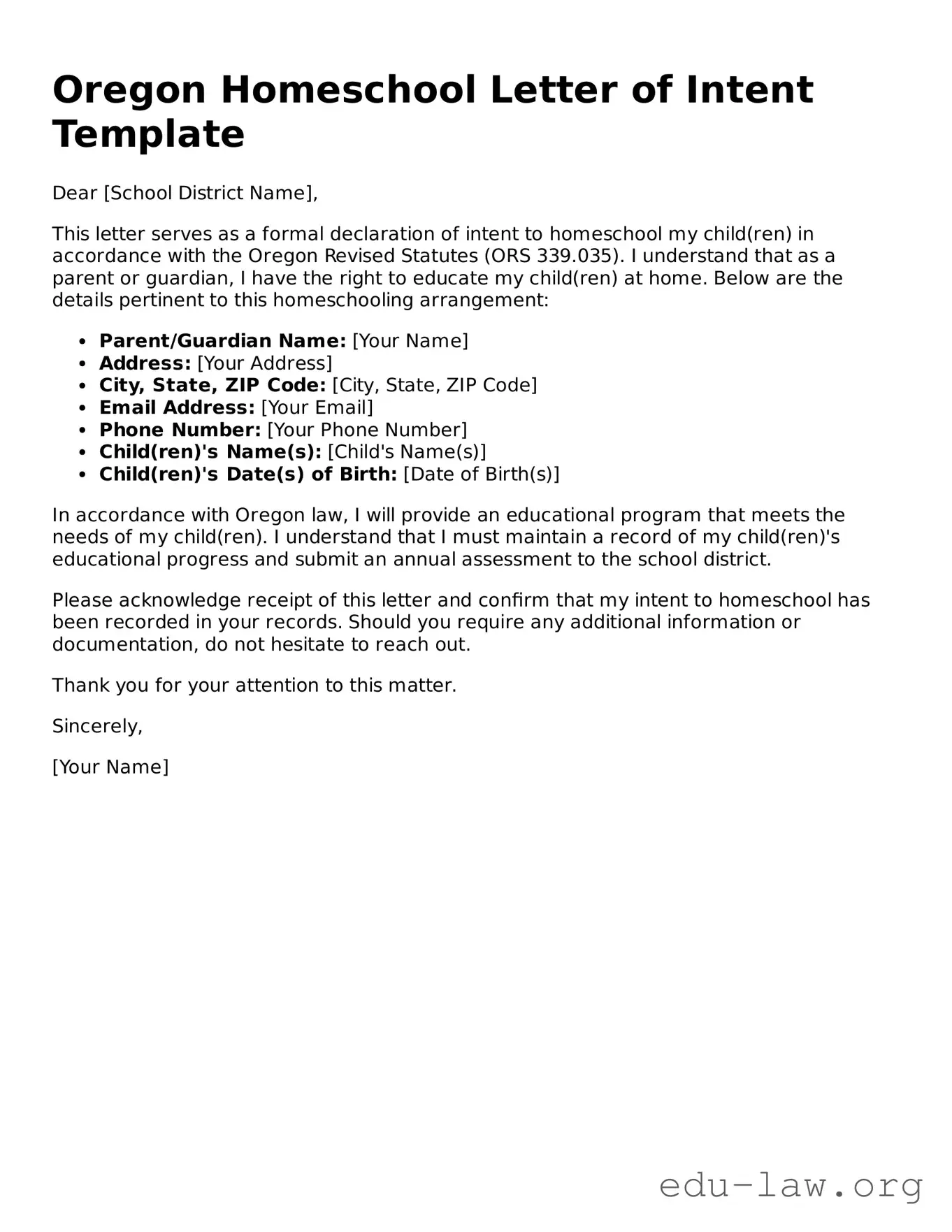
Oregon Homeschool Letter of Intent Template
Dear [School District Name],
This letter serves as a formal declaration of intent to homeschool my child(ren) in accordance with the Oregon Revised Statutes (ORS 339.035). I understand that as a parent or guardian, I have the right to educate my child(ren) at home. Below are the details pertinent to this homeschooling arrangement:
In accordance with Oregon law, I will provide an educational program that meets the needs of my child(ren). I understand that I must maintain a record of my child(ren)'s educational progress and submit an annual assessment to the school district.
Please acknowledge receipt of this letter and confirm that my intent to homeschool has been recorded in your records. Should you require any additional information or documentation, do not hesitate to reach out.
Thank you for your attention to this matter.
Sincerely,
[Your Name]
| Fact Name | Description |
|---|---|
| Purpose | The Oregon Homeschool Letter of Intent form is used to notify the local education authority of a parent's intent to homeschool their child. |
| Governing Law | The form is governed by Oregon Revised Statutes (ORS) 339.035, which outlines the requirements for homeschooling. |
| Submission Deadline | Parents must submit the Letter of Intent at least 10 days before starting the homeschooling program. |
| Age Requirement | The form is applicable for children aged 6 to 18 who are not enrolled in a public or private school. |
| Annual Updates | Parents are required to submit an updated Letter of Intent each year to continue homeschooling. |
| Content Requirements | The form must include the child's name, birth date, and the address of the homeschooling location. |
| Educational Plan | While not required at the time of submission, parents are encouraged to develop an educational plan for their child. |
| Notification Process | The local school district must acknowledge receipt of the Letter of Intent within 14 days. |
| Record Keeping | Parents must maintain educational records and provide them upon request from the local education authority. |
| Non-Compliance Consequences | Failure to submit the Letter of Intent or comply with homeschooling laws may result in legal action or loss of homeschooling privileges. |
Once you have the Oregon Homeschool Letter of Intent form, it’s time to fill it out accurately. Completing this form is an important step in notifying the state of your intention to homeschool your child. After submitting the form, you will be able to begin your homeschooling journey.
What is the Oregon Homeschool Letter of Intent form?
The Oregon Homeschool Letter of Intent is a formal document that parents or guardians must submit to notify their local school district of their intention to homeschool their child. This letter serves as an official declaration that the parents are taking on the responsibility of educating their child outside of the traditional school system.
Who needs to submit the Letter of Intent?
Any parent or guardian who wishes to homeschool a child between the ages of 6 and 18 must submit this letter. It is essential for establishing the legal status of homeschooling in Oregon. If a child has previously attended public school, the letter should be submitted prior to the start of homeschooling.
When should I submit the Letter of Intent?
The Letter of Intent should be submitted at least 10 days before the start of the homeschooling program. If you are withdrawing a child from public school, it is advisable to submit the letter as soon as possible to ensure compliance with state regulations.
What information is required in the Letter of Intent?
The Letter of Intent must include basic information such as the child’s name, age, and address. Additionally, parents should provide their own names and contact information. It is also important to specify that the intent is to homeschool the child. Some districts may request additional details, so it is wise to check with your local school district for any specific requirements.
Is there a specific format for the Letter of Intent?
While there is no mandated format for the Letter of Intent, it should be clear and concise. A simple statement declaring your intent to homeschool, along with the necessary information, is typically sufficient. It’s always a good idea to keep a copy for your records.
What happens after I submit the Letter of Intent?
Once the Letter of Intent is submitted, the local school district will acknowledge receipt of your letter. They may provide you with information about homeschooling regulations, resources, and any required assessments. It is important to stay informed about your obligations as a homeschooling parent.
Can I change my mind after submitting the Letter of Intent?
Yes, you can change your mind about homeschooling after submitting the Letter of Intent. If you decide to enroll your child in a public or private school, simply inform the school district of your decision. It’s important to communicate any changes to ensure compliance with state regulations.
Incomplete Information: Failing to provide all required details can lead to delays or issues with your application. Ensure that every section of the form is filled out completely.
Incorrect Names: Double-check the spelling of your child’s name and your own. Mistakes in names can cause confusion and may require you to resubmit the form.
Missing Signature: Some parents forget to sign the form. A missing signature means the form is not valid and cannot be processed.
Failure to Notify: Not informing the school district of your intent to homeschool can result in misunderstandings. It’s essential to send the letter to the correct district office.
Incorrect Dates: Providing wrong dates for the start of homeschooling can lead to complications. Ensure that the dates reflect when you plan to begin your homeschool journey.
Ignoring Local Regulations: Each district may have specific requirements. Always check for any additional paperwork or guidelines that may be necessary in your area.
Assuming It’s Optional: Some parents mistakenly think that submitting the letter is optional. In Oregon, it is a requirement, and neglecting it can lead to legal issues.
Not Keeping a Copy: Failing to keep a copy of the submitted letter can create problems later on. Always retain a copy for your records.
Overlooking Follow-Up: After submitting the letter, some parents forget to follow up with the school district. Confirming receipt can provide peace of mind and ensure everything is in order.
When you decide to homeschool in Oregon, submitting the Homeschool Letter of Intent is just the first step. There are several other forms and documents that can help ensure compliance with state regulations and support your homeschooling journey.
Having these documents prepared can streamline your homeschooling process and ensure that you meet all necessary requirements. Staying organized will not only ease your administrative burden but also enhance your child's educational experience.
The Oregon Homeschool Letter of Intent form shares similarities with the Enrollment Form used by public schools. Both documents serve as official notifications to the educational authorities regarding a child’s educational status. Just as the Letter of Intent informs the state that a family has chosen to homeschool, the Enrollment Form indicates that a child will be attending a public school. Each form requires basic information about the student, such as name and age, and both must be submitted to the appropriate educational institution to ensure compliance with state regulations.
Another document that resembles the Oregon Homeschool Letter of Intent is the Private School Enrollment Form. Like the Letter of Intent, this form is used to declare a child’s educational choice outside of the public school system. Parents must provide information about their child and the private school they plan to enroll them in. Both forms are essential for maintaining proper records and ensuring that the educational authorities are aware of a child’s schooling situation.
The Individualized Education Program (IEP) also has parallels with the Oregon Homeschool Letter of Intent. While the IEP is specifically designed for students with special needs, it serves a similar purpose in documenting a child’s educational plan. Both documents require detailed information about the student’s educational needs and goals. They help ensure that the educational authorities are aware of the child’s unique circumstances, allowing for appropriate support and resources to be allocated.
The Affidavit of Homeschooling, often used in various states, is another document that shares similarities with the Oregon Homeschool Letter of Intent. This affidavit acts as a sworn statement by parents that they are providing homeschooling for their child. Much like the Letter of Intent, it requires parents to affirm their educational choices and provide basic details about their child. Both documents aim to formalize the homeschooling process and ensure compliance with state laws.
Lastly, the Notification of Intent to Homeschool form in other states is quite similar to Oregon's form. This document serves the same fundamental purpose: to inform the state that parents have chosen to homeschool their children. The content typically includes the child’s name, age, and the educational plan parents intend to follow. By submitting this notification, parents fulfill their legal obligation to inform the state about their educational choices, just as they do with the Oregon Homeschool Letter of Intent.
When filling out the Oregon Homeschool Letter of Intent form, it's important to follow certain guidelines to ensure your submission is accurate and complete. Here are five things to keep in mind:
Many individuals considering homeschooling in Oregon may have misconceptions about the Homeschool Letter of Intent form. Understanding the facts can help clarify the process and requirements. Here are four common misconceptions:
This is incorrect. The Homeschool Letter of Intent must be submitted for all children who will be homeschooled, regardless of their age. Families should submit the form when they decide to homeschool their children.
While submitting the Homeschool Letter of Intent is a crucial step, it is not the only requirement. Parents must also ensure they provide an appropriate education that meets state standards.
This is a common misunderstanding. The Homeschool Letter of Intent is only required when a family begins homeschooling. If the family continues homeschooling without interruption, they do not need to resubmit the form each year.
Failing to submit the Homeschool Letter of Intent can lead to legal issues. The state requires this form to ensure compliance with homeschooling laws. Parents may face penalties if they do not adhere to these requirements.
When filling out and using the Oregon Homeschool Letter of Intent form, keep these key points in mind:
Following these guidelines will help ensure a smooth start to your homeschooling experience in Oregon.