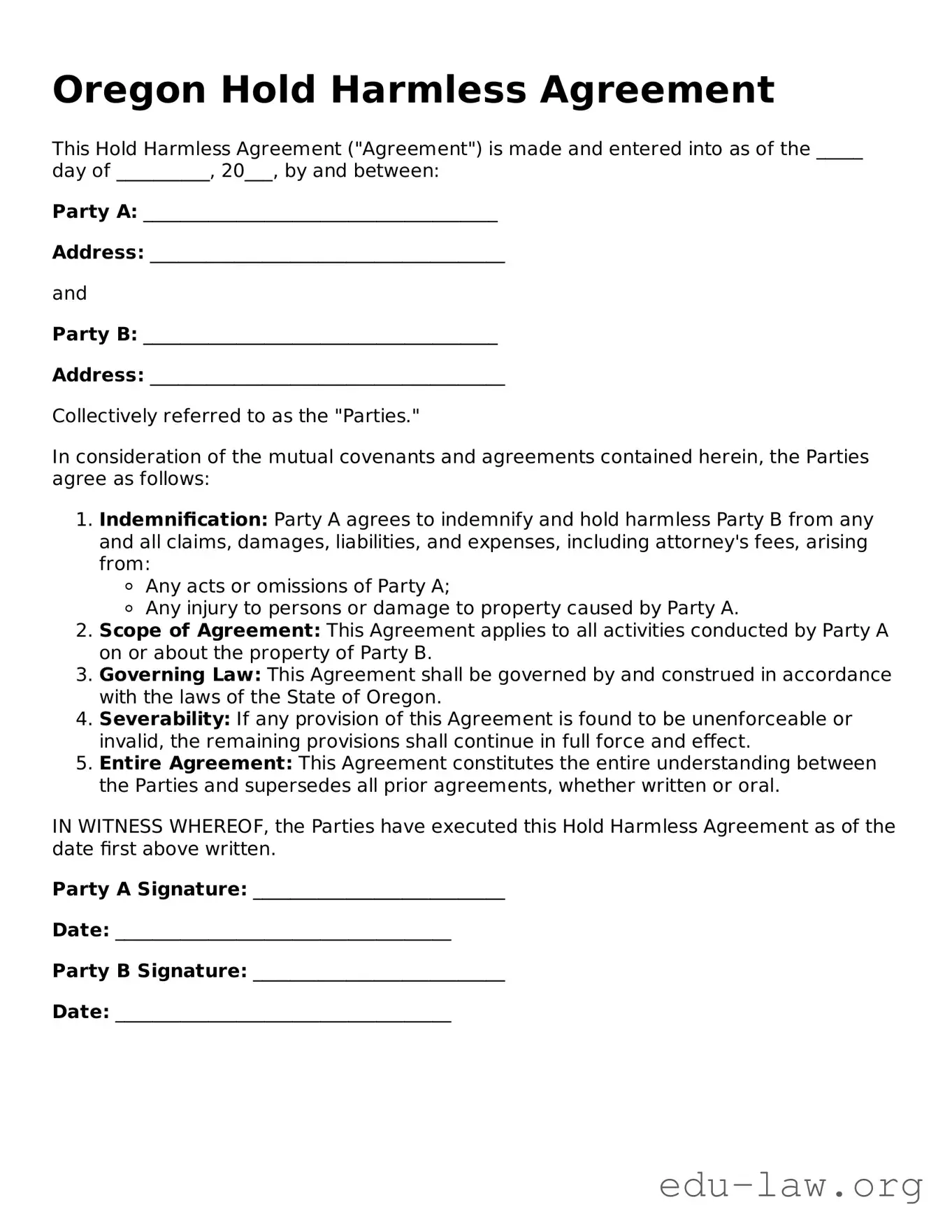
The Oregon Hold Harmless Agreement form plays a crucial role in various transactions and activities, particularly in real estate, construction, and event planning. This document serves as a legal tool that protects one party from liability for any injuries or damages that may occur during a specified activity or on a property. By signing this agreement, individuals or organizations agree to assume the risk associated with their actions, thereby shielding the other party from potential legal claims. Key elements of the form include clear identification of the parties involved, a detailed description of the activity or property in question, and specific language outlining the extent of liability being waived. Additionally, the agreement often includes provisions regarding indemnification, ensuring that the party assuming the risk agrees to cover any costs or damages that arise from incidents related to the activity. Understanding the nuances of this form is essential for anyone engaging in activities where liability concerns may arise, as it establishes a framework for accountability and risk management.
Oregon Hold Harmless Agreement
This Hold Harmless Agreement ("Agreement") is made and entered into as of the _____ day of __________, 20___, by and between:
Party A: ______________________________________
Address: ______________________________________
and
Party B: ______________________________________
Address: ______________________________________
Collectively referred to as the "Parties."
In consideration of the mutual covenants and agreements contained herein, the Parties agree as follows:
IN WITNESS WHEREOF, the Parties have executed this Hold Harmless Agreement as of the date first above written.
Party A Signature: ___________________________
Date: ____________________________________
Party B Signature: ___________________________
Date: ____________________________________
| Fact Name | Details |
|---|---|
| Definition | The Oregon Hold Harmless Agreement is a legal document that protects one party from liability for damages or injuries incurred by another party. |
| Purpose | This agreement is often used in contracts involving services, events, or property use to limit liability risks. |
| Governing Law | The agreement is governed by Oregon state law, specifically under the Oregon Revised Statutes. |
| Parties Involved | Typically, there are two parties: the indemnitor (the party assuming the risk) and the indemnitee (the party being protected). |
| Enforceability | For the agreement to be enforceable, it must be clear, specific, and voluntarily agreed upon by both parties. |
| Limitations | Hold harmless clauses cannot protect a party from liability arising from their own gross negligence or willful misconduct. |
| Common Uses | This agreement is frequently used in construction contracts, rental agreements, and event planning contracts. |
| Legal Review | It is advisable for parties to have the agreement reviewed by legal counsel to ensure compliance with state laws. |
| Modification | The terms of the agreement can be modified, but any changes must be documented and agreed upon by both parties. |
| Not a Substitute | A Hold Harmless Agreement does not replace insurance; it serves as an additional layer of protection. |
After obtaining the Oregon Hold Harmless Agreement form, you will need to complete it accurately to ensure that all necessary information is provided. Follow the steps below to fill out the form correctly.
Once you have completed the form, review it for any errors before submitting it to the relevant party. Keep a copy for your records.
What is an Oregon Hold Harmless Agreement?
An Oregon Hold Harmless Agreement is a legal document designed to protect one party from liability or claims that may arise from the actions or negligence of another party. It is often used in various contexts, such as rental agreements, construction contracts, or events where one party wishes to minimize their risk of being held responsible for accidents or damages that occur during a specific activity or event.
Who typically uses a Hold Harmless Agreement in Oregon?
Individuals and organizations across different sectors may utilize a Hold Harmless Agreement. Common users include property owners, contractors, event organizers, and businesses that engage in activities where there is a potential for injury or property damage. By using this agreement, they aim to ensure that they are not financially liable for incidents that occur outside their control.
What are the key components of a Hold Harmless Agreement?
A well-drafted Hold Harmless Agreement typically includes several essential elements. These may consist of the names of the parties involved, a clear description of the activities covered, the scope of liability being waived, and any specific terms regarding indemnification. Additionally, it should outline the governing law, usually the state of Oregon, and include signatures from all parties to confirm their agreement.
Is a Hold Harmless Agreement legally binding in Oregon?
Yes, a Hold Harmless Agreement can be legally binding in Oregon, provided it meets certain criteria. The agreement must be clear, specific, and voluntarily signed by all parties involved. Courts generally uphold these agreements unless they are deemed unconscionable or overly broad. It is advisable to ensure that the language used is understandable and that all parties fully comprehend the terms before signing.
Can a Hold Harmless Agreement be enforced if negligence is involved?
In Oregon, the enforceability of a Hold Harmless Agreement in cases of negligence can vary. Generally, agreements that attempt to waive liability for gross negligence or willful misconduct may not be enforceable. However, for ordinary negligence, such agreements can be upheld. It is crucial to consult legal advice to understand the nuances and limitations specific to your situation.
How can I create a Hold Harmless Agreement?
Creating a Hold Harmless Agreement involves drafting a document that clearly outlines the terms and conditions agreed upon by the parties. While templates are available online, it is advisable to tailor the agreement to fit the specific circumstances. Consulting with a legal professional can ensure that the agreement is comprehensive and compliant with Oregon law, thereby reducing the risk of future disputes.
What should I do if someone refuses to sign a Hold Harmless Agreement?
If a party refuses to sign a Hold Harmless Agreement, it may be necessary to assess the situation carefully. Consider discussing their concerns and the reasons behind their reluctance. Open communication can sometimes lead to a resolution. If the agreement is essential for proceeding with an activity or project, you may need to evaluate whether to proceed without it or find alternative risk management strategies.
Not reading the entire agreement carefully. Many people skim through the document, missing important clauses and conditions.
Failing to provide accurate personal information. It's crucial to ensure that names, addresses, and contact details are correct to avoid future complications.
Overlooking the date of the agreement. Forgetting to date the document can render it invalid, as it lacks a clear timeline.
Not understanding the implications of the agreement. Some individuals sign without fully grasping what they are agreeing to, which can lead to unexpected liabilities.
Leaving out necessary signatures. Both parties must sign the agreement; otherwise, it may not be enforceable.
Neglecting to clarify terms. If any part of the agreement is unclear, it’s important to seek clarification before signing.
Assuming the agreement is standard. Each Hold Harmless Agreement can have unique terms, and it’s essential to treat each one as specific to the situation.
Ignoring state-specific requirements. Different states may have particular rules or regulations that apply to Hold Harmless Agreements.
Not keeping a copy of the signed agreement. After signing, it’s vital to retain a copy for personal records and future reference.
When engaging in agreements that involve liability and risk, it is common to encounter various forms and documents that complement the Oregon Hold Harmless Agreement. Each of these documents serves a specific purpose, ensuring clarity and protection for all parties involved. Below is a list of eight such documents.
Understanding these documents can help individuals and organizations navigate potential risks and ensure all parties are adequately protected. Each form plays a vital role in fostering clear communication and establishing expectations in various agreements.
The Oregon Hold Harmless Agreement is closely related to the Indemnity Agreement. Both documents serve to protect one party from liability arising from the actions or negligence of another. In an Indemnity Agreement, one party agrees to compensate the other for any losses or damages incurred. This creates a financial safety net, similar to the Hold Harmless Agreement, which focuses more on preventing claims from being made in the first place. Both documents are commonly used in contracts where risk is present, such as construction projects or service agreements.
Another document that shares similarities is the Liability Waiver. A Liability Waiver is often used in situations where participants engage in activities that could result in injury, such as sports or recreational events. Like the Hold Harmless Agreement, it aims to limit the liability of the organizer or provider by having participants acknowledge the risks involved. Both documents require a clear understanding of the risks and the acceptance of responsibility by the individual signing the agreement.
The Release of Liability is also akin to the Hold Harmless Agreement. This document is typically used when one party agrees to release another from any future claims or legal actions. While the Hold Harmless Agreement focuses on preventing claims from arising, the Release of Liability explicitly states that the signer relinquishes their right to pursue any claims against the other party. Both documents emphasize the importance of informed consent and understanding of the risks involved.
The Mutual Release Agreement shares a similar purpose with the Hold Harmless Agreement but is often used in the context of settling disputes. In a Mutual Release Agreement, both parties agree to release each other from any future claims related to a specific issue or event. This is different from the Hold Harmless Agreement, which is more about ongoing protection from liability. However, both documents help to clarify the responsibilities and expectations of each party involved.
The Non-Disclosure Agreement (NDA) can also be considered similar, although its focus is on confidentiality rather than liability. An NDA prevents parties from sharing sensitive information that could lead to competitive harm. While the Hold Harmless Agreement protects against claims arising from actions, the NDA protects against the misuse of information. Both documents emphasize the importance of trust and clear communication between parties.
The Service Agreement is another document that can be compared to the Hold Harmless Agreement. In a Service Agreement, the terms of the service provided are outlined, including any liabilities that may arise during the service period. Often, these agreements will include Hold Harmless clauses to ensure that one party is protected from claims resulting from the other party's actions. This makes both documents essential in defining the scope of responsibility and risk management.
Next, the Construction Contract often includes Hold Harmless provisions to protect contractors and property owners from liability. In construction, the risks of accidents and injuries are significant. The Hold Harmless Agreement within the contract ensures that one party will not be held responsible for the actions of another, thereby clarifying liability and protecting financial interests. This relationship is crucial in the construction industry, where safety and accountability are paramount.
The Rental Agreement is another document that may incorporate Hold Harmless clauses. In rental agreements, landlords often seek to protect themselves from liability for injuries that occur on their property. By including a Hold Harmless clause, landlords can shift some of the responsibility to tenants, who agree not to hold the landlord liable for certain incidents. This mutual understanding helps to establish clear boundaries regarding liability and responsibility.
Finally, the Employment Agreement can also contain Hold Harmless provisions. Employers may include these clauses to protect themselves from claims arising from employee actions while performing their job duties. By having employees agree to hold the employer harmless, the agreement clarifies the expectations of behavior and responsibility in the workplace. This helps to foster a safer and more accountable work environment.
When filling out the Oregon Hold Harmless Agreement form, it's important to approach the process with care. Here are some essential dos and don'ts to consider:
By following these guidelines, you can help ensure that your Hold Harmless Agreement is completed correctly and effectively protects your interests.
Understanding the nuances of legal documents can be challenging, especially when it comes to specific agreements like the Oregon Hold Harmless Agreement. Misconceptions can lead to confusion and potentially unfavorable outcomes. Here are ten common misconceptions about this form, along with clarifications to help demystify its purpose and function.
By addressing these misconceptions, individuals can better understand the Oregon Hold Harmless Agreement and its implications, ensuring they are adequately protected in various situations.
When dealing with the Oregon Hold Harmless Agreement form, it's important to keep several key points in mind. Here are some essential takeaways:
By keeping these points in mind, you can effectively fill out and utilize the Oregon Hold Harmless Agreement form, ensuring clarity and protection for all parties involved.