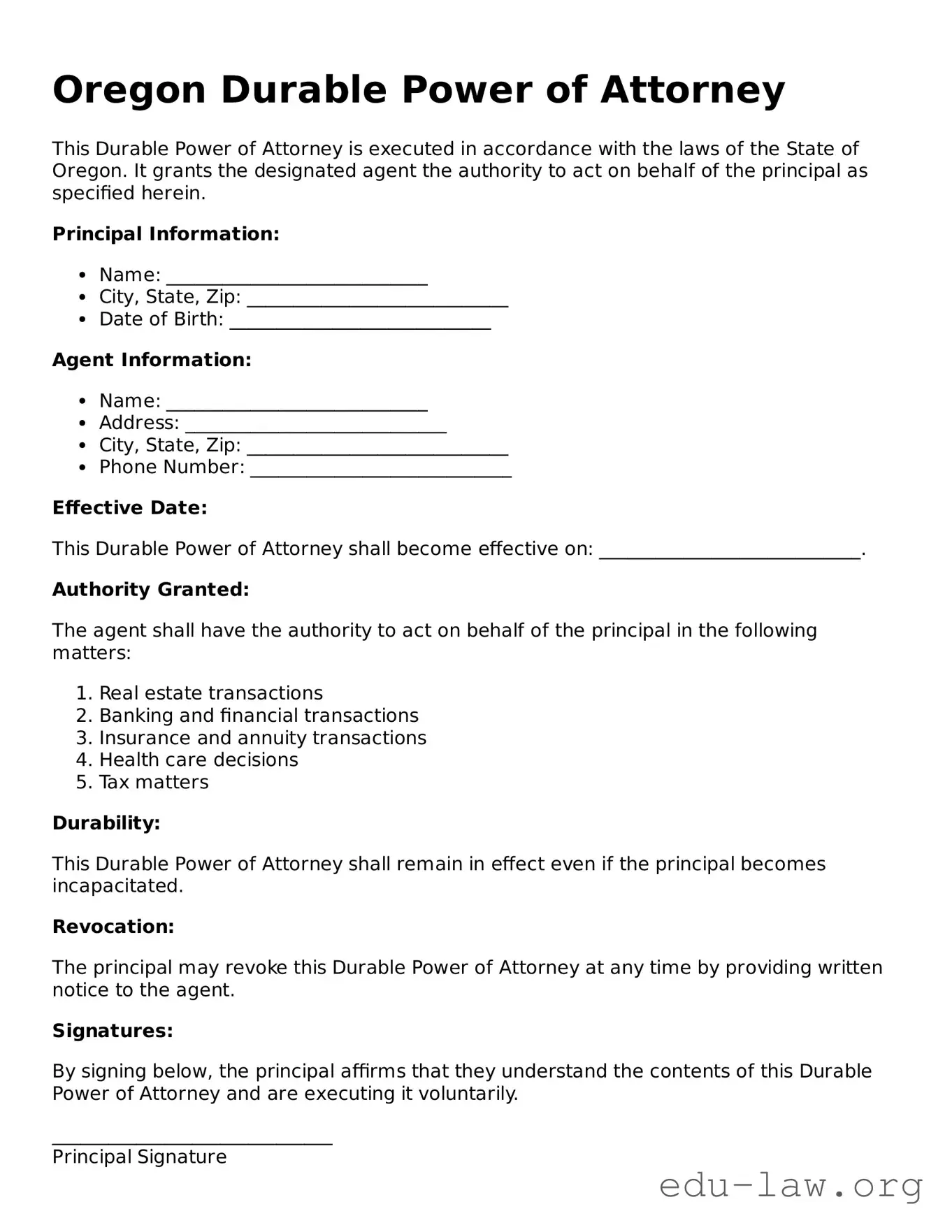
The Oregon Durable Power of Attorney form is an important legal document that enables individuals to appoint someone they trust to make decisions on their behalf in the event they become incapacitated. This form is designed to remain effective even if the person who created it loses the ability to manage their affairs. Key aspects of this form include the designation of an agent, the scope of authority granted to that agent, and the potential for the document to be customized to fit specific needs. Individuals can choose to grant broad powers or limit the agent's authority to particular areas, such as financial matters or healthcare decisions. Additionally, the form requires the signature of the person creating it, as well as the signatures of witnesses or a notary public to ensure its validity. Understanding these components is essential for anyone considering this form, as it provides a framework for managing personal and financial matters during challenging times.
Oregon Durable Power of Attorney
This Durable Power of Attorney is executed in accordance with the laws of the State of Oregon. It grants the designated agent the authority to act on behalf of the principal as specified herein.
Principal Information:
Agent Information:
Effective Date:
This Durable Power of Attorney shall become effective on: ____________________________.
Authority Granted:
The agent shall have the authority to act on behalf of the principal in the following matters:
Durability:
This Durable Power of Attorney shall remain in effect even if the principal becomes incapacitated.
Revocation:
The principal may revoke this Durable Power of Attorney at any time by providing written notice to the agent.
Signatures:
By signing below, the principal affirms that they understand the contents of this Durable Power of Attorney and are executing it voluntarily.
______________________________
Principal Signature
Date: ____________________________
______________________________
Agent Signature
Date: ____________________________
Witnesses:
This document must be signed in the presence of two witnesses who are not named as agents or related to the principal.
______________________________
Witness 1 Signature
Date: ____________________________
______________________________
Witness 2 Signature
Date: ____________________________
Notary Public:
State of Oregon
County of ____________________________
Subscribed and sworn to before me on this _____ day of __________, 20__.
______________________________
Notary Public Signature
My commission expires: ____________________________
| Fact Name | Description |
|---|---|
| Definition | The Oregon Durable Power of Attorney form allows an individual to designate someone to make financial and legal decisions on their behalf if they become incapacitated. |
| Governing Law | This form is governed by Oregon Revised Statutes, specifically ORS 125.005 to 125.045. |
| Durability | The power granted remains effective even if the principal becomes incapacitated, which is a key feature of a durable power of attorney. |
| Revocation | The principal can revoke the power of attorney at any time, as long as they are mentally competent to do so. |
After obtaining the Oregon Durable Power of Attorney form, you will need to carefully fill it out to ensure it meets your needs. Follow these steps to complete the form accurately.
What is an Oregon Durable Power of Attorney?
An Oregon Durable Power of Attorney is a legal document that allows an individual, known as the principal, to designate another person, called the agent, to make decisions on their behalf. This document remains effective even if the principal becomes incapacitated. It can cover a wide range of decisions, including financial and healthcare matters.
How do I create a Durable Power of Attorney in Oregon?
To create a Durable Power of Attorney in Oregon, you must complete the form provided by the state. You can find this form online or through legal resources. Fill out the necessary information, including the names of the principal and agent, and specify the powers granted to the agent. After signing the document, it must be witnessed by two individuals or notarized to be legally valid.
What powers can I grant to my agent?
You can grant your agent a wide range of powers, including managing your financial affairs, handling real estate transactions, and making healthcare decisions. It is essential to clearly outline the specific powers you wish to grant to avoid confusion in the future. You can also limit the powers if desired.
Can I revoke my Durable Power of Attorney?
Yes, you can revoke your Durable Power of Attorney at any time as long as you are mentally competent. To do so, you must create a written revocation document and notify your agent and any institutions or individuals that may have relied on the original document. It is advisable to also destroy any copies of the original form.
What happens if I become incapacitated and do not have a Durable Power of Attorney?
If you become incapacitated without a Durable Power of Attorney in place, your family may need to go through a legal process called guardianship to make decisions on your behalf. This process can be time-consuming and costly, and it may not reflect your wishes. Having a Durable Power of Attorney helps avoid this situation.
Do I need a lawyer to create a Durable Power of Attorney in Oregon?
No, you do not need a lawyer to create a Durable Power of Attorney in Oregon. However, consulting with a legal professional can provide guidance, especially if your situation is complex. A lawyer can help ensure that the document meets all legal requirements and accurately reflects your intentions.
Is my Durable Power of Attorney valid in other states?
Generally, a Durable Power of Attorney created in Oregon is valid in other states, but laws can vary. It is advisable to check the specific requirements of the state where you intend to use the document. Some states may require additional forms or notarization to recognize an out-of-state Durable Power of Attorney.
Not Specifying Powers Clearly: Individuals often fail to clearly outline the powers they wish to grant. This can lead to confusion or misuse of authority.
Forgetting to Date the Document: A common oversight is neglecting to date the form. Without a date, the validity of the document may be questioned.
Not Including Successor Agents: Many people overlook the importance of naming a successor agent. If the primary agent cannot act, this can create complications.
Improper Signatures: Signatures must be clear and consistent. Failing to sign correctly can invalidate the document.
Ignoring Witness Requirements: Some may not realize that Oregon requires witnesses for the document to be valid. Skipping this step can lead to legal challenges.
Not Considering Revocation: Individuals sometimes forget to include a clause on how to revoke the power of attorney. This can complicate future decisions.
Failing to Review the Document: Finally, many people neglect to review the completed form for accuracy. Errors can render the document ineffective.
The Oregon Durable Power of Attorney form allows individuals to designate someone to make financial and legal decisions on their behalf. This document is crucial for ensuring that a trusted person can manage affairs if the individual becomes incapacitated. However, several other documents often accompany this form to provide comprehensive legal support and clarity regarding the individual's wishes.
These documents work together to create a clear framework for decision-making, ensuring that an individual's wishes are honored in both medical and financial contexts. Properly preparing and organizing these forms can provide peace of mind for both the individual and their loved ones.
The Oregon Durable Power of Attorney (DPOA) form shares similarities with the General Power of Attorney (GPOA). Both documents allow one person to appoint another to make decisions on their behalf. However, the GPOA typically becomes invalid if the person who created it becomes incapacitated, whereas the DPOA remains effective even in such situations. This distinction makes the DPOA particularly valuable for long-term planning, ensuring that your financial and medical decisions are handled by someone you trust, no matter what happens to your health.
Another document akin to the DPOA is the Medical Power of Attorney (MPOA). The MPOA specifically focuses on healthcare decisions, allowing an appointed individual to make medical choices when the person is unable to do so. While the DPOA can include financial and legal matters, the MPOA is solely dedicated to health-related issues. This specialization ensures that your healthcare preferences are honored, especially during critical moments when you cannot voice them yourself.
The Living Will is another important document that complements the DPOA. A Living Will outlines your wishes regarding medical treatment in scenarios where you cannot communicate your desires. Unlike the DPOA, which appoints someone to make decisions for you, the Living Will serves as a guide for your appointed agent. It provides clarity on your preferences, ensuring that your values and wishes are respected in medical situations.
The Revocable Trust is similar to the DPOA in that it allows for the management of assets. With a Revocable Trust, you can place your assets in a trust during your lifetime, and you can change or revoke it at any time. Unlike the DPOA, which grants authority to another person, a Revocable Trust allows you to maintain control over your assets while providing a clear plan for distribution after your death. This can help avoid probate and ensure a smoother transition of your estate.
A Healthcare Proxy is closely related to the DPOA, as it allows you to designate someone to make healthcare decisions on your behalf. While the MPOA is specific to medical decisions, the Healthcare Proxy can also encompass broader healthcare directives. This document ensures that someone you trust is empowered to advocate for your medical needs, particularly when you cannot express your wishes.
The Financial Power of Attorney (FPOA) is another document that mirrors the DPOA's purpose. The FPOA specifically grants authority to manage financial matters, such as banking, investments, and property transactions. While the DPOA can cover both financial and medical decisions, the FPOA focuses solely on finances. This can be particularly useful if you want to separate financial management from healthcare decisions.
The Guardianship document is similar in that it involves appointing someone to make decisions for another person. However, Guardianship typically applies to minors or individuals deemed incapacitated by a court. This process can be more complex and requires court approval, unlike the DPOA, which is executed privately. The DPOA allows for a smoother transition of authority without the need for court intervention, providing peace of mind in times of need.
The Advance Directive is another document that aligns with the DPOA. It combines elements of both the Living Will and the MPOA, allowing you to express your healthcare preferences while designating an agent to make decisions on your behalf. This comprehensive approach ensures that your wishes are clear and that someone you trust is prepared to act on them, streamlining the decision-making process during critical moments.
Lastly, the Bill of Rights for Patients can be seen as a supportive document to the DPOA. While it does not grant authority, it outlines the rights of patients in healthcare settings. Understanding these rights can empower your appointed agent to advocate effectively for your preferences. This document ensures that your dignity and autonomy are respected, reinforcing the importance of having a trusted person in charge of your healthcare decisions.
When filling out the Oregon Durable Power of Attorney form, it is crucial to approach the task with care. This document grants someone the authority to make decisions on your behalf, so accuracy and clarity are key. Here are some important do's and don'ts to consider.
Understanding the Oregon Durable Power of Attorney form is essential for making informed decisions about your financial and medical affairs. However, several misconceptions often arise. Here are five common misunderstandings:
Many believe that a Durable Power of Attorney is limited to financial decisions. In reality, it can also cover health care decisions, depending on how it is drafted. This flexibility allows individuals to designate someone to make important choices on their behalf in various situations.
This is a significant misconception. A Durable Power of Attorney remains effective even if the principal becomes incapacitated. The term "durable" indicates that the authority granted continues regardless of the principal's mental or physical condition.
While you can choose anyone you trust as your agent, it is advisable to select someone who is responsible and understands your wishes. Additionally, certain legal restrictions may apply, such as not allowing your agent to be your health care provider.
Each Durable Power of Attorney can be tailored to fit individual needs. You have the option to specify what powers you grant and under what circumstances. This customization ensures that your preferences are respected.
This is not true. You can revoke or modify a Durable Power of Attorney at any time, as long as you are mentally competent. It is important to communicate any changes to your agent and any relevant institutions.
Addressing these misconceptions can help individuals make better decisions regarding their legal and financial planning. Always consult a qualified professional for personalized advice tailored to your situation.
When filling out and using the Oregon Durable Power of Attorney form, it's essential to keep several key points in mind. Here are nine important takeaways:
These takeaways can help ensure that you fill out and use the Oregon Durable Power of Attorney form effectively and in accordance with your wishes.