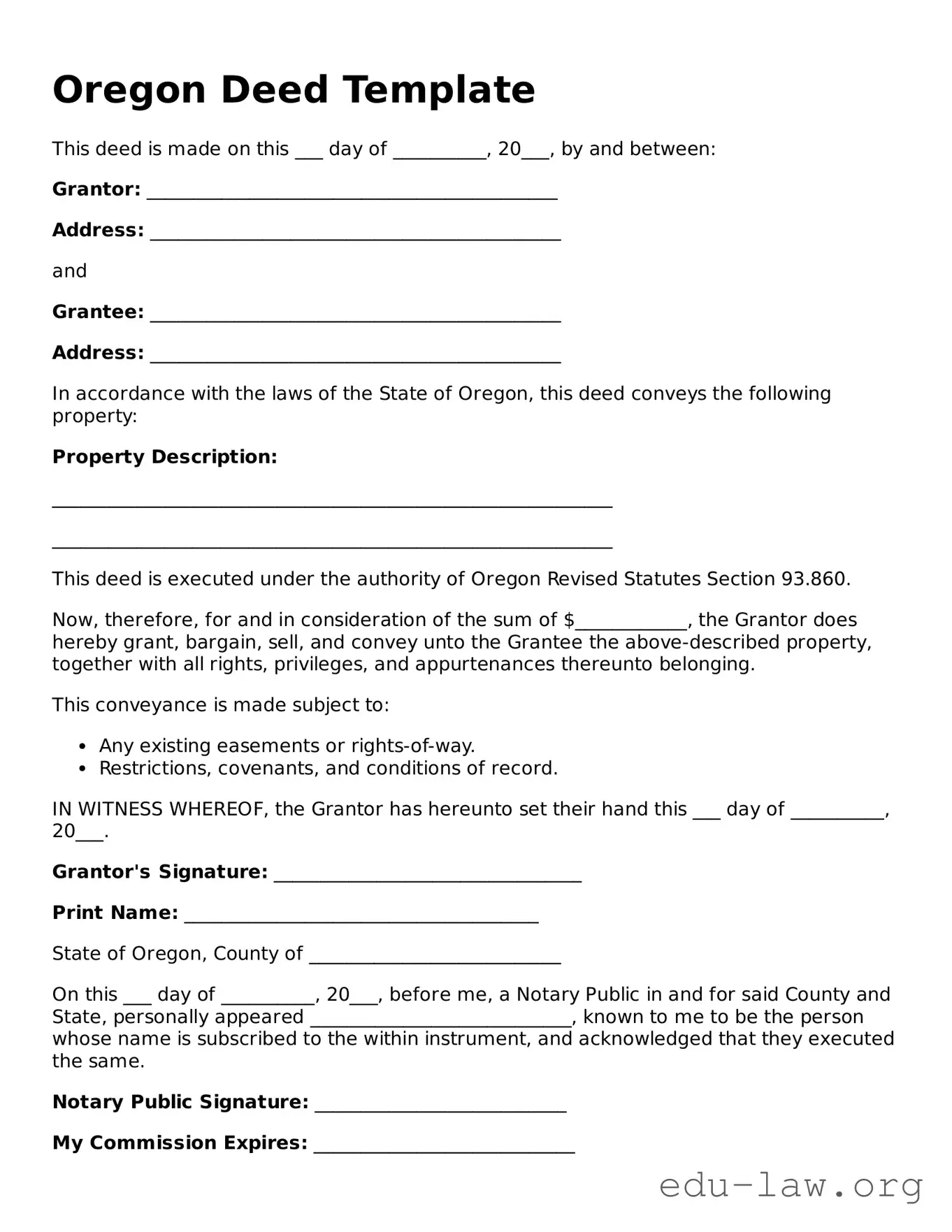
The Oregon Deed form plays a crucial role in real estate transactions within the state, serving as a legal document that facilitates the transfer of property ownership from one party to another. This form typically includes essential details such as the names of the grantor and grantee, a clear description of the property being transferred, and the terms of the conveyance. It is important to ensure that the property description is accurate and comprehensive, as this can prevent future disputes over boundaries or ownership rights. Additionally, the deed may specify any conditions or restrictions associated with the transfer, which can affect how the new owner can use the property. Notably, the Oregon Deed form must be signed and notarized to be legally binding, ensuring that both parties are in agreement and that the transaction is documented properly. Understanding these components is vital for anyone involved in buying or selling real estate in Oregon, as they help to safeguard the interests of all parties and ensure compliance with state laws.
Oregon Deed Template
This deed is made on this ___ day of __________, 20___, by and between:
Grantor: ____________________________________________
Address: ____________________________________________
and
Grantee: ____________________________________________
Address: ____________________________________________
In accordance with the laws of the State of Oregon, this deed conveys the following property:
Property Description:
____________________________________________________________
____________________________________________________________
This deed is executed under the authority of Oregon Revised Statutes Section 93.860.
Now, therefore, for and in consideration of the sum of $____________, the Grantor does hereby grant, bargain, sell, and convey unto the Grantee the above-described property, together with all rights, privileges, and appurtenances thereunto belonging.
This conveyance is made subject to:
IN WITNESS WHEREOF, the Grantor has hereunto set their hand this ___ day of __________, 20___.
Grantor's Signature: _________________________________
Print Name: ______________________________________
State of Oregon, County of ___________________________
On this ___ day of __________, 20___, before me, a Notary Public in and for said County and State, personally appeared ____________________________, known to me to be the person whose name is subscribed to the within instrument, and acknowledged that they executed the same.
Notary Public Signature: ___________________________
My Commission Expires: ____________________________
| Fact Name | Description |
|---|---|
| Definition | The Oregon Deed form is a legal document used to transfer ownership of real property in the state of Oregon. |
| Governing Law | The form is governed by Oregon Revised Statutes, particularly ORS Chapter 93, which outlines property transactions. |
| Types of Deeds | Common types of deeds in Oregon include Warranty Deeds, Quitclaim Deeds, and Bargain and Sale Deeds. |
| Signature Requirements | All parties involved in the transaction must sign the deed for it to be valid. |
| Notarization | The deed must be notarized to ensure authenticity and to meet recording requirements. |
| Recording | To protect ownership rights, the deed should be recorded with the county clerk's office where the property is located. |
| Legal Description | A precise legal description of the property must be included in the deed to avoid ambiguity. |
| Consideration | The deed should specify the consideration (payment) for the property, even if it is a gift. |
| Tax Implications | Property transfers may have tax implications, including potential capital gains tax for the seller. |
| Revocation | Once recorded, a deed can only be revoked through a subsequent legal process, such as a new deed or court order. |
Once you have the Oregon Deed form, you will need to complete it accurately to ensure the transfer of property is valid. After filling out the form, you will need to have it signed and notarized before submitting it to the appropriate county office.
What is a deed form in Oregon?
A deed form in Oregon is a legal document that transfers ownership of real property from one party to another. It serves as evidence of the transaction and outlines the rights and responsibilities of both the grantor (the seller) and the grantee (the buyer). The deed must be properly executed and recorded to be effective against third parties.
What types of deeds are available in Oregon?
Oregon recognizes several types of deeds, including warranty deeds, quitclaim deeds, and grant deeds. A warranty deed provides the highest level of protection to the grantee, ensuring that the grantor has clear title to the property. A quitclaim deed transfers whatever interest the grantor has without guaranteeing that the title is clear. A grant deed is similar to a warranty deed but offers limited warranties regarding the title.
How do I complete an Oregon deed form?
To complete an Oregon deed form, you must include essential information such as the names of the grantor and grantee, a legal description of the property, and the date of the transfer. It is also necessary to sign the deed in front of a notary public. Ensure that all information is accurate and complete to avoid any issues during the recording process.
Is notarization required for an Oregon deed?
Yes, notarization is required for an Oregon deed. The signatures of the grantor must be notarized to validate the document. This step is crucial as it helps prevent fraud and confirms that the grantor willingly signed the deed.
Do I need to record the deed after it is signed?
Recording the deed is not mandatory but is highly recommended. By recording the deed with the county clerk, you provide public notice of the ownership transfer. This protects the grantee's interest in the property and helps prevent disputes regarding ownership in the future.
What is the fee for recording a deed in Oregon?
The recording fee for a deed in Oregon varies by county. Generally, it ranges from $50 to $100. It is advisable to check with the local county clerk's office for the exact fee and any additional costs that may apply.
Can I use a deed form from another state in Oregon?
Using a deed form from another state is not advisable. Each state has specific requirements and formats for deed forms. It is essential to use an Oregon-specific deed form to ensure compliance with state laws and to avoid potential legal issues.
What happens if a deed is not properly executed?
If a deed is not properly executed, it may be deemed invalid. This could result in the grantee not having legal ownership of the property. Common issues include missing signatures, lack of notarization, or incomplete information. It is crucial to follow all legal requirements when executing a deed.
Can a deed be revoked or changed after it is recorded?
Once a deed is recorded, it generally cannot be revoked or changed unilaterally. However, the parties involved may execute a new deed to transfer ownership again or to correct any mistakes. It is advisable to consult with a legal professional when considering changes to a recorded deed.
Where can I obtain an Oregon deed form?
Oregon deed forms can be obtained from various sources, including legal stationery stores, online legal document providers, and the county clerk's office. It is important to ensure that the form you use complies with Oregon law and is appropriate for your specific transaction.
Not including the correct grantor and grantee names. Ensure that the names are spelled correctly and match the official identification documents.
Failing to provide a complete legal description of the property. This description must accurately reflect the boundaries and specifics of the property being transferred.
Neglecting to sign the deed. All required parties must sign the document; otherwise, it may be deemed invalid.
Not having the deed witnessed or notarized. In Oregon, a notary public must validate the signatures to ensure authenticity.
Using outdated forms. Always check for the most current version of the Oregon Deed form to avoid any legal issues.
Omitting the date of execution. Including the date helps establish when the transfer of ownership took place.
Forgetting to include any consideration amount. Even if the property is a gift, stating the consideration is essential for the record.
Not filing the deed with the appropriate county office. After completing the deed, it must be recorded to be legally recognized.
Leaving out property tax information. It's important to include any relevant tax details to avoid future complications.
Failing to review the deed for errors before submission. A careful review can prevent costly mistakes and delays.
When dealing with property transactions in Oregon, several forms and documents may accompany the Oregon Deed form. Each of these documents plays a crucial role in ensuring that the transfer of ownership is clear and legally binding. Here’s a list of some commonly used documents that you may encounter.
Understanding these documents can help you navigate the property transaction process with confidence. Each form serves a specific purpose, and together they create a comprehensive framework that protects the interests of all parties involved. If you have questions about any of these documents, seeking professional guidance can provide clarity and peace of mind.
The Oregon Deed form shares similarities with the Warranty Deed. A Warranty Deed guarantees that the seller holds clear title to the property and has the right to sell it. This type of deed also provides a warranty to the buyer, ensuring that they will not face any future claims against the property. Both documents serve to transfer ownership, but the Warranty Deed offers additional protection for the buyer regarding the title's legitimacy.
Another document similar to the Oregon Deed is the Quitclaim Deed. Unlike the Warranty Deed, a Quitclaim Deed transfers whatever interest the seller has in the property without making any guarantees about the title. This means that the buyer takes on more risk, as the seller does not promise that the title is clear. Both deeds are used to convey property, but the level of assurance regarding the title differs significantly.
The Bargain and Sale Deed is another document that resembles the Oregon Deed. This type of deed implies that the seller has the right to sell the property but does not provide any warranties against claims. While it conveys ownership, it does not guarantee that the title is free of issues. Both the Bargain and Sale Deed and the Oregon Deed facilitate the transfer of property, but the former lacks the assurances typically found in a Warranty Deed.
The Special Purpose Deed, often used in specific transactions, also bears similarities to the Oregon Deed. This type of deed is tailored for particular circumstances, such as transferring property into a trust or from an estate. Like the Oregon Deed, it accomplishes the transfer of ownership, but it may include unique provisions that cater to the specific needs of the transaction.
The Trustee's Deed is another document that parallels the Oregon Deed. This deed is used when a property is transferred by a trustee, often in situations involving a trust or foreclosure. While both documents serve to convey property, the Trustee's Deed specifically involves a fiduciary relationship, highlighting the role of the trustee in managing and transferring the property on behalf of the beneficiaries.
A Deed of Trust is similar in that it involves the transfer of property, but it serves a different purpose. This document is used to secure a loan, where the property is held as collateral. The Deed of Trust involves three parties: the borrower, the lender, and the trustee. Although both the Deed of Trust and the Oregon Deed facilitate property transactions, the Deed of Trust is primarily focused on securing financing rather than transferring ownership outright.
The Grant Deed also shares characteristics with the Oregon Deed. This type of deed guarantees that the property has not been sold to anyone else and that there are no undisclosed encumbrances. While both documents transfer ownership, the Grant Deed provides some assurances regarding the title, similar to a Warranty Deed, but typically with less extensive coverage.
Lastly, the Mineral Deed is another document that bears resemblance to the Oregon Deed. This deed specifically transfers rights to minerals or resources beneath the property. While both documents facilitate the transfer of ownership, the Mineral Deed is focused on subsurface rights rather than the surface property itself. This distinction makes it unique while still functioning within the framework of property transfer.
When filling out the Oregon Deed form, it's important to follow certain guidelines to ensure the process goes smoothly. Here’s a list of things you should and shouldn't do:
Understanding the Oregon Deed form is crucial for anyone involved in real estate transactions in the state. However, several misconceptions can lead to confusion. Here is a list of common misunderstandings regarding the Oregon Deed form:
By addressing these misconceptions, individuals can navigate the complexities of real estate transactions in Oregon with greater confidence and clarity.
Filling out and using the Oregon Deed form requires attention to detail and an understanding of the process. Here are some key takeaways to keep in mind:
By keeping these points in mind, you can navigate the process of filling out and using the Oregon Deed form more effectively.