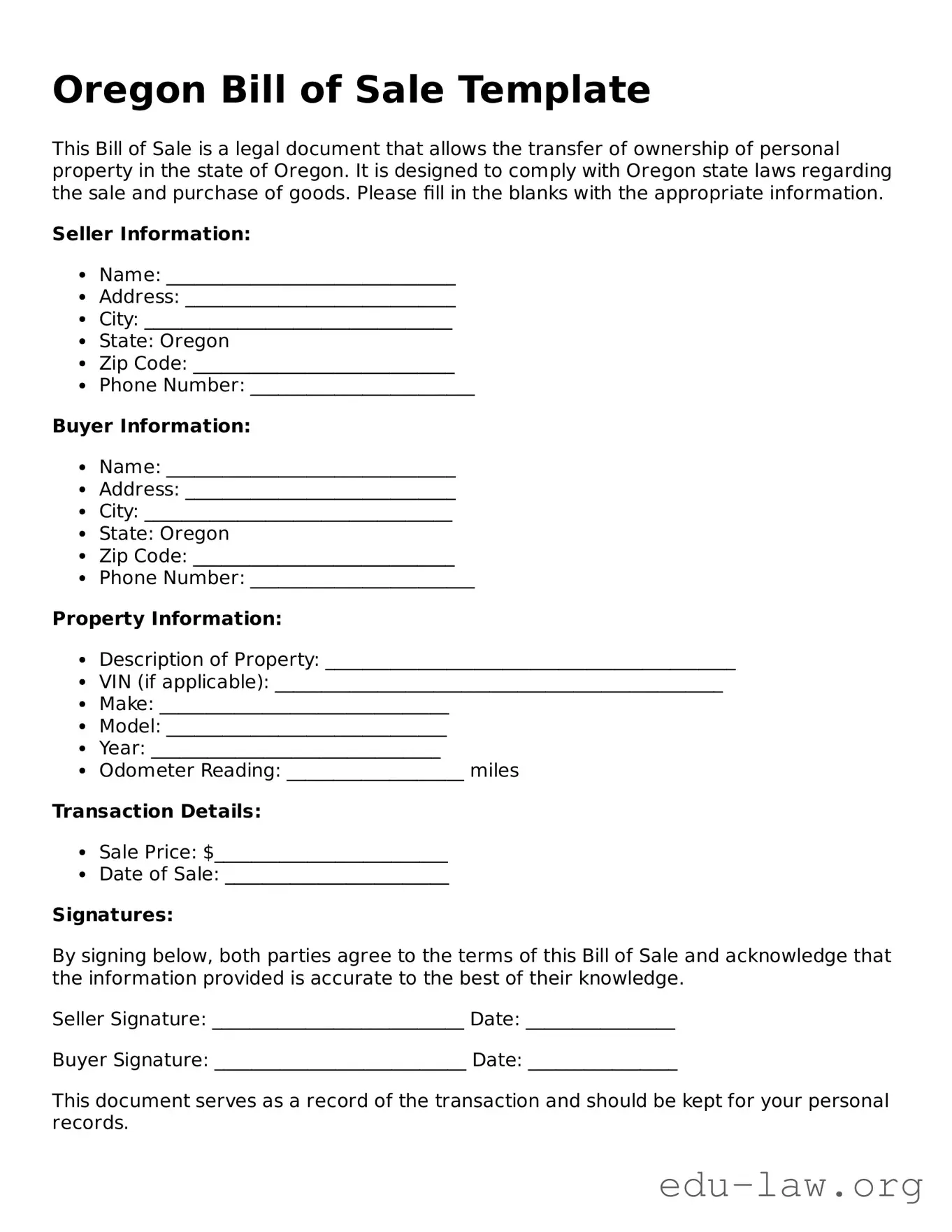
The Oregon Bill of Sale form serves as a vital document for individuals engaging in the sale or transfer of personal property within the state. This form is particularly important for transactions involving vehicles, boats, and other significant assets, as it provides a legal record of the transfer. Essential components of the form include the names and addresses of both the buyer and seller, a detailed description of the item being sold, and the purchase price. Additionally, the document may include information about any warranties or representations made by the seller. By completing this form, parties can ensure that the transaction is documented, which can help prevent disputes in the future. Furthermore, the Bill of Sale can be used for registration purposes with state authorities, making it a crucial element in the process of ownership transfer.
Oregon Bill of Sale Template
This Bill of Sale is a legal document that allows the transfer of ownership of personal property in the state of Oregon. It is designed to comply with Oregon state laws regarding the sale and purchase of goods. Please fill in the blanks with the appropriate information.
Seller Information:
Buyer Information:
Property Information:
Transaction Details:
Signatures:
By signing below, both parties agree to the terms of this Bill of Sale and acknowledge that the information provided is accurate to the best of their knowledge.
Seller Signature: ___________________________ Date: ________________
Buyer Signature: ___________________________ Date: ________________
This document serves as a record of the transaction and should be kept for your personal records.
| Fact Name | Details |
|---|---|
| Purpose | The Oregon Bill of Sale form is used to document the sale of personal property between a buyer and a seller. |
| Governing Law | The form is governed by Oregon Revised Statutes, specifically ORS 87.152 regarding the sale of goods. |
| Required Information | The form typically requires details such as the names and addresses of the buyer and seller, a description of the item sold, and the sale price. |
| Notarization | Notarization is not required for the Bill of Sale in Oregon, but it can add an extra layer of authenticity. |
| Use Cases | This form is commonly used for transactions involving vehicles, boats, and other personal property. |
| Retention | Both parties should retain a copy of the Bill of Sale for their records, as it serves as proof of the transaction. |
Filling out the Oregon Bill of Sale form is a straightforward process that requires attention to detail. Once completed, this document serves as a record of the transaction between the buyer and the seller. It is essential to ensure that all information is accurate to avoid potential disputes in the future.
What is an Oregon Bill of Sale?
An Oregon Bill of Sale is a legal document that records the transfer of ownership of personal property from one person to another. This document is especially useful for transactions involving vehicles, boats, and other significant items. It provides proof that the buyer has purchased the item and that the seller has received payment.
Do I need a Bill of Sale for every transaction?
What information is included in an Oregon Bill of Sale?
An Oregon Bill of Sale typically includes the names and addresses of both the buyer and seller, a description of the item being sold (including make, model, and VIN for vehicles), the sale price, and the date of the transaction. Both parties should sign the document to make it valid.
Is a Bill of Sale required for vehicle sales in Oregon?
Yes, a Bill of Sale is required for vehicle sales in Oregon. It serves as proof of ownership transfer and is necessary for the buyer to register the vehicle in their name. The Oregon DMV provides a specific Bill of Sale form that can be used for this purpose.
Can I create my own Bill of Sale?
Yes, you can create your own Bill of Sale. However, it’s important to ensure that it includes all the necessary information and complies with Oregon laws. Using a template can help ensure that you don’t miss any critical details.
Do I need to have the Bill of Sale notarized?
Notarization is not required for a Bill of Sale in Oregon, but it can add an extra layer of protection. Having the document notarized can help verify the identities of both parties and the authenticity of their signatures, which may be useful if disputes arise later.
What if the item being sold is not a vehicle?
A Bill of Sale can be used for various types of personal property, not just vehicles. Whether it’s furniture, electronics, or collectibles, a Bill of Sale can document the transaction and provide both parties with a record of the sale.
How does a Bill of Sale protect me?
A Bill of Sale protects both the buyer and seller by providing a clear record of the transaction. It outlines the terms of the sale and can help resolve disputes if they arise later. For buyers, it serves as proof of ownership, while sellers can use it to demonstrate that they have sold the item.
What should I do if I lose my Bill of Sale?
If you lose your Bill of Sale, you can create a new one, but both parties must agree to it. It’s advisable to keep copies of all important documents in a safe place to avoid losing them. If possible, ask the other party for a copy if they have one.
Where can I find an Oregon Bill of Sale template?
You can find Oregon Bill of Sale templates online, often on legal websites or government sites. Many templates are available for free and can be customized to fit your specific transaction. Ensure that the template you choose complies with Oregon law.
Not including all required information. Make sure to provide details such as the buyer's and seller's names, addresses, and the vehicle's VIN.
Failing to sign the document. Both parties need to sign the Bill of Sale for it to be valid.
Using incorrect dates. Double-check that the date of the transaction is accurate and clearly stated.
Neglecting to list the purchase price. Clearly state the agreed amount to avoid confusion later.
Forgetting to include a description of the item. Provide a detailed description of the vehicle, including make, model, and year.
Not keeping a copy. Always retain a copy of the completed Bill of Sale for your records.
The Oregon Bill of Sale form serves as a crucial document for the transfer of ownership of personal property. When engaging in transactions, several other forms and documents may accompany the Bill of Sale to ensure a comprehensive and legally sound process. Below is a list of commonly used documents that can enhance the clarity and security of such transactions.
Using these documents alongside the Oregon Bill of Sale can provide clarity and protection for both parties involved in a transaction. Each document plays a specific role in ensuring that the sale is conducted fairly and legally, thereby reducing the potential for disputes in the future.
The Oregon Bill of Sale form serves as a crucial document in the transfer of ownership for various types of property. One document that shares similarities with the Bill of Sale is the Vehicle Title Transfer. This document is essential when someone sells or purchases a vehicle. Like the Bill of Sale, it includes details about the buyer and seller, as well as a description of the vehicle. Both documents serve to prove the transfer of ownership and protect the interests of both parties involved in the transaction.
Another document that parallels the Bill of Sale is the Lease Agreement. While the Bill of Sale focuses on the sale of property, the Lease Agreement outlines the terms under which property is rented. Both documents require clear identification of the parties and the property involved. They also establish rights and responsibilities, ensuring that both the landlord and tenant understand their obligations during the lease period.
The Purchase Agreement is yet another document similar to the Bill of Sale. This document is commonly used in real estate transactions, detailing the terms of sale for a property. Like the Bill of Sale, it includes essential information about the buyer, seller, and the property being sold. Both documents serve as legally binding contracts that protect the interests of the parties involved, ensuring that the transaction proceeds smoothly.
In the realm of personal property, the Receipt is a document that bears resemblance to the Bill of Sale. A receipt provides proof of payment for goods or services rendered. While a Bill of Sale may include more detailed information about the item being sold, both documents serve as evidence of a transaction. They protect the buyer by confirming ownership and can be used to resolve disputes in the future.
The Affidavit of Ownership is another document that can be compared to the Bill of Sale. This affidavit is often used when a person needs to assert their ownership of a vehicle or other personal property, especially when a Bill of Sale is not available. Both documents can establish proof of ownership, but the affidavit may require notarization to validate the claim, adding an extra layer of legal protection.
In addition, the Warranty Deed is similar to the Bill of Sale in the context of real estate transactions. While a Bill of Sale is typically used for personal property, a Warranty Deed transfers ownership of real property. Both documents provide a written record of the transfer, ensuring that the new owner has a clear title. They also outline any warranties or guarantees regarding the property being sold.
The Donation Receipt is another document that resembles the Bill of Sale, particularly in charitable contexts. This receipt is issued when an individual donates property to a nonprofit organization. Similar to the Bill of Sale, it provides documentation of the transfer of ownership. It also serves as proof for tax deductions, highlighting the importance of both documents in establishing clear ownership and transaction records.
Lastly, the Assignment of Benefits form shares characteristics with the Bill of Sale, especially in insurance contexts. This form allows a policyholder to transfer their rights to benefits from an insurance policy to another party. Both documents require clear identification of the parties involved and the specific items or benefits being transferred. They ensure that the new party has the legal right to claim the benefits, just as a Bill of Sale confirms ownership of property.
When filling out the Oregon Bill of Sale form, it is important to follow specific guidelines to ensure accuracy and compliance. Below is a list of things to do and avoid.
Things You Should Do:
Things You Shouldn't Do:
The Oregon Bill of Sale form is a useful document for transferring ownership of personal property. However, there are several misconceptions surrounding its use. Here are six common misunderstandings:
Understanding these misconceptions can help ensure that you use the Oregon Bill of Sale form correctly and effectively in your transactions.
Filling out and using the Oregon Bill of Sale form is essential for a smooth transaction. Here are some key takeaways:
Understanding these points can help facilitate a successful and legally sound sale in Oregon.