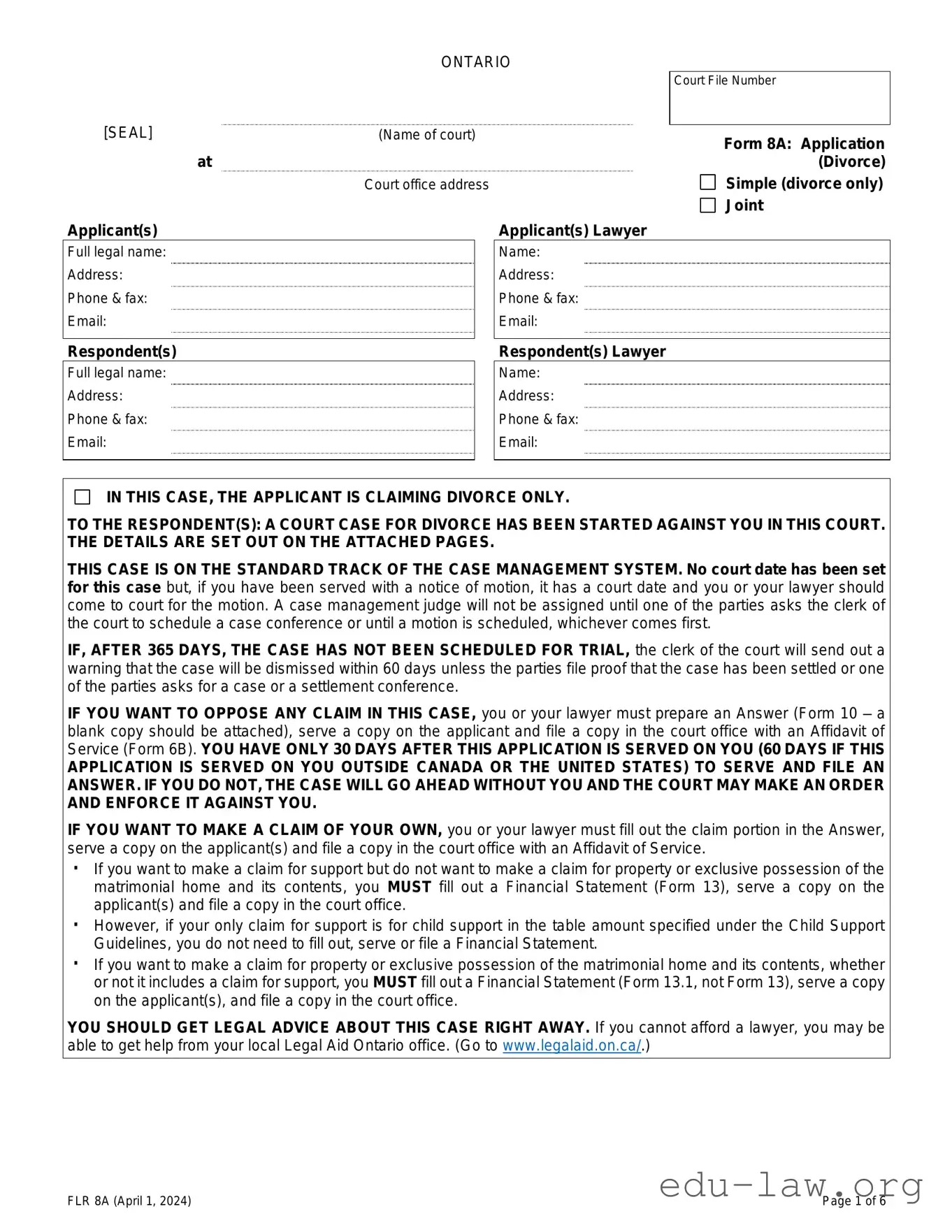
The Ontario Divorce 8A form serves as a critical document in the divorce process, outlining the necessary steps and requirements for individuals seeking a divorce in Ontario. This form is primarily used for simple divorce applications, allowing applicants to present their case to the court without the need for additional claims such as property division or support. It requires the full legal names and contact information of both the applicant and the respondent, along with details about their marriage, separation dates, and any children involved. The form also emphasizes the importance of timely responses, indicating that respondents have a limited timeframe to file an Answer if they wish to contest the divorce. If the case remains unresolved after a year, there are specific procedures that could lead to dismissal. Legal advice is highly recommended to navigate this complex process effectively. The form underscores the significance of compliance with court orders and encourages the use of out-of-court dispute resolution methods whenever possible. By understanding the implications and requirements of the Ontario Divorce 8A form, individuals can better prepare for the legal journey ahead.
ONTARIO
[SEAL] |
(Name of court) |
at
Court office address
Court File Number
Form 8A: Application
(Divorce)
Simple (divorce only)
Joint
Applicant(s)
Full legal name: Address: Phone & fax: Email:
Applicant(s) Lawyer
Name:
Address:
Phone & fax:
Email:
Respondent(s)
Full legal name: Address: Phone & fax: Email:
Respondent(s) Lawyer
Name:
Address:
Phone & fax:
Email:
IN THIS CASE, THE APPLICANT IS CLAIMING DIVORCE ONLY.
TO THE RESPONDENT(S): A COURT CASE FOR DIVORCE HAS BEEN STARTED AGAINST YOU IN THIS COURT. THE DETAILS ARE SET OUT ON THE ATTACHED PAGES.
THIS CASE IS ON THE STANDARD TRACK OF THE CASE MANAGEMENT SYSTEM. No court date has been set for this case but, if you have been served with a notice of motion, it has a court date and you or your lawyer should come to court for the motion. A case management judge will not be assigned until one of the parties asks the clerk of the court to schedule a case conference or until a motion is scheduled, whichever comes first.
IF, AFTER 365 DAYS, THE CASE HAS NOT BEEN SCHEDULED FOR TRIAL, the clerk of the court will send out a warning that the case will be dismissed within 60 days unless the parties file proof that the case has been settled or one of the parties asks for a case or a settlement conference.
IF YOU WANT TO OPPOSE ANY CLAIM IN THIS CASE, you or your lawyer must prepare an Answer (Form 10 – a blank copy should be attached), serve a copy on the applicant and file a copy in the court office with an Affidavit of Service (Form 6B). YOU HAVE ONLY 30 DAYS AFTER THIS APPLICATION IS SERVED ON YOU (60 DAYS IF THIS
APPLICATION IS SERVED ON YOU OUTSIDE CANADA OR THE UNITED STATES) TO SERVE AND FILE AN ANSWER. IF YOU DO NOT, THE CASE WILL GO AHEAD WITHOUT YOU AND THE COURT MAY MAKE AN ORDER AND ENFORCE IT AGAINST YOU.
IF YOU WANT TO MAKE A CLAIM OF YOUR OWN, you or your lawyer must fill out the claim portion in the Answer, serve a copy on the applicant(s) and file a copy in the court office with an Affidavit of Service.
·If you want to make a claim for support but do not want to make a claim for property or exclusive possession of the matrimonial home and its contents, you MUST fill out a Financial Statement (Form 13), serve a copy on the applicant(s) and file a copy in the court office.
·However, if your only claim for support is for child support in the table amount specified under the Child Support Guidelines, you do not need to fill out, serve or file a Financial Statement.
·If you want to make a claim for property or exclusive possession of the matrimonial home and its contents, whether or not it includes a claim for support, you MUST fill out a Financial Statement (Form 13.1, not Form 13), serve a copy on the applicant(s), and file a copy in the court office.
YOU SHOULD GET LEGAL ADVICE ABOUT THIS CASE RIGHT AWAY. If you cannot afford a lawyer, you may be able to get help from your local Legal Aid Ontario office. (Go to www.legalaid.on.ca/.)
FLR 8A (April 1, 2024) |
Page 1 of 6 |

Form 8A: Application (Divorce) |
(page 2) |
Court File Number
THIS CASE IS A JOINT APPLICATION FOR DIVORCE. THE DETAILS ARE SET OUT ON THE ATTACHED PAGES. The application and affidavits in support of the application will be presented to a judge when the materials have been checked for completeness.
If you are requesting anything other than a simple divorce, such as support or property or exclusive possession of the matrimonial home and its contents, then refer to page 1 for instructions regarding the Financial Statement you should file.
Date of issue |
Clerk of the court |
FLR 8A (April 1, 2024) |
Page 2 of 6 |
Form 8A: Application (Divorce) |
(page 3) |
Court file number
|
|
|
|
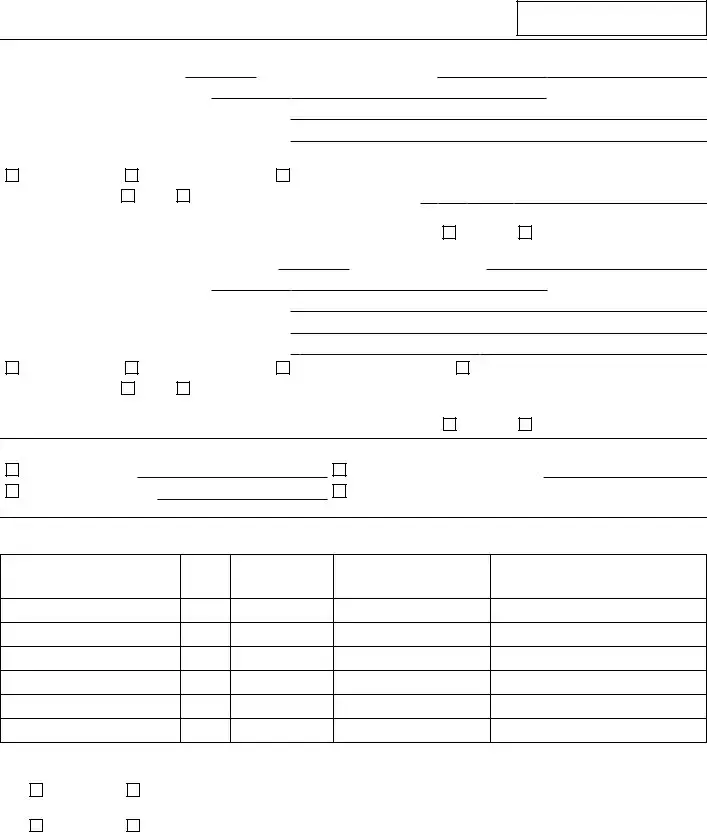
FAMILY HISTORY |
|
APPLICANT: |
Age: |
|
|
Birthdate: (d, m, y) |
|
Resident in (municipality & province) |
|
|
|
||
First name on the day before the marriage date: |
|
|
|||
Last name on the day before the marriage date: |
|
|
|||
Gender on the day before the marriage date: |
|
|
|||
Male |
Female |
|
|
Another gender |
|
Divorced before? |
No |
Yes (Place and date of previous divorce) |
|
||
Habitually resident in the province of Ontario for at least one year |
|
||||
immediately before this application was filed? |
No |
Yes |
|||
|
|
|
|
||
RESPONDENT/JOINT APPLICANT: |
Age: |
Birthdate: (d, m, y) |
|
||
Resident in (municipality & province)
First name on the day before the marriage date:
Last name on the day before the marriage date:
Gender on the day before the marriage date:
Male |
Female |
Another gender |
Divorced before? |
No |
Yes (Place and date of previous divorce) |
Habitually resident in the province of Ontario for at least one year immediately before this application was filed?
Gender information not available
NoYes
RELATIONSHIP DATES:
Married on (date) Separated on (date)
Started living together on (date) Never lived together
THE CHILD(REN)
List all children involved in this case, even if no claim is made for these children.
Full legal name
Age
Birthdate
(d,m,y)
Resident in
(municipality & province)
Now Living With
(name of person and relationship to
child)
|
PREVIOUS CASES OR AGREEMENTS |
Have the parties or the children been in a court case before? |
|
No |
Yes |
Have the parties made a written agreement dealing with any matter involved in this case? |
|
No |
Yes (Give date of agreement. Indicate which of its terms are in dispute. Attach an additional page if you |
|
need more space.) |
FLR 8A (April 1, 2024) |
Page 3 of 6 |
Form 8A: |
Application (Divorce) |
(page 4) |
Court file number
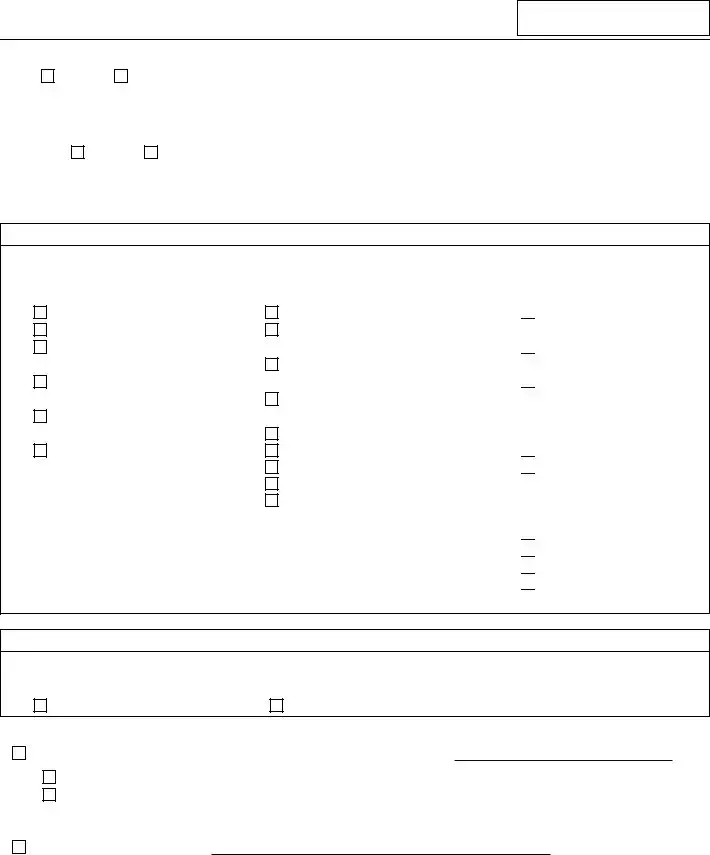
Has a Notice of Calculation and/or a Notice of Recalculation been issued by the online Child Support Service in this case?
No
Yes (Give date(s) of Notice(s) of Calculation or Recalculation.)
If yes, are you asking the court to make an order for child support that is different from the amount set out in the Notice?
No
Yes (Provide an explanation.)
CLAIMS
USE THIS FRAME ONLY IF THIS CASE IS A JOINT APPLICATION FOR DIVORCE
WE JOINTLY ASK THE COURT FOR THE FOLLOWING:
Claims under the Divorce Act |
Claims under the Family Law Act or |
|
Children’s Law Reform Act |
Claims relating to property
00
01
02
03
04
05
a divorce |
10 |
spousal support |
11 |
support for child(ren) – |
|
table amount |
12 |
support for child(ren) – |
|
other than table amount |
13 |
|
|
for child(ren) |
14 |
parenting time with child(ren) |
15 |
|
16 |
17
18
spousal support
support for child(ren) – table amount
support for child(ren) – other than table amount
parenting time with child(ren)
guardianship over child’s property
20 equalization of net family properties
21 exclusive possession of matrimonial home
22 exclusive possession of contents of matrimonial home
23 freezing assets
24 sale of family property
Other claims
30 costs
31 annulment of marriage
32 prejudgment interest
50 Other (Specify)
USE THIS FRAME ONLY IF THE APPLICANT’S ONLY CLAIM IN THIS CASE IS FOR DIVORCE.
I ASK THE COURT FOR:
(Check if applicable.)
00
a divorce |
30 |
costs
IMPORTANT FACTS SUPPORTING THE CLAIM FOR DIVORCE
Separation: The spouses have lived separate and apart since (date) |
and |
have not lived together again since that date in an unsuccessful attempt to reconcile.
have lived together again during the following periods(s) in an unsuccessful attempt to reconcile: (Give dates.)
Adultery: (Name of spouse) |
has committed adultery. |
(Give details. It is not necessary to name any other person involved but if you do name the other person, then you must serve this application on the other person.)
FLR 8A (April 1, 2024) |
Page 4 of 6 |
Form 8A: |
Application (Divorce) |
(page 5) |
Court File Number
Cruelty: (Name of spouse) |
has treated (name of |
spouse) |
with physical or mental cruelty of such a kind as to |
make continued cohabitation intolerable. (Give details.) |
|
USE THIS FRAME ONLY IF THIS CASE IS A JOINT APPLICATION FOR DIVORCE.
The details of the other order(s) that we jointly ask the court to make are as follows: (Include any amounts of support and the names of the children for whom support,
IMPORTANT FACTS SUPPORTING OUR CLAIM(S)
(Set out the facts that form the legal basis for your claim(s). Attach an additional page if you need more space.)
APPLICANT’S CERTIFICATE
(Your lawyer, if you are represented, must complete the Lawyer’s Certificate below.)
Sections 7.1 to 7.5 of the Divorce Act and section 33.1 of the Children’s Law Reform Act require you and the other party to:
Exercise your
Protect the child from conflict arising from this case, to the best of your ability;
Try to resolve your family law issues by using
Provide complete, accurate, and
Comply with any orders made in this case.
We/I certify that we are/I am aware of these duties under the Divorce Act and the Children’s Law Reform Act.
Complete this section if your only claim is for a divorce. Your lawyer, if you are represented, must complete the Lawyer’s Certificate below.
Date of signature |
Signature of applicant |
|
|
Complete this section if you are making a joint application for divorce. |
|
|
|
Date of signature |
Signature of joint applicant |
|
|
Date of signature |
Signature of joint applicant |
FLR 8A (April 1, 2024) |
Page 5 of 6 |
Form 8A: |
Application (Divorce) |
(page 6) |
Court File Number
LAWYER’S CERTIFICATE
My name is:
and I am the applicant’s lawyer in this case. I certify that I have complied with the requirements of section 7.7 of the Divorce Act and section 33.2 of the Children’s Law Reform Act regarding reconciliation and the duty to discuss and inform.
Date |
Lawyer’s signature |
My name is:
and I am the applicant’s lawyer in this case. I certify that I have complied with the requirements of section 7.7 of the Divorce Act and section 33.2 of the Children’s Law Reform Act regarding reconciliation and the duty to discuss and inform.
Date |
Lawyer’s signature |
FLR 8A (April 1, 2024) |
Page 6 of 6 |
| Fact Name | Details |
|---|---|
| Purpose | The Ontario Divorce 8A form is used to apply for a divorce in Ontario, Canada, specifically for simple divorce applications. |
| Governing Law | This form is governed by the Divorce Act and the Family Law Act in Ontario. |
| Filing Requirements | Applicants must provide personal details, including full legal names, addresses, and contact information for both parties involved. |
| Response Time | Respondents have 30 days to file an Answer after being served, or 60 days if served outside Canada or the United States. |
Filling out the Ontario Divorce 8A form is a crucial step in the divorce process. After completing this form, it will be submitted to the court, where it will be reviewed. The next steps will involve potential court dates and further documentation, depending on the specifics of your case.
What is the Ontario Divorce 8A form used for?
The Ontario Divorce 8A form is primarily used to initiate a divorce application in Ontario. It is designed for individuals who are seeking a divorce only, without any additional claims related to support or property. The form must be completed accurately and submitted to the appropriate court, where it will be processed as part of the divorce proceedings. If you are looking for a simple divorce, this form is the right choice, as it streamlines the process and focuses solely on the dissolution of the marriage.
What information do I need to provide when filling out the form?
When completing the Ontario Divorce 8A form, you will need to provide several key pieces of information. This includes full legal names and contact details for both the applicant and the respondent, as well as any lawyers representing them. You will also need to include relevant details about your marriage, such as the date of marriage, separation, and any children involved in the case. Additionally, if there have been any prior court cases or agreements related to the marriage, you should disclose that information as well. Ensuring that all details are accurate and complete is crucial, as this helps facilitate a smoother process in court.
What happens if I want to oppose the divorce application?
If you wish to oppose the divorce application, you must respond within a specific timeframe. You have 30 days from the date you are served with the application to prepare and file an Answer (Form 10) with the court. If you are outside Canada or the United States, this period extends to 60 days. In your Answer, you can outline your objections to the divorce and include any claims you wish to make. It’s essential to serve a copy of your Answer to the applicant and file it with an Affidavit of Service in the court office. Failing to respond within the allotted time may result in the court proceeding without your input.
Should I seek legal advice when completing the Divorce 8A form?
Failing to provide complete contact information for both the applicant and respondent. All fields, including full legal names, addresses, phone numbers, and emails, must be filled out accurately.
Not indicating whether the application is a joint application or a single application. This distinction is crucial for the processing of the case.
Omitting important dates related to marriage and separation. Dates of marriage, separation, and any attempts to reconcile must be clearly stated.
Neglecting to list all children involved in the case. Even if no claims are made for the children, their names and details must be included.
Incorrectly completing the claims section. Ensure that all claims under the Divorce Act and related laws are accurately checked and described.
Failing to provide details about any previous court cases or agreements. This information is necessary to assess the current situation.
Not attaching necessary forms, such as the Financial Statement when applicable. This is crucial if there are claims for support or property.
Overlooking the requirement to serve and file an Answer if opposing the claims. This must be done within the specified time frame.
Not seeking legal advice when needed. It is advisable to consult a lawyer, especially if there are complexities in the case.
The Ontario Divorce 8A form is a critical document for individuals seeking a divorce in Ontario. Along with this form, several other documents may be necessary to complete the divorce process effectively. Below is a list of commonly used forms and documents that may accompany the Ontario Divorce 8A form.
Understanding these forms and their purposes can help streamline the divorce process. It is advisable to seek legal guidance to ensure that all necessary documents are completed accurately and submitted on time.
The Ontario Divorce 8A form is similar to the Form 10: Answer (Divorce) because both documents are essential in the divorce process. While the 8A form initiates the divorce proceedings by outlining the applicant's claims, the Form 10 serves as the respondent's official response to those claims. The respondent must file the Form 10 within a specific timeframe after being served with the 8A form. This ensures that both parties have an opportunity to present their positions in the divorce case.
Another related document is the Form 13: Financial Statement. This form is required when a party seeks support but does not want to make a claim for property or exclusive possession of the matrimonial home. Similar to the 8A form, the Form 13 collects personal and financial information to facilitate the court's understanding of the parties' financial situations. Both forms aim to provide the court with necessary information to make informed decisions regarding support and other claims.
The Form 13.1: Financial Statement is also comparable to the 8A form. This document is used when a party wants to make a claim for property or exclusive possession of the matrimonial home, regardless of whether they are also seeking support. Like the 8A, the Form 13.1 requires detailed financial disclosures from the parties involved. This helps the court assess the financial aspects of the divorce and determine equitable resolutions.
Form 14: Support Order is another document that parallels the Ontario Divorce 8A form. While the 8A form initiates divorce proceedings, the Form 14 is utilized to request a court order for support. Both forms require specific information about the parties and their claims. The Form 14 is essential for parties seeking financial support as part of the divorce process, ensuring that their needs are formally presented to the court.
Similar to the 8A form, the Form 16: Notice of Motion is used to request specific orders from the court during divorce proceedings. The 8A form outlines the initial claims for divorce, while the Form 16 allows either party to ask the court for interim or additional relief. Both documents play a critical role in managing the divorce process and ensuring that the court is informed of the parties' needs and requests.
The Form 35: Affidavit of Service is another important document that shares similarities with the 8A form. This form serves as proof that the 8A form has been properly served to the respondent. Just as the 8A form initiates the divorce process, the Form 35 confirms that all parties are aware of the proceedings. This is crucial for maintaining fairness and transparency in the legal process.
Form 25: Order is also relevant in the context of the Ontario Divorce 8A form. While the 8A form starts the divorce proceedings, the Form 25 is used to document the court's decisions and orders resulting from those proceedings. Both forms are integral to the divorce process, with the 8A form initiating claims and the Form 25 formalizing the court's rulings.
The Form 29: Certificate of Divorce is another document that follows the 8A form. After the divorce proceedings are concluded, the Form 29 serves as the official record of the divorce. This document is crucial for individuals seeking to remarry or for legal purposes, similar to how the 8A form is essential for initiating the divorce process.
Lastly, the Form 36: Application to Change a Support Order is comparable to the 8A form in that both are used to address issues related to support. While the 8A form initiates divorce proceedings, the Form 36 is utilized when a party wishes to modify an existing support order. Both documents require detailed information and are essential for ensuring that support arrangements remain fair and appropriate as circumstances change.
When filling out the Ontario Divorce 8A form, it’s crucial to follow specific guidelines to ensure your application is processed smoothly. Below is a list of essential do's and don'ts to keep in mind.
This form is designed for both contested and uncontested divorces. It can be used when both parties agree to the divorce, making it suitable for joint applications.
While having legal representation can be beneficial, it is not a requirement. Individuals can file the form on their own if they choose to do so.
The form initiates the divorce process, but various factors can affect the timeline, including court schedules and the complexity of the case.
While separation is a common ground for divorce, there are other grounds, such as adultery or cruelty, that can be cited in the application.
Additional documents may be necessary depending on the circumstances, such as a Financial Statement if claims for support or property are involved.
It is essential to serve the application to the respondent. Failing to do so can result in the case proceeding without their input.
If you wish to oppose the divorce, you must file an Answer within the specified timeframe to present your case in court.
If you are making a claim for child support, you may need to complete a Financial Statement unless you are claiming only the table amount specified under the Child Support Guidelines.
A case management judge is not assigned until a party requests a case conference or a motion is scheduled, which means additional steps are necessary.
While it is best to ensure accuracy before filing, amendments can be made if necessary, but this may require additional procedures.
The Ontario Divorce Form 8A is used for applying for a divorce only, whether as a single applicant or as a joint application with your spouse.
It is crucial to provide accurate information about both parties, including full legal names, addresses, and contact details.
When filling out the form, ensure that all sections are completed, as incomplete applications may delay the process.
If you are the respondent and wish to oppose the divorce, you must file an Answer (Form 10) within 30 days of being served.
For claims related to child support, you may not need to submit a Financial Statement if you are only seeking the table amount specified under the Child Support Guidelines.
Legal advice is highly recommended. If you cannot afford a lawyer, consider reaching out to Legal Aid Ontario for assistance.
Filing the form starts a court case, but no court date is set until a case conference or motion is requested.
If the case remains unresolved for 365 days, it may be dismissed unless proof of settlement is provided or a conference is requested.