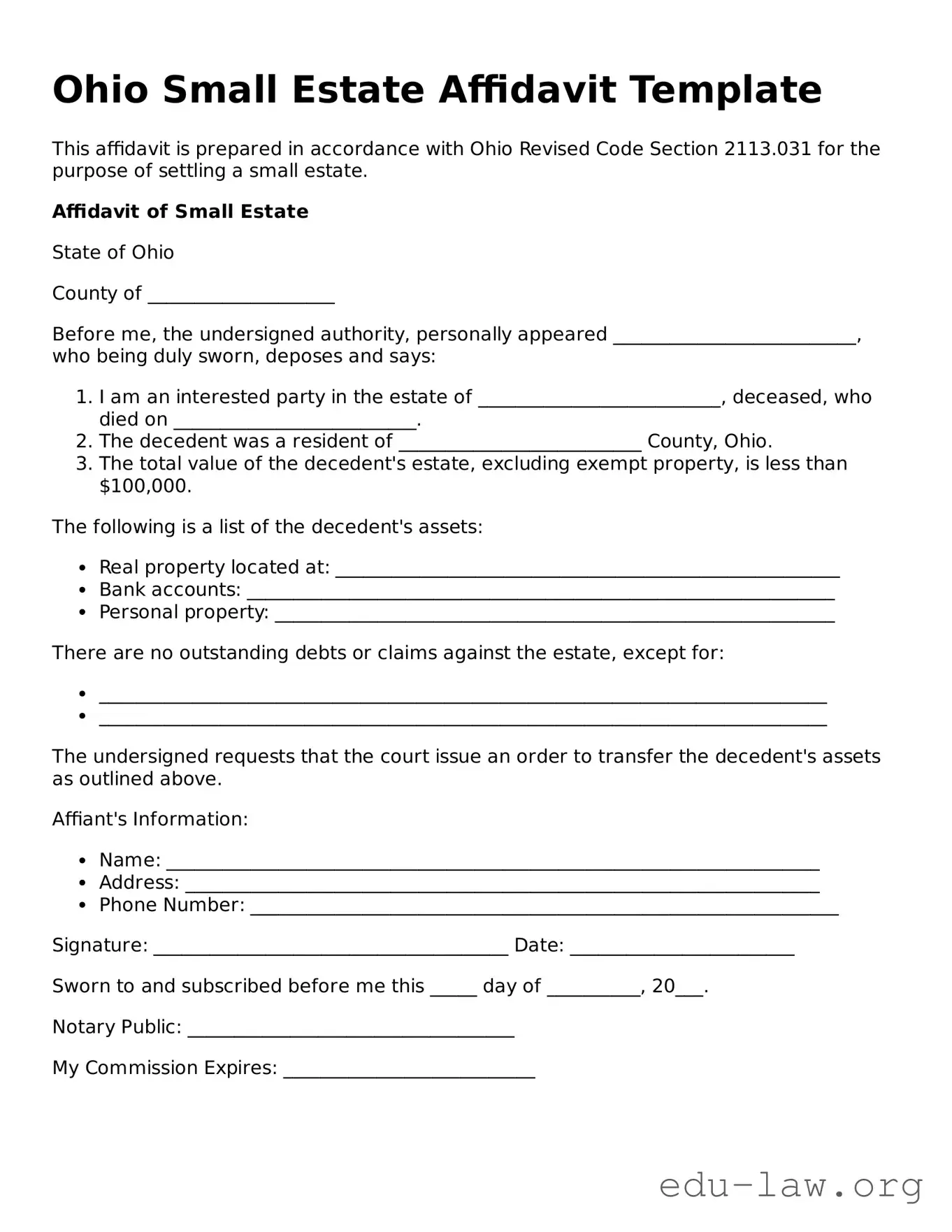
When navigating the complexities of settling an estate in Ohio, the Small Estate Affidavit form serves as a vital tool for individuals dealing with the estate of a deceased loved one. This form is designed for estates that fall below a certain value threshold, allowing heirs to bypass the lengthy and often costly probate process. To qualify, the total value of the estate must not exceed $100,000, excluding certain assets like real estate. By completing this affidavit, heirs can claim assets directly, simplifying the transfer process. The form requires specific information, including the decedent's details, a list of assets, and the names of all heirs. Additionally, it must be notarized to ensure its validity. Understanding the Small Estate Affidavit can significantly ease the burden of estate management during a challenging time, providing a straightforward pathway to resolving financial matters and distributing assets efficiently.
Ohio Small Estate Affidavit Template
This affidavit is prepared in accordance with Ohio Revised Code Section 2113.031 for the purpose of settling a small estate.
Affidavit of Small Estate
State of Ohio
County of ____________________
Before me, the undersigned authority, personally appeared __________________________, who being duly sworn, deposes and says:
The following is a list of the decedent's assets:
There are no outstanding debts or claims against the estate, except for:
The undersigned requests that the court issue an order to transfer the decedent's assets as outlined above.
Affiant's Information:
Signature: ______________________________________ Date: ________________________
Sworn to and subscribed before me this _____ day of __________, 20___.
Notary Public: ___________________________________
My Commission Expires: ___________________________
| Fact Name | Details |
|---|---|
| Governing Law | The Ohio Small Estate Affidavit is governed by Ohio Revised Code Section 2113.031. |
| Eligibility | The form is available for estates with a total value of $100,000 or less, excluding certain assets. |
| Purpose | The affidavit allows for the transfer of assets without formal probate proceedings. |
| Filing Requirements | The affidavit must be filed with the probate court in the county where the deceased resided. |
| Affidavit Signatories | The affidavit must be signed by the person claiming the estate and two disinterested witnesses. |
| Assets Included | Real estate, bank accounts, and personal property may be included, subject to certain limitations. |
| Debts and Liabilities | The affidavit does not relieve the estate from paying debts and liabilities owed by the deceased. |
| Timeframe for Filing | The affidavit should be filed within a reasonable time after the death of the individual. |
| Distribution of Assets | Assets can be distributed to heirs as outlined in the affidavit, following Ohio intestacy laws if there is no will. |
| Limitations | Not all assets are eligible; certain types, like jointly owned property, may not require the affidavit. |
After gathering the necessary information and documents, you will proceed to fill out the Ohio Small Estate Affidavit form. This process involves providing details about the deceased, the estate, and your relationship to the deceased. Follow these steps carefully to ensure the form is completed accurately.
Once the form is completed and notarized, you will file it with the probate court in the county where the deceased lived. This step is crucial for the legal recognition of the affidavit. Be prepared to provide any additional documentation that may be required by the court.
What is the Ohio Small Estate Affidavit form?
The Ohio Small Estate Affidavit form is a legal document that allows individuals to settle the estate of a deceased person without going through the lengthy and often costly probate process. This option is available when the total value of the deceased person's assets is below a certain threshold, which is currently set at $100,000 for real estate and $35,000 for personal property. By using this affidavit, heirs can claim the assets directly, streamlining the process of transferring ownership.
Who is eligible to use the Small Estate Affidavit in Ohio?
To use the Small Estate Affidavit, you must be an eligible heir of the deceased person. Typically, this includes spouses, children, parents, and siblings. Additionally, the estate must meet the value requirements mentioned earlier. If the deceased person had a will, it must be considered, but even if there is no will, heirs can still utilize the Small Estate Affidavit as long as they follow the appropriate legal guidelines.
How do I complete the Small Estate Affidavit form?
Completing the Small Estate Affidavit involves several steps. First, gather all necessary information about the deceased person, including their full name, date of death, and a list of their assets. Next, fill out the affidavit form, ensuring that you include details about the heirs and the assets being claimed. It is crucial to provide accurate information, as any discrepancies could lead to legal issues. Once completed, the affidavit must be signed in front of a notary public. After notarization, you can present the affidavit to the institutions holding the deceased’s assets, such as banks or title companies, to claim them.
What should I do if the estate exceeds the small estate limits?
If the total value of the estate exceeds the limits set for the Small Estate Affidavit, you will need to go through the formal probate process. This process is more complex and typically involves filing a petition with the probate court, notifying creditors, and possibly appointing an executor to manage the estate. While this route can take more time and resources, it is essential for larger estates to ensure that all debts are settled and assets are distributed according to the law or the deceased's wishes.
Incomplete Information: One common mistake is failing to provide all required information. This includes the decedent's name, date of death, and a complete list of assets. Omitting any details can lead to delays or rejections.
Incorrect Asset Valuation: People often miscalculate the value of assets. It is crucial to provide accurate valuations to ensure the estate qualifies as a small estate under Ohio law. Underestimating or overestimating can create complications.
Not Meeting Eligibility Requirements: Individuals sometimes overlook the eligibility criteria for using the Small Estate Affidavit. The total value of the estate must not exceed a specific limit. Failing to confirm this can result in the affidavit being invalid.
Improper Signatures: Signatures are a vital part of the affidavit. Mistakes occur when individuals do not sign the form correctly or fail to have it notarized. Each signature must be clear and comply with legal requirements.
Ignoring Required Attachments: Some people forget to include necessary documents, such as a death certificate or proof of asset ownership. These attachments support the information provided in the affidavit and are essential for processing.
The Ohio Small Estate Affidavit is a useful tool for individuals seeking to settle the estate of a deceased person when the total value of the estate is below a certain threshold. However, several other forms and documents may be necessary to complete the process effectively. Below is a list of commonly used forms and documents that accompany the Small Estate Affidavit.
Gathering these documents can streamline the process of settling an estate in Ohio. Having all necessary forms prepared and organized will facilitate a smoother experience for all parties involved.
The Ohio Small Estate Affidavit is similar to the Affidavit of Heirship. Both documents serve to establish the rightful heirs of a deceased person's estate. The Affidavit of Heirship is often used when a decedent has passed away without a will, allowing heirs to claim property and assets without going through formal probate. This document outlines the family relationships and provides necessary details about the deceased, helping to clarify the distribution of assets among heirs.
Another document akin to the Ohio Small Estate Affidavit is the Will. A Will outlines a person's wishes regarding the distribution of their assets after death. While the Small Estate Affidavit may be used when the estate is below a certain value and avoids probate, a Will typically requires probate to validate the deceased's wishes. Both documents are essential in determining how assets are handled, but they operate under different legal processes.
The Affidavit of Support is also comparable, particularly in its function of providing assurance regarding financial responsibilities. While the Small Estate Affidavit deals with estate assets, the Affidavit of Support is used primarily in immigration contexts to demonstrate that an individual can support a foreign national financially. Both documents require the signer to provide truthful information and can have significant legal implications if misrepresented.
The Power of Attorney is another related document, as it grants an individual the authority to act on someone else's behalf, particularly concerning financial matters. While the Small Estate Affidavit is used after a person's death to settle their estate, a Power of Attorney is effective during a person's lifetime. Both documents require clear identification of parties involved and specific powers granted, ensuring that intentions are documented and legally recognized.
Additionally, the Probate Inventory is similar in that it lists the assets of a deceased person’s estate. This document is often filed with the probate court and provides a comprehensive account of the decedent’s property. While the Small Estate Affidavit allows for a simplified process to claim assets without full probate, the Probate Inventory is typically part of the formal probate process, ensuring all assets are accounted for and valued appropriately.
The Deed of Distribution is another document that shares similarities with the Ohio Small Estate Affidavit. It is used to transfer property ownership from the estate to the heirs or beneficiaries. While the Small Estate Affidavit can facilitate the transfer of assets without probate, the Deed of Distribution formalizes the transfer of real estate and other property once the estate has been settled, ensuring that ownership is legally recognized.
The Certificate of Trust is also comparable, as it establishes the existence of a trust and the authority of the trustee to manage the trust assets. While the Small Estate Affidavit is used for settling estates, a Certificate of Trust can expedite the management of assets held in trust. Both documents provide a clear outline of the parties involved and their respective rights and responsibilities, ensuring proper administration of the assets.
Lastly, the Release of Claims document is similar in that it is used to relinquish rights to an estate or specific assets. This document is often signed by heirs or beneficiaries who agree to give up their claims to certain assets in favor of others. While the Small Estate Affidavit facilitates the transfer of assets without lengthy probate proceedings, a Release of Claims can help clarify and finalize the distribution of assets among multiple heirs, preventing future disputes.
When filling out the Ohio Small Estate Affidavit form, it is important to follow certain guidelines to ensure accuracy and compliance. Here are some dos and don'ts to keep in mind:
The Ohio Small Estate Affidavit is a useful tool for settling the estates of individuals who have passed away. However, several misconceptions about this form can lead to confusion. Here are five common misunderstandings:
Understanding these misconceptions can help individuals navigate the estate settlement process more effectively. It is always wise to seek guidance if unsure about the requirements or procedures involved.
Filling out the Ohio Small Estate Affidavit form can simplify the process of settling a deceased person's estate when the total value is under a certain limit. Here are some key takeaways to keep in mind:
By following these guidelines, you can navigate the Small Estate Affidavit process more effectively and ensure a smoother transition for the estate's beneficiaries.