In Ohio, the Release of Liability form serves as a crucial document for individuals and organizations looking to protect themselves from potential legal claims. This form is often used in various contexts, such as sports activities, recreational events, and even certain business transactions. By signing this document, participants acknowledge the inherent risks involved in the activity and agree to relinquish their right to sue in case of injury or loss. It is essential for both parties to understand that this form does not absolve negligence but rather outlines the expectations and responsibilities of everyone involved. Additionally, the Release of Liability form typically includes details about the event, the parties involved, and specific language that clarifies the scope of the release. Properly executed, it can be a powerful tool for risk management, allowing organizations to focus on providing safe and enjoyable experiences without the constant worry of potential lawsuits.
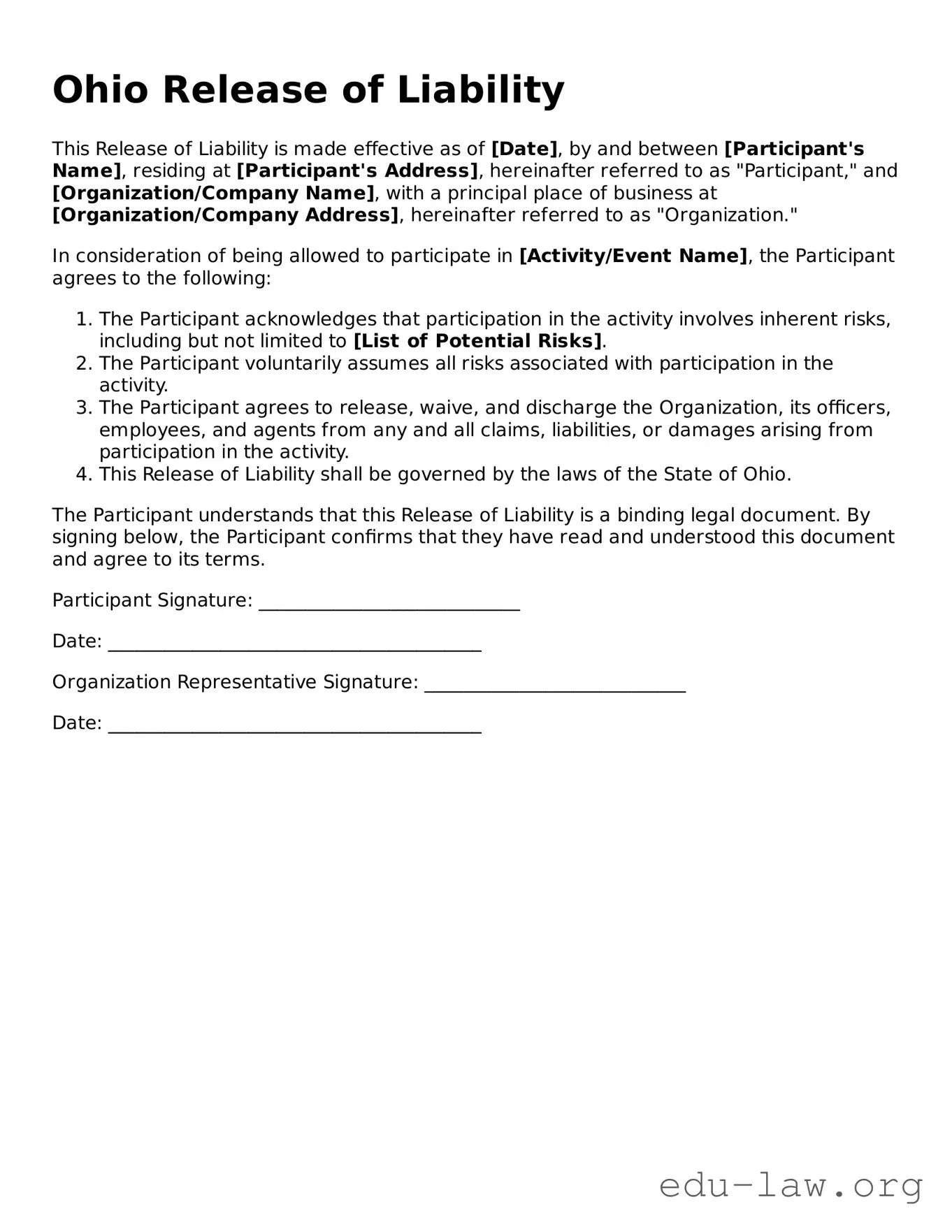
Ohio Release of Liability
This Release of Liability is made effective as of [Date], by and between [Participant's Name], residing at [Participant's Address], hereinafter referred to as "Participant," and [Organization/Company Name], with a principal place of business at [Organization/Company Address], hereinafter referred to as "Organization."
In consideration of being allowed to participate in [Activity/Event Name], the Participant agrees to the following:
The Participant understands that this Release of Liability is a binding legal document. By signing below, the Participant confirms that they have read and understood this document and agree to its terms.
Participant Signature: ____________________________
Date: ________________________________________
Organization Representative Signature: ____________________________
Date: ________________________________________
| Fact Name | Details |
|---|---|
| Purpose | The Ohio Release of Liability form is used to protect individuals and organizations from legal claims resulting from injuries or damages that may occur during specific activities. |
| Parties Involved | The form typically involves two parties: the releasor (the individual participating in the activity) and the releasee (the organization or individual hosting the activity). |
| Governing Law | The form is governed by Ohio state law, specifically under the principles of contract law and tort law. |
| Voluntary Agreement | The releasor must voluntarily sign the form, indicating their understanding of the risks involved in the activity. |
| Scope of Release | The release may cover a wide range of activities, including recreational events, sports, and other organized gatherings. |
| Minors | If the releasor is a minor, a parent or legal guardian must sign the form on their behalf. |
| Limitations | The form does not protect against gross negligence or intentional misconduct by the releasee. |
Once you have the Ohio Release of Liability form in front of you, it’s time to fill it out accurately. Completing this form correctly is essential for ensuring that all parties understand the terms involved. Follow these steps to make the process smooth and straightforward.
What is an Ohio Release of Liability form?
The Ohio Release of Liability form is a legal document designed to protect individuals or organizations from legal claims or lawsuits that may arise from specific activities or events. By signing this form, participants acknowledge the risks involved and agree not to hold the organizer liable for any injuries or damages that may occur during the activity.
Who should use a Release of Liability form?
This form is commonly used by businesses, event organizers, sports clubs, and recreational facilities. Anyone offering activities that carry inherent risks, such as sports events, outdoor adventures, or fitness classes, should consider using this form to safeguard against potential legal issues.
Is a Release of Liability form legally binding in Ohio?
Yes, a properly executed Release of Liability form can be legally binding in Ohio. However, it must meet certain criteria to be enforceable. This includes being clear, concise, and not containing any misleading language. It is advisable to consult with a legal professional to ensure that the form complies with Ohio law.
What should be included in the Release of Liability form?
A comprehensive Release of Liability form should include the following elements: a clear statement of the risks involved, a waiver of liability clause, a section for the participant's signature, and the date of signing. Additionally, it may include emergency contact information and a statement regarding the participant's health status.
Can minors sign a Release of Liability form?
Minors cannot legally sign a Release of Liability form on their own. Instead, a parent or legal guardian must sign on their behalf. This ensures that the minor's rights are protected while still allowing them to participate in activities that require a waiver.
What happens if someone is injured despite signing the form?
Even with a signed Release of Liability form, it is possible for injured parties to pursue legal action. However, the form can serve as a strong defense against claims, provided it is properly drafted. Courts may consider the circumstances surrounding the injury and whether negligence was involved.
How can I ensure my Release of Liability form is effective?
To enhance the effectiveness of your Release of Liability form, ensure it is tailored to the specific activity or event. Use clear language, avoid legal jargon, and make sure participants fully understand what they are signing. Consulting with a lawyer experienced in liability issues is highly recommended.
Where can I obtain an Ohio Release of Liability form?
Ohio Release of Liability forms can be obtained from various sources, including legal websites, law firms, or by creating a custom form with the help of a lawyer. It is crucial to ensure that the form is compliant with Ohio laws and meets the specific needs of your activity or event.
Incomplete Information: Many individuals forget to fill out all required fields. Omitting information such as names, addresses, or dates can lead to confusion and may invalidate the release.
Incorrect Dates: Failing to enter the correct date can create issues. Ensure that the date of signing matches the date of the event or activity to avoid any discrepancies.
Missing Signatures: Signatures are crucial. Some people neglect to sign the form or forget to have all necessary parties sign, which could render the document ineffective.
Not Understanding the Terms: A common mistake is not fully understanding the terms of the release. It’s important to read and comprehend what rights are being waived before signing.
Using Inappropriate Language: Some individuals may use informal language or jargon in the form. It is essential to use clear and appropriate language to maintain the form's legal validity.
Failing to Keep a Copy: After completing the form, not keeping a copy for personal records can lead to problems later. Always retain a signed copy for your records.
Not Consulting a Professional: Many people fill out the form without seeking advice. Consulting a legal professional can provide clarity and ensure that the document meets all necessary legal standards.
The Ohio Release of Liability form is an important document that helps protect individuals and organizations from legal claims related to injuries or damages. When using this form, several other documents may also be necessary to ensure comprehensive coverage and clarity. Here are some common forms that often accompany the Ohio Release of Liability form.
Using these forms in conjunction with the Ohio Release of Liability can help clarify responsibilities, enhance safety, and protect all parties involved. Understanding each document's purpose ensures that everyone is informed and prepared for the activity at hand.
The Waiver of Liability form is a document that shares similarities with the Ohio Release of Liability form. Both serve the purpose of protecting individuals or organizations from legal claims resulting from injuries or damages that may occur during specific activities. When someone signs a Waiver of Liability, they acknowledge the inherent risks involved in an activity and agree not to hold the organization responsible for any accidents that may happen. This mutual understanding is crucial in recreational settings, sports events, or any environment where risks are present.
Another document that resembles the Ohio Release of Liability is the Indemnity Agreement. This agreement focuses on shifting the responsibility for any losses or damages from one party to another. While the Release of Liability form primarily aims to prevent claims from being filed, an Indemnity Agreement often requires one party to compensate the other for any losses incurred. Both documents are essential in managing risk and protecting against potential lawsuits, but they approach the issue from slightly different angles.
The Consent to Treat form is also akin to the Ohio Release of Liability form, particularly in the context of medical or emergency situations. This document is often used in healthcare settings to obtain permission from a patient or their guardian before administering treatment. While the primary focus of a Consent to Treat form is to ensure informed consent, it may also include clauses that release healthcare providers from liability for certain risks associated with treatment. Both forms emphasize the importance of understanding risks and consent before proceeding with an activity or treatment.
The Hold Harmless Agreement further parallels the Ohio Release of Liability form. This document is designed to protect one party from being held liable for any injuries or damages that may occur. Similar to the Release of Liability, a Hold Harmless Agreement requires the signing party to waive their right to sue for any claims arising from the specified activity. Both documents aim to clarify the responsibilities of each party involved, ensuring that participants understand the risks and agree to assume them.
Lastly, the Participant Agreement shares notable characteristics with the Ohio Release of Liability form. Often used in recreational activities or events, this agreement outlines the terms and conditions under which participants engage in an activity. It typically includes a waiver of liability clause, which protects the organizers from legal claims. By signing this document, participants acknowledge the risks and agree to abide by the rules set forth, creating a clear understanding of expectations and responsibilities.
When filling out the Ohio Release of Liability form, it's important to approach the process with care. Here are some helpful tips on what to do and what to avoid.
By following these guidelines, you can help ensure that your experience with the Ohio Release of Liability form is smooth and straightforward.
Understanding the Ohio Release of Liability form is essential for anyone considering its use. Here are seven common misconceptions about this form, along with clarifications to help you navigate it better.
Many believe that signing a Release of Liability means they cannot be sued for any reason. However, this is not true. While the form can limit liability, it does not protect against gross negligence or willful misconduct.
Some think that Release of Liability forms are only necessary for high-risk activities, like skydiving or rock climbing. In reality, they can be used for a wide range of events, including sports, recreational activities, and even some business transactions.
People often assume that signing the form means giving up all legal rights. In fact, it typically only waives rights related to specific risks outlined in the document. Other rights may still remain intact.
There is a common belief that a Release of Liability must be notarized to be legally binding. However, notarization is not a requirement in Ohio. As long as the form is properly signed and dated, it can be enforceable.
Some think that signing a Release of Liability is equivalent to having insurance coverage. This is incorrect. The form does not provide financial protection; it merely outlines the risks and limits liability.
Many people believe that minors cannot be bound by a Release of Liability. While minors typically cannot sign contracts, parents or guardians can sign on their behalf to acknowledge the risks involved.
It’s a misconception that all Release of Liability forms are identical. Each form can vary significantly based on the activity, the parties involved, and specific state laws. It’s important to review each one carefully.
Being informed about these misconceptions can help individuals make better decisions when considering the use of a Release of Liability form in Ohio.
When filling out and using the Ohio Release of Liability form, there are several important points to keep in mind. Here are five key takeaways: