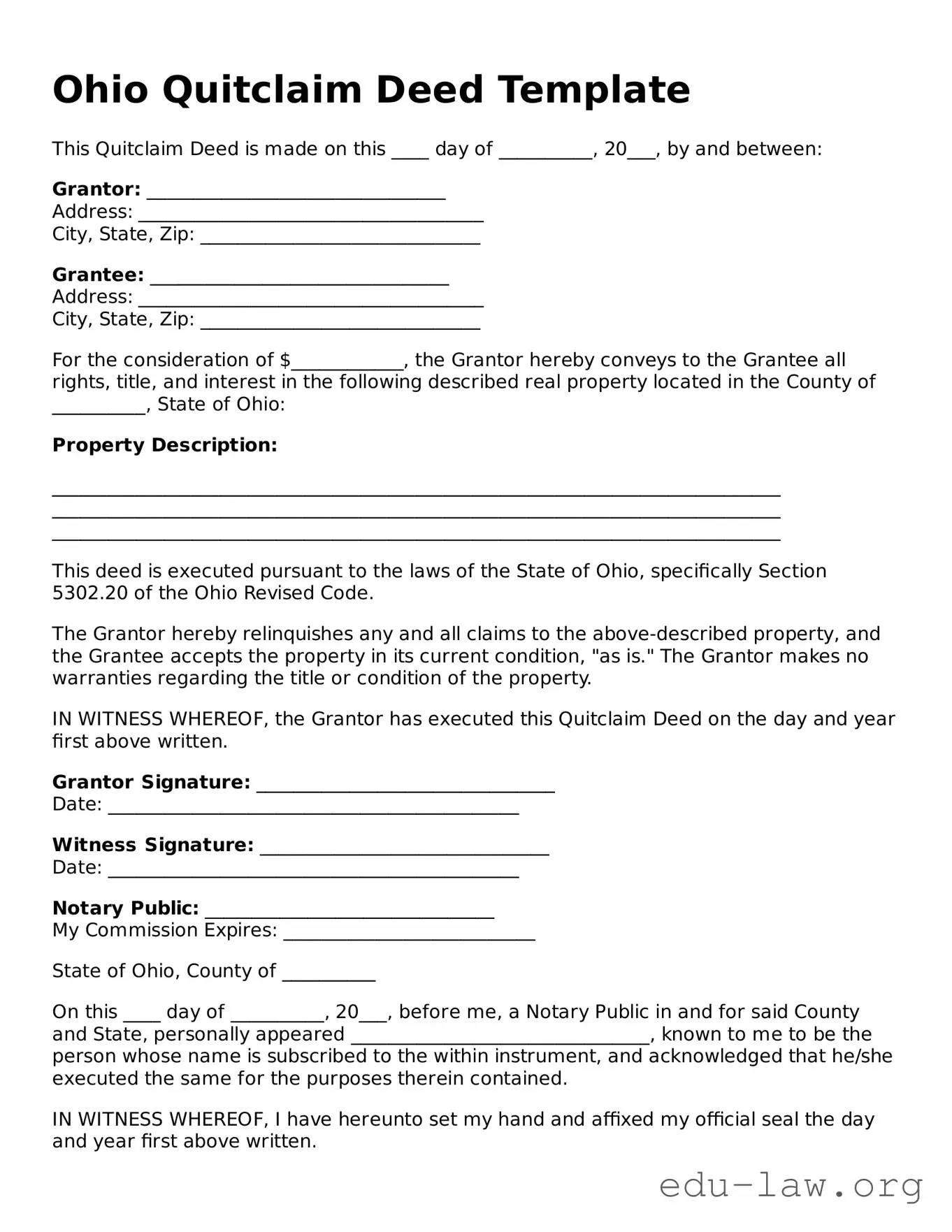
The Ohio Quitclaim Deed form serves as a crucial tool for property owners looking to transfer their interest in real estate without the complexities often associated with other types of deeds. This form is particularly useful in situations where the seller may not have clear title to the property or when the transfer is between family members or trusted parties. It allows the grantor, or seller, to relinquish any claim to the property, while the grantee, or buyer, receives whatever interest the grantor holds—if any. Importantly, a quitclaim deed does not guarantee that the title is free from encumbrances, which means buyers should conduct thorough due diligence before proceeding. The form must be completed accurately, including details such as the names of the parties involved, a legal description of the property, and the date of transfer. Once signed and notarized, the deed must be recorded with the county recorder's office to ensure public notice of the transaction. Understanding the nuances of this form can help property owners navigate the transfer process more smoothly and avoid potential disputes down the line.
Ohio Quitclaim Deed Template
This Quitclaim Deed is made on this ____ day of __________, 20___, by and between:
Grantor: ________________________________
Address: _____________________________________
City, State, Zip: ______________________________
Grantee: ________________________________
Address: _____________________________________
City, State, Zip: ______________________________
For the consideration of $____________, the Grantor hereby conveys to the Grantee all rights, title, and interest in the following described real property located in the County of __________, State of Ohio:
Property Description:
______________________________________________________________________________
______________________________________________________________________________
______________________________________________________________________________
This deed is executed pursuant to the laws of the State of Ohio, specifically Section 5302.20 of the Ohio Revised Code.
The Grantor hereby relinquishes any and all claims to the above-described property, and the Grantee accepts the property in its current condition, "as is." The Grantor makes no warranties regarding the title or condition of the property.
IN WITNESS WHEREOF, the Grantor has executed this Quitclaim Deed on the day and year first above written.
Grantor Signature: ________________________________
Date: ____________________________________________
Witness Signature: _______________________________
Date: ____________________________________________
Notary Public: _______________________________
My Commission Expires: ___________________________
State of Ohio, County of __________
On this ____ day of __________, 20___, before me, a Notary Public in and for said County and State, personally appeared ________________________________, known to me to be the person whose name is subscribed to the within instrument, and acknowledged that he/she executed the same for the purposes therein contained.
IN WITNESS WHEREOF, I have hereunto set my hand and affixed my official seal the day and year first above written.
_____________________________________
Notary Public
| Fact Name | Description |
|---|---|
| Definition | A quitclaim deed is a legal document used to transfer ownership of real estate from one party to another without any warranties regarding the title. |
| Governing Law | Ohio Revised Code Section 5302.20 governs the use and requirements of quitclaim deeds in Ohio. |
| Usage | This form is commonly used among family members or in situations where the seller does not wish to provide a warranty on the property title. |
| Filing Requirements | To be effective, the quitclaim deed must be signed, notarized, and filed with the county recorder's office in the county where the property is located. |
Filling out the Ohio Quitclaim Deed form is an important step in transferring property ownership. Once completed, this document needs to be filed with the appropriate county recorder's office to make the transfer official. Here’s how to fill it out correctly.
After filing, keep a copy of the Quitclaim Deed for your records. This ensures you have proof of the transfer, which can be important for future reference or any legal matters that may arise.
What is a Quitclaim Deed in Ohio?
A Quitclaim Deed is a legal document used to transfer ownership of real estate from one party to another without any warranties. It allows the grantor (the person transferring the property) to convey their interest in the property to the grantee (the person receiving the property). This type of deed is often used in situations where the parties know each other, such as family transfers or divorces.
When should I use a Quitclaim Deed?
Quitclaim Deeds are commonly used in specific situations, such as transferring property between family members, resolving disputes, or clearing up title issues. They are also useful when a property owner wants to add or remove someone from the title without the need for a formal sale.
What information is required on the Ohio Quitclaim Deed form?
The form typically requires the names and addresses of the grantor and grantee, a legal description of the property, and the date of the transfer. Additionally, it may include information about any consideration (payment) involved in the transfer, although this is not always necessary.
Do I need to have the Quitclaim Deed notarized?
Yes, in Ohio, a Quitclaim Deed must be notarized to be valid. This means that the signatures of the grantor must be acknowledged by a notary public, ensuring that the document is legally binding and can be recorded with the county recorder's office.
How do I record a Quitclaim Deed in Ohio?
To record a Quitclaim Deed, you must take the notarized document to the county recorder's office where the property is located. There may be a recording fee, which varies by county. Once recorded, the deed becomes a public record, providing notice of the ownership transfer.
Are there any tax implications when using a Quitclaim Deed?
Generally, transferring property via a Quitclaim Deed may not trigger a tax event. However, it’s essential to check with a tax professional or local authorities to understand any potential implications, especially if the property is sold or if there are significant changes in ownership.
Can a Quitclaim Deed be revoked?
A Quitclaim Deed cannot be revoked once it has been executed and recorded. However, the grantor may create a new deed to transfer the property back or to another party. This new deed would need to follow the same legal requirements as the original Quitclaim Deed.
What are the risks associated with using a Quitclaim Deed?
The primary risk is that a Quitclaim Deed does not guarantee that the grantor has clear title to the property. This means that if there are any liens or claims against the property, the grantee may inherit those issues. It’s advisable to conduct a title search before completing the transfer.
Can I use a Quitclaim Deed for commercial properties?
Yes, Quitclaim Deeds can be used for both residential and commercial properties in Ohio. However, due diligence is particularly important in commercial transactions, as the potential for existing liens or title issues may be more complex.
Is legal assistance recommended when using a Quitclaim Deed?
While it is not legally required to have an attorney assist with a Quitclaim Deed, it is often advisable. An attorney can help ensure that the deed is completed correctly, address any potential issues with the property title, and provide guidance on the implications of the transfer.
Failing to include the correct names of the grantor and grantee. It is essential that the individuals involved are accurately identified to avoid future disputes.
Not providing the legal description of the property. This description must be precise, as it defines the boundaries and specifics of the property being transferred.
Omitting the date of the transaction. Including a date is crucial for establishing the timeline of ownership and can affect legal rights.
Neglecting to sign the form. A signature is a fundamental requirement for the deed to be valid; without it, the document holds no legal weight.
Using incorrect or outdated forms. Always ensure you are using the latest version of the Quitclaim Deed form to comply with current regulations.
Not having the deed notarized. A notarization is often required to authenticate the signatures and ensure the document is legally binding.
Forgetting to record the deed with the county recorder’s office. Recording is essential for public notice and protects the interests of the new owner.
Failing to check for existing liens or encumbrances on the property. Buyers should be aware of any financial claims against the property before proceeding with the transfer.
Overlooking the tax implications of the transfer. Understanding potential tax consequences can help avoid unexpected financial burdens in the future.
When transferring property in Ohio, a Quitclaim Deed is a common choice. However, several other forms and documents often accompany this deed to ensure a smooth and legally sound transaction. Below is a list of these important documents, each serving a specific purpose in the property transfer process.
Understanding these documents can greatly assist in navigating the complexities of property transactions in Ohio. Each one plays a crucial role in ensuring that the transfer is conducted smoothly and legally, safeguarding the interests of all parties involved.
A Warranty Deed is often compared to a Quitclaim Deed because both are used to transfer property ownership. However, the key difference lies in the level of protection they offer. A Warranty Deed guarantees that the seller holds clear title to the property and is free of any liens or encumbrances. This means the buyer can feel secure knowing that they are receiving a legitimate claim to the property. In contrast, a Quitclaim Deed makes no such promises. It simply transfers whatever interest the seller has in the property, if any, without any guarantees. This makes Warranty Deeds a safer choice for buyers seeking assurance about their new property.
Another document similar to a Quitclaim Deed is a Bargain and Sale Deed. This type of deed conveys property from one party to another but does not provide any warranties against encumbrances. Like a Quitclaim Deed, it transfers whatever interest the seller has, but it implies that the seller has some ownership rights. This can create a bit more confidence for the buyer compared to a Quitclaim Deed, yet it still lacks the full protections of a Warranty Deed. Therefore, it’s essential for buyers to understand the implications of using a Bargain and Sale Deed.
A Special Purpose Deed also shares similarities with a Quitclaim Deed, particularly in its limited guarantees. This type of deed is used in specific situations, such as transfers between family members or in divorce settlements. Like a Quitclaim Deed, a Special Purpose Deed does not provide warranties about the property’s title. It’s primarily a straightforward way to transfer ownership without the complexities often involved in traditional sales. Buyers should be aware that while this deed simplifies the process, it doesn’t offer the same level of security as a Warranty Deed.
In some cases, a Deed of Trust can be likened to a Quitclaim Deed, especially when it comes to transferring interests in property. A Deed of Trust involves three parties: the borrower, the lender, and a trustee. This document secures a loan with the property as collateral. While it serves a different purpose than a Quitclaim Deed, both documents can involve the transfer of property interests. The Deed of Trust is primarily focused on securing a loan, while the Quitclaim Deed is about transferring ownership. Understanding these distinctions is vital for anyone navigating property transactions.
Lastly, a Life Estate Deed can resemble a Quitclaim Deed in that it transfers property rights, but it does so with specific conditions. A Life Estate Deed allows the owner to retain the right to live in or use the property for their lifetime, after which the property passes to another party. While both documents facilitate the transfer of property, the Life Estate Deed incorporates elements of ownership retention and future interest. This makes it a unique option for individuals looking to pass on property while still enjoying its benefits during their lifetime.
When filling out the Ohio Quitclaim Deed form, precision and attention to detail are crucial. Here are eight important dos and don'ts to keep in mind.
Following these guidelines will help ensure that your Quitclaim Deed is properly executed and recorded. Take the time to review your form carefully before submission.
There are several misconceptions about the Ohio Quitclaim Deed form that can lead to confusion. Understanding these misconceptions can help individuals make informed decisions when dealing with property transfers. Below are some common misunderstandings:
Being aware of these misconceptions can help individuals navigate property transfers more effectively. Always consider consulting a legal professional for personalized guidance.
Filling out and using the Ohio Quitclaim Deed form is straightforward, but attention to detail is crucial. Here are some key takeaways: