In Ohio, the Power of Attorney form serves as a vital legal document that empowers individuals to make important decisions on behalf of another person. This form is particularly significant in situations where someone may be unable to manage their own affairs due to health issues, absence, or other circumstances. With a Power of Attorney, the designated agent can handle financial matters, make healthcare decisions, and even manage property transactions. It's essential to understand the different types of Powers of Attorney available, such as durable, medical, and limited, as each serves a unique purpose and provides varying levels of authority. Additionally, the process of creating this document involves specific requirements, including the need for signatures and, in some cases, notarization. By establishing a Power of Attorney, individuals can ensure that their wishes are respected and that their affairs are handled by someone they trust, providing peace of mind for both the principal and the agent.
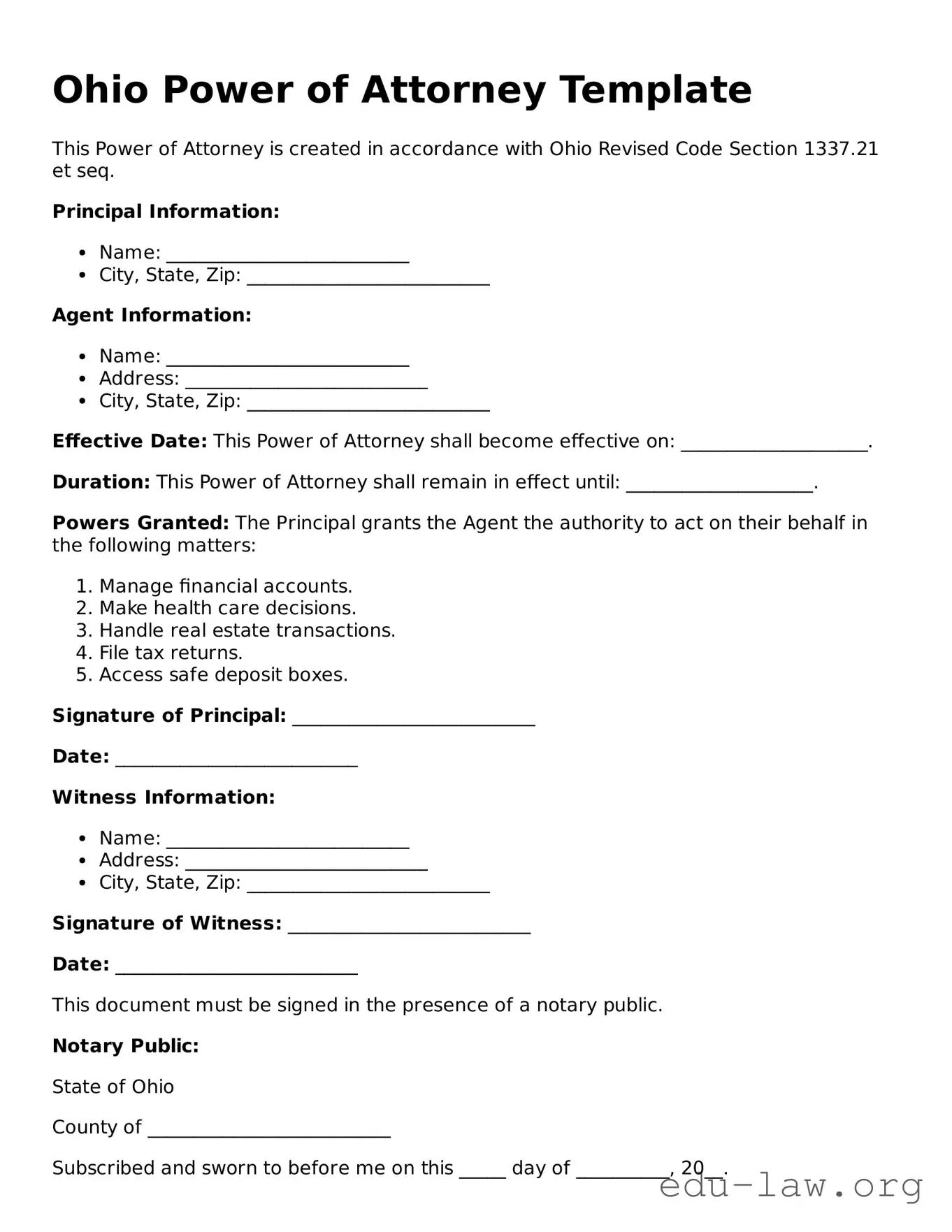
Ohio Power of Attorney Template
This Power of Attorney is created in accordance with Ohio Revised Code Section 1337.21 et seq.
Principal Information:
Agent Information:
Effective Date: This Power of Attorney shall become effective on: ____________________.
Duration: This Power of Attorney shall remain in effect until: ____________________.
Powers Granted: The Principal grants the Agent the authority to act on their behalf in the following matters:
Signature of Principal: __________________________
Date: __________________________
Witness Information:
Signature of Witness: __________________________
Date: __________________________
This document must be signed in the presence of a notary public.
Notary Public:
State of Ohio
County of __________________________
Subscribed and sworn to before me on this _____ day of __________, 20__.
Signature of Notary Public: __________________________
My Commission Expires: __________________________
| Fact Name | Description |
|---|---|
| Definition | The Ohio Power of Attorney form allows an individual to designate another person to make decisions on their behalf, particularly in financial or legal matters. |
| Governing Law | This form is governed by Ohio Revised Code Section 1337.21 through 1337.64, which outlines the rules and regulations surrounding powers of attorney in Ohio. |
| Types of Authority | It can grant general or specific powers. General powers allow for broad authority, while specific powers limit the agent's authority to particular tasks. |
| Agent Requirements | The agent must be at least 18 years old and competent to act. This ensures that the person chosen can make sound decisions. |
| Durability | The form can be durable, meaning it remains effective even if the principal becomes incapacitated, unless explicitly stated otherwise. |
| Revocation | The principal can revoke the Power of Attorney at any time, provided they are competent to do so. This revocation must be documented in writing. |
| Witness and Notary Requirements | The form must be signed in the presence of a notary public. In some cases, two witnesses may also be required, depending on the specific powers granted. |
| Common Uses | Individuals often use this form for financial management, healthcare decisions, or handling legal affairs, especially when they are unable to do so themselves. |
Filling out the Ohio Power of Attorney form is an important step in designating someone to act on your behalf in legal or financial matters. After completing the form, it will need to be signed and possibly notarized, depending on the specific requirements. Below are the steps to accurately fill out the form.
What is a Power of Attorney in Ohio?
A Power of Attorney (POA) in Ohio is a legal document that allows one person, known as the principal, to grant another person, called the agent or attorney-in-fact, the authority to act on their behalf. This authority can cover a wide range of decisions, including financial matters, healthcare decisions, or other specific tasks. The principal can specify what powers the agent has, making it a flexible tool for managing personal affairs.
How do I create a Power of Attorney in Ohio?
Creating a Power of Attorney in Ohio involves several steps. First, you need to choose a trusted individual to act as your agent. Next, you will fill out the Ohio Power of Attorney form, which can be found online or through legal resources. It’s important to ensure that the form is properly completed and signed. In Ohio, the principal must sign the document in the presence of a notary public or two witnesses to make it legally binding.
Can I revoke a Power of Attorney in Ohio?
Yes, you can revoke a Power of Attorney in Ohio at any time, as long as you are mentally competent. To revoke it, you should create a written document stating your intention to revoke the POA and notify your agent and any relevant institutions, such as banks or healthcare providers. It’s a good idea to keep a copy of the revocation for your records and ensure that the original Power of Attorney document is destroyed or marked as revoked.
What happens if I become incapacitated and have a Power of Attorney?
If you become incapacitated and have a valid Power of Attorney in place, your agent can step in to make decisions on your behalf. This can include managing your finances, making healthcare decisions, and handling other important matters. It’s crucial to choose someone you trust, as they will have significant authority over your affairs during this time.
Is a Power of Attorney effective immediately in Ohio?
In Ohio, a Power of Attorney can be effective immediately upon signing, unless the document specifies a different start date. Alternatively, you can create a “springing” Power of Attorney, which only becomes effective under certain conditions, such as your incapacity. It’s important to clearly outline your intentions in the document to avoid any confusion regarding when the agent can begin acting on your behalf.
Not specifying the powers granted: Many individuals fail to clearly outline the specific powers they wish to grant. This can lead to confusion and limit the agent's ability to act effectively.
Choosing the wrong agent: Selecting someone who lacks the necessary skills or trustworthiness can result in poor decision-making. It's essential to choose an agent who understands your values and wishes.
Failing to sign and date: Omitting a signature or date can invalidate the document. Always ensure that the form is properly signed and dated to confirm its authenticity.
Not having witnesses or notarization: In Ohio, certain types of Power of Attorney forms require witnesses or notarization. Neglecting this step can render the document unenforceable.
Using outdated forms: Laws change over time. Using an old version of the Power of Attorney form may lead to complications. Always ensure you have the most current form.
Not discussing intentions with the agent: Failing to communicate your intentions and preferences can lead to misunderstandings. It’s important to have an open conversation with your agent.
Overlooking alternate agents: Designating only one agent without an alternative can create issues if that person is unavailable. Consider naming a backup agent to ensure continuity.
Ignoring state-specific requirements: Each state has its own rules regarding Power of Attorney forms. Ignoring these can lead to invalidation of the document.
Not reviewing the document periodically: Life circumstances change. Failing to review and update the Power of Attorney can result in outdated decisions or preferences.
When creating a Power of Attorney (POA) in Ohio, several other forms and documents may be necessary to ensure comprehensive legal coverage. Each of these documents serves a unique purpose and can enhance the effectiveness of the POA. Below is a list of commonly used forms that may accompany the Ohio Power of Attorney.
Understanding these documents can significantly aid in the planning process. By considering the use of these forms alongside the Ohio Power of Attorney, individuals can ensure their wishes are clearly communicated and legally upheld during critical times.
The Ohio Power of Attorney form shares similarities with a Living Will. A Living Will outlines an individual's preferences regarding medical treatment in situations where they may be unable to communicate their wishes. Like a Power of Attorney, it is a legal document that provides guidance to healthcare providers and family members about what actions to take. Both documents empower individuals to make decisions about their health and finances, ensuring that their wishes are respected even when they cannot speak for themselves.
Another document that resembles the Ohio Power of Attorney is the Healthcare Proxy. A Healthcare Proxy designates a specific person to make medical decisions on behalf of someone else if they are unable to do so. This form focuses primarily on health-related decisions, while a Power of Attorney can cover a broader range of financial and legal matters. Both documents are essential for ensuring that a person’s preferences are honored, highlighting the importance of having a trusted individual to advocate for them in critical situations.
The Durable Power of Attorney is closely related to the Ohio Power of Attorney form. While both documents grant authority to another person to make decisions on behalf of someone else, the Durable Power of Attorney remains effective even if the principal becomes incapacitated. This durability feature provides peace of mind, knowing that financial and legal matters can be managed without interruption. In contrast, a standard Power of Attorney may become void under certain circumstances, such as the principal’s incapacitation.
Lastly, the Financial Power of Attorney is another document that bears resemblance to the Ohio Power of Attorney. This form specifically focuses on granting authority to manage financial matters, such as banking, investments, and property transactions. While the Ohio Power of Attorney can encompass both financial and healthcare decisions, the Financial Power of Attorney is tailored for those who want to ensure their financial affairs are handled by a trusted individual. Both forms are vital tools for effective planning and decision-making in various aspects of life.
When filling out the Ohio Power of Attorney form, it’s important to follow certain guidelines to ensure the document is valid and meets your needs. Here are five things you should and shouldn't do:
By following these guidelines, you can help ensure that your Power of Attorney is effective and serves its intended purpose.
Understanding the Ohio Power of Attorney form is crucial for making informed decisions about your financial and healthcare matters. However, several misconceptions can lead to confusion. Here are five common misunderstandings:
This is not true. While many people associate Power of Attorney with financial decisions, it can also encompass healthcare decisions. A healthcare Power of Attorney specifically allows someone to make medical decisions on your behalf if you become unable to do so.
This is incorrect. You can revoke a Power of Attorney at any time, as long as you are mentally competent. It is important to notify the agent and any institutions involved to ensure the revocation is effective.
While the agent does have significant authority, they must act in your best interest and follow your wishes. They are legally obligated to manage your affairs responsibly and ethically.
This is a common belief, but anyone can benefit from having a Power of Attorney. Unexpected events can happen to anyone, and having a designated person to make decisions can provide peace of mind.
While consulting a lawyer is beneficial, it is not mandatory. Ohio provides a standard Power of Attorney form that individuals can complete on their own. However, legal guidance can help ensure that the form meets all necessary requirements.
Clarifying these misconceptions can help individuals take appropriate steps in planning for their future and ensuring their wishes are honored.
Filling out and using the Ohio Power of Attorney form is an important step in ensuring that your financial and healthcare decisions are managed according to your wishes. Here are some key takeaways to keep in mind:
Taking these steps can help ensure that your Power of Attorney is effective and aligns with your personal wishes. It’s a proactive measure that can provide peace of mind for you and your loved ones.