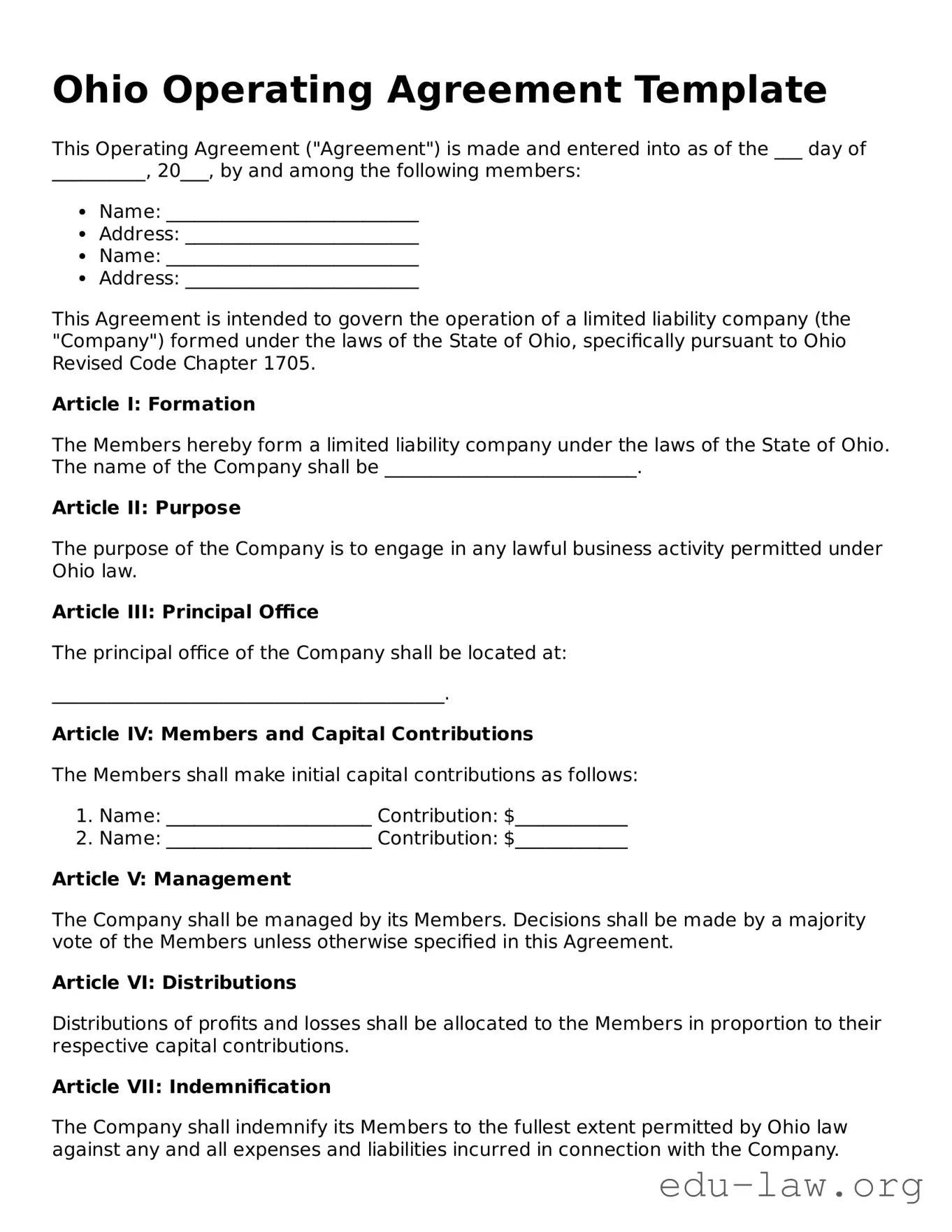
When starting a business in Ohio, one of the most important documents to consider is the Operating Agreement. This essential form outlines the management structure and operational guidelines for a Limited Liability Company (LLC). It serves as a roadmap for how the business will function, detailing the roles and responsibilities of members, decision-making processes, and how profits and losses will be distributed. Additionally, the Operating Agreement can address various scenarios, such as what happens if a member wants to leave the company or how disputes will be resolved. Having a well-drafted Operating Agreement not only helps to prevent misunderstandings among members but also provides a level of protection for the LLC's limited liability status. By clearly defining the rules and expectations, this document fosters a sense of stability and trust among business partners, making it a crucial step in the formation of any LLC in Ohio.
Ohio Operating Agreement Template
This Operating Agreement ("Agreement") is made and entered into as of the ___ day of __________, 20___, by and among the following members:
This Agreement is intended to govern the operation of a limited liability company (the "Company") formed under the laws of the State of Ohio, specifically pursuant to Ohio Revised Code Chapter 1705.
Article I: Formation
The Members hereby form a limited liability company under the laws of the State of Ohio. The name of the Company shall be ___________________________.
Article II: Purpose
The purpose of the Company is to engage in any lawful business activity permitted under Ohio law.
Article III: Principal Office
The principal office of the Company shall be located at:
__________________________________________.
Article IV: Members and Capital Contributions
The Members shall make initial capital contributions as follows:
Article V: Management
The Company shall be managed by its Members. Decisions shall be made by a majority vote of the Members unless otherwise specified in this Agreement.
Article VI: Distributions
Distributions of profits and losses shall be allocated to the Members in proportion to their respective capital contributions.
Article VII: Indemnification
The Company shall indemnify its Members to the fullest extent permitted by Ohio law against any and all expenses and liabilities incurred in connection with the Company.
Article VIII: Amendments
This Agreement may be amended only by a written agreement signed by all Members.
Article IX: Governing Law
This Agreement shall be governed by and construed in accordance with the laws of the State of Ohio.
IN WITNESS WHEREOF, the Members have executed this Operating Agreement as of the date first above written.
_________________________________ _________________________________
Member Signature Member Signature
_________________________________ _________________________________
Print Name Print Name
| Fact Name | Description |
|---|---|
| Purpose | The Ohio Operating Agreement outlines the management structure and operational procedures for a limited liability company (LLC) in Ohio. |
| Governing Law | This agreement is governed by the Ohio Revised Code, specifically Title 17, Chapter 1705, which pertains to limited liability companies. |
| Members | All members of the LLC should be included in the agreement, detailing their rights, responsibilities, and ownership percentages. |
| Flexibility | The agreement allows for flexibility in management structure, enabling members to choose between member-managed or manager-managed setups. |
| Dispute Resolution | It often includes provisions for resolving disputes among members, which can help prevent conflicts and misunderstandings. |
| Amendments | The Ohio Operating Agreement can be amended as needed, allowing members to adapt to changing circumstances or business needs. |
| Importance | Having a well-drafted Operating Agreement is crucial for protecting the interests of members and ensuring the smooth operation of the LLC. |
Filling out the Ohio Operating Agreement form is a straightforward process that ensures all necessary information is captured accurately. Follow these steps to complete the form effectively.
What is an Ohio Operating Agreement?
An Ohio Operating Agreement is a legal document that outlines the management structure and operating procedures of a limited liability company (LLC) in Ohio. It serves as a blueprint for how the LLC will function, detailing the rights and responsibilities of its members. This agreement is essential for ensuring that all members are on the same page regarding the company’s operations.
Is an Operating Agreement required in Ohio?
No, an Operating Agreement is not legally required in Ohio. However, having one is highly recommended. It provides clarity and helps prevent misunderstandings among members. Additionally, it can protect your limited liability status by demonstrating that your LLC is a separate entity from its members.
Who should draft the Operating Agreement?
What should be included in the Operating Agreement?
An Operating Agreement should include several key components. These typically cover the management structure, voting rights, profit distribution, member responsibilities, and procedures for adding or removing members. It may also outline how disputes will be resolved and what happens if the LLC dissolves.
Can the Operating Agreement be amended?
Yes, the Operating Agreement can be amended. The process for making changes should be clearly outlined in the document itself. Typically, amendments require a certain percentage of member approval. This ensures that all members have a say in significant changes to the agreement.
What happens if we don’t have an Operating Agreement?
If your LLC does not have an Operating Agreement, Ohio state laws will govern the operations of your business. This may not align with the specific needs or intentions of your members. Without a tailored agreement, members may face disputes over management and profit distribution, leading to potential conflicts.
How does the Operating Agreement affect liability protection?
The Operating Agreement plays a crucial role in maintaining your LLC’s liability protection. By clearly defining the separation between personal and business assets, it helps reinforce that the LLC is a distinct entity. This can protect members from personal liability for the debts and obligations of the business, as long as the LLC is properly maintained.
Can a single-member LLC have an Operating Agreement?
Yes, a single-member LLC can and should have an Operating Agreement. Even if there is only one member, this document can clarify how the business will be managed, how profits will be handled, and what happens in the event of the member’s death or incapacity. It helps establish the LLC as a separate entity, which is crucial for liability protection.
How do we execute the Operating Agreement?
To execute the Operating Agreement, all members of the LLC should sign the document. It is advisable to have the signatures witnessed or notarized, though this is not a requirement in Ohio. Once signed, each member should keep a copy for their records. This ensures that everyone has access to the terms agreed upon.
Where can I find a template for an Ohio Operating Agreement?
Templates for Ohio Operating Agreements can be found online through various legal websites, or you may consult with an attorney for a customized version. While templates can be a helpful starting point, ensure that the final document reflects the specific needs and agreements of your LLC members.
Incomplete Information: One common mistake is leaving sections of the form blank. Each member's name, address, and contribution should be clearly stated. Omitting this information can lead to misunderstandings later.
Incorrect Member Roles: It's crucial to accurately define the roles of each member within the agreement. Mislabeling a member’s role can create confusion about responsibilities and authority, potentially leading to disputes.
Failure to Specify Profit Distribution: Not detailing how profits and losses will be shared among members is a frequent oversight. Clear terms regarding distribution help prevent disagreements in the future.
Not Updating the Agreement: After the initial formation, some individuals neglect to update the Operating Agreement when changes occur, such as new members joining or existing members leaving. Keeping the document current is essential for maintaining clarity and legal compliance.
The Ohio Operating Agreement is a crucial document for limited liability companies (LLCs) in Ohio. It outlines the management structure and operating procedures of the company. Several other forms and documents often accompany the Operating Agreement to ensure compliance with state laws and effective governance. Below is a list of these documents.
These documents collectively support the formation and operation of an LLC in Ohio. Each plays a distinct role in ensuring that the company runs smoothly and adheres to legal requirements.
The Ohio Operating Agreement is similar to the Limited Liability Company (LLC) Agreement used in other states. Both documents outline the management structure, responsibilities, and operational guidelines of an LLC. They serve to protect the members' personal assets by clearly defining the business's legal framework. Just like the Ohio version, LLC Agreements in other states can be customized to fit the specific needs of the business and its members, ensuring that all parties are on the same page regarding their roles and expectations.
Another document that shares similarities with the Ohio Operating Agreement is the Partnership Agreement. This agreement is used by partnerships to define the roles of each partner, the distribution of profits and losses, and the decision-making process. Like the Operating Agreement, it establishes the operational framework necessary for smooth business operations. Both documents aim to minimize disputes by providing clear guidelines and expectations for all involved parties.
The Corporate Bylaws are also comparable to the Ohio Operating Agreement. While Bylaws are specific to corporations, they serve a similar purpose in outlining the governance structure and operational procedures of the business. Both documents detail the rights and responsibilities of members or shareholders, ensuring that everyone understands their role within the organization. This clarity helps prevent conflicts and promotes effective management.
The Shareholder Agreement is another document akin to the Ohio Operating Agreement. This agreement is used by corporations to outline the rights and obligations of shareholders. It addresses issues such as the transfer of shares, voting rights, and dividend distribution. Similar to the Operating Agreement, it aims to protect the interests of the shareholders and provide a clear framework for governance, thereby fostering a stable business environment.
The Joint Venture Agreement bears resemblance to the Ohio Operating Agreement as well. This document outlines the terms and conditions under which two or more parties collaborate on a specific project or business venture. Like the Operating Agreement, it specifies the roles, contributions, and profit-sharing arrangements of each party involved. This clarity helps ensure that all parties are aligned in their objectives and responsibilities, reducing the likelihood of misunderstandings.
The Nonprofit Bylaws can also be compared to the Ohio Operating Agreement. Nonprofit organizations utilize Bylaws to define their governance structure, membership requirements, and operational procedures. Both documents serve to establish clear guidelines for decision-making and accountability, ensuring that all members or directors understand their roles and responsibilities within the organization.
The Employment Agreement shares some similarities with the Ohio Operating Agreement, particularly in how it outlines roles and responsibilities. While the Operating Agreement focuses on the management of the business, the Employment Agreement specifies the terms of employment for individual employees. Both documents aim to create a clear understanding of expectations, thereby fostering a productive working environment and reducing potential conflicts.
Lastly, the Franchise Agreement can be likened to the Ohio Operating Agreement. This document outlines the relationship between the franchisor and franchisee, detailing the rights, obligations, and operational guidelines for both parties. Similar to the Operating Agreement, it establishes a framework for how the business will operate, ensuring that both parties have a mutual understanding of their roles and responsibilities in the franchise relationship.
When filling out the Ohio Operating Agreement form, it is essential to approach the task with care and attention to detail. Here are some important dos and don'ts to keep in mind:
By following these guidelines, you can navigate the process of completing the Ohio Operating Agreement form more effectively, ensuring that your business's foundation is solid and legally sound.
When it comes to the Ohio Operating Agreement form, there are several misconceptions that can lead to confusion. Understanding these myths can help you navigate the process more smoothly. Here’s a look at ten common misconceptions:
By clearing up these misconceptions, you can better appreciate the importance of the Ohio Operating Agreement form and how it can benefit your business.
When filling out and using the Ohio Operating Agreement form, several important considerations can guide individuals and businesses. Below are key takeaways to keep in mind:
By keeping these key points in mind, individuals can create a more effective and functional Operating Agreement for their LLC in Ohio.