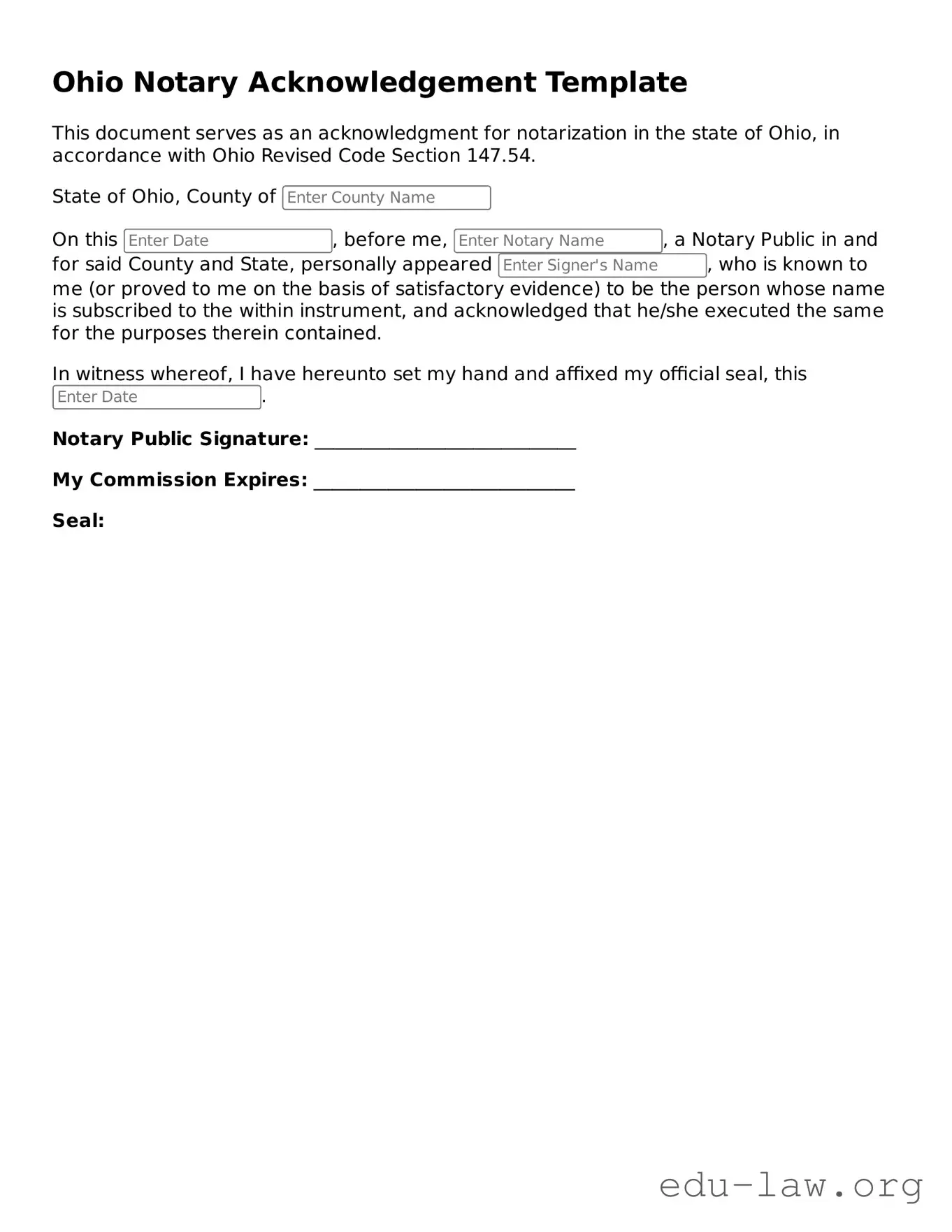
The Ohio Notary Acknowledgment form plays a crucial role in the notarization process, serving as a formal declaration that a signature on a document is genuine and that the signer has willingly provided it. This form is essential for various legal documents, including deeds, contracts, and affidavits, ensuring that they carry the weight of authenticity. Typically, the form includes the name of the signer, the date of the acknowledgment, and the notary’s signature and seal, which together validate the act of notarization. In Ohio, the notary must confirm the identity of the signer through acceptable identification methods, reinforcing the integrity of the transaction. Additionally, the form specifies the capacity in which the signer is acting, whether as an individual or on behalf of an entity. Understanding the intricacies of this form is vital for anyone involved in legal documentation, as it safeguards against fraud and upholds the principles of trust and transparency in legal affairs.
Ohio Notary Acknowledgement Template
This document serves as an acknowledgment for notarization in the state of Ohio, in accordance with Ohio Revised Code Section 147.54.
State of Ohio, County of
On this , before me, , a Notary Public in and for said County and State, personally appeared , who is known to me (or proved to me on the basis of satisfactory evidence) to be the person whose name is subscribed to the within instrument, and acknowledged that he/she executed the same for the purposes therein contained.
In witness whereof, I have hereunto set my hand and affixed my official seal, this .
Notary Public Signature: ____________________________
My Commission Expires: ____________________________
Seal:
| Fact Name | Description |
|---|---|
| Purpose | The Ohio Notary Acknowledgment form serves to verify the identity of a signer and confirm their willingness to sign a document. |
| Governing Law | The use of the Notary Acknowledgment form is governed by Ohio Revised Code § 147.53. |
| Signature Requirement | The signer must personally appear before the notary public at the time of signing. |
| Notary's Role | The notary public must complete the acknowledgment by signing and sealing the document. |
| Form Components | The form typically includes the name of the signer, the date of the acknowledgment, and the notary's information. |
| Identification | The notary may require the signer to present valid identification to confirm their identity. |
| Document Types | This acknowledgment can be used for various documents, including deeds, contracts, and affidavits. |
| Fees | Notaries in Ohio may charge a fee for their services, which is regulated by state law. |
| Record Keeping | Notaries are required to keep a record of their acknowledgments in a journal for accountability. |
After obtaining the Ohio Notary Acknowledgement form, you will need to fill it out carefully to ensure it is completed correctly. This form is an important document that requires accurate information. Follow these steps to fill out the form properly.
Once you have completed these steps, the form will be ready for submission or use as needed. Ensure that all information is accurate to avoid any issues later on.
What is an Ohio Notary Acknowledgement form?
The Ohio Notary Acknowledgement form is a document that serves as proof that a signer has appeared before a notary public and acknowledged that they signed a particular document willingly. This form is often used in various legal and official transactions to ensure that the signatures on important documents are authentic and have been verified by a qualified notary. It helps prevent fraud and provides a layer of security in legal dealings.
When do I need to use a Notary Acknowledgement in Ohio?
You will need to use a Notary Acknowledgement when you are signing documents that require notarization to be considered valid. Common situations include real estate transactions, powers of attorney, and certain court documents. If you are unsure whether your document requires notarization, it's always a good idea to check with a legal professional or the entity requesting the document.
How do I complete an Ohio Notary Acknowledgement form?
To complete the form, the signer must first appear before the notary public. The notary will then verify the identity of the signer, usually by checking a government-issued ID. After confirming the identity, the signer will need to sign the document in the presence of the notary. The notary will then fill out the Acknowledgement form, which includes details like the date, the notary's signature, and their official seal. Make sure to follow all instructions carefully to ensure the form is valid.
Is there a fee for notarization in Ohio?
Yes, notaries in Ohio are allowed to charge a fee for their services. The maximum fee for a standard notarization is set by state law, and it typically ranges around $5 per signature. However, additional fees may apply for services such as travel or additional documents. It's wise to discuss any fees upfront with the notary to avoid surprises.
Not including the signer's name correctly. It is important that the name matches the identification provided. Double-check spelling and order.
Failing to provide the date of the acknowledgment. This date is crucial for the validity of the notarization.
Not using the correct notary seal. Ensure that the seal is clear and legible. A missing or unclear seal can invalidate the acknowledgment.
Overlooking the signature of the notary. The notary must sign the form in the designated area. Without this signature, the acknowledgment is incomplete.
Using an outdated version of the form. Always check that you have the most current version of the Ohio Notary Acknowledgment form to avoid any issues.
When dealing with notary services in Ohio, several documents often accompany the Ohio Notary Acknowledgment form. Each of these documents serves a specific purpose in the notarization process, ensuring that everything is in order and legally binding. Below is a list of some commonly used forms and documents.
Understanding these accompanying documents can streamline the notarization process and ensure that all legal requirements are met. When prepared properly, these forms help facilitate smooth transactions and protect the rights of all parties involved.
The Ohio Notary Acknowledgment form is similar to the Affidavit. An affidavit is a written statement confirmed by oath or affirmation, used as evidence in court. Both documents require a notary public to verify the identity of the signers. In an affidavit, the signer swears to the truth of the contents, while the notary certifies that the signature was made in their presence. This process provides a layer of authenticity and trustworthiness to the statements made within the affidavit.
Another document similar to the Ohio Notary Acknowledgment is the Power of Attorney (POA). A POA grants someone the authority to act on behalf of another person in legal or financial matters. Like the acknowledgment form, a POA must be signed in front of a notary to ensure that the principal’s identity is verified. This notarization helps prevent fraud and ensures that the principal understands the powers they are granting to their agent.
The Deed is another document that shares similarities with the Ohio Notary Acknowledgment. A deed is a legal document that conveys ownership of real property. For a deed to be valid, it must be signed by the grantor and notarized. The notary's role is to confirm the identity of the person transferring the property and to ensure that they are doing so willingly. This process protects both the buyer and seller in a real estate transaction.
Additionally, the Mortgage document is comparable to the Ohio Notary Acknowledgment. A mortgage is a legal agreement in which a borrower pledges property as security for a loan. Notarization is required for the mortgage documents to validate the identities of the parties involved. This step helps to prevent disputes about the authenticity of the signatures and the agreement itself, ensuring that all parties are aware of their obligations.
The Bill of Sale also resembles the Ohio Notary Acknowledgment form. A bill of sale is a document that transfers ownership of personal property from one person to another. Notarization may be required to verify the identities of the parties involved, especially in transactions involving high-value items. This process helps establish a clear record of ownership and can be crucial in case of disputes later on.
In addition, the Lease Agreement can be compared to the Ohio Notary Acknowledgment. A lease agreement outlines the terms under which one party rents property from another. While not all lease agreements require notarization, having a notary present can enhance the document's credibility. This can be particularly important in disputes regarding the terms of the lease or the responsibilities of the parties involved.
The Trust document is another form that shares similarities with the Ohio Notary Acknowledgment. A trust is a fiduciary arrangement where one party holds property for the benefit of another. Notarization of the trust document helps ensure that the grantor's intentions are clear and that the document is executed properly. This adds a layer of security and helps prevent challenges to the trust's validity in the future.
Lastly, the Certification of Trust is akin to the Ohio Notary Acknowledgment. This document provides evidence of the existence of a trust and the authority of its trustee. Notarization is often required to confirm the identities of the individuals involved and to validate the document. This process assures third parties that the trustee has the legal authority to act on behalf of the trust, thereby facilitating transactions and agreements involving trust assets.
When filling out the Ohio Notary Acknowledgement form, there are important guidelines to follow. Here are some dos and don'ts to ensure the process goes smoothly.
Understanding the Ohio Notary Acknowledgment form is crucial for anyone involved in notarization. However, several misconceptions can lead to confusion. Here are seven common misunderstandings:
Being aware of these misconceptions can help individuals navigate the notarization process more effectively. Understanding the true role and limitations of a notary can lead to smoother transactions.
When filling out and using the Ohio Notary Acknowledgement form, it is important to understand its purpose and how to properly complete it. Here are some key takeaways to keep in mind:
Understanding these key points can help ensure that the Ohio Notary Acknowledgement form is completed correctly and serves its intended purpose effectively.