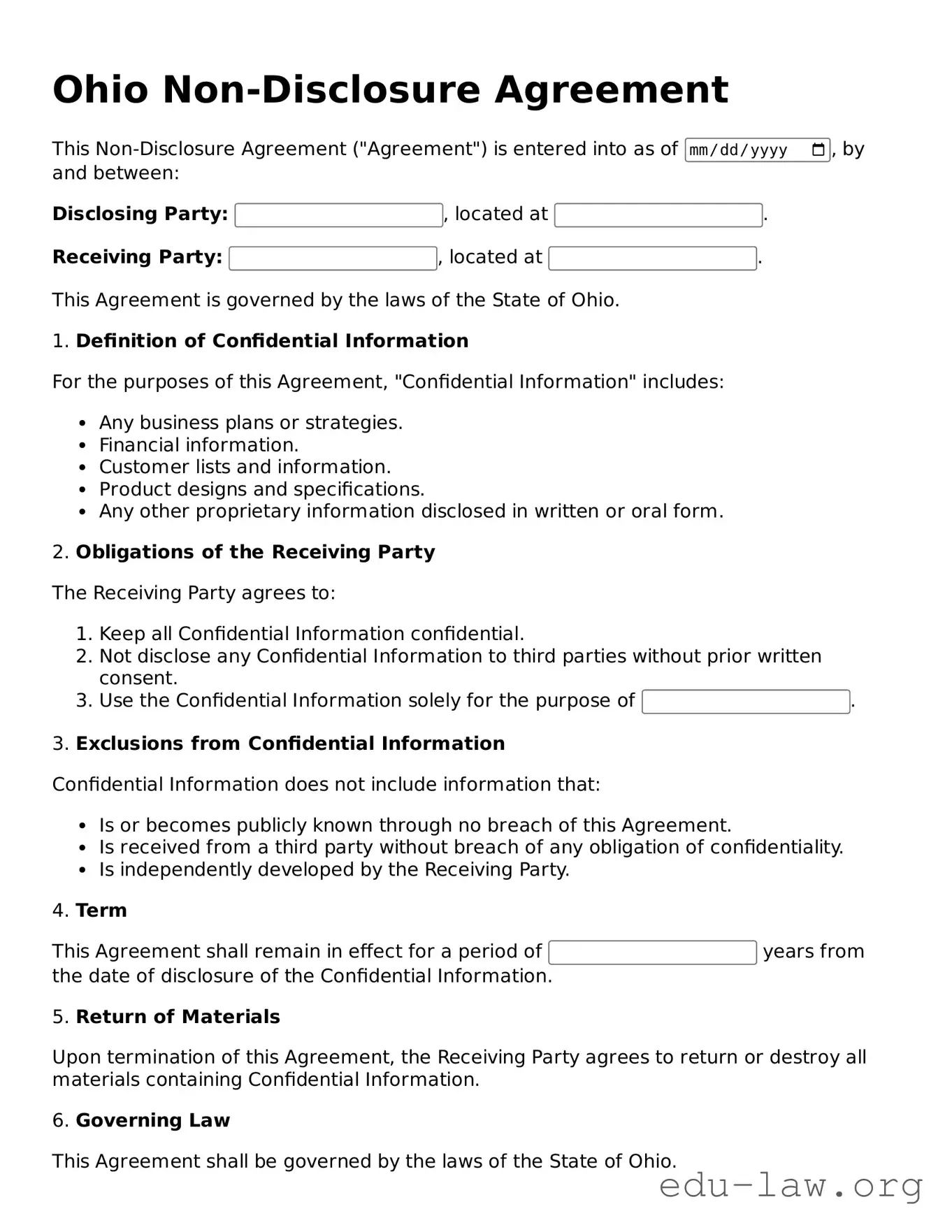
The Ohio Non-disclosure Agreement (NDA) form serves as a critical tool for individuals and businesses seeking to protect sensitive information from unauthorized disclosure. This legal document establishes a confidential relationship between parties, ensuring that proprietary information, trade secrets, and other sensitive data remain secure. Key components of the form include the identification of the parties involved, a clear definition of what constitutes confidential information, and the duration of the confidentiality obligations. Additionally, the NDA outlines the permitted uses of the confidential information and the remedies available in case of a breach. By utilizing this form, parties can foster trust and facilitate open communication while safeguarding their intellectual property and competitive advantage.
Ohio Non-Disclosure Agreement
This Non-Disclosure Agreement ("Agreement") is entered into as of , by and between:
Disclosing Party: , located at .
Receiving Party: , located at .
This Agreement is governed by the laws of the State of Ohio.
1. Definition of Confidential Information
For the purposes of this Agreement, "Confidential Information" includes:
2. Obligations of the Receiving Party
The Receiving Party agrees to:
3. Exclusions from Confidential Information
Confidential Information does not include information that:
4. Term
This Agreement shall remain in effect for a period of years from the date of disclosure of the Confidential Information.
5. Return of Materials
Upon termination of this Agreement, the Receiving Party agrees to return or destroy all materials containing Confidential Information.
6. Governing Law
This Agreement shall be governed by the laws of the State of Ohio.
IN WITNESS WHEREOF, the parties hereto have executed this Non-Disclosure Agreement as of the date first above written.
Disclosing Party Signature: ___________________________
Date:
Receiving Party Signature: ___________________________
Date:
| Fact Name | Description |
|---|---|
| Purpose | An Ohio Non-disclosure Agreement (NDA) protects confidential information shared between parties. |
| Governing Law | The NDA is governed by Ohio state law, specifically the Ohio Revised Code. |
| Parties Involved | Typically, the NDA involves at least two parties: the disclosing party and the receiving party. |
| Duration | The duration of confidentiality obligations can vary but is often specified within the agreement. |
| Enforcement | If a party breaches the NDA, the other party may seek legal remedies, including injunctions and damages. |
| Exclusions | Information that is public knowledge or independently developed is usually excluded from confidentiality obligations. |
Filling out the Ohio Non-disclosure Agreement form is a straightforward process. Once completed, this document will help protect sensitive information between parties. Make sure you have all the necessary details ready before you begin.
After completing the form, it’s essential to keep it in a safe place. This document serves as a crucial tool in maintaining confidentiality in your business dealings.
What is an Ohio Non-disclosure Agreement (NDA)?
An Ohio Non-disclosure Agreement is a legal contract that protects confidential information shared between parties. It ensures that sensitive information, such as trade secrets or proprietary data, remains confidential. This agreement is commonly used in business settings when discussing potential partnerships, investments, or employment relationships.
Who should use an Ohio NDA?
Any individual or business that needs to share confidential information can benefit from an Ohio NDA. This includes entrepreneurs, employers, and companies looking to protect their intellectual property. If you plan to disclose sensitive information to another party, having an NDA in place is advisable to safeguard your interests.
What are the key components of an Ohio NDA?
An Ohio NDA typically includes several important components. These may consist of definitions of confidential information, obligations of the receiving party, the duration of confidentiality, and any exclusions from confidentiality. It is essential to clearly outline these terms to avoid misunderstandings in the future.
How can I enforce an Ohio NDA?
Enforcement of an Ohio NDA can occur through legal action if the agreement is breached. The party whose information was disclosed can seek remedies, which may include monetary damages or injunctive relief. To strengthen enforcement, it is important to ensure that the NDA is well-drafted and clearly outlines the obligations of both parties.
Not reading the entire agreement: Many individuals rush through the document and miss important clauses that could affect their rights and obligations.
Failing to provide accurate information: Incorrect names, addresses, or other details can invalidate the agreement or create confusion later on.
Leaving out essential dates: Omitting the date of signing or the effective date can lead to disputes about when the agreement is in force.
Not specifying the confidential information: Vague descriptions of what constitutes confidential information can lead to misunderstandings.
Ignoring the duration of confidentiality: Failing to state how long the information must remain confidential can lead to issues down the line.
Not including a dispute resolution clause: Without a clear process for resolving disagreements, parties may find themselves in lengthy and costly disputes.
Forgetting to sign the agreement: A signed document is essential. Without signatures, the agreement holds no legal weight.
Not consulting a legal professional: Skipping this step can lead to mistakes that could have been avoided with proper guidance.
When entering into a Non-disclosure Agreement (NDA) in Ohio, several other forms and documents may be useful to ensure clarity and protection for all parties involved. Each of these documents serves a specific purpose and can complement the NDA effectively.
These documents, when used alongside the Ohio Non-disclosure Agreement, can enhance the legal framework surrounding confidential information and ensure that all parties are adequately protected. Understanding each document's role can facilitate smoother business transactions and foster trust among involved parties.
The Ohio Non-Disclosure Agreement (NDA) shares similarities with the Confidentiality Agreement. Both documents aim to protect sensitive information shared between parties. A Confidentiality Agreement is often used in various contexts, such as employment or business negotiations, to ensure that confidential information remains private. Like the Ohio NDA, it outlines the obligations of the parties involved, specifying what information is considered confidential and the consequences of unauthorized disclosure. This document serves as a foundational tool for maintaining trust in professional relationships.
Another document akin to the Ohio NDA is the Non-Circumvention Agreement. This agreement is designed to prevent one party from bypassing another to engage directly with a third party. In business dealings, a Non-Circumvention Agreement often complements an NDA by ensuring that the parties involved not only protect confidential information but also respect each other’s business connections. Both agreements work together to create a secure environment for collaboration, making them essential in negotiations where trust is paramount.
The Proprietary Information Agreement is also similar to the Ohio NDA. This type of agreement specifically focuses on proprietary information, which is data or knowledge that gives a business a competitive edge. Like the Ohio NDA, it establishes guidelines for handling proprietary information, detailing what constitutes such information and the obligations of the parties to protect it. This document is crucial for companies that rely on trade secrets and unique processes, ensuring that their competitive advantages remain secure.
In addition, the Mutual Non-Disclosure Agreement (MNDA) bears resemblance to the Ohio NDA. An MNDA involves two parties agreeing to protect each other’s confidential information. This document is particularly useful in situations where both parties will share sensitive data, such as in joint ventures or partnerships. The structure of an MNDA mirrors that of the Ohio NDA, as it clearly outlines the obligations of both parties and the scope of the information to be kept confidential, fostering a balanced and secure exchange of information.
The Employment Non-Disclosure Agreement is another document that aligns closely with the Ohio NDA. Employers often require employees to sign this agreement to protect sensitive company information, such as trade secrets or client lists. Similar to the Ohio NDA, it specifies what information is confidential and the repercussions for violating the agreement. This type of NDA is essential for safeguarding a company’s intellectual property and ensuring that employees understand their responsibilities regarding confidentiality.
Lastly, the Service Agreement may also be compared to the Ohio NDA. While primarily focused on the terms of service between a provider and a client, it often includes confidentiality clauses to protect sensitive information shared during the course of the service. Like the Ohio NDA, a Service Agreement delineates the responsibilities of both parties concerning confidential information. This ensures that both the service provider and the client maintain the integrity of shared data, which is vital for successful business operations.
When filling out the Ohio Non-disclosure Agreement form, it's important to be careful and thorough. Here are some dos and don'ts to keep in mind.
Following these guidelines will help ensure that the agreement is valid and enforceable.
Understanding the Ohio Non-disclosure Agreement (NDA) can be tricky, and there are several misconceptions that people often have. Here are five common misunderstandings:
Many believe that all non-disclosure agreements are identical. In reality, each NDA can be tailored to fit specific needs and circumstances. The terms can vary widely based on the parties involved and the nature of the information being protected.
While businesses frequently use NDAs to protect trade secrets, individuals can also benefit from them. Freelancers, inventors, and employees may use NDAs to safeguard their personal ideas and information.
This is a common fear, but it’s not entirely accurate. NDAs typically limit disclosure to specific parties or under certain conditions. You may still be able to discuss the information with trusted individuals, such as legal or financial advisors, depending on the agreement's terms.
Some people think that NDAs are only valid within the state where they are signed. However, NDAs can be enforceable in other jurisdictions as well, depending on the agreement's terms and the laws of those areas.
Many assume that NDAs last indefinitely. However, most agreements specify a time frame for how long the information must remain confidential. Once that period expires, the obligation to keep the information secret may no longer apply.
By clarifying these misconceptions, individuals and businesses can better understand how to use NDAs effectively and protect their valuable information.
When filling out and using the Ohio Non-disclosure Agreement (NDA) form, keep the following key takeaways in mind:
Using these guidelines will help ensure that your Ohio Non-disclosure Agreement is effective and legally binding.