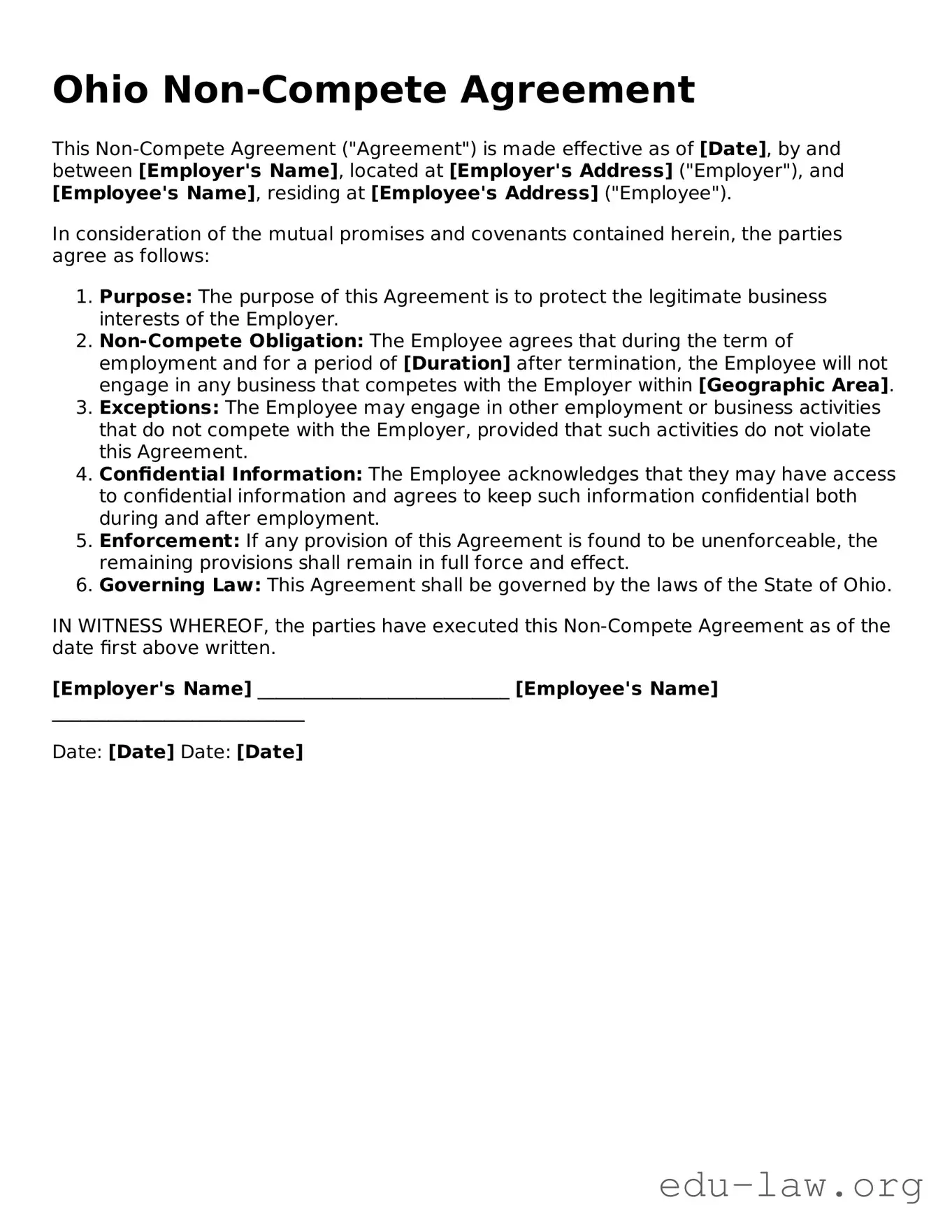
In Ohio, the Non-compete Agreement form serves as a critical tool for employers seeking to protect their business interests while outlining the limitations placed on employees after their employment ends. This form typically includes key elements such as the duration of the non-compete period, the geographic area in which the restrictions apply, and the specific activities that are prohibited. Employers must ensure that the terms are reasonable and not overly restrictive, as Ohio courts may scrutinize these agreements for enforceability. Additionally, the form often addresses considerations such as compensation during the non-compete period and any exceptions that may apply. By clearly defining the expectations and limitations for both parties, the Non-compete Agreement aims to balance the protection of trade secrets and proprietary information with the employee's right to seek future employment opportunities.
Ohio Non-Compete Agreement
This Non-Compete Agreement ("Agreement") is made effective as of [Date], by and between [Employer's Name], located at [Employer's Address] ("Employer"), and [Employee's Name], residing at [Employee's Address] ("Employee").
In consideration of the mutual promises and covenants contained herein, the parties agree as follows:
IN WITNESS WHEREOF, the parties have executed this Non-Compete Agreement as of the date first above written.
[Employer's Name] ___________________________ [Employee's Name] ___________________________
Date: [Date] Date: [Date]
| Fact Name | Description |
|---|---|
| Governing Law | Ohio law governs non-compete agreements, specifically under Ohio Revised Code Section 1331.01. |
| Enforceability | Non-compete agreements in Ohio are enforceable if they are reasonable in duration, geographic area, and scope of activity. |
| Duration Limit | Typically, a duration of one to two years is considered reasonable for non-compete agreements in Ohio. |
| Geographic Scope | The geographic area must be clearly defined and should not be overly broad to ensure enforceability. |
| Consideration Requirement | For a non-compete agreement to be valid, there must be consideration, such as employment or a promotion. |
| Trade Secrets Protection | Non-compete agreements can help protect trade secrets and proprietary information in Ohio. |
| Public Policy | Ohio courts may refuse to enforce non-compete agreements that violate public policy or are deemed overly restrictive. |
| Judicial Scrutiny | Ohio courts often scrutinize non-compete agreements to ensure they are not injurious to public interests. |
| Employee Rights | Employees have the right to challenge non-compete agreements that they believe are unreasonable or unfair. |
| Modification Possibility | Ohio courts may modify overly broad non-compete agreements to make them reasonable and enforceable. |
Completing the Ohio Non-compete Agreement form is a crucial step in ensuring that all parties understand the terms of the agreement. Follow these steps carefully to ensure accuracy and compliance.
After filling out the form, it is advisable to review it with a legal professional to ensure that it meets all necessary legal requirements and protects the interests of both parties involved.
What is a Non-compete Agreement in Ohio?
A Non-compete Agreement is a contract between an employer and an employee. It restricts the employee from working for a competitor or starting a competing business for a certain period after leaving the company. This agreement aims to protect the employer's business interests, trade secrets, and sensitive information.
Are Non-compete Agreements enforceable in Ohio?
Yes, Non-compete Agreements can be enforceable in Ohio, but certain conditions must be met. The agreement must be reasonable in terms of duration, geographical area, and the scope of activities it covers. Courts will evaluate whether the agreement protects legitimate business interests without overly restricting the employee's ability to find work.
How long can a Non-compete Agreement last in Ohio?
The duration of a Non-compete Agreement in Ohio varies, but it typically ranges from six months to two years. Courts generally look for agreements that are reasonable. A longer duration may be acceptable in some cases, especially if the employee had access to sensitive information or trade secrets.
What should be included in a Non-compete Agreement?
A Non-compete Agreement should clearly outline the following: the specific activities that are restricted, the geographical area where the restrictions apply, and the duration of the agreement. It should also state the consequences of violating the agreement and any compensation or benefits the employee may receive during the non-compete period.
Can an employee negotiate a Non-compete Agreement?
Yes, employees can negotiate the terms of a Non-compete Agreement. It’s important for employees to understand the implications of the agreement before signing. If an employee feels that the terms are too restrictive, they should discuss their concerns with their employer. Negotiation can lead to a more balanced agreement that protects both parties.
What happens if I violate a Non-compete Agreement?
If an employee violates a Non-compete Agreement, the employer may take legal action. This could result in a lawsuit seeking damages or an injunction to prevent the employee from working for a competitor. It’s crucial for employees to understand the potential consequences before agreeing to such terms.
Can a Non-compete Agreement be terminated?
Yes, a Non-compete Agreement can be terminated, but this typically requires mutual consent from both parties. Sometimes, an employer may choose to release an employee from the agreement, especially if the employment relationship ends amicably. Employees should review the terms of the agreement to understand how it can be terminated.
Inadequate Definition of Restricted Activities: Individuals often fail to clearly define the activities that are restricted. A vague description can lead to confusion and potential enforcement issues.
Unreasonable Geographic Scope: Many people make the mistake of setting an overly broad geographic area. This can render the agreement unenforceable if it is deemed excessive.
Excessive Duration: A common error is specifying a duration that is too long. Courts may reject agreements that impose restrictions for an unreasonable period.
Lack of Consideration: Failing to provide adequate consideration is another frequent mistake. The agreement must offer something of value in exchange for the employee's commitment.
Not Including a Severability Clause: Omitting a severability clause can be detrimental. This clause allows the remainder of the agreement to remain enforceable if one part is invalidated.
Ignoring State-Specific Laws: Many individuals overlook the specific laws governing non-compete agreements in Ohio. Not adhering to these regulations can lead to invalid agreements.
When entering into a Non-compete Agreement in Ohio, several other forms and documents may also be relevant to ensure a comprehensive understanding of the terms and conditions involved. Each of these documents serves a specific purpose and can help clarify the rights and responsibilities of both parties. Here’s a list of commonly associated documents:
Understanding these associated documents can help both employers and employees navigate the complexities of employment relationships. Each document plays a vital role in establishing clear expectations and protecting interests in the workplace.
The Ohio Non-compete Agreement is similar to a Non-disclosure Agreement (NDA). Both documents aim to protect sensitive information. An NDA prevents individuals from sharing confidential information with outsiders. In contrast, a Non-compete Agreement restricts individuals from engaging in competitive activities after leaving a company. While NDAs focus on confidentiality, Non-compete Agreements emphasize limiting competition to safeguard business interests.
Another document akin to the Ohio Non-compete Agreement is the Employment Agreement. This type of agreement outlines the terms of employment, including job responsibilities, salary, and benefits. Often, a Non-compete clause is included within the Employment Agreement to ensure that employees understand their obligations regarding competition after their employment ends. Both documents serve to clarify expectations and protect the employer's interests.
A Confidentiality Agreement also shares similarities with the Ohio Non-compete Agreement. Like NDAs, Confidentiality Agreements are designed to protect proprietary information. They ensure that employees do not disclose sensitive data to competitors or the public. While the focus of a Confidentiality Agreement is on information sharing, a Non-compete Agreement extends to restricting an employee’s ability to work for competitors, thereby protecting the business’s market position.
Lastly, the Ohio Non-compete Agreement is comparable to a Partnership Agreement. This document outlines the terms of a partnership, including roles, responsibilities, and profit-sharing. In some cases, a Partnership Agreement may include clauses that restrict partners from competing with the business during and after the partnership. Both agreements aim to establish clear expectations and protect the interests of the parties involved, although they apply to different business structures.
When filling out the Ohio Non-compete Agreement form, it is essential to approach the task with care. Below are four important considerations to keep in mind:
Non-compete agreements are often misunderstood, leading to confusion among employees and employers alike. Here are seven common misconceptions about the Ohio Non-compete Agreement form:
Understanding these misconceptions can help individuals navigate their rights and obligations under non-compete agreements more effectively.
When considering a Non-compete Agreement in Ohio, it’s essential to understand the implications and requirements. Here are some key takeaways to keep in mind:
By keeping these points in mind, both employers and employees can better navigate the complexities of Non-compete Agreements in Ohio.