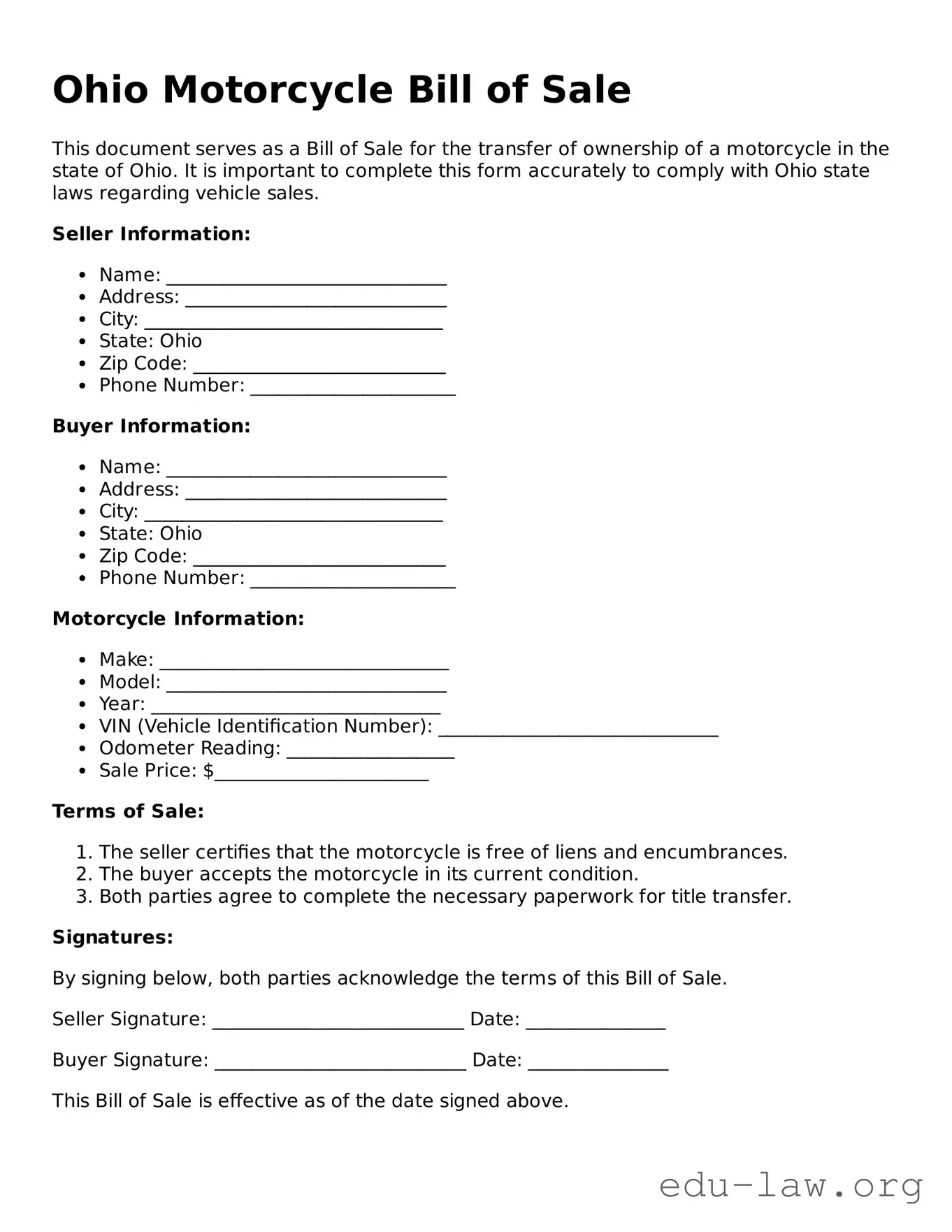
When purchasing or selling a motorcycle in Ohio, a Motorcycle Bill of Sale form is an essential document that protects both parties involved in the transaction. This form serves as a written record of the sale, capturing vital information such as the buyer’s and seller’s names and addresses, the motorcycle’s make, model, year, and Vehicle Identification Number (VIN). Additionally, it outlines the sale price and any terms agreed upon by both parties. By providing a clear account of the transaction, this form helps to prevent disputes and ensures that the transfer of ownership is legally recognized. Furthermore, it can be instrumental in the registration process with the Ohio Bureau of Motor Vehicles, making it a crucial step for anyone looking to buy or sell a motorcycle in the state.
Ohio Motorcycle Bill of Sale
This document serves as a Bill of Sale for the transfer of ownership of a motorcycle in the state of Ohio. It is important to complete this form accurately to comply with Ohio state laws regarding vehicle sales.
Seller Information:
Buyer Information:
Motorcycle Information:
Terms of Sale:
Signatures:
By signing below, both parties acknowledge the terms of this Bill of Sale.
Seller Signature: ___________________________ Date: _______________
Buyer Signature: ___________________________ Date: _______________
This Bill of Sale is effective as of the date signed above.
| Fact Name | Description |
|---|---|
| Purpose | The Ohio Motorcycle Bill of Sale serves as a legal document to record the sale and transfer of ownership of a motorcycle. |
| Governing Law | The sale of motorcycles in Ohio is governed by Ohio Revised Code § 4505.04. |
| Required Information | The form must include details such as the buyer's and seller's names, addresses, motorcycle identification number (VIN), and sale price. |
| Signatures | Both the buyer and seller must sign the Bill of Sale to validate the transaction. |
| Notarization | While notarization is not mandatory, it is recommended to enhance the document's credibility. |
| Record Keeping | It is advisable for both parties to keep a copy of the Bill of Sale for their records after the transaction. |
Filling out the Ohio Motorcycle Bill of Sale form is a straightforward process. Once completed, this form will serve as a record of the sale between the buyer and the seller. Make sure to have all necessary information ready before you start.
Once you have completed these steps, you can provide copies to both parties for their records. This ensures everyone has a reference for the transaction.
What is a Motorcycle Bill of Sale in Ohio?
A Motorcycle Bill of Sale is a legal document that serves as proof of the sale and transfer of ownership of a motorcycle from one party to another. It includes essential details such as the buyer's and seller's information, the motorcycle's make, model, year, Vehicle Identification Number (VIN), and the sale price. This document is important for both parties, as it protects their rights and provides a record of the transaction.
Is a Motorcycle Bill of Sale required in Ohio?
While it is not legally required to have a Bill of Sale for every motorcycle transaction in Ohio, it is highly recommended. This document can help prevent disputes over ownership and can be useful when registering the motorcycle with the Ohio Bureau of Motor Vehicles (BMV). Additionally, having a Bill of Sale can protect both the buyer and seller in case of future legal issues.
What information should be included in the Motorcycle Bill of Sale?
A comprehensive Motorcycle Bill of Sale should include the following information: the full names and addresses of both the buyer and seller, the motorcycle's make, model, year, color, and VIN, the sale price, the date of the transaction, and any terms or conditions of the sale. Both parties should sign and date the document to validate it.
Can I create my own Motorcycle Bill of Sale?
Yes, you can create your own Motorcycle Bill of Sale. Many templates are available online that you can customize to fit your needs. Ensure that you include all necessary information and that both parties sign the document. However, using a template that is specifically designed for Ohio can help ensure that you meet any state-specific requirements.
Do I need to have the Motorcycle Bill of Sale notarized?
In Ohio, notarization of the Motorcycle Bill of Sale is not required. However, having the document notarized can add an extra layer of authenticity and can be beneficial if any disputes arise in the future. It provides a witness to the transaction, which can be helpful in legal situations.
What should I do with the Motorcycle Bill of Sale after the sale?
After the sale, both the buyer and seller should keep a copy of the Motorcycle Bill of Sale for their records. The buyer will need this document when registering the motorcycle with the Ohio BMV. It’s also wise for the seller to retain a copy in case any issues arise later regarding the sale or ownership.
How does the Motorcycle Bill of Sale affect registration?
The Motorcycle Bill of Sale is an essential document when registering a motorcycle in Ohio. The buyer must present this document to the BMV to prove ownership and facilitate the transfer of the title. Without it, the registration process may be delayed or denied.
What if the motorcycle has a lien on it?
If there is a lien on the motorcycle, the seller must disclose this information to the buyer. The Bill of Sale should include a statement regarding the lien, and the seller should ensure that the lien is satisfied before completing the sale. Failing to do so can lead to legal complications for both parties.
Can I use a Motorcycle Bill of Sale for other types of vehicles?
While a Motorcycle Bill of Sale is specifically tailored for motorcycles, similar documents can be used for other types of vehicles, such as cars or trucks. However, it’s important to use the appropriate form that meets the requirements for the specific type of vehicle being sold to ensure compliance with state laws.
Not providing complete information about the motorcycle. This includes details such as the make, model, year, and Vehicle Identification Number (VIN). Incomplete information can lead to confusion or disputes later.
Failing to include the seller's and buyer's full names and addresses. Accurate identification of both parties is crucial for legal purposes.
Neglecting to specify the sale price. Omitting this detail can create issues regarding the transaction's legitimacy and tax obligations.
Not signing the form. Both the seller and buyer must provide their signatures to validate the transaction. Without signatures, the document lacks legal standing.
Using incorrect dates. The date of the transaction must be accurate, as it affects the transfer of ownership and any applicable taxes.
Leaving out any applicable disclosures. If the motorcycle has any known defects or issues, these should be disclosed to avoid future liability.
Not keeping a copy of the completed bill of sale. Both parties should retain a copy for their records. This serves as proof of the transaction.
Failing to check state-specific requirements. Ohio may have particular regulations regarding the bill of sale that must be followed.
Overlooking the need for a notary. While not always required, having the document notarized can provide additional legal protection and verification of the transaction.
When completing a motorcycle transaction in Ohio, several forms and documents may be necessary alongside the Ohio Motorcycle Bill of Sale. These documents help ensure a smooth transfer of ownership and compliance with state regulations.
Having these documents ready can facilitate a seamless transaction. Ensure that all forms are filled out accurately to avoid delays in the transfer process.
The Ohio Boat Bill of Sale form serves a similar purpose as the Motorcycle Bill of Sale. Both documents are used to transfer ownership of a vehicle from one party to another. Just like the motorcycle bill, the boat bill includes details about the seller, buyer, and the specific watercraft being sold. This ensures that both parties have a clear record of the transaction, protecting their interests in case of future disputes.
The Ohio Car Bill of Sale form is another document that shares similarities with the Motorcycle Bill of Sale. Both forms facilitate the transfer of ownership for motor vehicles. They require information such as the vehicle identification number (VIN), sale price, and the names of the buyer and seller. This helps to establish a legal record of the sale, which can be important for registration and title purposes.
The Ohio ATV Bill of Sale form is also akin to the Motorcycle Bill of Sale. It serves to document the sale of all-terrain vehicles. Like the motorcycle form, it captures essential details about the buyer, seller, and the ATV itself. This documentation helps ensure that ownership is properly transferred and can be referenced if any issues arise later.
The Ohio Snowmobile Bill of Sale form is another document that functions similarly to the Motorcycle Bill of Sale. Both forms are used for transferring ownership of recreational vehicles. They include key information about the vehicle and the parties involved in the transaction. This helps protect both the buyer and seller by providing proof of the sale.
The Ohio Mobile Home Bill of Sale form is similar in that it also facilitates the transfer of ownership. While it deals with mobile homes rather than vehicles, both documents require information about the seller, buyer, and the item being sold. This ensures that both parties have a clear understanding of the transaction and protects their interests.
Lastly, the Ohio Vessel Title Application is comparable to the Motorcycle Bill of Sale in that it is used for registering and titling watercraft. While it is not a bill of sale per se, it requires similar information about the buyer and seller. Both documents help establish ownership and provide a legal record of the transaction, which is crucial for future dealings.
When filling out the Ohio Motorcycle Bill of Sale form, it's essential to follow certain guidelines to ensure accuracy and compliance. Below are four important do's and don'ts to consider.
Misconception 1: A Motorcycle Bill of Sale is not necessary in Ohio.
Many people believe that a bill of sale is optional when selling or buying a motorcycle. However, in Ohio, a bill of sale serves as an important document that provides proof of the transaction. It can protect both the buyer and the seller by detailing the terms of the sale.
Misconception 2: The Motorcycle Bill of Sale must be notarized.
Some individuals think that notarization is a requirement for a Motorcycle Bill of Sale in Ohio. While having the document notarized can add an extra layer of authenticity, it is not a legal requirement. A simple signed agreement between the buyer and seller suffices.
Misconception 3: The bill of sale needs to include a lot of personal information.
There is a common belief that a Motorcycle Bill of Sale must contain extensive personal details about both parties. In reality, the essential information includes the names and addresses of the buyer and seller, the motorcycle's make, model, year, and VIN. Too much information can complicate the document unnecessarily.
Misconception 4: A Motorcycle Bill of Sale is only for private sales.
Some people assume that this document is only relevant for transactions between private individuals. However, a Motorcycle Bill of Sale can also be beneficial when purchasing from a dealer. It serves as a record of the transaction and can help clarify any terms agreed upon during the sale.
When dealing with the Ohio Motorcycle Bill of Sale form, it's essential to understand its purpose and how to fill it out correctly. This document serves as a record of the sale and transfer of ownership for a motorcycle. Here are some key takeaways to keep in mind:
Understanding these key points can help ensure a smooth transaction and protect both the seller and buyer in the process of transferring motorcycle ownership in Ohio.