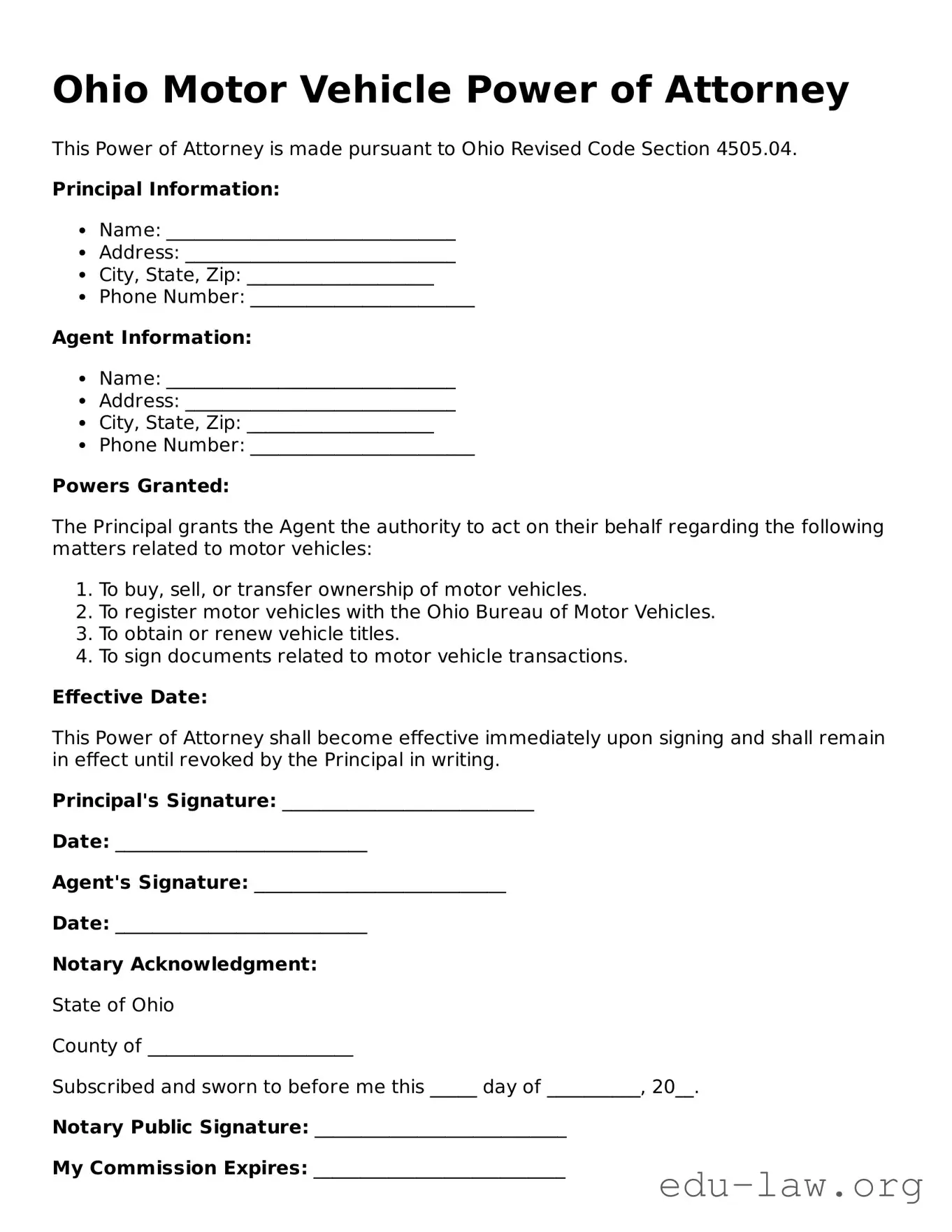
In Ohio, the Motor Vehicle Power of Attorney form serves as a vital tool for individuals who need to delegate authority over their vehicle-related matters to another person. This form allows a designated agent to handle tasks such as transferring vehicle titles, registering vehicles, and obtaining necessary documentation on behalf of the vehicle owner. It is particularly useful in situations where the owner cannot be present, whether due to distance, health issues, or time constraints. The form requires specific information, including the names and addresses of both the vehicle owner and the agent, as well as details about the vehicle itself. Properly completing and notarizing this document ensures that the agent has the legal backing to act in the owner’s best interest. Understanding the nuances of this form is essential for anyone looking to simplify their vehicle management or assist a loved one in need.
Ohio Motor Vehicle Power of Attorney
This Power of Attorney is made pursuant to Ohio Revised Code Section 4505.04.
Principal Information:
Agent Information:
Powers Granted:
The Principal grants the Agent the authority to act on their behalf regarding the following matters related to motor vehicles:
Effective Date:
This Power of Attorney shall become effective immediately upon signing and shall remain in effect until revoked by the Principal in writing.
Principal's Signature: ___________________________
Date: ___________________________
Agent's Signature: ___________________________
Date: ___________________________
Notary Acknowledgment:
State of Ohio
County of ______________________
Subscribed and sworn to before me this _____ day of __________, 20__.
Notary Public Signature: ___________________________
My Commission Expires: ___________________________
| Fact Name | Description |
|---|---|
| Purpose | The Ohio Motor Vehicle Power of Attorney form allows an individual to authorize another person to handle motor vehicle transactions on their behalf. |
| Governing Law | This form is governed by the Ohio Revised Code, specifically sections related to powers of attorney and motor vehicle transactions. |
| Signature Requirement | The form must be signed by the principal, the individual granting the power, in the presence of a notary public. |
| Revocation | The power of attorney can be revoked by the principal at any time, provided the revocation is documented in writing. |
| Duration | This power of attorney remains in effect until the specified tasks are completed or until it is revoked by the principal. |
| Usage | The form is typically used for tasks such as transferring title, registering a vehicle, or obtaining vehicle-related documents. |
Filling out the Ohio Motor Vehicle Power of Attorney form is a straightforward process. This document allows you to designate someone to act on your behalf regarding your vehicle. Follow these steps to complete the form accurately.
Once you have completed these steps, your form will be ready for submission or use as needed. Ensure that the appointed person understands their responsibilities and authority regarding your vehicle.
What is the Ohio Motor Vehicle Power of Attorney form?
The Ohio Motor Vehicle Power of Attorney form is a legal document that allows an individual to appoint another person to act on their behalf in matters related to motor vehicles. This can include tasks such as transferring ownership, registering a vehicle, or handling title issues. By using this form, the principal (the person granting authority) can ensure that their chosen agent has the necessary power to manage these specific affairs without needing to be present.
Who can be designated as an agent in the Ohio Motor Vehicle Power of Attorney?
Any adult can be designated as an agent in the Ohio Motor Vehicle Power of Attorney. This includes family members, friends, or professionals such as attorneys or car dealers. It is important that the person chosen is trustworthy and capable of handling the responsibilities outlined in the document. The agent must also be willing to accept the authority granted to them.
How is the Ohio Motor Vehicle Power of Attorney form executed?
To execute the Ohio Motor Vehicle Power of Attorney form, the principal must complete the document by filling in the required information, including their name, the name of the agent, and the specific powers granted. Once completed, the principal must sign the form in the presence of a notary public. The notary will then affix their seal, confirming that the signature is valid. This notarization is essential for the form to be legally binding.
Can the Ohio Motor Vehicle Power of Attorney be revoked?
Yes, the Ohio Motor Vehicle Power of Attorney can be revoked at any time by the principal. To do so, the principal should create a written notice of revocation, stating their intent to cancel the authority granted to the agent. It is advisable to inform the agent and any relevant parties, such as the Ohio Bureau of Motor Vehicles, about the revocation to avoid any confusion. Keeping a copy of the revocation notice for personal records is also a good practice.
Not Identifying the Principal Clearly: One common mistake is failing to provide clear identification of the person granting power of attorney, known as the principal. Ensure that the full name, address, and any other required identification details are accurate and complete.
Overlooking the Agent's Information: The agent, or the person receiving power of attorney, must also be clearly identified. Omitting this information or providing incorrect details can lead to confusion and potential disputes.
Inadequate Scope of Authority: It’s crucial to specify the exact powers being granted. Failing to outline the scope of authority can limit the agent's ability to act effectively on your behalf. Be precise about what actions the agent can take regarding your vehicle.
Not Signing or Dating the Form: A common oversight is neglecting to sign and date the form. Without a signature, the document is not legally binding. Always double-check that both the principal and the agent have signed and dated the form appropriately.
When dealing with motor vehicle transactions in Ohio, the Motor Vehicle Power of Attorney form is often accompanied by several other important documents. Each of these forms plays a crucial role in ensuring that the process runs smoothly and legally. Here’s a list of commonly used documents that you may encounter:
Having these documents ready can streamline the process of buying, selling, or transferring a vehicle in Ohio. Being organized and informed will help you navigate the legal landscape with confidence.
The Ohio Motor Vehicle Power of Attorney form bears similarities to the General Power of Attorney document. Both forms grant authority to an individual, known as the agent or attorney-in-fact, to act on behalf of another person, referred to as the principal. In the case of the General Power of Attorney, the agent can perform a wide range of actions, which may include financial decisions, property management, and legal matters. However, the Ohio Motor Vehicle Power of Attorney is more specialized, focusing specifically on matters related to motor vehicles, such as transferring titles and registering vehicles.
Another document that resembles the Ohio Motor Vehicle Power of Attorney is the Durable Power of Attorney. This form is similar in that it allows an agent to make decisions on behalf of the principal. The key distinction is that the Durable Power of Attorney remains effective even if the principal becomes incapacitated. This feature is crucial for individuals who wish to ensure their financial and medical decisions are managed by a trusted person when they can no longer do so themselves. In contrast, the Ohio Motor Vehicle Power of Attorney is typically used for specific vehicle-related transactions and does not necessarily address broader financial or health care decisions.
The Limited Power of Attorney is also akin to the Ohio Motor Vehicle Power of Attorney. Like the latter, the Limited Power of Attorney grants specific powers to the agent, but it can encompass various tasks beyond vehicle-related issues. For example, it might allow an individual to handle real estate transactions or manage bank accounts for a defined period or purpose. The Ohio Motor Vehicle Power of Attorney, however, is tailored to the unique needs of vehicle ownership and registration, thus providing a more focused authority.
The Healthcare Power of Attorney shares a conceptual similarity with the Ohio Motor Vehicle Power of Attorney in that both documents empower an agent to make decisions on behalf of the principal. However, the Healthcare Power of Attorney specifically pertains to medical decisions, allowing the agent to make choices about the principal's health care in the event they cannot communicate their wishes. While both documents involve delegation of authority, their scopes differ significantly, with one focusing on health care and the other on motor vehicle matters.
The Vehicle Title Transfer form is another document that is related to the Ohio Motor Vehicle Power of Attorney. While the Power of Attorney allows someone to act on behalf of the vehicle owner, the Vehicle Title Transfer form is the actual instrument used to change ownership of a vehicle. The Power of Attorney can facilitate this transfer by granting the agent the authority to sign the title on behalf of the owner. Thus, while the Vehicle Title Transfer is a transactional document, the Power of Attorney serves as a means to execute that transaction.
The Bill of Sale is similar in context to the Ohio Motor Vehicle Power of Attorney, as both are used in the process of transferring ownership of a vehicle. A Bill of Sale serves as a legal document that records the sale and transfer of ownership from one party to another. While the Ohio Motor Vehicle Power of Attorney allows an agent to execute the transfer, the Bill of Sale documents the transaction itself. Both are essential for ensuring that ownership is properly transferred and legally recognized.
Lastly, the Affidavit of Heirship can be likened to the Ohio Motor Vehicle Power of Attorney in terms of its role in the transfer of assets. When a vehicle owner passes away, an Affidavit of Heirship may be used to establish the rightful heirs to the vehicle. This document can help heirs navigate the transfer of ownership without going through probate. While the Ohio Motor Vehicle Power of Attorney is utilized during the owner’s lifetime, both documents ultimately facilitate the transfer of vehicle ownership, albeit in different contexts.
When filling out the Ohio Motor Vehicle Power of Attorney form, it is crucial to follow specific guidelines to ensure the process goes smoothly. Here are ten important dos and don'ts to keep in mind:
By following these guidelines, you can help ensure that your Power of Attorney form is completed correctly and serves its intended purpose.
Many people have misunderstandings about the Ohio Motor Vehicle Power of Attorney form. Here are seven common misconceptions:
Understanding these misconceptions can help individuals make informed decisions regarding their vehicle transactions and the use of the Power of Attorney form in Ohio.
Filling out and using the Ohio Motor Vehicle Power of Attorney form can be straightforward if you keep a few key points in mind. Here are some important takeaways: