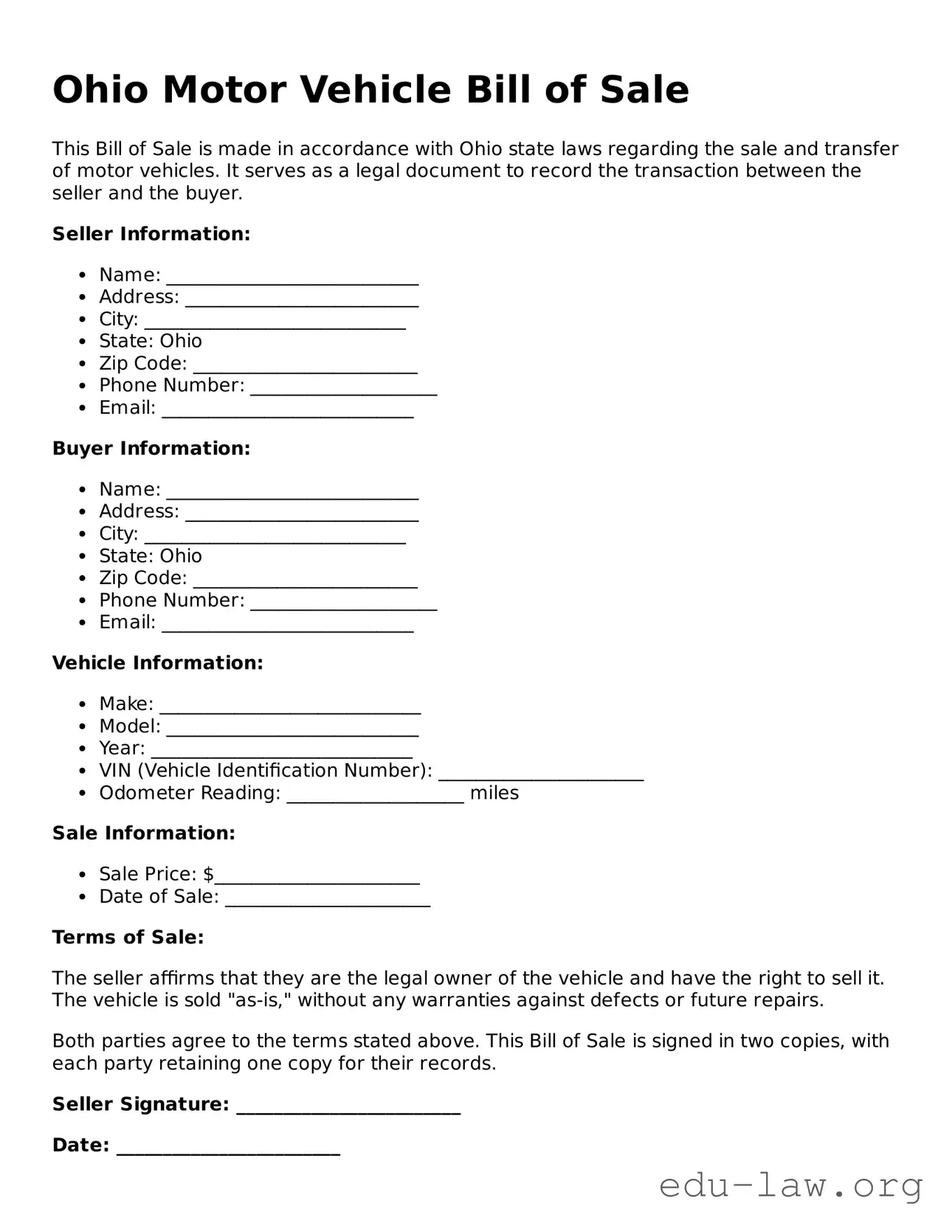
The Ohio Motor Vehicle Bill of Sale form serves as a crucial document in the process of buying or selling a vehicle within the state. This form provides essential information about the transaction, including details about the vehicle, such as its make, model, year, and Vehicle Identification Number (VIN). Additionally, it includes the names and addresses of both the seller and the buyer, ensuring that both parties are clearly identified. The form also outlines the sale price, which helps establish the financial terms of the agreement. Signatures from both parties are typically required to validate the transaction, making it legally binding. Furthermore, the Ohio Motor Vehicle Bill of Sale may also serve as a record for tax purposes and assists in the transfer of ownership, ensuring that the new owner can register the vehicle with the state. By documenting the sale, this form helps protect the interests of both the buyer and the seller, providing a clear record of the transaction for future reference.
Ohio Motor Vehicle Bill of Sale
This Bill of Sale is made in accordance with Ohio state laws regarding the sale and transfer of motor vehicles. It serves as a legal document to record the transaction between the seller and the buyer.
Seller Information:
Buyer Information:
Vehicle Information:
Sale Information:
Terms of Sale:
The seller affirms that they are the legal owner of the vehicle and have the right to sell it. The vehicle is sold "as-is," without any warranties against defects or future repairs.
Both parties agree to the terms stated above. This Bill of Sale is signed in two copies, with each party retaining one copy for their records.
Seller Signature: ________________________
Date: ________________________
Buyer Signature: ________________________
Date: ________________________
| Fact Name | Details |
|---|---|
| Purpose | The Ohio Motor Vehicle Bill of Sale form is used to document the sale of a vehicle between a buyer and a seller. |
| Governing Law | This form is governed by Ohio Revised Code Section 4505.04. |
| Required Information | The form requires details such as the vehicle's make, model, year, VIN, and sale price. |
| Seller's Information | The seller must provide their name, address, and signature to validate the sale. |
| Buyer's Information | The buyer's name and address must also be included for proper identification. |
| Date of Sale | The date of the transaction must be clearly stated on the form. |
| Notarization | While notarization is not mandatory, it is recommended for added legal protection. |
| Use for Title Transfer | This form is often used to facilitate the transfer of the vehicle title in Ohio. |
| Record Keeping | Both parties should keep a copy of the completed Bill of Sale for their records. |
| Availability | The form can be obtained online or from local Bureau of Motor Vehicles (BMV) offices. |
Filling out the Ohio Motor Vehicle Bill of Sale form is a straightforward process that helps facilitate the transfer of vehicle ownership. Once completed, this form will serve as a legal record of the transaction between the buyer and seller.
What is a Motor Vehicle Bill of Sale in Ohio?
A Motor Vehicle Bill of Sale is a legal document that records the transfer of ownership of a vehicle from one party to another. It serves as proof of the sale and includes essential details about the vehicle, the buyer, and the seller. This document is often required for vehicle registration and titling in Ohio.
Is a Bill of Sale required to sell a vehicle in Ohio?
While Ohio law does not mandate a Bill of Sale for every vehicle sale, it is highly recommended. Having a Bill of Sale provides protection for both the buyer and the seller by documenting the transaction and the agreed-upon terms.
What information should be included in the Ohio Bill of Sale?
The Bill of Sale should include the following information: the names and addresses of the buyer and seller, the vehicle identification number (VIN), make, model, year, odometer reading at the time of sale, purchase price, and the date of the transaction. Both parties should sign the document to validate the sale.
Can I create my own Bill of Sale for a vehicle in Ohio?
Yes, you can create your own Bill of Sale. However, it is important to ensure that it includes all necessary information and complies with Ohio laws. Alternatively, you can use a template or obtain a Bill of Sale form from the Ohio Bureau of Motor Vehicles (BMV) to ensure accuracy.
Do I need to have the Bill of Sale notarized?
Notarization is not required for a Bill of Sale in Ohio. However, having the document notarized can provide an extra layer of security and authenticity, especially in disputes or if the transaction is questioned later.
What if the vehicle has a lien on it?
If there is a lien on the vehicle, it is essential to disclose this information in the Bill of Sale. The seller should ensure that the lien is satisfied before transferring ownership. Buyers should verify the status of the lien to avoid complications in the future.
How does a Bill of Sale affect vehicle registration?
A Bill of Sale is often required when registering a vehicle in Ohio. It serves as proof of ownership and may be needed to obtain a new title. The buyer should present the Bill of Sale to the local BMV office along with other necessary documents for registration.
What should I do if I lose my Bill of Sale?
If you lose your Bill of Sale, it is advisable to recreate the document as soon as possible. Both the buyer and seller can sign a new Bill of Sale to replace the lost one. Keeping copies of important documents is recommended to avoid such issues.
Can I use a Bill of Sale for a trade-in vehicle?
Yes, a Bill of Sale can be used for a trade-in vehicle. It should outline the details of the trade, including the vehicle being traded in and the new vehicle being purchased. This documentation can help clarify the terms of the trade and assist with tax calculations.
Where can I obtain a Bill of Sale form in Ohio?
You can obtain a Bill of Sale form from the Ohio Bureau of Motor Vehicles (BMV) website or local BMV offices. Various online resources also provide templates that can be customized to meet your needs.
Not including all required information. It's important to fill out every section of the form to ensure it is complete.
Failing to sign the document. Both the buyer and seller must sign the bill of sale for it to be valid.
Using incorrect vehicle identification numbers (VIN). Double-check the VIN to avoid any errors.
Not providing accurate odometer readings. Make sure to record the correct mileage at the time of sale.
Leaving out the sale price. Clearly state the amount agreed upon to prevent misunderstandings.
Not dating the form. Including the date of the transaction is essential for record-keeping.
Using outdated forms. Always ensure you have the latest version of the Ohio Motor Vehicle Bill of Sale.
Not keeping a copy. Both parties should retain a copy of the completed bill of sale for their records.
Failing to check for additional requirements. Certain vehicles may have specific regulations that need to be followed.
When buying or selling a vehicle in Ohio, the Motor Vehicle Bill of Sale form is a crucial document. However, several other forms and documents are often needed to ensure a smooth transaction. Below is a list of these essential documents, each serving a unique purpose.
Having these documents in order can greatly simplify the vehicle transfer process in Ohio. Each form plays a vital role in ensuring that both parties are protected and that the transaction complies with state regulations.
The Ohio Motor Vehicle Bill of Sale form is similar to a general Bill of Sale, which is a document used to transfer ownership of personal property. Like the motor vehicle version, a general Bill of Sale includes details about the buyer and seller, a description of the item being sold, and the sale price. Both documents serve as proof of the transaction and help protect the rights of both parties involved. However, the general Bill of Sale can be used for various items, such as furniture or electronics, while the Ohio Motor Vehicle Bill of Sale is specifically tailored for vehicles.
Another document that shares similarities is the Vehicle Title. The Vehicle Title is an official government document that proves ownership of a vehicle. While the Motor Vehicle Bill of Sale provides evidence of the transaction, the title is crucial for registering the vehicle with the state. Both documents require accurate information about the vehicle, including its make, model, and VIN. In many cases, a Bill of Sale is needed to obtain a new title after purchasing a vehicle.
The Odometer Disclosure Statement is another related document. This form is required by federal law when selling a vehicle, ensuring that the seller discloses the accurate mileage on the odometer at the time of sale. Similar to the Motor Vehicle Bill of Sale, it protects both the buyer and seller by preventing odometer fraud. While the Bill of Sale focuses on the transaction details, the Odometer Disclosure Statement specifically addresses the vehicle's mileage.
A Purchase Agreement is also comparable to the Ohio Motor Vehicle Bill of Sale. This document outlines the terms and conditions of the sale, including payment details and any warranties. While the Bill of Sale serves as a receipt and proof of ownership transfer, the Purchase Agreement is more comprehensive and may include negotiation points. Both documents are important in ensuring clarity and mutual understanding between the buyer and seller.
The Release of Liability form is another important document in the vehicle transaction process. This form notifies the state that the seller is no longer responsible for the vehicle once it has been sold. It is similar to the Motor Vehicle Bill of Sale in that it protects the seller from future liabilities associated with the vehicle. Both documents require signatures from the seller and buyer, confirming the completion of the sale.
The Affidavit of Ownership can also be likened to the Ohio Motor Vehicle Bill of Sale. This document is often used when the seller cannot provide a title, allowing them to declare ownership of the vehicle. Like the Bill of Sale, the Affidavit of Ownership includes pertinent information about the vehicle and the parties involved. It serves as a legal statement affirming the seller's right to sell the vehicle.
The Application for Title is another document that parallels the Motor Vehicle Bill of Sale. This application is submitted to the state when a vehicle is purchased, and it is necessary for obtaining a new title. Both documents require similar information about the vehicle and the parties involved. The Bill of Sale acts as proof of the transaction, while the Application for Title is the formal request to register the vehicle in the buyer’s name.
The Certificate of Title is also related, as it serves as the official proof of ownership for a vehicle. When a vehicle is sold, the title must be signed over to the new owner, and the Motor Vehicle Bill of Sale is often used to document this transfer. Both documents are essential in the process of legally transferring ownership and ensuring that the buyer has the right to register the vehicle.
Finally, the VIN Verification form can be considered similar to the Ohio Motor Vehicle Bill of Sale. This document confirms the Vehicle Identification Number (VIN) of the vehicle being sold. It is often required when registering a vehicle in a new state. Like the Bill of Sale, the VIN Verification form helps ensure that the buyer is receiving the correct vehicle and protects against fraud.
When filling out the Ohio Motor Vehicle Bill of Sale form, attention to detail is crucial. This document serves as proof of the sale and transfer of ownership of a vehicle. Here are some important dos and don'ts to consider:
The Ohio Motor Vehicle Bill of Sale form is a critical document in the process of buying or selling a vehicle. However, several misconceptions can lead to confusion. Below is a list of common misconceptions regarding this form, along with clarifications.
Understanding these misconceptions can help individuals navigate the vehicle sale process more effectively. Proper documentation ensures that both buyers and sellers are protected throughout the transaction.
When dealing with the Ohio Motor Vehicle Bill of Sale form, understanding its key components is essential for a smooth transaction. Here are some important takeaways: