In Ohio, the Medical Power of Attorney form plays a crucial role in ensuring that your healthcare wishes are respected when you cannot speak for yourself. This legal document allows you to appoint someone you trust, known as your agent, to make medical decisions on your behalf. It covers a range of healthcare choices, from treatment options to end-of-life care, providing clarity during difficult times. By filling out this form, you empower your agent to act according to your preferences, which can ease the burden on family members who might otherwise struggle with making tough decisions. It's important to understand the requirements for creating a valid Medical Power of Attorney in Ohio, including the necessity for your signature and the need for witnesses or notarization. This document not only safeguards your rights but also ensures that your healthcare aligns with your values and desires.
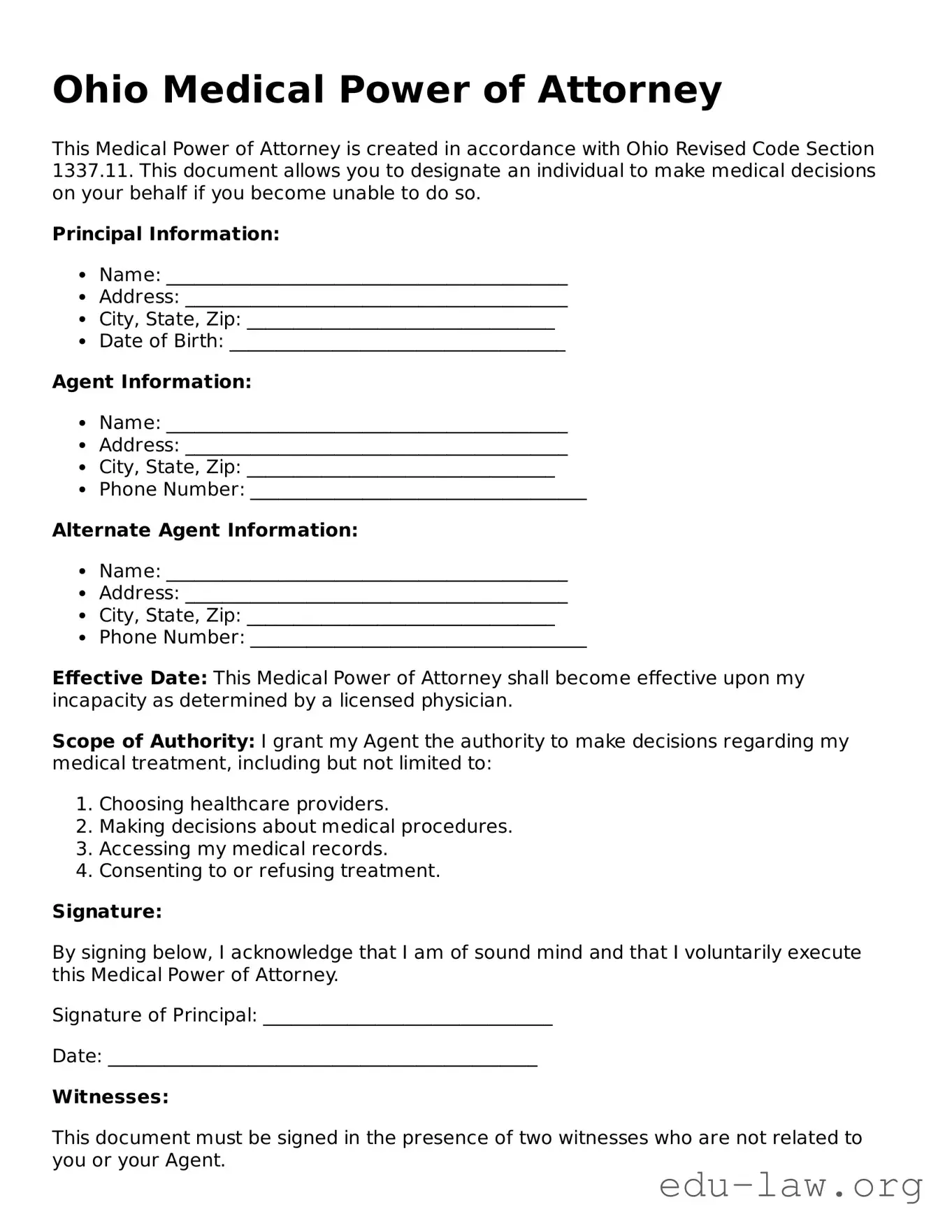
Ohio Medical Power of Attorney
This Medical Power of Attorney is created in accordance with Ohio Revised Code Section 1337.11. This document allows you to designate an individual to make medical decisions on your behalf if you become unable to do so.
Principal Information:
Agent Information:
Alternate Agent Information:
Effective Date: This Medical Power of Attorney shall become effective upon my incapacity as determined by a licensed physician.
Scope of Authority: I grant my Agent the authority to make decisions regarding my medical treatment, including but not limited to:
Signature:
By signing below, I acknowledge that I am of sound mind and that I voluntarily execute this Medical Power of Attorney.
Signature of Principal: _______________________________
Date: ______________________________________________
Witnesses:
This document must be signed in the presence of two witnesses who are not related to you or your Agent.
This Medical Power of Attorney is hereby executed on this _____ day of ____________, 20__.
| Fact Name | Description |
|---|---|
| Definition | The Ohio Medical Power of Attorney form allows an individual to designate someone to make healthcare decisions on their behalf if they become unable to do so. |
| Governing Law | This form is governed by Ohio Revised Code § 1337.11, which outlines the legal framework for advance directives. |
| Eligibility | Any competent adult in Ohio can create a Medical Power of Attorney. |
| Agent Selection | The individual creating the form, known as the principal, can choose any adult as their agent, except for healthcare providers involved in the principal's care. |
| Signature Requirement | The form must be signed by the principal and witnessed by at least two individuals or notarized. |
| Effective Date | The Medical Power of Attorney becomes effective immediately upon signing unless specified otherwise in the document. |
| Revocation | The principal can revoke the Medical Power of Attorney at any time, as long as they are competent to do so. |
| Limitations | Agents must act in the best interests of the principal and follow any specific instructions provided in the form. |
| Healthcare Decisions | The agent can make decisions regarding medical treatment, including life-sustaining measures, based on the principal's wishes. |
Filling out the Ohio Medical Power of Attorney form is a crucial step in ensuring that your healthcare decisions are respected when you cannot make them yourself. By designating a trusted individual to act on your behalf, you can have peace of mind knowing that your wishes will be honored. Below are the steps to complete this important document.
What is a Medical Power of Attorney in Ohio?
A Medical Power of Attorney (MPOA) in Ohio is a legal document that allows you to appoint someone you trust to make healthcare decisions on your behalf if you become unable to do so. This person, known as your agent or proxy, can make critical medical choices, such as what treatments to pursue or whether to continue life-sustaining measures. Having an MPOA ensures that your healthcare preferences are honored, even when you cannot communicate them directly.
How do I create a Medical Power of Attorney in Ohio?
Creating a Medical Power of Attorney in Ohio involves several straightforward steps. First, you need to select a trusted individual to act as your agent. It is essential to discuss your healthcare wishes with them beforehand. Next, you can obtain the official Ohio Medical Power of Attorney form, which is available online or through legal resources. After filling it out, you must sign the document in the presence of a notary public or two witnesses who are not related to you or beneficiaries of your estate. Once completed, provide copies to your agent and your healthcare providers to ensure they are aware of your wishes.
Can I revoke my Medical Power of Attorney in Ohio?
Yes, you can revoke your Medical Power of Attorney at any time as long as you are mentally competent. To do this, you should create a written document stating your intent to revoke the MPOA. It is advisable to notify your agent and any healthcare providers who may have a copy of the original MPOA. Additionally, destroying the original document can help prevent any confusion about your healthcare decisions in the future. Remember, your healthcare preferences can change, and it is important to keep your documents up to date.
What happens if I do not have a Medical Power of Attorney?
If you do not have a Medical Power of Attorney in place and become unable to make your own healthcare decisions, your family members may need to go through a court process to appoint a guardian. This can be a lengthy and emotionally challenging process, potentially leading to disagreements among family members about your care. By having an MPOA, you can avoid this uncertainty and ensure that your healthcare decisions are made by someone who understands your values and preferences.
Failing to choose a competent agent. It is crucial to select someone who understands your wishes and can make decisions on your behalf. This person should be reliable and trustworthy.
Not specifying the powers granted. Some people overlook the importance of detailing what decisions their agent can make. Be clear about medical treatments, end-of-life care, and other critical choices.
Ignoring state-specific requirements. Each state has its own rules regarding Medical Power of Attorney forms. Ensure you comply with Ohio’s specific regulations to avoid invalidation.
Neglecting to update the document. Life changes, and so do your preferences. Regularly review and, if necessary, revise your Medical Power of Attorney to reflect your current wishes.
When preparing a Medical Power of Attorney in Ohio, it's important to consider other related forms and documents that can enhance your healthcare planning. Each of these documents serves a unique purpose and can help ensure your medical wishes are respected.
Using these forms in conjunction with your Medical Power of Attorney can provide a comprehensive approach to your healthcare planning. It ensures that your preferences are clear and legally documented, giving you peace of mind and clarity for your loved ones.
The Ohio Living Will is similar to the Medical Power of Attorney because both documents address healthcare decisions. While the Medical Power of Attorney allows someone to make decisions on your behalf, the Living Will outlines your preferences for medical treatment in specific situations. Both documents ensure that your wishes are respected when you cannot communicate them yourself. They work together to provide a comprehensive approach to end-of-life care and medical treatment preferences.
The Durable Power of Attorney is another document that shares similarities with the Medical Power of Attorney. While the Medical Power of Attorney specifically focuses on healthcare decisions, the Durable Power of Attorney covers a broader range of financial and legal matters. Both documents allow you to appoint someone you trust to act on your behalf, ensuring that your interests are protected when you are unable to make decisions for yourself.
The Do Not Resuscitate (DNR) order is closely related to the Medical Power of Attorney. A DNR order specifically instructs medical personnel not to perform CPR if your heart stops or if you stop breathing. Like the Medical Power of Attorney, it reflects your wishes regarding medical treatment. Both documents serve to communicate your preferences to healthcare providers, ensuring that your choices are honored in critical situations.
The Advance Directive encompasses both the Living Will and the Medical Power of Attorney. This document allows individuals to specify their healthcare preferences and appoint a representative to make decisions on their behalf. By combining these elements, the Advance Directive provides a clear and comprehensive guide for medical professionals and loved ones. It ensures that your healthcare wishes are understood and followed, even when you cannot voice them yourself.
The Healthcare Proxy is another document that functions similarly to the Medical Power of Attorney. It designates a person to make medical decisions for you when you are unable to do so. While the terminology may vary, the purpose remains the same: to ensure that someone you trust can advocate for your healthcare choices. This relationship is crucial in situations where immediate decisions are necessary, and your preferences must be known and respected.
When filling out the Ohio Medical Power of Attorney form, it is crucial to follow specific guidelines to ensure that your document is valid and accurately reflects your wishes. Below is a list of things you should and shouldn't do during this process.
Things You Should Do:
Things You Shouldn't Do:
By following these guidelines, you can help ensure that your Medical Power of Attorney accurately reflects your healthcare wishes and is legally valid in Ohio.
Understanding the Ohio Medical Power of Attorney form is crucial for making informed healthcare decisions. However, several misconceptions surround this important document. Here are ten common misunderstandings:
By addressing these misconceptions, individuals can better navigate the complexities of healthcare decision-making and ensure their preferences are respected.
When filling out and using the Ohio Medical Power of Attorney form, there are several important points to keep in mind. Here are ten key takeaways:
By keeping these takeaways in mind, you can ensure that your Medical Power of Attorney form serves its intended purpose effectively.