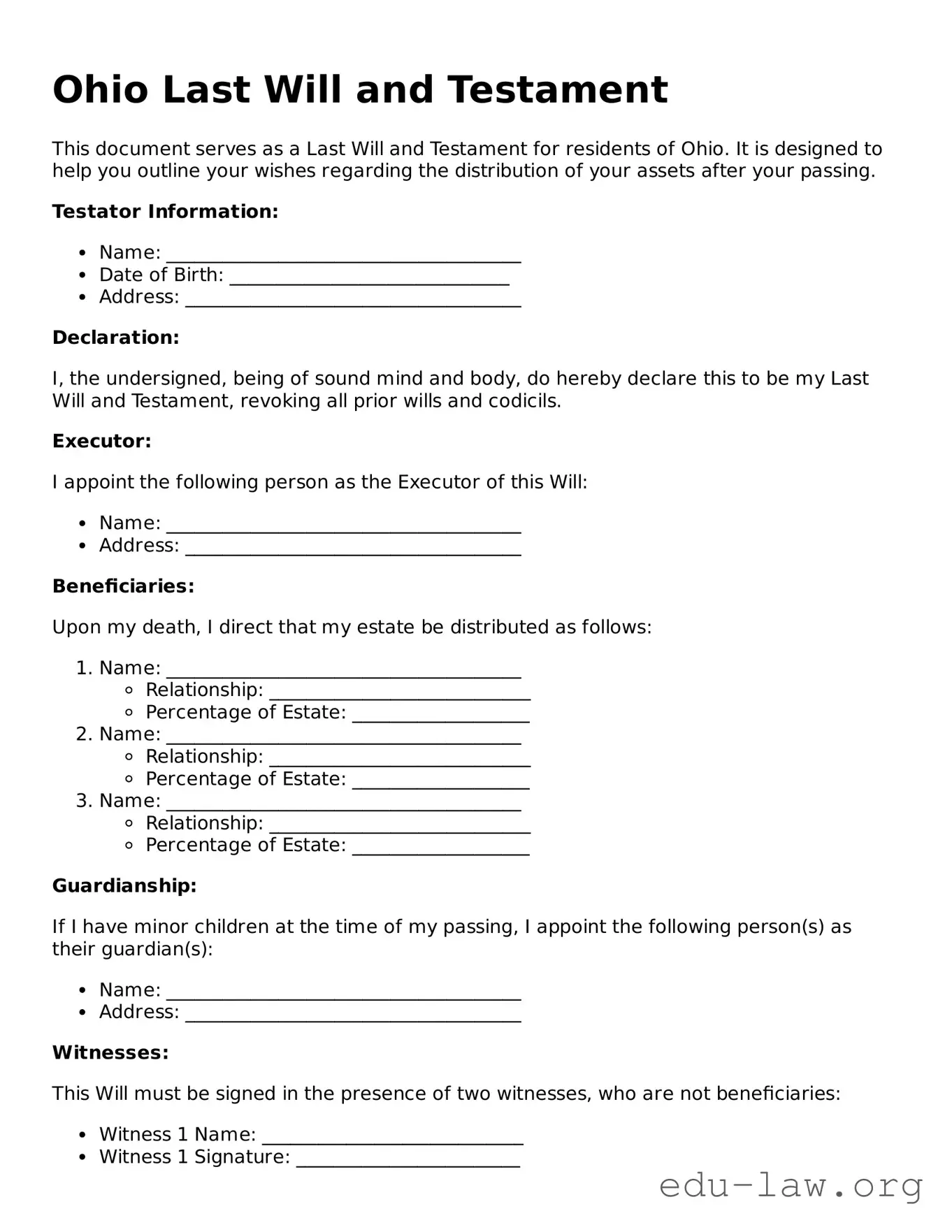
Creating a Last Will and Testament is an essential step in ensuring that your wishes are honored after your passing. In Ohio, the Last Will and Testament form serves as a legal document that outlines how your assets should be distributed, who will be responsible for carrying out your wishes, and any specific instructions you may have regarding guardianship of minor children. This form provides clarity and direction, helping to minimize disputes among family members during a challenging time. It typically includes essential elements such as the identification of the testator, the appointment of an executor, and detailed bequests to beneficiaries. Additionally, the form must be signed and witnessed according to Ohio law to ensure its validity. Understanding these components is crucial for anyone looking to create a will that accurately reflects their intentions and provides peace of mind for both themselves and their loved ones.
Ohio Last Will and Testament
This document serves as a Last Will and Testament for residents of Ohio. It is designed to help you outline your wishes regarding the distribution of your assets after your passing.
Testator Information:
Declaration:
I, the undersigned, being of sound mind and body, do hereby declare this to be my Last Will and Testament, revoking all prior wills and codicils.
Executor:
I appoint the following person as the Executor of this Will:
Beneficiaries:
Upon my death, I direct that my estate be distributed as follows:
Guardianship:
If I have minor children at the time of my passing, I appoint the following person(s) as their guardian(s):
Witnesses:
This Will must be signed in the presence of two witnesses, who are not beneficiaries:
Signatures:
In witness whereof, I have hereunto subscribed my name this _____ day of __________, 20__.
Signature of Testator: __________________________
| Fact Name | Details |
|---|---|
| Definition | A Last Will and Testament is a legal document that outlines how a person's assets and affairs should be handled after their death. |
| Governing Law | The Ohio Last Will and Testament is governed by Ohio Revised Code Section 2107. |
| Requirements | In Ohio, a valid will must be in writing, signed by the testator, and witnessed by at least two individuals. |
| Holographic Wills | Ohio recognizes holographic wills, which are handwritten and do not require witnesses, provided they are signed by the testator. |
| Revocation | A will can be revoked in Ohio by creating a new will, by destroying the original, or by a clear declaration of intent to revoke. |
| Probate Process | After death, the will must be submitted to probate court in Ohio to validate its authenticity and to oversee the distribution of the estate. |
After you have gathered your information and are ready to create your Last Will and Testament, you will need to fill out the form carefully. This document outlines your wishes regarding the distribution of your assets and the care of any dependents. Follow these steps to complete the form accurately.
Once you have completed the form, make sure to store it in a safe place. Consider sharing the location with your executor or trusted family members. This ensures that your wishes will be carried out as you intended.
What is a Last Will and Testament in Ohio?
A Last Will and Testament is a legal document that outlines how a person's assets and property should be distributed after their death. In Ohio, this document allows individuals to specify their wishes regarding the distribution of their estate, appoint guardians for minor children, and name an executor to manage the estate. It is essential for ensuring that your wishes are honored and can help prevent disputes among family members.
Who can create a Last Will and Testament in Ohio?
In Ohio, any person who is at least 18 years old and of sound mind can create a Last Will and Testament. This means you should understand the nature of your actions and the consequences of making a will. If you meet these criteria, you have the legal capacity to draft and execute a will.
Do I need a lawyer to create a Last Will and Testament in Ohio?
While it is not required to have a lawyer to create a Last Will and Testament in Ohio, consulting with one can be beneficial. A lawyer can help ensure that your will complies with state laws, is properly executed, and accurately reflects your wishes. If your estate is complex or if you have specific concerns, seeking legal advice is a wise choice.
What are the requirements for a valid Last Will and Testament in Ohio?
For a Last Will and Testament to be valid in Ohio, it must be in writing and signed by the person making the will (the testator). Additionally, it should be witnessed by at least two individuals who are not beneficiaries of the will. These witnesses must also sign the document in the presence of the testator. Following these requirements helps ensure the will is legally enforceable.
Can I change my Last Will and Testament after it is created?
Yes, you can change your Last Will and Testament at any time while you are alive and of sound mind. This is typically done by creating a new will or adding a codicil, which is an amendment to the existing will. It is important to follow the same legal requirements for signing and witnessing as you did with the original will to ensure the changes are valid.
Not clearly identifying themselves. It’s crucial to include your full name and address. This helps avoid confusion about your identity.
Failing to specify beneficiaries. Clearly name the individuals or organizations who will inherit your assets. Leaving this vague can lead to disputes.
Not updating the will after major life changes. Events like marriage, divorce, or the birth of a child should prompt a review and potential update of your will.
Overlooking the need for witnesses. In Ohio, you must have at least two witnesses sign your will. Without their signatures, the will may not be valid.
Using outdated forms. Ensure you are using the most current version of the Ohio Last Will and Testament form. Laws can change, and outdated forms may not comply.
Neglecting to sign the will properly. Your signature must be at the end of the document. Failing to do so can lead to challenges in enforcing the will.
Not including a residuary clause. This clause addresses any assets not specifically mentioned in the will. Omitting it can create confusion about what happens to those assets.
Ignoring tax implications. Be aware of potential estate taxes and how your will might affect your beneficiaries’ tax liabilities.
Failing to communicate your wishes. Discuss your will with your beneficiaries. Transparency can help prevent misunderstandings and disputes later on.
Not storing the will in a safe place. Keep your will in a secure location and inform someone you trust where it can be found. This ensures it is accessible when needed.
When preparing a Last Will and Testament in Ohio, several other documents can complement it. These forms help ensure that your wishes are carried out and that your estate is managed according to your preferences. Here are five important documents often used alongside a will:
Having these documents in place can provide peace of mind. They work together to ensure your wishes are honored and that your loved ones are taken care of according to your preferences.
The Living Will is a document that outlines an individual's preferences regarding medical treatment in the event they become unable to communicate their wishes. Like a Last Will and Testament, it reflects personal choices and can be revised as circumstances change. Both documents require careful consideration and should be executed according to state laws to ensure they are valid and enforceable.
A Durable Power of Attorney allows a person to appoint someone to make financial or legal decisions on their behalf if they become incapacitated. Similar to a Last Will, this document ensures that an individual's preferences are honored. It can be revoked or modified, just like a will, and must be signed and witnessed according to state requirements.
The Health Care Power of Attorney designates an individual to make medical decisions for someone who is unable to do so. This document is akin to a Last Will in that it allows individuals to express their wishes regarding health care. Both documents require clear communication of intent and must comply with state laws to be effective.
A Trust is a legal arrangement that allows a person to transfer assets to a trustee for the benefit of beneficiaries. Like a Last Will, a Trust can help manage the distribution of assets after death. However, a Trust can also provide benefits during a person's lifetime, allowing for more flexible management of assets compared to a Last Will.
The Codicil is a legal document that modifies an existing Last Will and Testament. It allows individuals to make changes without creating an entirely new will. Both documents must be executed with the same formalities, ensuring that any changes are legally binding and reflect the individual’s current intentions.
A Declaration of Guardian for Minor Children is a document that specifies who will take care of minor children if both parents pass away. This is similar to a Last Will in that it addresses the distribution of personal responsibilities and wishes. It can be included in a will or created separately, but must be clear and legally valid to ensure the children's best interests are prioritized.
The Advance Directive combines a Living Will and Health Care Power of Attorney. It provides comprehensive instructions for medical care and appoints someone to make decisions on behalf of the individual. Like a Last Will, it ensures that personal preferences are respected and must be executed according to state laws.
The Affidavit of Heirship is a document used to establish the heirs of a deceased person when there is no will. While a Last Will clearly outlines the distribution of assets, an Affidavit of Heirship serves a similar purpose by identifying heirs. This document can help facilitate the transfer of property when a will is not available.
A Bill of Sale is a document that transfers ownership of personal property from one party to another. Although it serves a different purpose than a Last Will, both documents involve the transfer of assets. A Bill of Sale is typically used for tangible items, while a Last Will governs the distribution of all types of property after death.
The Prenuptial Agreement is a contract created before marriage that outlines the division of assets in the event of divorce or death. Similar to a Last Will, it addresses asset distribution and personal wishes. Both documents require careful drafting and must adhere to legal standards to be enforceable.
Creating a Last Will and Testament is an important step in ensuring that your wishes are honored after your passing. When filling out the Ohio Last Will and Testament form, there are specific actions you should take and some you should avoid. Here’s a helpful list:
Following these guidelines can help ensure that your Last Will and Testament is clear, valid, and reflective of your wishes. It’s always a good idea to consult with a legal professional if you have any questions or concerns.
Understanding the Ohio Last Will and Testament form is essential for anyone looking to plan their estate. However, several misconceptions can lead to confusion and potentially costly mistakes. Here are seven common misconceptions:
Many people believe that a will is only necessary for those with significant assets. In reality, everyone can benefit from having a will, regardless of their financial situation. A will helps ensure that your wishes are honored and can simplify the process for your loved ones.
This is not true. Ohio recognizes handwritten wills, also known as holographic wills, as valid if they meet certain criteria. However, it is advisable to follow the formal requirements of a typed will to avoid disputes.
This misconception can lead to significant issues. In Ohio, individuals have the right to modify or revoke their will at any time, as long as they are mentally competent. Regularly reviewing and updating your will is a best practice.
Not necessarily. Some assets, such as those held in joint tenancy or those with designated beneficiaries (like life insurance policies), may bypass the will and go directly to the named individuals. Understanding how your assets are titled is crucial.
While it is true that a spouse has rights to a portion of the estate, the distribution may not align with your wishes if you die intestate (without a will). Ohio has specific laws governing intestate succession that may not reflect your intentions.
A will can also include provisions for guardianship of minor children, ensuring that your wishes regarding their care are followed. This aspect is often overlooked but is critical for parents.
This is a common myth. Even a properly executed will can be contested under certain circumstances, such as claims of undue influence or lack of mental capacity at the time of signing. Understanding the grounds for contesting a will can help in planning effectively.
By dispelling these misconceptions, individuals can make informed decisions regarding their estate planning and ensure that their wishes are honored after their passing.
When filling out and using the Ohio Last Will and Testament form, there are several important points to keep in mind. Understanding these can help ensure that your wishes are clearly communicated and legally recognized.
Following these guidelines can help you create a valid and effective Last Will and Testament in Ohio. Taking the time to ensure everything is properly completed can provide peace of mind for you and your loved ones.