For families in Ohio who choose to educate their children at home, the Homeschool Letter of Intent is a crucial first step in the homeschooling journey. This simple yet essential form serves as a formal notification to the local school district that parents intend to homeschool their children for the upcoming academic year. By submitting this letter, parents affirm their commitment to providing a comprehensive education tailored to their child’s unique needs and learning style. The form typically requires basic information, such as the names and ages of the children being homeschooled, as well as the educational curriculum that will be used. Understanding how to properly complete and submit this letter can help ensure a smooth transition into homeschooling, allowing families to focus on creating a nurturing and effective learning environment at home. Moreover, keeping track of deadlines and requirements outlined by the Ohio Department of Education is essential for compliance and peace of mind. With the right preparation, families can embark on this rewarding educational path with confidence.
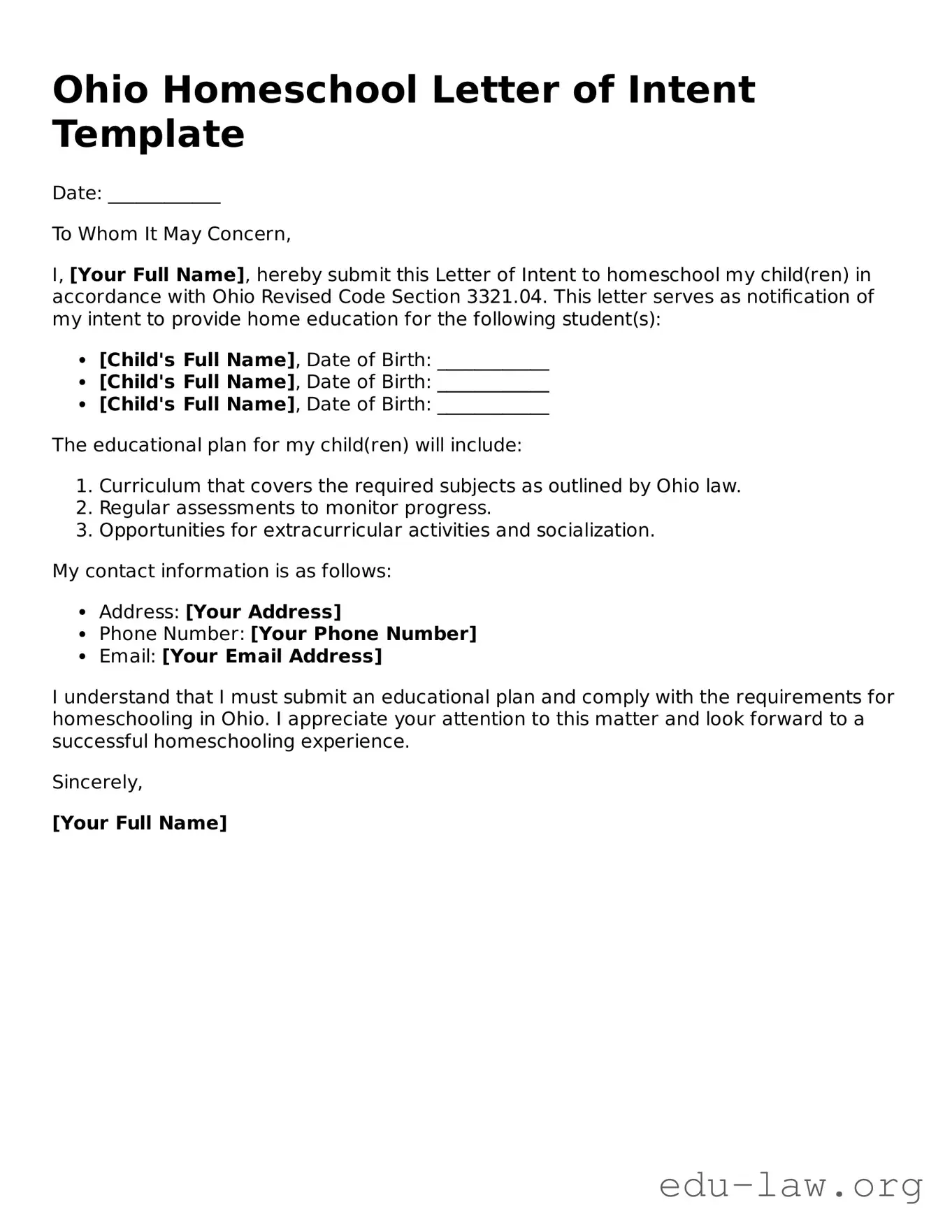
Ohio Homeschool Letter of Intent Template
Date: ____________
To Whom It May Concern,
I, [Your Full Name], hereby submit this Letter of Intent to homeschool my child(ren) in accordance with Ohio Revised Code Section 3321.04. This letter serves as notification of my intent to provide home education for the following student(s):
The educational plan for my child(ren) will include:
My contact information is as follows:
I understand that I must submit an educational plan and comply with the requirements for homeschooling in Ohio. I appreciate your attention to this matter and look forward to a successful homeschooling experience.
Sincerely,
[Your Full Name]
| Fact Name | Details |
|---|---|
| Purpose | The Ohio Homeschool Letter of Intent form is used to notify the local school district of a parent's intention to homeschool their child. |
| Governing Law | The form is governed by Ohio Revised Code Section 3321.04, which outlines the requirements for homeschooling in Ohio. |
| Submission Timeline | Parents must submit the Letter of Intent within one year of starting the homeschooling process or by the first day of the school year. |
| Required Information | The form requires basic information such as the child's name, age, and the educational plan being implemented. |
After completing the Ohio Homeschool Letter of Intent form, you will submit it to your local school district. This step is crucial to ensure that you comply with Ohio's homeschooling regulations. The district will review your submission and provide any necessary feedback or additional steps.
What is the Ohio Homeschool Letter of Intent form?
The Ohio Homeschool Letter of Intent form is a document that parents or guardians must submit to the local school district to officially notify them of their intention to homeschool their child. This form is a crucial first step in the homeschooling process, as it establishes the parent's commitment to providing an educational program that meets state requirements. By submitting this letter, parents take on the responsibility for their child's education and outline their plan for learning outside of the traditional school setting.
Who needs to submit the Letter of Intent?
Any parent or guardian who wishes to homeschool their child in Ohio must submit the Letter of Intent. This includes families with children who are just beginning their educational journey, as well as those who are transitioning from public or private schools to homeschooling. It's important to remember that the letter must be submitted for each child being homeschooled, ensuring that the local school district is aware of your educational plans for each individual student.
When should the Letter of Intent be submitted?
The Letter of Intent should be submitted at least 14 days before you begin homeschooling your child. This timeline allows the local school district to process the letter and ensures that you are in compliance with Ohio's homeschooling laws. If you are withdrawing a child from a public or private school, it’s advisable to submit the letter as soon as possible to avoid any gaps in your child's education.
What information is required on the Letter of Intent?
Incomplete Information: One of the most common mistakes is not providing all the required information. Ensure that every section of the form is filled out completely.
Incorrect Dates: Double-check the dates you enter. Providing incorrect start or end dates can lead to confusion and potential issues with your homeschooling status.
Missing Signatures: Failing to sign the form is a frequent oversight. Remember, your signature is essential for validating your intent to homeschool.
Not Keeping Copies: Many forget to keep a copy of the submitted form. Always retain a copy for your records in case you need to reference it later.
Submitting Late: Timeliness is crucial. Submit the letter of intent by the required deadline to avoid complications with your homeschooling plans.
Ignoring Local Requirements: Each district may have specific requirements. Failing to check local guidelines can lead to misunderstandings or delays.
When parents decide to homeschool their children in Ohio, they must submit the Homeschool Letter of Intent. This form serves as a formal notification to the local school district. However, several other forms and documents are often used in conjunction with the Letter of Intent to ensure compliance with state regulations and to facilitate the homeschooling process.
These documents collectively support the homeschooling process and help ensure that families adhere to Ohio's educational requirements. Proper documentation can facilitate a smoother experience for both parents and students as they navigate the homeschooling journey.
The Ohio Homeschool Letter of Intent form bears similarities to the Notice of Intent to Homeschool used in various states. This document serves as a formal declaration to the local education authority that a parent or guardian intends to educate their child at home. Like the Ohio form, it typically requires basic information such as the child’s name, age, and the educational plan the parent intends to follow. Both documents aim to establish a clear line of communication between the homeschooling family and the school district, ensuring compliance with state regulations.
Another document that aligns closely with the Ohio Homeschool Letter of Intent is the Educational Plan or Curriculum Outline. This outline details the subjects and materials that will be used throughout the school year. Much like the intent form, it serves to inform the local education authority about the educational approach being taken. Both documents emphasize the importance of a structured educational framework, helping to assure that the child’s learning needs are being met.
The Individualized Education Plan (IEP) is also comparable to the Ohio Homeschool Letter of Intent, particularly for families who are homeschooling a child with special needs. An IEP outlines specific educational goals and services tailored to the child’s unique requirements. While the intent form announces the decision to homeschool, the IEP provides a roadmap for achieving educational success, ensuring that all necessary accommodations are in place. Both documents prioritize the child’s educational welfare and promote accountability in learning.
The Withdrawal Form from Public School is another document that resonates with the Ohio Homeschool Letter of Intent. This form is submitted to officially remove a child from the public school system. It serves a similar purpose by notifying the school that the parent has chosen an alternative educational path. Both documents mark a significant transition in a child’s education, establishing the parent’s commitment to homeschooling as the chosen method of instruction.
The Affidavit of Homeschooling is yet another document that shares similarities with the Ohio Homeschool Letter of Intent. This affidavit is often required in various states to affirm that the parent will provide an education that meets state standards. Like the intent form, it serves as a formal declaration and often includes information about the curriculum and educational philosophy. Both documents reinforce the legal standing of the homeschooling arrangement and underscore the parent’s responsibility in the educational process.
The Annual Assessment Report is also akin to the Ohio Homeschool Letter of Intent. This document provides a summary of a child's educational progress at the end of the school year. While the intent form initiates the homeschooling process, the assessment report serves as a checkpoint, ensuring that the educational goals set forth are being met. Both documents work in tandem to uphold educational standards and demonstrate accountability to the local education authority.
Lastly, the Enrollment Form for Private Schools can be compared to the Ohio Homeschool Letter of Intent. This form is utilized when parents choose to enroll their child in a private institution, outlining the child’s information and the educational plan. Both documents signify a choice in educational pathways and require parents to provide relevant details about their child’s education. They reflect the parents’ active role in selecting the best educational environment for their children, whether at home or in a private setting.
When filling out the Ohio Homeschool Letter of Intent form, it's important to follow certain guidelines to ensure your application is completed correctly. Here are five things you should and shouldn't do:
By adhering to these guidelines, you can help ensure a smooth process in your homeschooling journey.
Misconception 1: The Letter of Intent is only for new homeschoolers.
This form is required for any family that chooses to homeschool, regardless of whether they are starting fresh or continuing their homeschooling journey. Returning families must submit a new Letter of Intent each school year.
Misconception 2: Submitting the Letter of Intent guarantees approval from the school district.
While submitting the form is a necessary step, it does not guarantee that the school district will approve the homeschooling plan. However, most districts accept the letter as long as it meets the state requirements.
Misconception 3: The Letter of Intent requires detailed lesson plans.
The form itself does not ask for lesson plans or specific curriculum details. It simply informs the school district of your intent to homeschool and provides basic information about your educational approach.
Misconception 4: You can only homeschool if you have a teaching degree.
Ohio law does not require parents to have a teaching degree to homeschool their children. Parents can effectively teach their children using various resources and methods, regardless of their formal education background.
Misconception 5: Once the Letter of Intent is submitted, there are no further requirements.
After submitting the Letter of Intent, parents must still comply with Ohio’s homeschooling laws. This includes keeping educational records and submitting an annual assessment of their child's progress.
Filling out the Ohio Homeschool Letter of Intent form is an important step for families choosing to educate their children at home. Here are some key takeaways to keep in mind:
By following these guidelines, you can navigate the process smoothly and focus on providing a quality education at home.