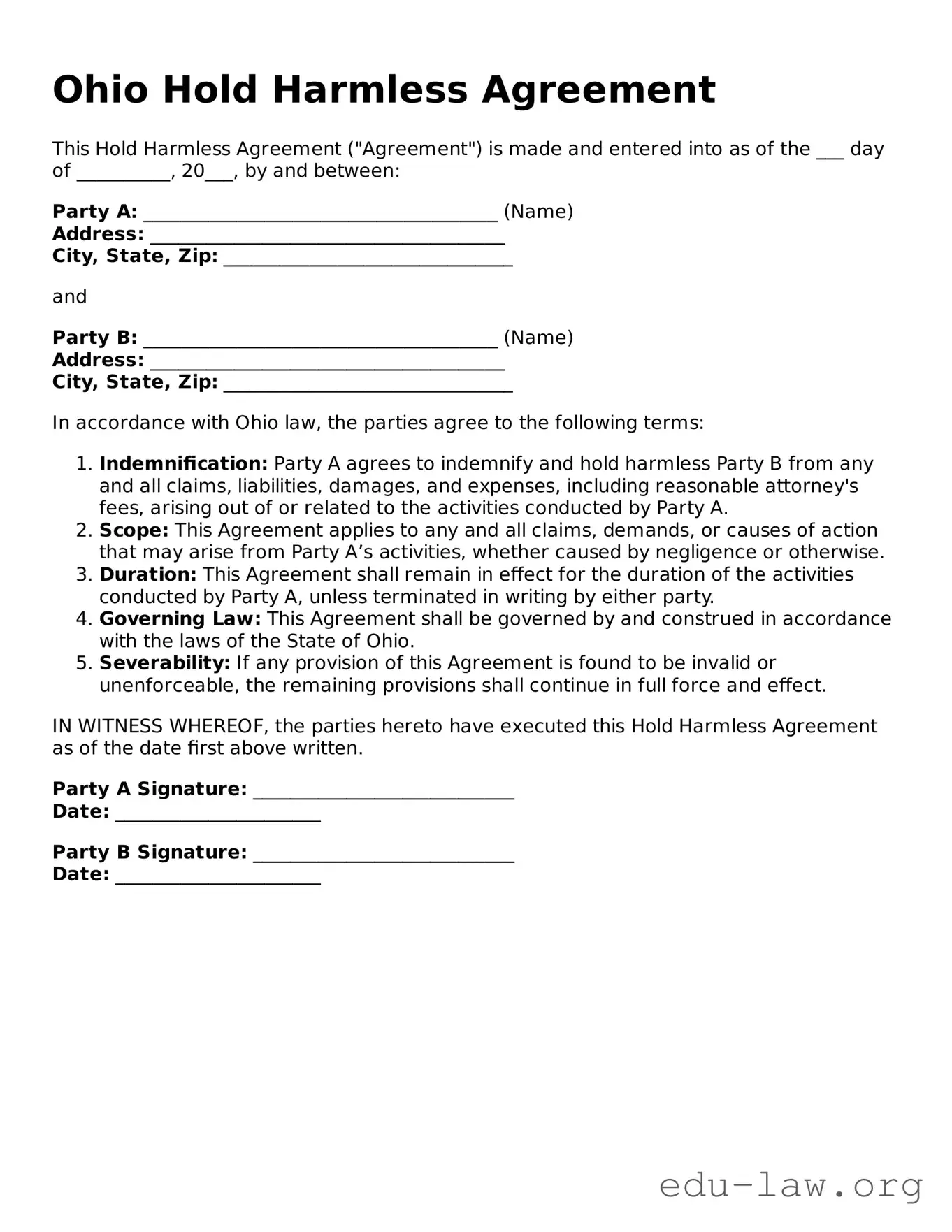
The Ohio Hold Harmless Agreement form serves as a crucial legal document designed to protect one party from liability for certain actions or events. This agreement is often utilized in various contexts, such as construction projects, rental agreements, and event planning, where one party may be exposed to risks associated with the activities of another. By signing this form, the parties involved acknowledge the potential for injury or damage and agree that one party will not hold the other responsible. Key components of the agreement typically include clear definitions of the parties involved, a detailed description of the activities covered, and the specific liabilities being waived. Additionally, the form may outline any insurance requirements and stipulate the governing law applicable to the agreement. Understanding the implications of this document is essential for both parties to ensure adequate protection and minimize legal risks.
Ohio Hold Harmless Agreement
This Hold Harmless Agreement ("Agreement") is made and entered into as of the ___ day of __________, 20___, by and between:
Party A: ______________________________________ (Name)
Address: ______________________________________
City, State, Zip: _______________________________
and
Party B: ______________________________________ (Name)
Address: ______________________________________
City, State, Zip: _______________________________
In accordance with Ohio law, the parties agree to the following terms:
IN WITNESS WHEREOF, the parties hereto have executed this Hold Harmless Agreement as of the date first above written.
Party A Signature: ____________________________
Date: ______________________
Party B Signature: ____________________________
Date: ______________________
| Fact Name | Details |
|---|---|
| Definition | The Ohio Hold Harmless Agreement is a legal document that protects one party from liability for any injuries or damages incurred by another party. |
| Purpose | This agreement is used to ensure that one party will not hold the other responsible for certain risks or liabilities. |
| Common Use | It is frequently utilized in contracts involving services, events, or property usage where risks are present. |
| Governing Law | The agreement is governed by the laws of the State of Ohio. |
| Key Components | Typically includes the names of the parties, a description of the activity, and the specific liabilities being waived. |
| Enforceability | For the agreement to be enforceable, it must be clear, specific, and voluntarily signed by both parties. |
Filling out the Ohio Hold Harmless Agreement form is straightforward. Once completed, you'll be ready to proceed with your intended activity while ensuring that all parties understand their responsibilities. It's important to take your time and provide accurate information to avoid any misunderstandings.
What is a Hold Harmless Agreement?
A Hold Harmless Agreement is a legal document that protects one party from liability for any damages or injuries that may occur during a specific activity or event. It is often used in situations where one party agrees to assume the risk of potential claims against another party.
Why would someone use a Hold Harmless Agreement in Ohio?
In Ohio, individuals and organizations use Hold Harmless Agreements to minimize their liability exposure. This is particularly common in activities involving physical risks, such as sports events, construction projects, or rental agreements. By signing this agreement, parties acknowledge the risks involved and agree not to hold each other responsible for certain liabilities.
Who typically signs a Hold Harmless Agreement?
Typically, the parties involved in an activity or event sign the agreement. This may include event organizers, participants, property owners, or contractors. Each party’s role and responsibilities should be clearly outlined in the document to ensure mutual understanding.
Are Hold Harmless Agreements enforceable in Ohio?
Yes, Hold Harmless Agreements are generally enforceable in Ohio, provided they are clearly written and both parties voluntarily agree to the terms. However, courts may not enforce provisions that are deemed overly broad or that attempt to waive liability for gross negligence or intentional misconduct.
What should be included in a Hold Harmless Agreement?
A comprehensive Hold Harmless Agreement should include the names of the parties involved, a clear description of the activity or event, specific liabilities covered, and the duration of the agreement. Additionally, it should specify whether the agreement is mutual or unilateral and include a signature line for all parties.
Can a Hold Harmless Agreement protect against all types of liability?
No, a Hold Harmless Agreement cannot protect against all types of liability. While it can cover many risks associated with an activity, it typically does not shield parties from liability arising from gross negligence, willful misconduct, or violations of law. It is essential to understand these limitations when drafting or signing the agreement.
How do I create a Hold Harmless Agreement?
To create a Hold Harmless Agreement, start by clearly identifying the parties involved and the specific activity or event. Outline the liabilities being assumed and any limitations. It may be beneficial to consult with a legal professional to ensure the agreement complies with Ohio law and effectively protects your interests.
Can a Hold Harmless Agreement be revoked?
Yes, a Hold Harmless Agreement can be revoked, but this typically requires mutual consent from all parties involved. Revocation should be documented in writing to avoid future disputes. It is advisable to consult a legal professional to ensure that the revocation process is handled correctly.
Incomplete Information: Failing to provide all required personal and contact information can lead to delays or rejection of the agreement.
Incorrect Dates: Entering the wrong date or failing to sign and date the document can invalidate the agreement.
Not Understanding the Terms: Signing without fully understanding the terms and conditions can result in unintended legal obligations.
Omitting Witness Signatures: Not including the necessary witness signatures, if required, may compromise the validity of the agreement.
Using Inconsistent Names: Discrepancies in the names used throughout the form can create confusion and legal issues.
Failing to Review: Not reviewing the completed form for errors or omissions can lead to significant problems down the line.
Ignoring Local Laws: Not considering local regulations or requirements related to the Hold Harmless Agreement may result in an unenforceable document.
When preparing a Hold Harmless Agreement in Ohio, it is often beneficial to consider additional forms and documents that may complement the agreement. These documents can help clarify responsibilities, outline terms, and ensure that all parties are adequately protected. Below is a list of commonly used forms that may accompany a Hold Harmless Agreement.
Each of these documents serves a specific purpose and can enhance the effectiveness of a Hold Harmless Agreement. By understanding and utilizing these forms, all parties can ensure that their rights and responsibilities are clearly defined, fostering a safer and more secure environment for all involved.
The Ohio Hold Harmless Agreement is similar to a Waiver of Liability form, which is often used in recreational and sports activities. Both documents aim to protect one party from legal claims arising from injuries or damages incurred by another party. By signing a Waiver of Liability, participants acknowledge the risks involved and agree not to hold the organization responsible for any accidents. This mutual understanding fosters a safer environment for both parties, as it clarifies expectations and responsibilities.
Another document akin to the Hold Harmless Agreement is the Indemnity Agreement. This legal instrument serves to transfer the financial burden of a claim from one party to another. In many cases, an indemnitor agrees to compensate the indemnitee for losses or damages resulting from a specific event. Both agreements focus on risk management, but the Indemnity Agreement explicitly addresses financial responsibilities, while the Hold Harmless Agreement emphasizes the prevention of legal claims.
The Release of Claims form shares similarities with the Hold Harmless Agreement in that it also seeks to prevent legal action. When individuals sign a Release of Claims, they forfeit their right to pursue legal action against another party for specified incidents. This document, like the Hold Harmless Agreement, requires clear communication about the risks involved and the implications of waiving legal rights, thereby ensuring that all parties understand their obligations.
In the realm of construction and real estate, the Construction Contract often includes clauses that resemble the Hold Harmless Agreement. These clauses typically require one party to assume responsibility for certain risks or liabilities that may arise during a project. By incorporating such provisions, parties can delineate their responsibilities and protect themselves from potential legal disputes, much like the Hold Harmless Agreement does in other contexts.
The Professional Services Agreement also bears a resemblance to the Hold Harmless Agreement, particularly in its risk allocation provisions. Professionals, such as consultants or contractors, often include indemnification clauses that protect them from claims arising from their services. This ensures that clients understand the limits of liability and the associated risks, paralleling the protective intent of the Hold Harmless Agreement.
Lastly, the Non-Disclosure Agreement (NDA) can be considered similar in its protective nature, albeit in a different context. While NDAs focus on confidentiality and the protection of sensitive information, they can also include clauses that limit liability for the disclosure of information. Both documents aim to create a secure environment for parties involved, whether in terms of physical safety or the safeguarding of proprietary knowledge.
When filling out the Ohio Hold Harmless Agreement form, it's essential to be careful and thorough. Here are five things to keep in mind:
The Ohio Hold Harmless Agreement form is often misunderstood. Here are seven common misconceptions about this agreement:
Understanding these misconceptions can help individuals and businesses make informed decisions when considering the use of a Hold Harmless Agreement in Ohio.
Filling out and utilizing the Ohio Hold Harmless Agreement form can be a straightforward process, but it is essential to understand its implications fully. Here are some key takeaways to consider: