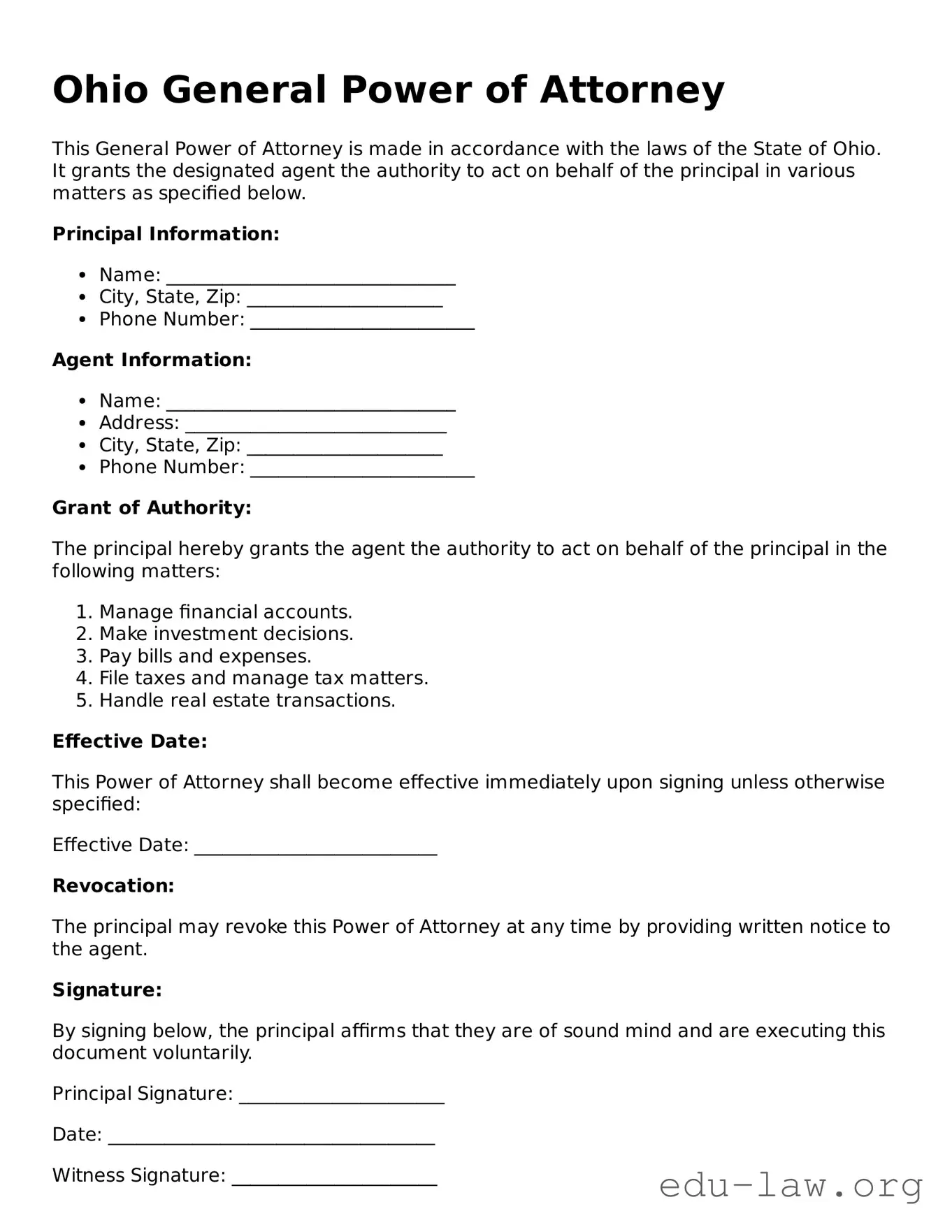
The Ohio General Power of Attorney form serves as a crucial legal document that empowers an individual, known as the principal, to designate another person, referred to as the agent, to act on their behalf in a variety of financial and legal matters. This form is particularly significant for individuals who wish to ensure that their affairs are managed according to their wishes, especially during times of incapacity or absence. The agent can be granted broad authority, allowing them to make decisions regarding property, banking, investments, and even healthcare, depending on how the document is structured. It is essential for the principal to clearly outline the scope of powers granted to the agent to avoid any ambiguity. Furthermore, the Ohio General Power of Attorney form requires specific formalities, such as signatures and, in some cases, notarization, to be legally binding. Understanding these elements is vital for anyone considering this form, as it not only safeguards personal interests but also provides peace of mind knowing that trusted individuals can manage affairs when needed.
Ohio General Power of Attorney
This General Power of Attorney is made in accordance with the laws of the State of Ohio. It grants the designated agent the authority to act on behalf of the principal in various matters as specified below.
Principal Information:
Agent Information:
Grant of Authority:
The principal hereby grants the agent the authority to act on behalf of the principal in the following matters:
Effective Date:
This Power of Attorney shall become effective immediately upon signing unless otherwise specified:
Effective Date: __________________________
Revocation:
The principal may revoke this Power of Attorney at any time by providing written notice to the agent.
Signature:
By signing below, the principal affirms that they are of sound mind and are executing this document voluntarily.
Principal Signature: ______________________
Date: ___________________________________
Witness Signature: ______________________
Date: ___________________________________
Notary Public Signature: ________________
Date: ___________________________________
| Fact Name | Details |
|---|---|
| Definition | The Ohio General Power of Attorney form allows an individual to appoint someone else to make decisions on their behalf regarding financial and legal matters. |
| Governing Law | This form is governed by Ohio Revised Code Section 1337.21 through 1337.64. |
| Durability | The power of attorney can be made durable, meaning it remains effective even if the principal becomes incapacitated. |
| Revocation | The principal can revoke the power of attorney at any time, as long as they are mentally competent to do so. |
Once you have the Ohio General Power of Attorney form, you can begin filling it out. Ensure you have all necessary information at hand, as this will streamline the process. Follow these steps carefully to complete the form accurately.
What is a General Power of Attorney in Ohio?
A General Power of Attorney (GPOA) in Ohio is a legal document that allows one person, known as the "principal," to appoint another person, called the "agent," to act on their behalf. This can include making financial decisions, managing property, and handling various personal affairs. The powers granted can be broad or limited, depending on the principal's wishes.
When does a General Power of Attorney take effect?
A General Power of Attorney can take effect immediately upon signing, or it can be set to activate only under certain conditions, such as when the principal becomes incapacitated. This is known as a "springing" power of attorney. It's essential to specify when the authority begins to ensure clarity and avoid confusion.
Can I revoke a General Power of Attorney in Ohio?
Yes, a General Power of Attorney can be revoked at any time by the principal, as long as they are mentally competent. To revoke it, the principal should create a written notice of revocation and provide copies to the agent and any relevant third parties who may rely on the original document.
Do I need a lawyer to create a General Power of Attorney in Ohio?
No, you do not need a lawyer to create a General Power of Attorney in Ohio. However, it is highly recommended to consult with a legal professional to ensure that the document meets all legal requirements and accurately reflects your intentions. This can help prevent potential disputes or issues in the future.
What powers can be granted in a General Power of Attorney?
A General Power of Attorney can grant a wide range of powers, including but not limited to managing bank accounts, buying or selling property, filing taxes, and making healthcare decisions. The principal can specify which powers the agent will have, allowing for flexibility based on individual needs.
Is a General Power of Attorney valid if the principal becomes incapacitated?
If the General Power of Attorney is not a springing power of attorney, it becomes invalid if the principal becomes incapacitated. However, if it is designed to spring into effect upon incapacitation, the agent can continue to act on behalf of the principal. It's crucial to understand the type of power of attorney being created to ensure it meets your needs.
Do I need to have the General Power of Attorney notarized?
In Ohio, it is not strictly required to have a General Power of Attorney notarized, but doing so is highly recommended. Notarization adds an extra layer of authenticity and can help prevent challenges to the document's validity in the future. Additionally, some institutions may require notarization before accepting the power of attorney.
Not specifying the powers granted. It's essential to clearly outline what authority is being given to the agent. General terms can lead to confusion.
Failing to sign and date the form. Without a signature and date, the document may not be considered valid.
Neglecting to have witnesses or a notary. Ohio requires that the General Power of Attorney be signed in front of a notary public or witnesses to ensure its legality.
Choosing an unreliable agent. Selecting someone without the necessary judgment or trustworthiness can lead to misuse of authority.
Not keeping a copy of the completed form. Always retain a copy for personal records and provide copies to the agent and any relevant institutions.
Overlooking state-specific requirements. Different states have unique rules. Ensure that the form complies with Ohio's regulations.
Failing to review and update the document. Life circumstances change. Regularly revisiting the Power of Attorney ensures it reflects current wishes.
When creating a General Power of Attorney in Ohio, individuals often consider additional forms and documents that complement this legal instrument. Each of these documents serves a specific purpose and can provide further clarity and security in managing one’s affairs.
Incorporating these documents alongside the General Power of Attorney can provide a comprehensive approach to managing personal and financial affairs. Each document plays a vital role in safeguarding an individual’s wishes and ensuring that their rights are upheld during times of need.
The Ohio General Power of Attorney (GPOA) form is similar to the Durable Power of Attorney (DPOA). Both documents allow a person, known as the principal, to appoint someone else, called an agent, to make decisions on their behalf. The key difference is that a Durable Power of Attorney remains effective even if the principal becomes incapacitated. This feature makes the DPOA particularly useful for long-term planning, ensuring that the agent can continue to act when the principal cannot communicate their wishes.
Another document that resembles the GPOA is the Medical Power of Attorney (MPOA). Like the GPOA, the MPOA allows an individual to designate someone to make decisions for them. However, the MPOA specifically focuses on health care decisions. This means that if a person becomes unable to make medical choices, the agent named in the MPOA can step in to make those decisions, ensuring that the principal's medical preferences are honored.
The Healthcare Proxy is similar to the Medical Power of Attorney but is often used in different jurisdictions. It allows a person to appoint someone to make health care decisions when they are unable to do so. While both documents serve the same purpose, the terminology and specific legal requirements may vary by state. This can lead to confusion, so it is important for individuals to understand the specific laws in their area.
The Living Will is another document that shares similarities with the GPOA. While the GPOA grants someone the authority to act on behalf of the principal, a Living Will outlines the principal's wishes regarding medical treatment in specific situations, particularly at the end of life. This document does not appoint an agent but rather provides guidance to healthcare providers and loved ones about the principal's desires.
The Revocable Trust is also comparable to the General Power of Attorney. A Revocable Trust allows individuals to manage their assets during their lifetime and decide how those assets should be distributed after their death. While the GPOA grants authority to an agent to make decisions, a Revocable Trust allows the creator to maintain control over their assets, with the flexibility to change the terms as needed.
The Financial Power of Attorney is closely related to the General Power of Attorney. This document specifically focuses on financial matters, giving the agent authority to handle banking, investments, and property transactions. While the GPOA can cover a broader range of decisions, the Financial Power of Attorney is tailored for financial management, making it a vital tool for those who want to ensure their financial affairs are in good hands.
The Springing Power of Attorney is another variant that resembles the GPOA. This document only becomes effective under certain conditions, typically when the principal becomes incapacitated. This feature can provide peace of mind, as the principal retains control until they are unable to manage their affairs. However, it requires clear documentation of the triggering event to avoid confusion.
The Limited Power of Attorney is similar but more restrictive than the General Power of Attorney. It allows the principal to specify certain tasks or decisions the agent can handle. For example, a Limited Power of Attorney might allow someone to sell a specific property or manage a particular bank account. This tailored approach can be useful when the principal wants to maintain control over other aspects of their life.
The Statutory Power of Attorney is another document that aligns with the GPOA. This type of power of attorney is created using a form that is approved by state law. It typically provides a broad range of powers to the agent and is designed to simplify the process of granting authority. By using a statutory form, individuals can ensure compliance with legal standards while making it easier for their agents to act on their behalf.
Lastly, the Power of Attorney for Child Care is similar in that it allows a parent or guardian to appoint someone to make decisions regarding their child’s care. This document is particularly useful for temporary situations, such as when a parent is traveling or unable to care for their child. While it serves a different purpose than the GPOA, both documents share the common goal of ensuring that someone trusted can make important decisions when the principal is unavailable.
When completing the Ohio General Power of Attorney form, it is essential to follow specific guidelines to ensure that the document is valid and meets your needs. Below is a list of things you should and shouldn't do.
Things You Should Do:
Things You Shouldn't Do:
When considering a General Power of Attorney (POA) in Ohio, it’s important to clear up some common misconceptions. Understanding these can help you make informed decisions about your legal documents.
This is not true. While a General POA often includes financial decisions, it can also grant authority for healthcare decisions, property management, and other personal affairs, depending on how it is drafted.
In reality, a General POA can be revoked at any time by the person who created it, as long as they are still mentally competent. This flexibility allows individuals to maintain control over their affairs.
While it is advisable to seek legal advice, individuals can prepare a General POA themselves using templates or forms provided by the state. However, ensuring it meets all legal requirements is crucial.
Agents have a fiduciary duty to act in the best interest of the principal. This means they must manage the principal's affairs responsibly and transparently, and they can be held accountable for their actions.
A standard General POA typically ends if the principal becomes incapacitated. However, a Durable Power of Attorney remains effective even in such situations, allowing for continued management of affairs.
When considering a General Power of Attorney (POA) in Ohio, it’s essential to understand its implications and the process involved. Here are some key takeaways to keep in mind:
By understanding these key points, you can make informed decisions about using a General Power of Attorney in Ohio.