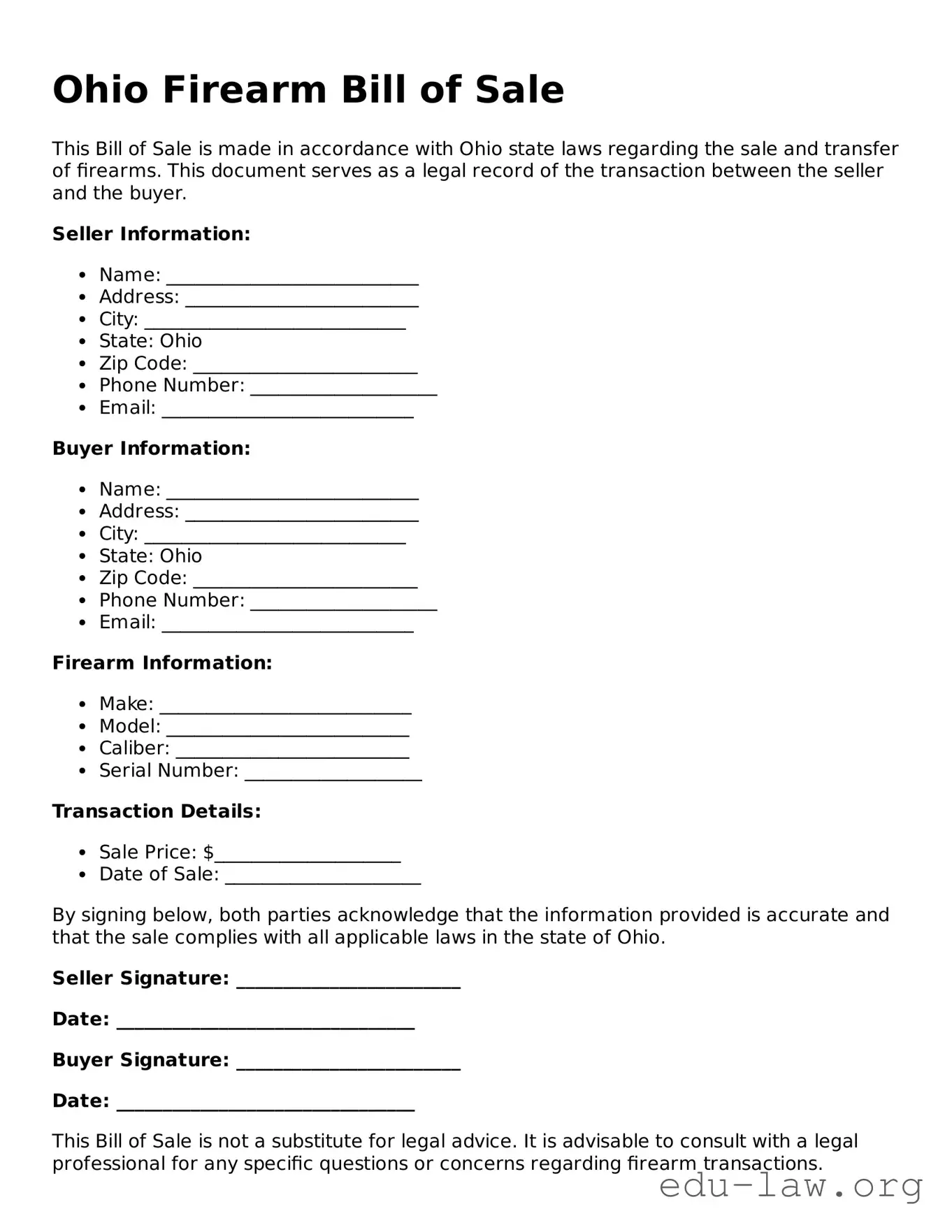
When it comes to buying or selling firearms in Ohio, having a Firearm Bill of Sale form is essential. This document serves as proof of the transaction between the seller and the buyer, ensuring that both parties are protected. It includes important details such as the names and addresses of both the buyer and seller, a description of the firearm being sold, and the sale price. Additionally, the form may require information about the firearm's serial number, which helps to verify its legality and traceability. By completing this form, both parties acknowledge the transfer of ownership and comply with state laws. Understanding the significance of this document can help facilitate a smooth transaction while also promoting responsible firearm ownership.
Ohio Firearm Bill of Sale
This Bill of Sale is made in accordance with Ohio state laws regarding the sale and transfer of firearms. This document serves as a legal record of the transaction between the seller and the buyer.
Seller Information:
Buyer Information:
Firearm Information:
Transaction Details:
By signing below, both parties acknowledge that the information provided is accurate and that the sale complies with all applicable laws in the state of Ohio.
Seller Signature: ________________________
Date: ________________________________
Buyer Signature: ________________________
Date: ________________________________
This Bill of Sale is not a substitute for legal advice. It is advisable to consult with a legal professional for any specific questions or concerns regarding firearm transactions.
| Fact Name | Description |
|---|---|
| Purpose | The Ohio Firearm Bill of Sale form serves as a legal document to record the sale and transfer of firearms between private parties. |
| Governing Law | This form is governed by Ohio Revised Code § 2923.12, which outlines regulations for firearm transfers. |
| Parties Involved | The form requires information from both the seller and the buyer, ensuring transparency in the transaction. |
| Identification Requirements | Both parties must provide valid identification, such as a driver's license or state ID, to verify their identity. |
| Record Keeping | It is advisable for both the seller and buyer to keep a copy of the completed Bill of Sale for their records. |
After you have gathered all necessary information, you can proceed to fill out the Ohio Firearm Bill of Sale form. This document is essential for recording the transfer of ownership of a firearm between parties. Follow these steps carefully to ensure that all required details are accurately captured.
What is the Ohio Firearm Bill of Sale form?
The Ohio Firearm Bill of Sale form is a legal document that records the sale or transfer of a firearm between two parties. This form serves as proof of the transaction and includes essential details such as the buyer's and seller's names, addresses, and the specific firearm being sold. It is important for both parties to retain a copy for their records to ensure clarity and compliance with state laws.
Is the Ohio Firearm Bill of Sale form required by law?
While Ohio law does not mandate a Bill of Sale for private firearm transactions, it is highly recommended. Having a Bill of Sale provides legal protection for both the buyer and seller. It helps establish ownership and can serve as a defense in case of disputes or legal issues arising from the firearm's use after the sale.
What information should be included in the form?
The form should include the full names and addresses of both the buyer and the seller. Additionally, it should detail the firearm being sold, including the make, model, caliber, and serial number. The date of the transaction and the signatures of both parties should also be present to validate the agreement.
Can I use a generic Bill of Sale template for firearms?
While a generic Bill of Sale template can be used, it is advisable to use a form specifically designed for firearms transactions. This ensures that all necessary information is captured and complies with Ohio's regulations. Using a tailored form minimizes the risk of overlooking crucial details that could affect the legality of the sale.
What should I do if I lose my Bill of Sale?
If a Bill of Sale is lost, it is recommended to recreate the document as accurately as possible. Both parties should agree on the details and sign the new form. This new Bill of Sale can serve as a replacement, but it is essential to keep copies in a secure location to avoid future issues.
Are there any age restrictions for completing a Bill of Sale in Ohio?
In Ohio, individuals must be at least 18 years old to purchase a firearm. Therefore, both the buyer and seller should be of legal age when completing the Bill of Sale. This requirement ensures that the transaction adheres to state laws regarding firearm ownership and transfers.
Incorrect Buyer and Seller Information: People often fail to provide accurate names, addresses, or contact details for both the buyer and seller. This information is crucial for legal verification.
Missing Signatures: Some individuals neglect to sign the form altogether. Without signatures, the document lacks validity and cannot serve its purpose.
Failure to Include Firearm Details: Buyers and sellers may forget to specify critical details about the firearm, such as make, model, and serial number. Omitting this information can lead to confusion and legal issues.
Not Notarizing the Document: While notarization is not always required, many overlook this step. A notarized bill of sale adds an extra layer of authenticity and can be beneficial if disputes arise.
Inaccurate Date of Sale: Some people mistakenly enter the wrong date or leave it blank. This can create problems, especially if the transaction is questioned later.
Ignoring State Regulations: Many individuals are unaware of specific Ohio laws regarding firearm sales. Failing to comply with these regulations can result in legal repercussions.
Not Keeping Copies: After completing the form, some forget to keep a copy for their records. Retaining a copy is essential for future reference and proof of the transaction.
Rushing the Process: People often hurry through filling out the form, leading to careless mistakes. Taking time to review the document can prevent errors and ensure accuracy.
The Ohio Firearm Bill of Sale form is an essential document for the private sale or transfer of firearms. It serves as proof of the transaction and outlines the details of the sale. Alongside this form, several other documents may be necessary to ensure compliance with state laws and to facilitate a smooth transfer process. Below is a list of other commonly used forms and documents.
Using these additional documents can help ensure that the sale of a firearm is conducted legally and transparently. Each document plays a role in protecting both the buyer and the seller throughout the transaction process.
The Ohio Firearm Bill of Sale form bears similarities to a Vehicle Bill of Sale. Both documents serve as proof of transfer of ownership from one party to another. Just as a Vehicle Bill of Sale includes essential details such as the buyer and seller's names, addresses, and the vehicle's identification number, the Firearm Bill of Sale requires similar information for the firearm being sold. Additionally, both forms often include a description of the item being sold, ensuring clarity in the transaction and protecting the rights of both parties involved.
Another document that aligns closely with the Ohio Firearm Bill of Sale is the Personal Property Bill of Sale. This form is used for the sale of various personal items, ranging from furniture to electronics. Like the Firearm Bill of Sale, it outlines the specifics of the item, including its condition and any warranties or guarantees. Both documents aim to provide legal protection for the buyer and seller by clearly detailing the terms of the sale and ensuring that the transfer of ownership is properly documented.
The Real Estate Purchase Agreement is another related document, albeit for a different type of transaction. This agreement formalizes the sale of real property, much like how the Firearm Bill of Sale formalizes the sale of a firearm. Both documents require the identification of the parties involved and a detailed description of the item being sold. While the Real Estate Purchase Agreement is more complex and often involves contingencies, both forms serve the essential function of documenting a transfer of ownership.
In the realm of business transactions, the Equipment Bill of Sale can be compared to the Ohio Firearm Bill of Sale. This document is used when selling or transferring ownership of equipment, whether for personal or business use. Similar to the Firearm Bill of Sale, it details the equipment being sold, the parties involved, and the sale price. Both documents help protect the interests of the buyer and seller, ensuring that the transaction is clear and legally binding.
The Lease Agreement also shares some characteristics with the Ohio Firearm Bill of Sale. While primarily used for renting property, it also outlines the terms of a temporary transfer of rights, similar to how a Bill of Sale finalizes the sale of a firearm. Both documents require the identification of parties and the specifics of the item or property involved. They ensure that all parties understand their rights and obligations, promoting transparency in the transaction.
The Gift Receipt is another document that can be seen as related to the Ohio Firearm Bill of Sale. Although it is not a sale, it documents the transfer of ownership without monetary exchange. A Gift Receipt includes details about the item given and the parties involved, similar to the information required in a Bill of Sale. Both documents serve to confirm the transfer of ownership, providing proof that can be important for future reference.
Lastly, the Pawn Ticket has similarities with the Ohio Firearm Bill of Sale, particularly in how it documents the temporary transfer of ownership. When a firearm is pawned, the Pawn Ticket serves as a record of the transaction, just like a Bill of Sale does for a purchase. Both documents include information about the item, the parties involved, and the terms of the transaction, ensuring that there is a clear understanding of the arrangement made.
When filling out the Ohio Firearm Bill of Sale form, it's important to follow specific guidelines. Here’s a list of what you should and shouldn't do:
Misconception 1: A Bill of Sale is only necessary for private sales.
Many people believe that a Bill of Sale is only required when firearms are sold privately. However, this document can also be beneficial in transactions involving dealers or other entities. It serves as proof of ownership and can help clarify the terms of the sale, regardless of who is involved.
Misconception 2: The Bill of Sale is not legally binding.
Some individuals think that a Bill of Sale holds no legal weight. In reality, this document is a legally binding contract that outlines the terms of the sale. It can be used in court if disputes arise, making it an important part of the transaction process.
Misconception 3: Only licensed dealers need to complete a Bill of Sale.
It is a common belief that only licensed dealers are required to fill out a Bill of Sale. In fact, anyone transferring ownership of a firearm should consider completing this form. This helps protect both the buyer and seller by providing a clear record of the transaction.
Misconception 4: The Bill of Sale must be notarized to be valid.
Some people think that notarization is a requirement for the Bill of Sale to be valid. While having a notary can add an extra layer of authenticity, it is not a legal requirement in Ohio. A properly completed Bill of Sale is valid even without notarization, as long as both parties agree to the terms.
When filling out and using the Ohio Firearm Bill of Sale form, it is important to keep the following key takeaways in mind: