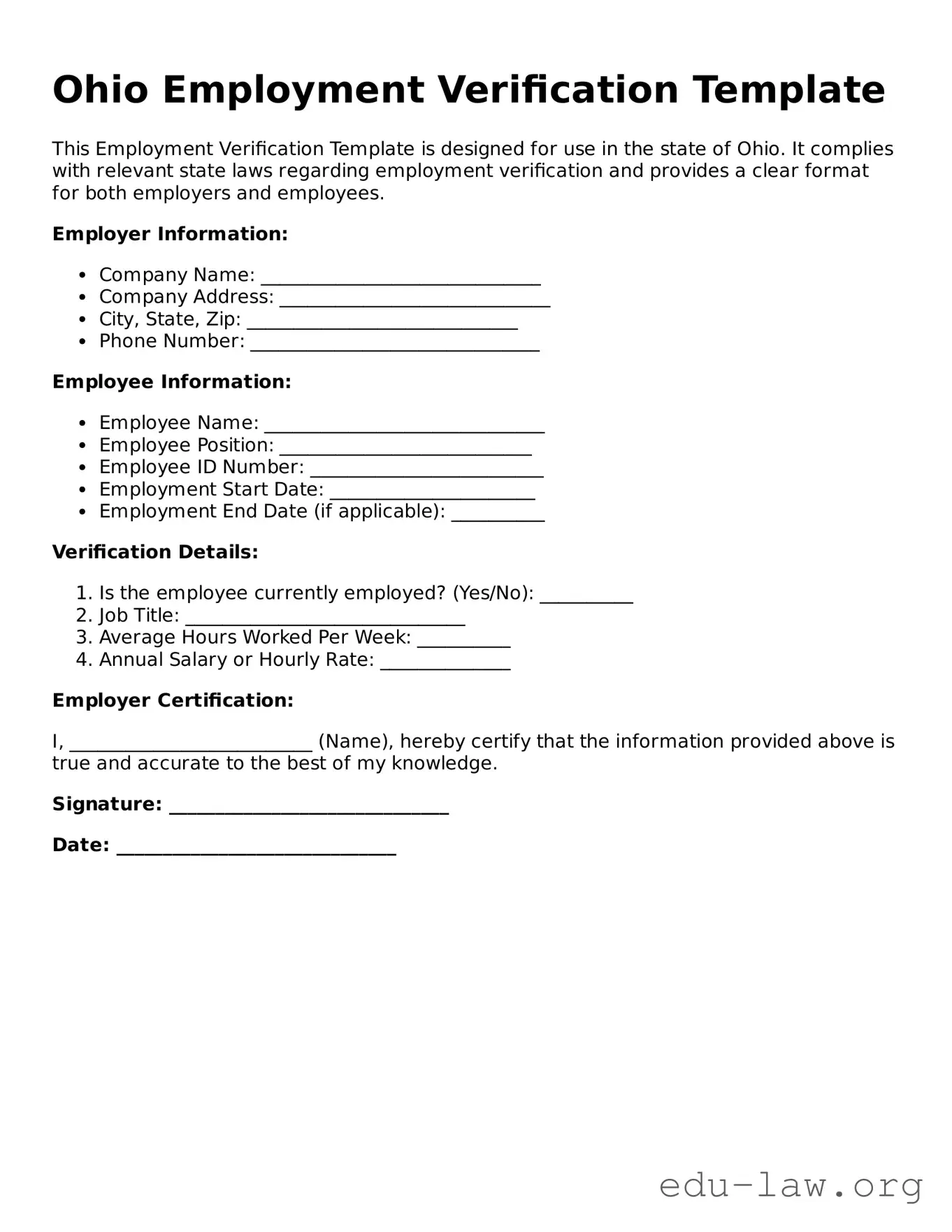
The Ohio Employment Verification form serves as an essential document for both employers and employees in the state of Ohio. This form is primarily used to confirm an individual's employment status, including details such as job title, dates of employment, and salary information. Employers are often required to complete this form when an employee applies for loans, housing, or government assistance programs, as it provides the necessary proof of income and employment history. Additionally, the form can be utilized in various situations, such as when an employee is seeking new job opportunities or when verifying eligibility for benefits. By ensuring that accurate and up-to-date information is provided, the Employment Verification form plays a crucial role in facilitating smooth transactions between employees and third parties. It is important for both parties to understand the significance of this document and to handle it with care to maintain confidentiality and compliance with relevant regulations.
Ohio Employment Verification Template
This Employment Verification Template is designed for use in the state of Ohio. It complies with relevant state laws regarding employment verification and provides a clear format for both employers and employees.
Employer Information:
Employee Information:
Verification Details:
Employer Certification:
I, __________________________ (Name), hereby certify that the information provided above is true and accurate to the best of my knowledge.
Signature: ______________________________
Date: ______________________________
| Fact Name | Description |
|---|---|
| Purpose | The Ohio Employment Verification form is used to confirm an individual's employment status and details, typically for purposes such as loan applications or background checks. |
| Governing Law | This form is governed by Ohio Revised Code Section 4111.14, which outlines employer obligations regarding employee verification. |
| Required Information | The form typically requires the employee's name, job title, employment dates, and the employer's contact information. |
| Submission Process | Employees may request the completion of this form from their employer, who must then provide the requested information accurately. |
| Confidentiality | Employers must handle the information on the form with care, as it contains personal data that is protected under privacy laws. |
After receiving the Ohio Employment Verification form, you will need to complete it accurately to ensure the verification process goes smoothly. Follow these steps to fill out the form correctly.
Once the form is filled out, it should be submitted to the appropriate department or individual as specified in the instructions. Keep a copy for your records.
What is the Ohio Employment Verification form?
The Ohio Employment Verification form is a document used to confirm an individual's employment status. It serves as proof for various purposes, such as applying for loans, renting a home, or verifying income for government assistance programs. Employers typically complete this form to provide accurate information about an employee's job title, dates of employment, and salary.
Who needs to complete the Ohio Employment Verification form?
This form is generally completed by employers on behalf of their employees. Employees may request this verification when they need to provide proof of employment to third parties, such as banks or housing authorities. In some cases, employees may need to fill out a section of the form to authorize their employer to release their information.
What information is typically required on the form?
The form usually requires basic information about the employee, including their name, job title, and the dates they have worked for the employer. Additionally, it may ask for details regarding the employee's salary or hourly wage. Employers may also need to provide their contact information and the company's name and address.
How can an employee obtain the Ohio Employment Verification form?
Is there a fee associated with obtaining the employment verification?
Typically, there is no fee for obtaining an employment verification form. Employers usually provide this service as part of their responsibilities. However, if an employee requests additional documentation or services, there may be a fee involved, depending on the employer's policies.
How long does it take to receive the completed form?
The time it takes to receive the completed Ohio Employment Verification form can vary. In many cases, employers can provide the verification within a few days. However, if the request is made during a busy period or if additional information is needed, it may take longer. Employees should communicate with their employer to get a better idea of the expected timeline.
Can the employment verification be sent directly to a third party?
Yes, in many situations, the employment verification can be sent directly to a third party, such as a bank or landlord. Employees often need to provide written consent for their employer to share this information with others. This consent is usually included in the request for verification.
What should an employee do if there is an error on the form?
If an employee notices an error on the employment verification form, they should contact their employer immediately. It is important to address any inaccuracies, as they can affect the employee's ability to secure loans or housing. Employers typically have procedures in place to correct errors and issue a revised form.
Is the Ohio Employment Verification form legally required?
Incomplete Information: Many individuals fail to provide all required details, such as the employee's full name, Social Security number, or the employer's contact information. Missing any of these crucial elements can delay the verification process.
Incorrect Dates: Some people mistakenly enter the wrong employment dates. This can lead to confusion and may require additional follow-up to clarify the timeline of employment.
Signature Issues: Failing to sign the form or providing a signature that does not match the name listed can create complications. A signature is essential for validating the information provided.
Neglecting to Update Information: If there have been recent changes to the employee's status, such as a promotion or termination, not reflecting these updates can result in inaccuracies.
Providing Inaccurate Job Titles: Listing the wrong job title can lead to misunderstandings about the employee's role and responsibilities. It's important to ensure that the job title matches what is on record with the employer.
Failing to Include Contact Information: Not providing a way for the verifier to reach the employer can stall the verification process. Including a phone number or email address is vital for any follow-up questions.
Overlooking Required Documentation: Some individuals forget to attach necessary supporting documents, such as pay stubs or tax forms. These documents can substantiate the information provided and enhance the verification process.
When completing the Ohio Employment Verification form, you may need to gather additional documents to support your employment status or provide necessary information. Here are some commonly used forms and documents that can accompany the Employment Verification form:
Having these documents ready can streamline the verification process and provide a clearer picture of your employment situation. Being organized and prepared can make a significant difference in how quickly your information is processed.
The I-9 form, officially known as the Employment Eligibility Verification form, is a critical document used by employers in the United States to verify the identity and employment authorization of individuals hired for employment. Like the Ohio Employment Verification form, the I-9 requires employees to provide proof of their identity and eligibility to work. This form must be completed by both the employer and the employee within three days of the employee's start date. The I-9 is essential for compliance with federal immigration laws, ensuring that only authorized individuals are employed in the country.
The W-2 form, or Wage and Tax Statement, serves a different purpose but is similar in that it documents employment information. Employers use the W-2 to report an employee's annual wages and the taxes withheld from their paycheck. Both the Ohio Employment Verification form and the W-2 require accurate information about the employee, but the W-2 focuses on financial compensation and tax obligations rather than employment eligibility. Employees receive their W-2 at the end of the year for tax filing purposes, making it an important document for financial record-keeping.
The 1099 form, particularly the 1099-MISC or 1099-NEC, is another document relevant to employment verification, especially for independent contractors. While the Ohio Employment Verification form is typically used for employees, the 1099 serves as a record of payments made to non-employees. Both documents require accurate reporting of individual information, but the 1099 focuses on income received rather than employment status. This distinction is crucial for tax reporting and compliance, particularly for those who work as freelancers or independent contractors.
The State Unemployment Insurance (SUI) form is also similar in that it relates to employment verification and status. Employers are required to report wages and employment status to state unemployment agencies through this form. This information is essential for determining eligibility for unemployment benefits. Like the Ohio Employment Verification form, the SUI form helps maintain accurate records of employment, ensuring that individuals who are unemployed can access the benefits they need during difficult times.
Finally, the Social Security Administration's (SSA) Employer Verification form plays a vital role in employment verification. This document allows employers to verify an employee's Social Security number and ensure that the individual is eligible for Social Security benefits. Similar to the Ohio Employment Verification form, the SSA verification process aims to prevent identity fraud and ensure that all employees are accurately documented. Both forms require careful attention to detail, as inaccuracies can lead to significant consequences for both employers and employees.
When filling out the Ohio Employment Verification form, it’s important to be thorough and accurate. Here are some helpful tips on what to do and what to avoid.
By following these guidelines, you can help ensure that your Employment Verification form is completed correctly and processed without delay.
Understanding the Ohio Employment Verification form can be challenging. Here are some common misconceptions that people may have:
Being aware of these misconceptions can help both employers and employees navigate the verification process more effectively.
Filling out and using the Ohio Employment Verification form is an important process for both employers and employees. Here are key takeaways to keep in mind: