The Ohio Do Not Resuscitate (DNR) Order form is a critical document that allows individuals to express their wishes regarding medical treatment in emergency situations. This form is designed for patients who have a terminal condition or are in a state where resuscitation would not lead to a meaningful recovery. It serves as a clear directive to healthcare providers, ensuring that the patient's preferences are respected during life-threatening emergencies. The form must be completed and signed by a physician, and it is essential that it is readily accessible to emergency personnel. Additionally, it is important to understand that the DNR Order is not a standalone document; it should be part of a broader discussion about advance care planning. Individuals can revoke the order at any time, providing flexibility as circumstances change. Understanding the implications of this form can empower individuals to make informed decisions about their healthcare and end-of-life preferences.
Ohio Do Not Resuscitate Order
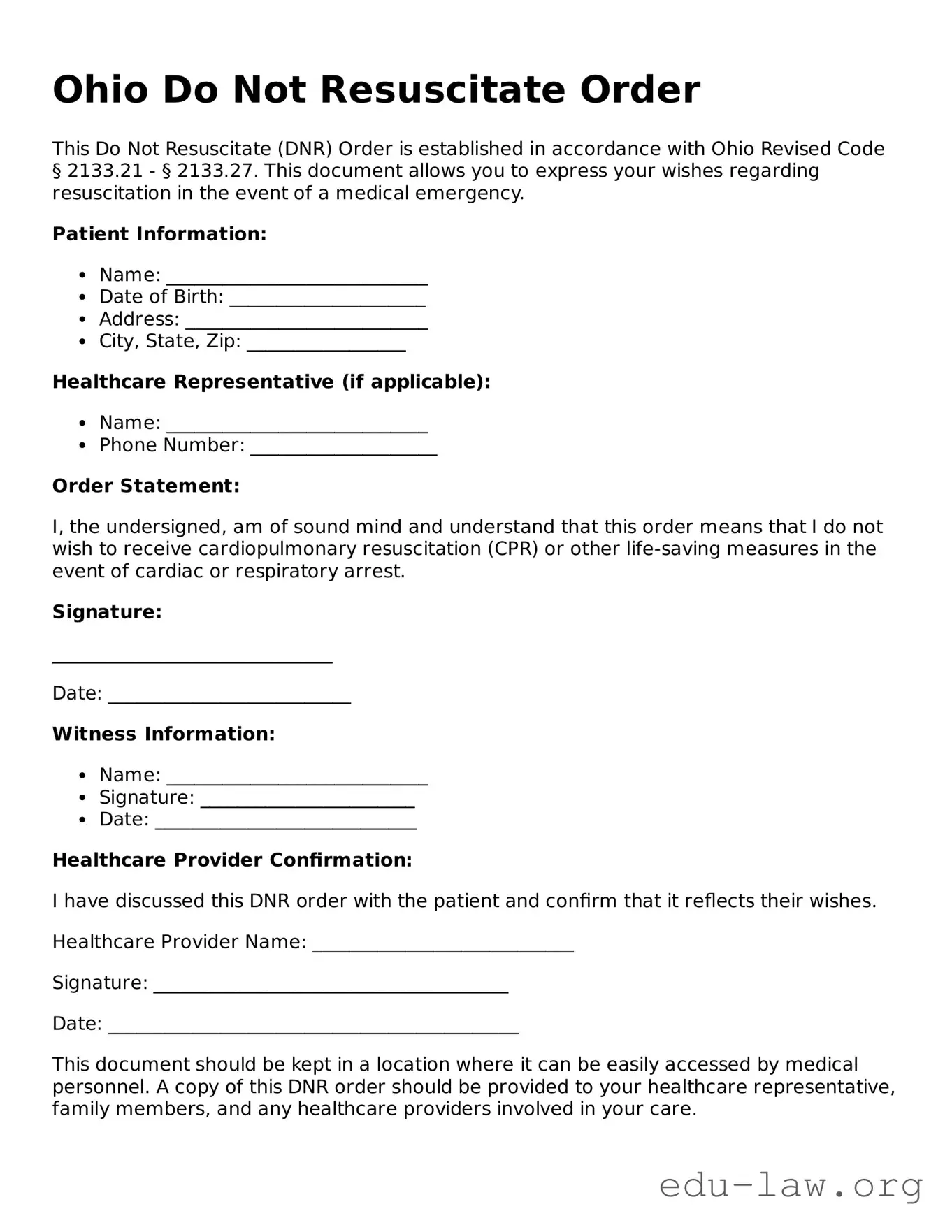
This Do Not Resuscitate (DNR) Order is established in accordance with Ohio Revised Code § 2133.21 - § 2133.27. This document allows you to express your wishes regarding resuscitation in the event of a medical emergency.
Patient Information:
Healthcare Representative (if applicable):
Order Statement:
I, the undersigned, am of sound mind and understand that this order means that I do not wish to receive cardiopulmonary resuscitation (CPR) or other life-saving measures in the event of cardiac or respiratory arrest.
Signature:
______________________________
Date: __________________________
Witness Information:
Healthcare Provider Confirmation:
I have discussed this DNR order with the patient and confirm that it reflects their wishes.
Healthcare Provider Name: ____________________________
Signature: ______________________________________
Date: ____________________________________________
This document should be kept in a location where it can be easily accessed by medical personnel. A copy of this DNR order should be provided to your healthcare representative, family members, and any healthcare providers involved in your care.
| Fact Name | Description |
|---|---|
| Definition | The Ohio Do Not Resuscitate (DNR) Order form is a legal document that allows individuals to refuse resuscitation efforts in the event of cardiac arrest or respiratory failure. |
| Governing Law | The Ohio DNR Order is governed by Ohio Revised Code § 2133.21 to § 2133.29, which outlines the legal framework for advance directives and DNR orders. |
| Eligibility | Any adult can complete a DNR order, provided they are of sound mind and understand the implications of the decision. |
| Signature Requirement | The form must be signed by the patient, or by a legal representative if the patient is unable to sign, and witnessed by two adults or notarized. |
| Placement | It is recommended that the DNR order be prominently displayed in the patient's home and included in their medical records to ensure it is easily accessible during emergencies. |
| Revocation | A DNR order can be revoked at any time by the patient or their legal representative, either verbally or by destroying the form. |
| Emergency Medical Services | Emergency medical personnel are required to honor a valid DNR order and must refrain from performing resuscitation efforts if presented with the form. |
Completing the Ohio Do Not Resuscitate Order form is an important step for individuals who wish to express their medical treatment preferences. Once you have filled out the form, it will need to be signed and dated, and then shared with your healthcare provider and family members to ensure that your wishes are respected.
Once the form is filled out and signed, ensure that it is easily accessible to those who may need to refer to it in a medical situation. Communication is key, so discuss your wishes with your loved ones.
What is a Do Not Resuscitate (DNR) Order in Ohio?
A Do Not Resuscitate Order is a legal document that allows individuals to refuse resuscitation in the event of a medical emergency. In Ohio, this order specifically indicates that if a person stops breathing or their heart stops beating, medical personnel should not perform CPR or other life-saving measures. This decision is typically made by individuals with serious medical conditions or those who wish to avoid aggressive medical interventions at the end of life.
Who can request a DNR Order in Ohio?
In Ohio, a DNR Order can be requested by a patient who is at least 18 years old and is capable of making informed decisions about their healthcare. If the patient is unable to make decisions, a legally authorized representative, such as a family member or guardian, may initiate the process on their behalf.
How do I obtain a DNR Order form in Ohio?
You can obtain a DNR Order form from various sources, including healthcare providers, hospitals, and online resources. The Ohio Department of Health provides a standardized DNR form that can be downloaded and printed. It is important to ensure that the form is filled out correctly and signed by the patient or their representative, as well as a physician.
What information is required on the DNR Order form?
The DNR Order form requires several key pieces of information. This includes the patient's name, date of birth, and a statement of their wishes regarding resuscitation. Additionally, it must be signed by the patient or their authorized representative and a physician. The physician's signature confirms that the patient has been informed about the implications of the DNR Order.
Is a DNR Order valid in all healthcare settings in Ohio?
Yes, a properly executed DNR Order is valid in all healthcare settings in Ohio, including hospitals, nursing homes, and at home. However, it is crucial to ensure that the form is easily accessible and clearly visible to medical personnel in case of an emergency.
Can a DNR Order be revoked?
Yes, a DNR Order can be revoked at any time by the patient or their authorized representative. To revoke the order, the individual should inform their healthcare provider and may need to complete a new form indicating their desire for resuscitation. It is advisable to keep a copy of the revocation for personal records.
What happens if a DNR Order is not followed?
If a DNR Order is not followed, it can lead to legal complications for healthcare providers. Medical personnel are required to respect the wishes outlined in a valid DNR Order. If there is confusion or uncertainty about the order, medical staff may perform resuscitation efforts until they can verify the validity of the DNR Order.
Are there any specific requirements for the DNR Order to be valid?
For a DNR Order to be valid in Ohio, it must be completed on the official form, signed by the patient or their representative, and signed by a physician. The form should also be dated. Ensuring that the form is completed correctly and kept in an accessible location is essential for it to be honored by medical personnel.
How does a DNR Order affect other medical treatments?
A DNR Order specifically addresses resuscitation efforts and does not affect other medical treatments. Patients with a DNR Order can still receive all other forms of medical care, including pain management, comfort care, and treatment for existing conditions. It is important to discuss any concerns about treatment options with healthcare providers.
Can a DNR Order be part of an advance directive?
Yes, a DNR Order can be included as part of a broader advance directive, which outlines a person's wishes regarding medical treatment and end-of-life care. An advance directive may encompass various healthcare decisions, including preferences for resuscitation, organ donation, and appointing a healthcare proxy. It's beneficial to discuss these wishes with family members and healthcare providers to ensure everyone is informed.
Inaccurate Information: Providing incorrect personal details, such as name or date of birth, can lead to confusion and invalidate the order.
Missing Signatures: Failing to sign the form or not having the required witness signatures can render the document ineffective.
Not Understanding the Terms: Some individuals may not fully grasp what a Do Not Resuscitate Order entails, leading to decisions that do not reflect their wishes.
Improper Completion: Leaving sections of the form blank or not following the instructions provided can create issues when the order is needed.
Failure to Update: Not revising the order after significant life changes, such as a change in health status or personal beliefs, can lead to outdated directives.
Not Discussing with Family: Failing to communicate the decision with family members may cause confusion and distress during critical moments.
Ignoring State Requirements: Each state has specific regulations regarding DNR orders. Not adhering to Ohio's requirements can invalidate the form.
Not Keeping Copies: Failing to make and distribute copies of the signed order to relevant parties, such as healthcare providers and family members, can lead to misunderstandings.
The Ohio Do Not Resuscitate (DNR) Order form is an important document for individuals who wish to specify their preferences regarding resuscitation efforts in case of a medical emergency. Along with this form, several other documents may be relevant to ensure that a person's healthcare wishes are honored. Below is a list of commonly used forms and documents that often accompany the DNR Order.
Having these documents in place can provide clarity and ensure that healthcare providers and family members understand an individual's wishes. It is essential to review and update these documents regularly to reflect any changes in preferences or circumstances.
The Ohio Do Not Resuscitate (DNR) Order form shares similarities with the Advance Directive. An Advance Directive is a legal document that allows individuals to express their healthcare preferences in advance. Like the DNR, it can specify the types of medical treatment a person wishes to receive or avoid in case they become unable to communicate their wishes. Both documents aim to ensure that medical care aligns with the individual's values and preferences.
Another document similar to the DNR is the Physician Orders for Life-Sustaining Treatment (POLST). The POLST form is designed for individuals with serious illnesses or frailty. It translates a patient's treatment preferences into actionable medical orders. Like the DNR, it is intended to guide healthcare providers in emergency situations, ensuring that the patient's wishes are respected.
The Living Will is also comparable to the Ohio DNR Order form. A Living Will is a type of advance directive that outlines a person's wishes regarding medical treatment in end-of-life situations. It may include preferences about resuscitation efforts, similar to those expressed in a DNR. Both documents serve to communicate a person's healthcare desires when they are unable to do so themselves.
In addition, the Health Care Power of Attorney (HCPOA) is relevant. This document designates an individual to make healthcare decisions on behalf of another person if they are incapacitated. While the DNR specifies preferences regarding resuscitation, the HCPOA allows the appointed individual to make broader medical decisions, including those related to resuscitation efforts.
The Medical Order for Scope of Treatment (MOST) form is another document that parallels the DNR. The MOST form is often used in certain states to convey a patient's preferences regarding medical treatment, particularly for those with serious health conditions. Like the DNR, it provides clear guidance to healthcare providers about the level of care the patient desires in emergencies.
The Do Not Intubate (DNI) Order is also similar. A DNI order specifically instructs healthcare providers not to place a patient on a ventilator. While the DNR focuses on resuscitation efforts more broadly, the DNI is a specific directive that can accompany a DNR order, further clarifying the patient's wishes regarding life-sustaining measures.
Another related document is the End-of-Life Care Plan. This plan outlines a person's preferences for care during their final days. It may include preferences for pain management, resuscitation, and other medical interventions. Like the DNR, the End-of-Life Care Plan is designed to ensure that healthcare providers honor the individual's wishes as they approach the end of life.
The Comfort Care Order is also comparable. This document focuses on providing comfort and alleviating suffering rather than prolonging life through aggressive treatments. Similar to the DNR, a Comfort Care Order emphasizes the importance of quality of life and aligns with the patient's wishes to avoid unnecessary medical interventions.
Finally, the Do Not Hospitalize (DNH) order is relevant. This order instructs healthcare providers not to admit a patient to a hospital for treatment. It is often used for patients with terminal illnesses who wish to remain at home or in a hospice setting. Like the DNR, the DNH order reflects the individual's desire to limit medical interventions in certain situations.
When filling out the Ohio Do Not Resuscitate Order form, it’s important to approach the process with care. Here are some essential dos and don'ts to consider:
Following these guidelines can help ensure that your wishes are respected in a medical emergency.
Understanding the Ohio Do Not Resuscitate (DNR) Order form is crucial for individuals and families making end-of-life decisions. However, several misconceptions often cloud this important topic. Below are eight common misconceptions about the Ohio DNR Order form, along with clarifications.
A DNR order means no medical care will be provided. This is false. A DNR order specifically addresses resuscitation efforts in the event of cardiac arrest. Other medical treatments can still be administered based on the patient's wishes and medical needs.
Only terminally ill patients can have a DNR order. This is not true. While many individuals with terminal conditions choose to create a DNR, anyone can request one based on their personal preferences regarding resuscitation.
A DNR order is the same as a living will. This is a misconception. A DNR order specifically relates to resuscitation efforts, while a living will outlines a person's wishes regarding other medical treatments and end-of-life care.
Once a DNR order is signed, it cannot be changed. This is incorrect. Individuals can modify or revoke their DNR order at any time, provided they are mentally competent to do so.
Healthcare providers are required to follow a DNR order in all situations. This is misleading. While healthcare providers must respect a valid DNR order, they are also obligated to provide care that is necessary and appropriate based on the patient's overall medical condition.
A DNR order is only valid in hospitals. This is not accurate. In Ohio, a DNR order is valid in various settings, including at home, nursing facilities, and other healthcare environments, as long as it is properly documented.
Having a DNR order means giving up on life. This is a harmful misconception. A DNR order reflects a person's values and preferences regarding their end-of-life care, not a desire to end their life prematurely.
All DNR orders are the same. This is false. DNR orders can vary by state and may have specific requirements or formats. It is essential to use the correct form for Ohio to ensure it is legally recognized.
Addressing these misconceptions can help individuals and families make informed decisions regarding end-of-life care and ensure that their wishes are respected.
Understanding the Ohio Do Not Resuscitate (DNR) Order form is crucial for individuals who wish to make their healthcare preferences clear. Here are some key takeaways to consider:
Taking these steps can help ensure that your healthcare wishes are honored and provide peace of mind for you and your loved ones.