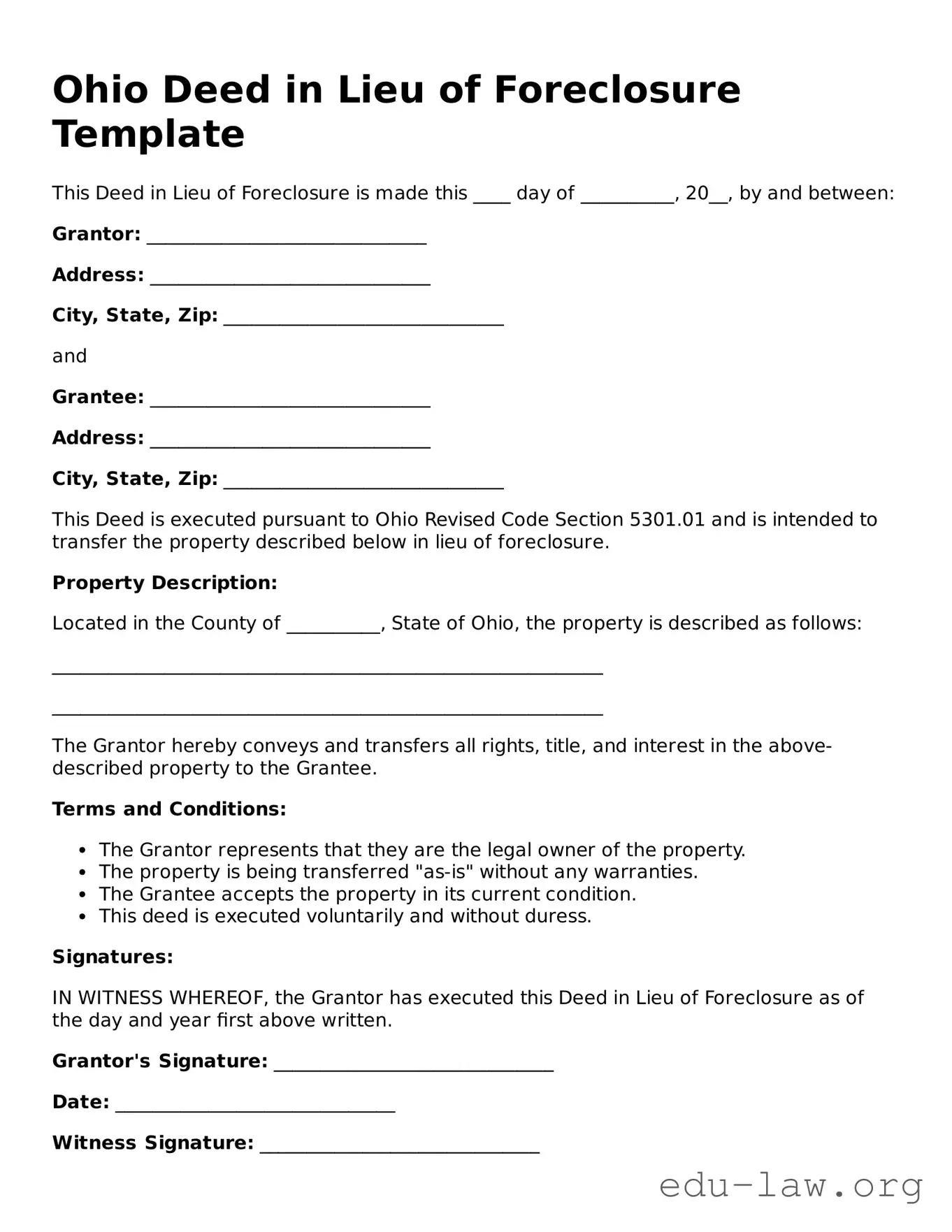
In Ohio, homeowners facing financial difficulties may find themselves exploring various options to avoid foreclosure. One such option is the Deed in Lieu of Foreclosure. This process allows a homeowner to voluntarily transfer their property to the lender, effectively settling the mortgage debt without the lengthy and often stressful foreclosure process. The Deed in Lieu of Foreclosure form is a crucial document in this scenario, as it outlines the agreement between the homeowner and the lender. It typically includes important details such as the property description, the parties involved, and any specific terms related to the transfer. By utilizing this form, homeowners can potentially protect their credit score and move forward more quickly than if they were to go through foreclosure. Understanding the ins and outs of this form can empower homeowners to make informed decisions during challenging financial times.
Ohio Deed in Lieu of Foreclosure Template
This Deed in Lieu of Foreclosure is made this ____ day of __________, 20__, by and between:
Grantor: ______________________________
Address: ______________________________
City, State, Zip: ______________________________
and
Grantee: ______________________________
Address: ______________________________
City, State, Zip: ______________________________
This Deed is executed pursuant to Ohio Revised Code Section 5301.01 and is intended to transfer the property described below in lieu of foreclosure.
Property Description:
Located in the County of __________, State of Ohio, the property is described as follows:
___________________________________________________________
___________________________________________________________
The Grantor hereby conveys and transfers all rights, title, and interest in the above-described property to the Grantee.
Terms and Conditions:
Signatures:
IN WITNESS WHEREOF, the Grantor has executed this Deed in Lieu of Foreclosure as of the day and year first above written.
Grantor's Signature: ______________________________
Date: ______________________________
Witness Signature: ______________________________
Date: ______________________________
Notary Public:
State of Ohio, County of __________
Subscribed and sworn to before me this ____ day of __________, 20__.
Notary Public Signature: ______________________________
My Commission Expires: ______________________________
| Fact Name | Description |
|---|---|
| Definition | An Ohio Deed in Lieu of Foreclosure is a legal document where a borrower voluntarily transfers property ownership to the lender to avoid foreclosure. |
| Governing Law | This form is governed by Ohio Revised Code § 5301.01 and other relevant foreclosure laws. |
| Purpose | The primary purpose is to help borrowers avoid the lengthy and costly foreclosure process. |
| Eligibility | Borrowers must be facing financial hardship and unable to continue mortgage payments to qualify for this option. |
| Process | The borrower and lender must agree to the terms, and the deed must be properly executed and recorded. |
| Impact on Credit | A deed in lieu of foreclosure can negatively affect the borrower's credit score, but typically less so than a foreclosure. |
Completing the Ohio Deed in Lieu of Foreclosure form is an important step in addressing your financial situation. Once you have filled out the form correctly, it will be submitted to the appropriate authorities. This process can help facilitate a smoother transition for both you and your lender.
What is a Deed in Lieu of Foreclosure?
A Deed in Lieu of Foreclosure is a legal document that allows a homeowner to voluntarily transfer ownership of their property to the lender to avoid foreclosure. This option is often pursued when a homeowner is unable to keep up with mortgage payments and wants to prevent the lengthy and costly foreclosure process. By signing the deed, the homeowner gives up their rights to the property, and in return, the lender may agree to forgive the remaining mortgage debt.
What are the benefits of choosing a Deed in Lieu of Foreclosure?
There are several advantages to opting for a Deed in Lieu of Foreclosure. First, it can help preserve the homeowner's credit score compared to a foreclosure, which typically has a more significant negative impact. Second, the process is generally quicker and less expensive than a foreclosure. Homeowners may also have the opportunity to negotiate terms with the lender, such as a potential waiver of deficiency judgments, which can relieve them from owing any remaining balance on the mortgage. Additionally, the homeowner may be able to stay in the home until the transfer is finalized, providing some time to plan for relocation.
What are the potential drawbacks of a Deed in Lieu of Foreclosure?
While there are benefits, there are also drawbacks to consider. Not all lenders accept Deeds in Lieu of Foreclosure, so homeowners should confirm their lender’s policies. Additionally, the homeowner may still face tax implications, as forgiven debt can sometimes be considered taxable income. Furthermore, the homeowner will lose their property and any equity they may have built. It is essential for individuals to weigh these factors and consult with a financial advisor or attorney before proceeding.
How can a homeowner initiate a Deed in Lieu of Foreclosure?
To initiate a Deed in Lieu of Foreclosure, the homeowner should first contact their lender to discuss the situation. It is advisable to gather relevant financial documents and prepare to explain the reasons for the inability to continue making mortgage payments. The lender will typically require a formal request and may ask for a hardship letter detailing the homeowner's financial circumstances. Once the lender agrees to the deed, both parties will need to sign the document, and it should be recorded with the county recorder’s office to finalize the transfer of ownership.
Incomplete Information: One of the most common mistakes is leaving out essential details, such as the names of the parties involved or the property address. Ensure all fields are filled out completely.
Incorrect Legal Description: Failing to provide the accurate legal description of the property can lead to complications. Always verify this information through public records.
Not Signing the Document: Both parties must sign the deed. Forgetting to include signatures can render the document invalid.
Improper Notarization: The deed must be notarized correctly. Skipping this step or using an unlicensed notary can cause issues later.
Failing to Review State Laws: Each state has its own requirements for a deed in lieu of foreclosure. Not being familiar with Ohio’s specific regulations can lead to errors.
Ignoring Tax Implications: Not considering the potential tax consequences of transferring the property can lead to unexpected financial burdens.
Not Consulting a Professional: Many individuals attempt to fill out the form without legal advice. Consulting an attorney or real estate expert can help avoid pitfalls.
Missing Deadlines: There are often deadlines associated with submitting the deed. Missing these can complicate the process further.
Not Keeping Copies: Failing to keep copies of the completed deed and any related documents can create problems if disputes arise later.
A Deed in Lieu of Foreclosure is a legal document that allows a homeowner to transfer ownership of their property to the lender, typically to avoid the lengthy foreclosure process. In Ohio, several other forms and documents are often used in conjunction with this deed to ensure the process is smooth and legally compliant. Below is a list of these documents, along with brief descriptions of each.
Understanding these documents can help homeowners navigate the complexities of a Deed in Lieu of Foreclosure. It is advisable for individuals to seek guidance from legal professionals when dealing with such matters to ensure that their rights and interests are protected throughout the process.
The Ohio Deed in Lieu of Foreclosure form shares similarities with a mortgage release document. Both serve to terminate the borrower's obligations under the mortgage. When a mortgage release is executed, the lender agrees to release the borrower from the mortgage lien, often after the borrower has fulfilled certain conditions, such as making a final payment. This process can help avoid the lengthy and costly foreclosure process, offering a more straightforward resolution for both parties.
Another document akin to the Deed in Lieu of Foreclosure is the short sale agreement. In a short sale, the homeowner sells the property for less than the amount owed on the mortgage, with the lender's consent. Similar to a deed in lieu, a short sale aims to mitigate losses for the lender while allowing the homeowner to avoid foreclosure. Both options require lender approval and can provide a more amicable exit for homeowners facing financial difficulties.
The foreclosure settlement agreement also bears resemblance to the Deed in Lieu of Foreclosure. This document typically outlines the terms under which a borrower can settle their mortgage debt, often involving a negotiated payoff amount. Both agreements can prevent foreclosure and provide a clear path for the borrower to resolve their mortgage obligations, albeit through different mechanisms.
A loan modification agreement is another document that shares common ground with the Deed in Lieu of Foreclosure. In a loan modification, the terms of the existing mortgage are altered to make payments more manageable for the borrower. While a deed in lieu transfers ownership to the lender, a loan modification retains ownership with the borrower, allowing them to continue living in the home under revised terms.
The release of lien document is also similar to the Deed in Lieu of Foreclosure. This document officially removes the lender's claim against the property, often after the mortgage has been paid off or settled. Both documents serve to clear the title of the property, enabling a smoother transfer of ownership and reducing complications for future transactions.
The quitclaim deed is another relevant document. A quitclaim deed allows a property owner to transfer their interest in a property to another party without guaranteeing that the title is clear. While a Deed in Lieu of Foreclosure involves a more formal process with lender approval, both documents facilitate the transfer of property ownership, albeit under different circumstances and with different implications for the parties involved.
Lastly, the bankruptcy discharge document can be compared to the Deed in Lieu of Foreclosure. When a borrower files for bankruptcy, they may receive a discharge that eliminates personal liability for certain debts, including mortgages. While a deed in lieu involves voluntarily transferring property to avoid foreclosure, both outcomes aim to provide relief to borrowers facing financial hardship, allowing them to move forward without the burden of the previous debt.
When filling out the Ohio Deed in Lieu of Foreclosure form, it's important to follow certain guidelines to ensure accuracy and compliance. Here are seven things you should and shouldn't do:
The Deed in Lieu of Foreclosure is often misunderstood. Here are eight common misconceptions regarding this legal document:
Many people believe that signing a Deed in Lieu of Foreclosure cancels all debts associated with the property. However, it typically only addresses the mortgage debt, and other debts may still remain.
While a Deed in Lieu of Foreclosure can be faster than traditional foreclosure, the process can still take time. Lenders must review and approve the deed, which can involve extensive paperwork and communication.
Not all homeowners qualify for a Deed in Lieu of Foreclosure. Lenders often have specific criteria that must be met, including the homeowner's financial situation and the condition of the property.
Many assume that a Deed in Lieu of Foreclosure has no impact on credit scores. In reality, it can negatively affect credit ratings, similar to a foreclosure, although the extent may vary.
A Deed in Lieu of Foreclosure is not the same as a short sale. In a short sale, the property is sold for less than the mortgage balance with lender approval, while a Deed in Lieu transfers ownership back to the lender without a sale.
Some believe that once a Deed in Lieu is signed, they are free from any future liabilities. This is not always the case, as lenders may pursue deficiencies or other obligations depending on the agreement.
While a Deed in Lieu can help avoid foreclosure, it is not guaranteed. Lenders may deny the request based on their policies or the homeowner's situation.
Homeowners often think that a Deed in Lieu of Foreclosure is a straightforward process without negotiation. However, discussions with the lender about terms and conditions are usually necessary.
When considering the Ohio Deed in Lieu of Foreclosure, understanding the process and implications is crucial. Here are some key takeaways:
By understanding these key points, homeowners can make informed decisions regarding their property and financial future.