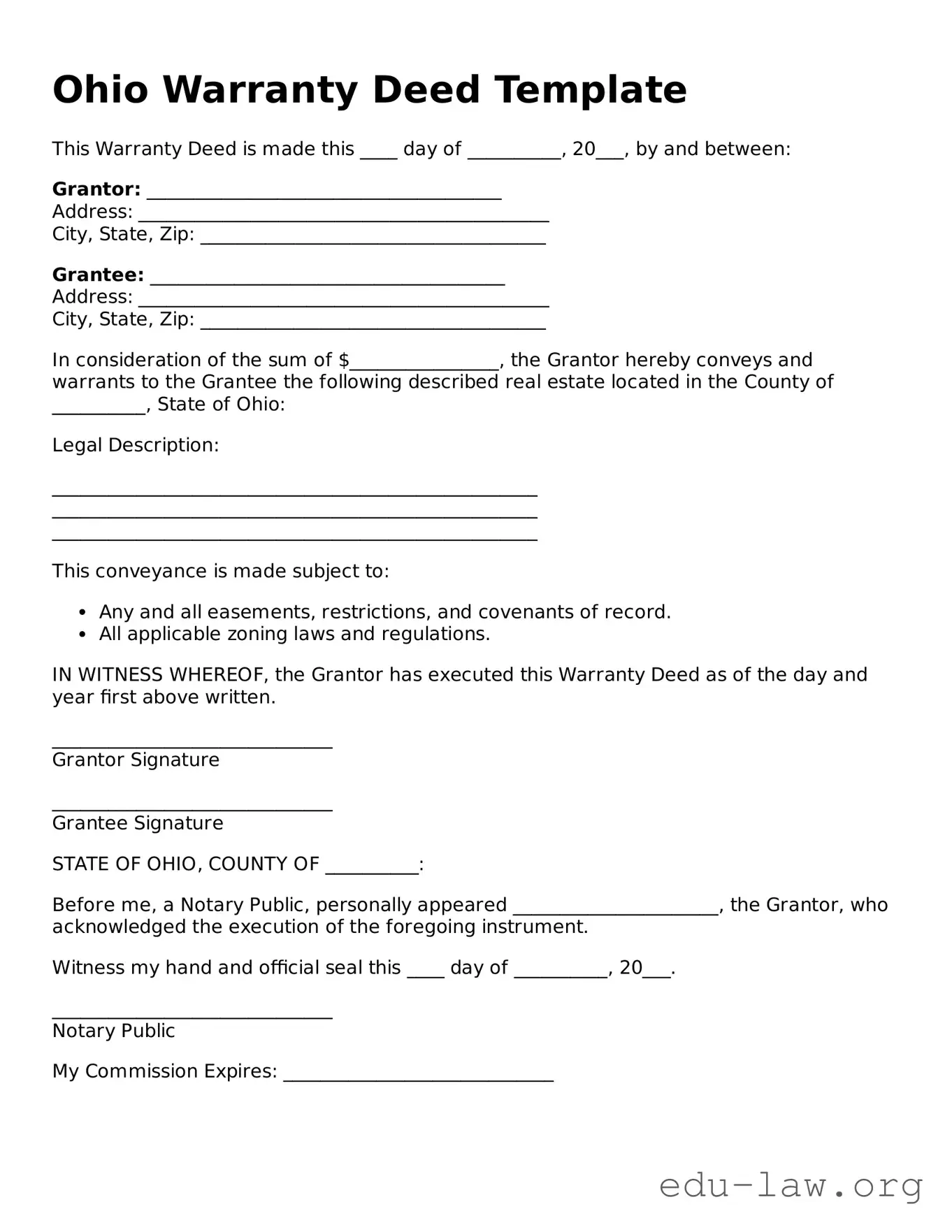
When it comes to transferring property ownership in Ohio, the Ohio Deed form plays a crucial role in ensuring that the transaction is legally recognized and binding. This form serves as the official document that records the transfer of real estate from one party to another, detailing essential information such as the names of the grantor (the person transferring the property) and the grantee (the person receiving the property). Additionally, the deed must include a clear description of the property being transferred, which typically involves the parcel's address and legal description. To make the transaction valid, the form requires the signatures of the grantor and, in some cases, the grantee, along with a notary public's acknowledgment. Understanding the nuances of the Ohio Deed form is vital for anyone involved in real estate transactions, as it not only protects the rights of the parties involved but also ensures compliance with state laws. Whether you are buying, selling, or gifting property, knowing how to properly fill out and file this form can help you avoid potential legal issues down the line.
Ohio Warranty Deed Template
This Warranty Deed is made this ____ day of __________, 20___, by and between:
Grantor: ______________________________________
Address: ____________________________________________
City, State, Zip: _____________________________________
Grantee: ______________________________________
Address: ____________________________________________
City, State, Zip: _____________________________________
In consideration of the sum of $________________, the Grantor hereby conveys and warrants to the Grantee the following described real estate located in the County of __________, State of Ohio:
Legal Description:
____________________________________________________
____________________________________________________
____________________________________________________
This conveyance is made subject to:
IN WITNESS WHEREOF, the Grantor has executed this Warranty Deed as of the day and year first above written.
______________________________
Grantor Signature
______________________________
Grantee Signature
STATE OF OHIO, COUNTY OF __________:
Before me, a Notary Public, personally appeared ______________________, the Grantor, who acknowledged the execution of the foregoing instrument.
Witness my hand and official seal this ____ day of __________, 20___.
______________________________
Notary Public
My Commission Expires: _____________________________
| Fact Name | Details |
|---|---|
| Definition | An Ohio deed form is a legal document that transfers ownership of real property from one party to another. |
| Types of Deeds | Common types include warranty deeds, quitclaim deeds, and special warranty deeds. |
| Governing Law | Ohio Revised Code Section 5301 governs the execution and recording of deeds in Ohio. |
| Execution Requirements | The deed must be signed by the grantor (the seller) and notarized to be valid. |
| Recording | To protect the buyer's interest, the deed should be recorded with the county recorder's office. |
| Consideration | A nominal consideration is often stated in the deed, but it does not need to reflect the actual sale price. |
| Legal Description | The deed must include a legal description of the property, which identifies it precisely. |
| Tax Implications | Transfer taxes may apply, and it’s essential to check local regulations for any fees. |
| Witnesses | Ohio law does not require witnesses for the execution of a deed, but having them can provide additional verification. |
| Revocation | Once a deed is executed and delivered, it cannot be revoked without the consent of the grantee (the buyer). |
After obtaining the Ohio Deed form, the next steps involve carefully filling out the required information. Ensuring accuracy is crucial, as any errors may lead to complications in the property transfer process. Follow the steps outlined below to complete the form correctly.
What is an Ohio Deed form?
An Ohio Deed form is a legal document used to transfer ownership of real property in the state of Ohio. It serves as evidence of the transfer and outlines the rights and responsibilities of the parties involved. Various types of deeds exist, including warranty deeds, quitclaim deeds, and special warranty deeds, each serving different purposes and offering varying levels of protection to the buyer.
Who needs to use an Ohio Deed form?
How do I complete an Ohio Deed form?
Is a notary public required for an Ohio Deed form?
Where do I file an Ohio Deed form?
What happens if I do not file the Ohio Deed form?
Can I use a generic deed form for my Ohio property transfer?
Failing to include the correct names of all parties involved. Ensure that the names match the legal documents and identification.
Not providing a complete legal description of the property. This description should be detailed enough to clearly identify the property being transferred.
Omitting the date of the transaction. The date is essential for establishing the timeline of ownership and for recording purposes.
Neglecting to have the document witnessed or notarized. Many states, including Ohio, require signatures to be notarized for the deed to be valid.
Using incorrect or outdated forms. Always ensure you are using the most current version of the deed form as specified by Ohio law.
Failing to pay the required filing fees. Be aware of the fees associated with recording the deed, as these must be paid at the time of submission.
Not providing sufficient contact information for all parties. This information is necessary for future correspondence and legal notifications.
Overlooking the need for property tax information. Ensure that any outstanding taxes or assessments are addressed during the transfer process.
When preparing to transfer property in Ohio, it’s important to consider several other forms and documents that may accompany the Ohio Deed form. Each of these documents serves a specific purpose in ensuring a smooth and legally sound transaction.
Having these documents ready can facilitate a smoother transaction process and help ensure that all legal requirements are met. Proper preparation is key to a successful property transfer in Ohio.
The Ohio Deed form shares similarities with the Warranty Deed. A Warranty Deed provides a guarantee from the seller to the buyer that the property is free from any claims or liens. This document assures the buyer that the seller has clear title to the property and the right to sell it. Like the Ohio Deed, the Warranty Deed requires signatures from both parties and is typically recorded with the county to provide public notice of the transfer.
Another document similar to the Ohio Deed is the Quitclaim Deed. A Quitclaim Deed transfers any interest the seller has in the property without making any guarantees about the title. This type of deed is often used among family members or in divorce settlements. While the Ohio Deed generally provides more protection to the buyer, the Quitclaim Deed is simpler and faster to execute.
The Special Purpose Deed is also comparable to the Ohio Deed. This type of deed is used for specific transactions, such as transferring property into a trust or from a trust to a beneficiary. Like the Ohio Deed, it requires proper execution and recording, ensuring that the transfer is legally recognized. However, its use is more limited to particular circumstances.
A Bargain and Sale Deed is another document that resembles the Ohio Deed. This deed implies that the seller has title to the property and the right to sell it, but it does not provide any warranties about the title. It is often used in foreclosure sales or tax sales. The Ohio Deed typically offers more assurance regarding the title than a Bargain and Sale Deed.
The Grant Deed is similar to the Ohio Deed as well. A Grant Deed transfers ownership of property and includes certain guarantees, such as the assurance that the property has not been sold to anyone else. This document is often used in real estate transactions. Both the Grant Deed and the Ohio Deed are recorded to establish public notice of ownership changes.
Another related document is the Trustee's Deed. This deed is used when a property is transferred by a trustee, often in the context of a trust or bankruptcy. Like the Ohio Deed, a Trustee's Deed must be executed and recorded to be effective. The key difference lies in the role of the trustee and the specific circumstances under which the property is transferred.
Lastly, the Executor's Deed is comparable to the Ohio Deed in that it is used to transfer property from a deceased person's estate to heirs or beneficiaries. This deed is executed by the executor of the estate and must be recorded to finalize the transfer. Both the Executor's Deed and the Ohio Deed serve the purpose of legally transferring property, but they operate within different contexts—one in the realm of estate management and the other in general real estate transactions.
When filling out the Ohio Deed form, it is important to follow certain guidelines to ensure accuracy and compliance. Here are five things to do and five things to avoid:
Things to Do:
Things to Avoid:
Understanding the Ohio Deed form is essential for anyone involved in real estate transactions in the state. However, several misconceptions often arise, leading to confusion among property owners and buyers. Below are six common misconceptions about the Ohio Deed form, along with clarifications for each.
By addressing these misconceptions, individuals can navigate the complexities of property transactions more effectively and ensure that their rights are protected.
When filling out and using the Ohio Deed form, keep the following key takeaways in mind: