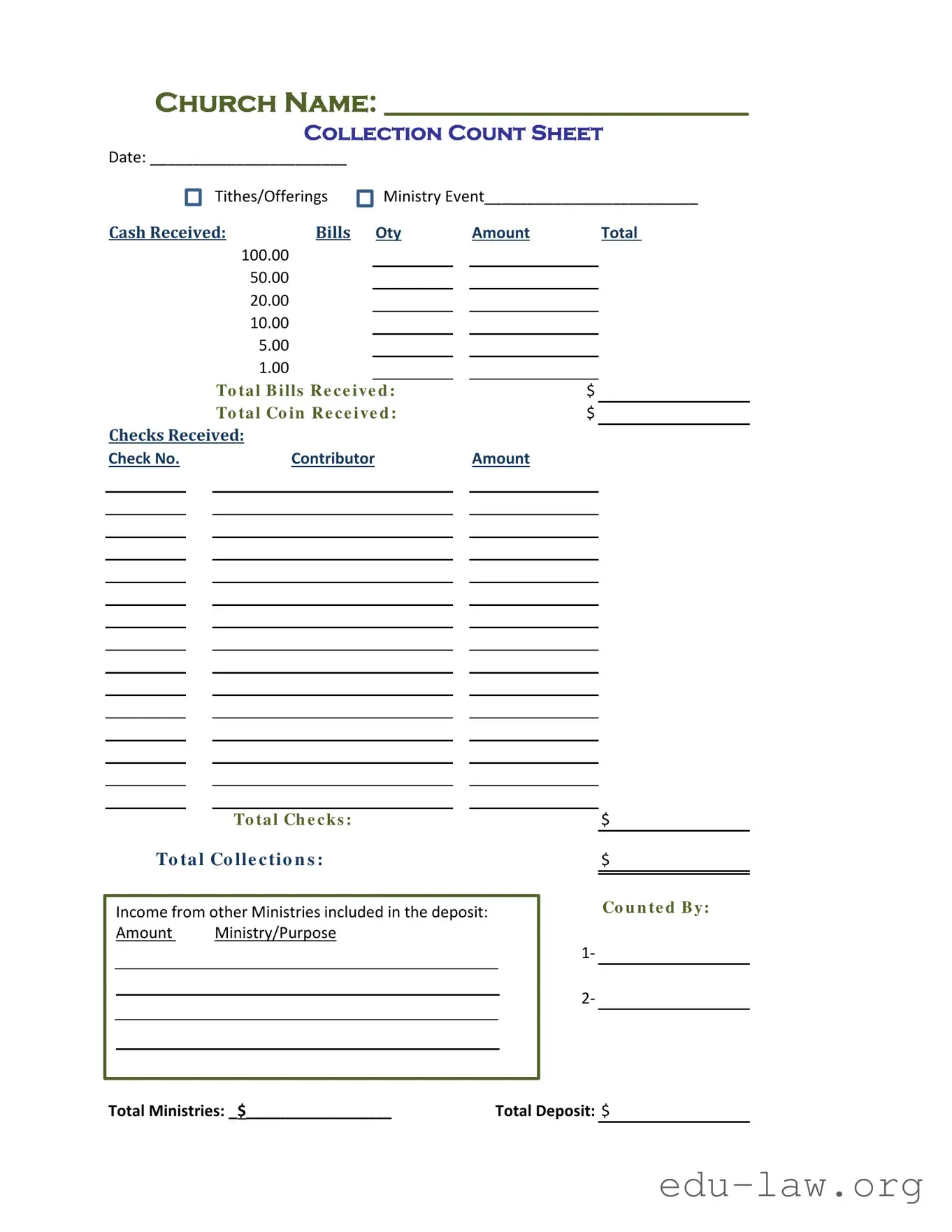
The Offer Report form serves as a vital tool for churches to accurately document and track the financial contributions received during services and events. This form includes essential sections such as the church name, date, and details about the collection, ensuring that all necessary information is captured systematically. It outlines the cash received, detailing the denominations of bills and coins, which helps in maintaining transparency and accountability. Additionally, the form provides space for recording checks received, including the check number and contributor's name, thereby allowing for easy reference and follow-up if needed. Income from other ministries can also be included, ensuring a comprehensive overview of the total collections. The form concludes with a section for the total deposit and the name of the individual who counted the funds, reinforcing the importance of accuracy in financial reporting.

CHURCH NAME: __________________________
COLLECTION COUNT SHEET
Date: _______________________ |
|
|
|
|
|
|
||||
|
|
Tithes/Offerings |
Ministry Event_________________________ |
|||||||
CASH RECEIVED: |
BILLS |
Oty |
|
Amount |
|
|
Total |
|||
100.00 |
|
|
|
|
|
|
|
|
||
50.00 |
|
|
|
|
|
|
|
|
||
|
|
|
|
|
|
|
|
|||
20.00 |
|
|
|
|
|
|
|
|
||
|
|
|
|
|
|
|
|
|||
10.00 |
|
|
|
|
|
|
|
|
||
5.00 |
|
|
|
|
|
|
|
|
||
|
|
|
|
|
|
|
|
|||
1.00 |
|
|
|
|
|
|
|
|
||
|
|
|
|
|
|
|
|
|||
|
|
To ta l B i lls R e c e i ve d : |
|
|
$ |
|
|
|||
|
|
To ta l Co i n R e c e i ve d : |
|
|
$ |
|
|
|||
CHECKS RECEIVED: |
|
|
|
|
|
|
|
|
||
Check No. |
Contributor |
|
|
Amount |
|
|
|
|||
|
|
|
|
|
|
|
|
|
|
|
|
|
|
|
|
|
|
|
|
|
|
|
|
|
|
|
|
|
|
|
|
|
|
|
|
|
|
|
|
|
|
|
|
|
|
|
|
|
|
|
|
|
|
|
|
|
|
|
|
|
|
|
|
|
|
|
|
|
|
|
|
|
|
|
|
|
|
|
|
|
|
|
|
|
|
|
|
|
|
|
|
|
|
|
|
|
|
|
|
|
|
|
|
|
|
|
|
|
|
|
|
|
|
|
|
|
|
|
|
|
|
|
|
|
|
|
|
|
|
|
|
|
|
|
|
|
|
|
|
|
|
|
|
|
|
|
|
|
|
|
|
|
|
|
|
|
|
|
|
|
|
|
|
|
To ta l Ch e c k s :
To ta l Co lle c ti o n s :
Income from other Ministries included in the deposit:
Amount Ministry/Purpose
$
$
Co u n te d B y:
1‐
2‐
Total Ministries: _$_________________ |
Total Deposit: $ |
|
|
|
|
| Fact Name | Description |
|---|---|
| Purpose | The Offer Report form is used by churches to document the collection of tithes and offerings during services or events. |
| Collection Tracking | This form helps track the cash and checks received, ensuring accurate accounting of donations. |
| Date Requirement | The form includes a date section to specify when the collection took place, aiding in record-keeping. |
| Cash Breakdown | It provides a detailed breakdown of cash received, including various bill denominations. |
| Checks Documentation | The form allows for the recording of check numbers, contributors, and amounts, ensuring transparency. |
| Ministry Events | It can be used for specific ministry events, allowing for targeted tracking of collections related to those events. |
| Total Collection | The form calculates total collections, combining cash and checks for a comprehensive total. |
| Income from Other Ministries | Churches can include income from other ministries, providing a complete financial picture. |
| Accountability | The form includes a section for the person who counted the collection, promoting accountability and accuracy. |
| State-Specific Laws | In some states, specific laws govern how churches must handle and report donations, such as IRS regulations for tax-exempt organizations. |
After completing the Offer Report form, it will be submitted to the appropriate church authority for record-keeping and financial tracking. Ensure all sections are filled out accurately to reflect the true financial status.
What is the purpose of the Offer Report form?
The Offer Report form is designed to help churches document and track the collection of tithes and offerings. It provides a clear record of the cash and checks received during a specific ministry event. This form assists in maintaining transparency and accountability in financial reporting within the church community.
What information do I need to fill out on the Offer Report form?
You will need to provide several key pieces of information. Start by entering the church name and the date of the collection. Then, detail the cash received by listing the denominations and their quantities. For checks, include the check number, contributor's name, and the amount. Additionally, you should note any income from other ministries that is included in the deposit.
How do I calculate the total cash received?
To calculate the total cash received, sum the amounts for each denomination listed on the form. Multiply the quantity of each bill by its value and then add these amounts together. Ensure that you also include the total amount of coins received, if applicable, to arrive at a comprehensive total for cash.
What should I do if there are discrepancies in the totals?
If you notice discrepancies in the totals, it is important to review the counts carefully. Double-check the amounts of cash and checks recorded. You may want to recount the cash and verify the checks against your records. If the discrepancies persist, consult with another member of the church staff or a financial officer for assistance in resolving the issue.
Who is responsible for completing the Offer Report form?
The responsibility for completing the Offer Report form typically falls to the individual or team designated to handle the collection during the ministry event. This may include church staff, volunteers, or finance committee members. It is crucial that the person completing the form is diligent and accurate to ensure proper financial reporting.
How should the Offer Report form be stored after completion?
Once completed, the Offer Report form should be securely stored in a designated location, such as a financial records file or a secure database. It is important to maintain these records for future reference and for auditing purposes. Digital copies may also be created to ensure backup and easier access.
Can the Offer Report form be modified for specific events?
Yes, the Offer Report form can be modified to suit specific events or needs. Churches may choose to add sections for additional information, such as special designations for certain offerings or events. However, any modifications should still allow for accurate tracking and reporting of the collections received.
Failing to provide the church name clearly. This can lead to confusion about where the funds are allocated.
Not including the date of the collection. This is essential for record-keeping and tracking donations over time.
Leaving the ministry event section blank. Identifying the event helps in understanding the context of the donations.
Incorrectly counting or reporting the cash received. Ensure that all bills and coins are accurately tallied to reflect the true amount.
Neglecting to list the check numbers received. This information is vital for tracking individual contributions.
Omitting the contributor's name for checks. Without this, it may be difficult to acknowledge donations or provide receipts.
Not calculating the total collections correctly. Double-check all totals to ensure accuracy in financial reporting.
Failing to include income from other ministries. This can lead to an incomplete picture of the overall financial health.
Leaving the counted by section blank. This is important for accountability and transparency.
Not signing or dating the form after completion. This final step confirms that the report is accurate and complete.
The Offer Report form is an essential document for tracking financial contributions within a church. However, several other forms and documents often accompany it to ensure comprehensive record-keeping and transparency. Below is a list of these related documents, each serving a specific purpose.
Each of these documents plays a vital role in maintaining financial integrity and accountability within the church community. Together, they support effective management of resources and foster trust among members.
The Offer Report form bears resemblance to a Cash Receipt form, which is commonly used in various organizations to document the receipt of cash payments. Both documents serve to track financial transactions, ensuring accountability and transparency. While the Offer Report focuses specifically on church collections, the Cash Receipt form can be utilized in a broader context, including retail and service industries. Each form typically includes details such as the date, amount received, and the purpose of the transaction, thus providing a clear record for financial auditing.
Another similar document is the Donation Receipt. This form is essential for nonprofits and charitable organizations, as it provides donors with proof of their contributions for tax purposes. Like the Offer Report, the Donation Receipt includes pertinent information such as the donor's name, the amount donated, and the date of the donation. Both documents play a crucial role in maintaining accurate financial records and ensuring that contributions are properly acknowledged.
The Fundraising Report is akin to the Offer Report in that it summarizes the financial outcomes of specific fundraising events. This document typically includes details about the total amount raised, expenses incurred, and the net proceeds. Similar to the Offer Report, it provides a comprehensive overview of financial performance related to a specific initiative, helping organizations assess the success of their fundraising efforts.
A Pledge Form also shares similarities with the Offer Report. This document is used to record commitments made by individuals or groups to contribute a specified amount over a certain period. While the Offer Report captures actual contributions, the Pledge Form focuses on future commitments. Both documents are vital for financial planning and budgeting within organizations, especially in a church setting.
The Expense Report can be compared to the Offer Report in terms of financial tracking. While the Offer Report documents incoming funds, the Expense Report details outgoing expenditures. Both forms require accurate record-keeping and may include similar fields such as dates, amounts, and purposes. Together, they provide a holistic view of an organization’s financial health.
The Ledger, a more comprehensive financial document, is similar to the Offer Report in that it serves as a record of all financial transactions over a specified period. The Offer Report captures specific instances of cash and check collections, while the Ledger provides a broader overview, including all income and expenses. Both documents are essential for maintaining accurate financial records and ensuring compliance with accounting standards.
A Bank Deposit Slip also shares characteristics with the Offer Report. This document is used to detail the contents of a deposit made to a bank account, including cash and checks. Like the Offer Report, it requires precise information about the amounts and types of funds being deposited. Both documents ensure that financial transactions are accurately recorded and verified by the respective institutions.
The Financial Statement, particularly the Statement of Activities, is similar to the Offer Report in that it summarizes an organization’s revenues and expenses over a certain period. While the Offer Report focuses specifically on collections, the Financial Statement provides a broader view of financial performance. Both documents are crucial for stakeholders who wish to understand the financial position of the organization.
The Contribution Tracking Spreadsheet is another document that aligns with the Offer Report. This spreadsheet is often used by organizations to maintain a detailed record of individual contributions over time. While the Offer Report captures a snapshot of a single collection event, the Contribution Tracking Spreadsheet allows for ongoing tracking and analysis of donor behavior and trends.
Finally, the Reconciliation Report can be compared to the Offer Report as it involves the process of ensuring that recorded transactions match the actual amounts held by the organization. While the Offer Report documents specific collections, the Reconciliation Report serves to verify that those amounts align with bank statements and other financial records. Both documents are integral to maintaining financial integrity and accuracy within an organization.
When filling out the Offer Report form, it is important to follow certain guidelines. Here are some things to do and not do:
Here are five common misconceptions about the Offer Report form:
This form is useful for churches of all sizes. Whether you have a small congregation or a large one, keeping track of donations is important.
Both cash and checks must be documented. The form has sections for each type of donation to ensure complete reporting.
The Offer Report form should be used regularly, not just for special events. Regular reporting helps maintain accurate financial records.
This section is crucial for understanding the full financial picture. It ensures transparency and accountability for all contributions.
The Offer Report form is straightforward. Each section is clearly labeled, making it easy to fill out.
When filling out and using the Offer Report form, it’s essential to keep a few key points in mind. This form serves as a vital tool for tracking contributions and ensuring transparency within your church's financial activities.
By following these takeaways, you can effectively utilize the Offer Report form to enhance your church's financial management and foster trust within your community.