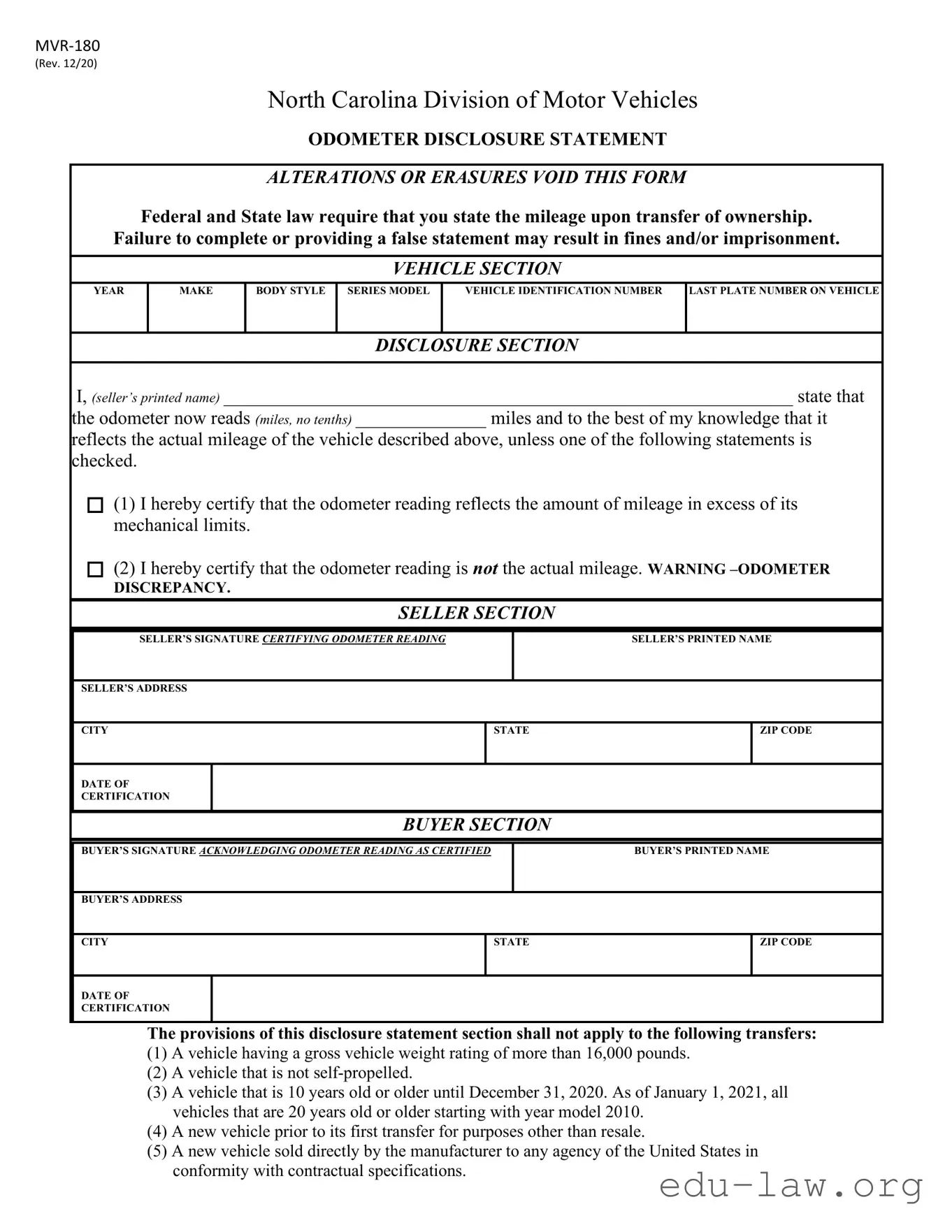
When buying or selling a vehicle in North Carolina, one important document that comes into play is the Odometer Disclosure Statement, known as the MVR-180 form. This form serves a crucial purpose: it ensures that the mileage on a vehicle's odometer is accurately reported during the transfer of ownership. Both federal and state laws mandate this disclosure, emphasizing the importance of honesty in the transaction. Notably, the form requires the seller to provide their name, the vehicle's details—including year, make, model, and identification number—and the current odometer reading. In addition, the seller must certify whether the mileage is actual or if it exceeds the mechanical limits of the odometer. Buyers also have a role, as they must acknowledge the odometer reading by signing the form. Importantly, certain vehicles are exempt from this requirement, including those over a specific weight limit or those that are 10 years old or older, with some exceptions. Understanding the MVR-180 form is essential for both parties to ensure a smooth and legally compliant vehicle transaction.
(Rev. 12/20)
North Carolina Division of Motor Vehicles
ODOMETER DISCLOSURE STATEMENT
ALTERATIONS OR ERASURES VOID THIS FORM
Federal and State law require that you state the mileage upon transfer of ownership.
Failure to complete or providing a false statement may result in fines and/or imprisonment.
VEHICLE SECTION
YEAR
MAKE
BODY STYLE SERIES MODEL
VEHICLE IDENTIFICATION NUMBER |
LAST PLATE NUMBER ON VEHICLE |
|
|
DISCLOSURE SECTION
I, (seller’s printed name) _____________________________________________________________ state that
the odometer now reads (miles, no tenths) ______________ miles and to the best of my knowledge that it
reflects the actual mileage of the vehicle described above, unless one of the following statements is checked.
(1) I hereby certify that the odometer reading reflects the amount of mileage in excess of its mechanical limits.
(2) I hereby certify that the odometer reading is not the actual mileage. WARNING
DISCREPANCY.
SELLER SECTION
SELLER’S SIGNATURE CERTIFYING ODOMETER READING
SELLER’S PRINTED NAME
SELLER’S ADDRESS
CITY
STATE
ZIP CODE
DATE OF
CERTIFICATION
BUYER SECTION
BUYER’S SIGNATURE ACKNOWLEDGING ODOMETER READING AS CERTIFIED
BUYER’S PRINTED NAME
BUYER’S ADDRESS
CITY
STATE
ZIP CODE
DATE OF
CERTIFICATION
The provisions of this disclosure statement section shall not apply to the following transfers:
(1)A vehicle having a gross vehicle weight rating of more than 16,000 pounds.
(2)A vehicle that is not
(3)A vehicle that is 10 years old or older until December 31, 2020. As of January 1, 2021, all vehicles that are 20 years old or older starting with year model 2010.
(4)A new vehicle prior to its first transfer for purposes other than resale.
(5)A new vehicle sold directly by the manufacturer to any agency of the United States in conformity with contractual specifications.
| Fact Name | Details |
|---|---|
| Form Title | MVR-180 Odometer Disclosure Statement |
| Governing Law | Federal and North Carolina state laws require odometer disclosure during vehicle ownership transfer. |
| Form Revision Date | Last revised in December 2020. |
| Odometer Reading Requirement | The seller must state the vehicle's mileage at the time of sale. |
| Consequences of False Statements | Providing a false odometer reading can lead to fines and/or imprisonment. |
| Disclosure Exceptions | Exemptions apply for vehicles over 16,000 pounds, not self-propelled, or 10 years old (until 2021). |
| Certification Statements | Two certification options exist for sellers regarding the odometer reading's accuracy. |
| Signature Requirement | Both seller and buyer must sign the form to acknowledge the odometer reading. |
| Buyer Acknowledgment | The buyer must acknowledge the odometer reading as certified by the seller. |
| Vehicle Identification | The form requires the vehicle's make, model, year, and VIN for proper identification. |
After gathering the necessary information, you will need to fill out the Odometer Statement MVR 180 form accurately. Ensure that all details are correct before submitting the form. Follow these steps to complete the form.
What is the purpose of the Odometer Statement MVR-180 form?
The Odometer Statement MVR-180 form is used to disclose the mileage of a vehicle at the time of ownership transfer. This is a legal requirement under both federal and state law. Accurately reporting the odometer reading helps protect buyers from potential fraud and ensures transparency in vehicle transactions.
Who needs to fill out the MVR-180 form?
The seller of the vehicle is responsible for completing the MVR-180 form. The seller must provide their printed name, the current odometer reading, and certify that the information is accurate. Buyers should also sign the form to acknowledge the odometer reading as certified by the seller.
What information is required on the MVR-180 form?
The form requires specific details about the vehicle, including the year, make, model, body style, vehicle identification number (VIN), and the last plate number on the vehicle. Additionally, the seller must state the current odometer reading in miles, without tenths.
What happens if the odometer reading is incorrect?
If the odometer reading is not accurate, the seller must check the appropriate box on the form to indicate that the reading is either not the actual mileage or that it reflects mileage in excess of its mechanical limits. Providing false information can lead to serious consequences, including fines or imprisonment.
Are there any vehicles exempt from using the MVR-180 form?
Yes, certain vehicles are exempt from completing the MVR-180 form. These include vehicles with a gross vehicle weight rating over 16,000 pounds, vehicles that are not self-propelled, and vehicles that are 10 years old or older (until December 31, 2020). As of January 1, 2021, vehicles that are 20 years old or older are also exempt.
What is the consequence of failing to complete the MVR-180 form?
Failure to complete the MVR-180 form or providing false information can result in legal repercussions. This includes potential fines and imprisonment, as both federal and state laws mandate accurate mileage disclosure during the transfer of vehicle ownership.
How should the form be signed?
The seller must sign the form to certify the odometer reading. The buyer should also sign to acknowledge the reading. Both parties should ensure that their printed names and addresses are clearly written, along with the date of certification.
What should I do if I need to make corrections on the MVR-180 form?
If corrections are necessary, it is important to fill out a new form instead of altering the original. Any alterations or erasures can void the form. Ensure that all information is accurate before signing to avoid complications.
Where can I obtain the MVR-180 form?
The MVR-180 form can typically be obtained from the North Carolina Division of Motor Vehicles (DMV) website or local DMV offices. It is advisable to use the most current version of the form to ensure compliance with the latest regulations.
Is there a fee associated with submitting the MVR-180 form?
There is no fee specifically for completing the MVR-180 form itself. However, other fees may apply when transferring vehicle ownership, such as title transfer fees or taxes. It is best to check with your local DMV for detailed information regarding any associated costs.
Not providing accurate mileage: It is crucial to report the correct odometer reading. Double-check the mileage before filling out the form.
Failing to sign the form: Both the seller and buyer must sign the document. Missing signatures can delay the transfer process.
Ignoring the certification statements: If the odometer reading is not accurate, it is important to check the appropriate statement. Failing to do so can lead to legal issues.
Leaving out personal information: Ensure that all required information, such as names and addresses, is filled in completely. Incomplete forms can be rejected.
Not including the vehicle identification number (VIN): The VIN is essential for identifying the vehicle. Make sure it is entered correctly.
Using incorrect mileage format: Report mileage in whole numbers, without tenths. This helps avoid confusion and ensures clarity.
Overlooking the date of certification: Both parties must include the date when the odometer reading was certified. This is important for record-keeping.
Not understanding exemptions: Familiarize yourself with the exemptions that apply to certain vehicles. This can save time and prevent mistakes.
The Odometer Statement MVR-180 form is essential for documenting the mileage of a vehicle during ownership transfers. However, several other forms and documents are commonly used alongside it to ensure a smooth transaction. Here is a list of these documents, each serving a unique purpose in the vehicle transfer process.
Each of these documents plays a critical role in the vehicle transfer process. Ensuring that all necessary forms are completed and submitted can help prevent delays and complications, providing both the buyer and seller with peace of mind during the transaction.
The Odometer Disclosure Statement is similar to the Vehicle Bill of Sale. A Vehicle Bill of Sale is a document that records the transaction between the buyer and seller of a vehicle. It typically includes details such as the vehicle’s make, model, and identification number, along with the sale price. Like the Odometer Statement, it also requires the seller to disclose the mileage at the time of sale. Both documents serve to protect the interests of both parties and ensure that accurate information is provided during the transfer of ownership.
Another document that resembles the Odometer Statement is the Title Transfer Application. This form is used when a vehicle's title is transferred from one owner to another. It includes information about the vehicle and the new owner, similar to the Odometer Statement. The Title Transfer Application also requires the seller to confirm the accuracy of the odometer reading, ensuring that the mileage is correctly recorded. This helps prevent fraud and misrepresentation in vehicle sales.
The Odometer Statement is also akin to the Affidavit of Odometer Reading. This affidavit is a sworn statement that confirms the mileage on a vehicle at the time of transfer. It is often used when the original odometer reading is unavailable or unclear. Like the Odometer Statement, it requires the seller to provide truthful information about the vehicle's mileage and may include similar penalties for false statements. Both documents aim to maintain transparency and accountability in vehicle transactions.
Lastly, the Manufacturer's Certificate of Origin (MCO) shares similarities with the Odometer Statement. The MCO is a document that establishes the first ownership of a new vehicle. It includes details about the vehicle, including the odometer reading at the time of sale. Just like the Odometer Statement, the MCO ensures that the buyer receives accurate information regarding the vehicle's mileage. This helps prevent future disputes and supports the integrity of vehicle ownership records.
When filling out the Odometer Statement MVR 180 form, it’s essential to follow specific guidelines to ensure accuracy and compliance with the law. Here’s a list of things you should and shouldn’t do:
Completing the form correctly is crucial. Mistakes can lead to legal issues or penalties. Always double-check your entries before submitting the form.
When it comes to the Odometer Statement MVR 180 form, many people have misconceptions that can lead to confusion. Let’s clear up some of these misunderstandings.
In fact, as of January 1, 2021, the requirement applies to all vehicles that are 20 years old or older, starting with the model year 2010.
This is incorrect. You must provide the mileage reading. Leaving it blank can lead to legal issues.
Both the seller and the buyer must sign the form. This acknowledges that both parties agree on the odometer reading.
Actually, this form is legally binding. Providing false information can result in fines or even imprisonment.
Altering or erasing any part of the form makes it void. If you make a mistake, it’s best to fill out a new form.
This form is required for all transfers of ownership, including dealership sales.
This is true. The provisions of this form do not apply to vehicles with a gross vehicle weight rating over 16,000 pounds.
Regardless of how informal the transfer is, the Odometer Statement is still required by law.
Understanding these points can help ensure a smooth transfer of vehicle ownership and keep you compliant with the law.
When filling out the Odometer Statement MVR-180 form, it's essential to understand its purpose and the legal implications involved. Here are some key takeaways: