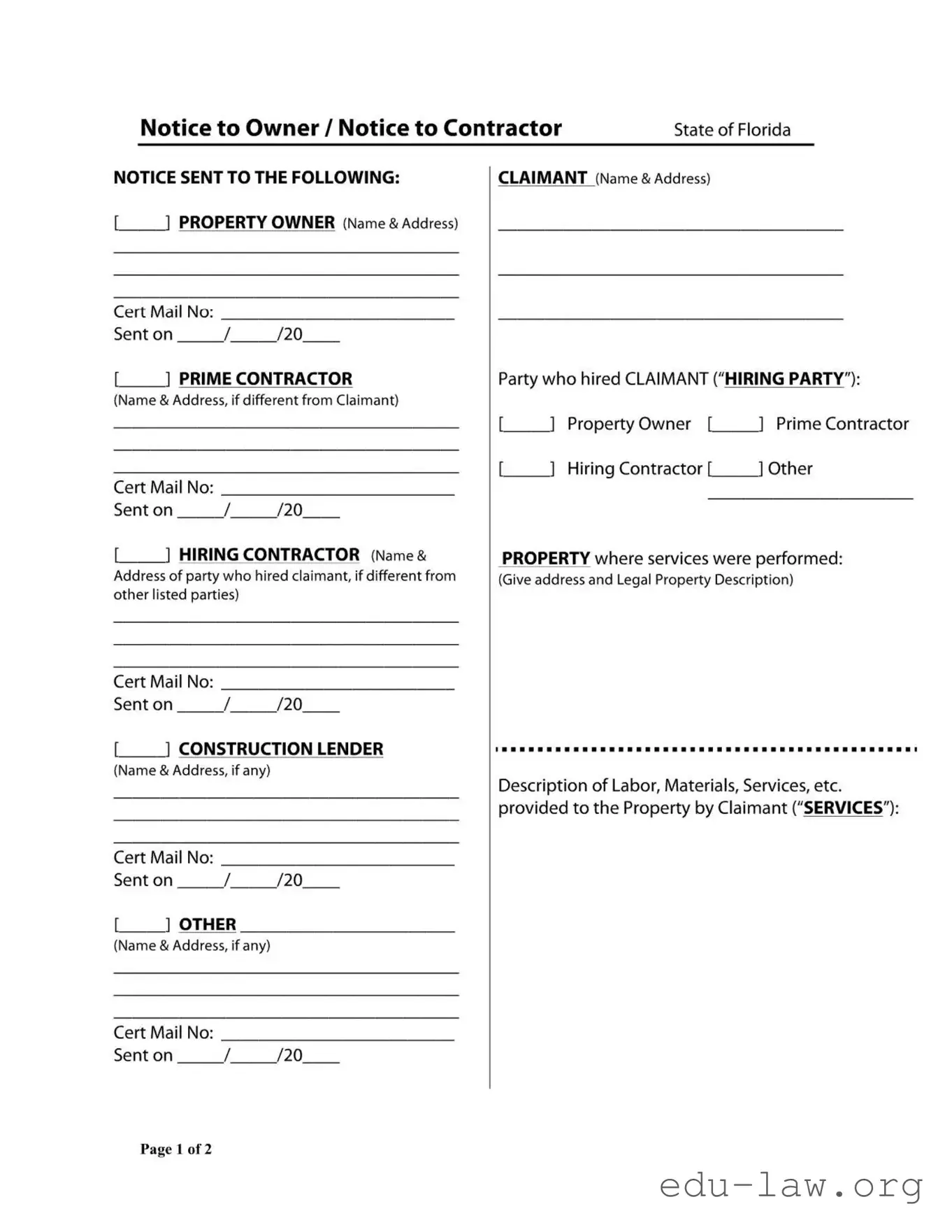
The Notice Owner Florida form plays a crucial role in the construction industry, particularly for property owners, contractors, and subcontractors. This form serves as a formal notification that informs relevant parties about the services being provided on a property. It includes essential details such as the names and addresses of the property owner, prime contractor, hiring contractor, and construction lender, ensuring that everyone involved is aware of the ongoing work. The form also outlines the specific labor, materials, and services provided, creating a clear record of the contributions made to the property. Importantly, it warns property owners about the potential for construction liens, which can arise if contractors or subcontractors do not receive payment. This warning emphasizes the need for property owners to secure written releases from contractors upon payment, thus protecting themselves from the risk of paying twice for the same services. By understanding the implications of this notice, property owners can take proactive steps to safeguard their interests and navigate the complexities of Florida's construction lien laws.
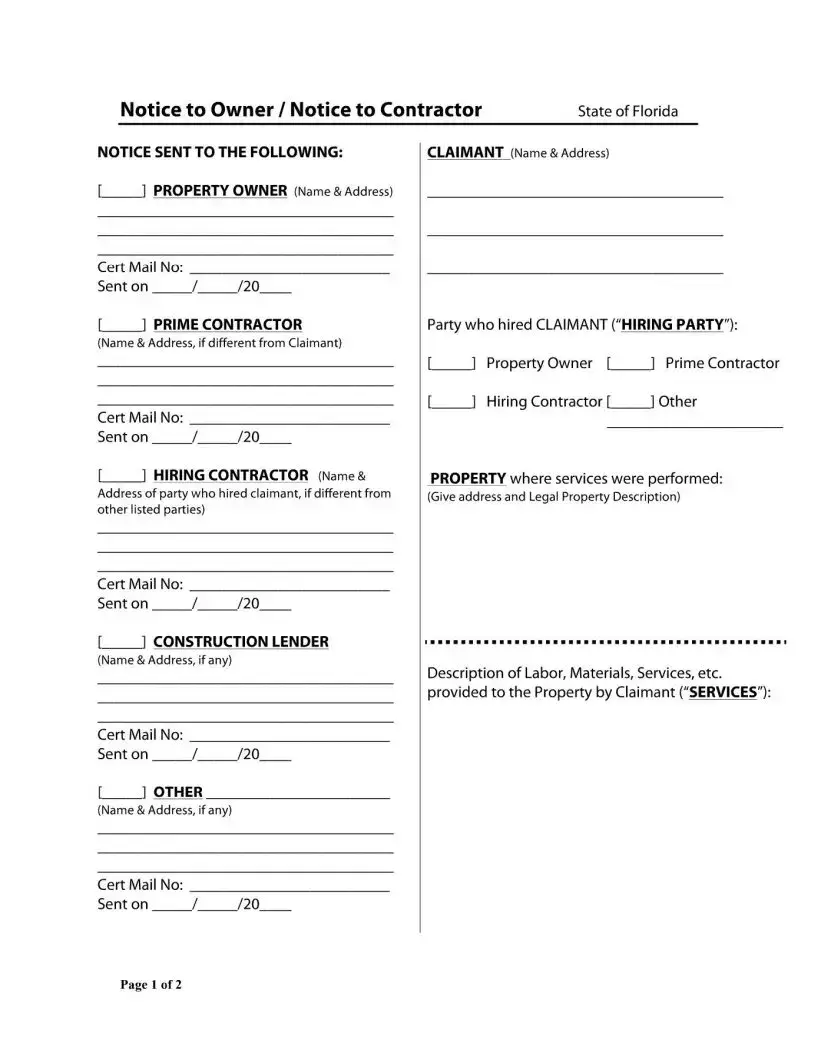
Notice to Owner/ Notice to Contractor |
State of Florida |
NOTICE SENT TO THE FOLLOWING:
~_ _,) PROPERTY OWNER (Name & Address)
Cert Mail No: ___________
Sent on __!__!20
..__..) PRIME CONTRACTOR
(Name & Address, if different from Claimant)
Cert Mail No: ___________
Senton __/__/20__
..__..) HIRING CONTRACTOR (Name &
Address of party who hired claimant, if different from other listed parties)
Cert Mail No:
Senton __/ __/20__
..__..) CONSTRUCTION LENDER
(Name & Address, if any)
Cert Mail No:
Sent on __/__/20__
~_ _,] OTHER __________
(Name & Address, if any)
CLAIMANT (Name & Address)
Party who hired CLAIMANT ("HIRING PARTY"):
Property Owner .__[_ __,) Prime Contractor
Hiring Contractor.__[_ __,) Other
PROPERTY where services were performed:
(Give address and Legal Property Description)
..........•.•.... |
• |
• |
• |
• |
Description of Labor, Materials, Services, et c. provided to t he Property by Claimant ("SERVICES"):
Cert Mail No:
Sent on __/__/20__
Page 1 of2
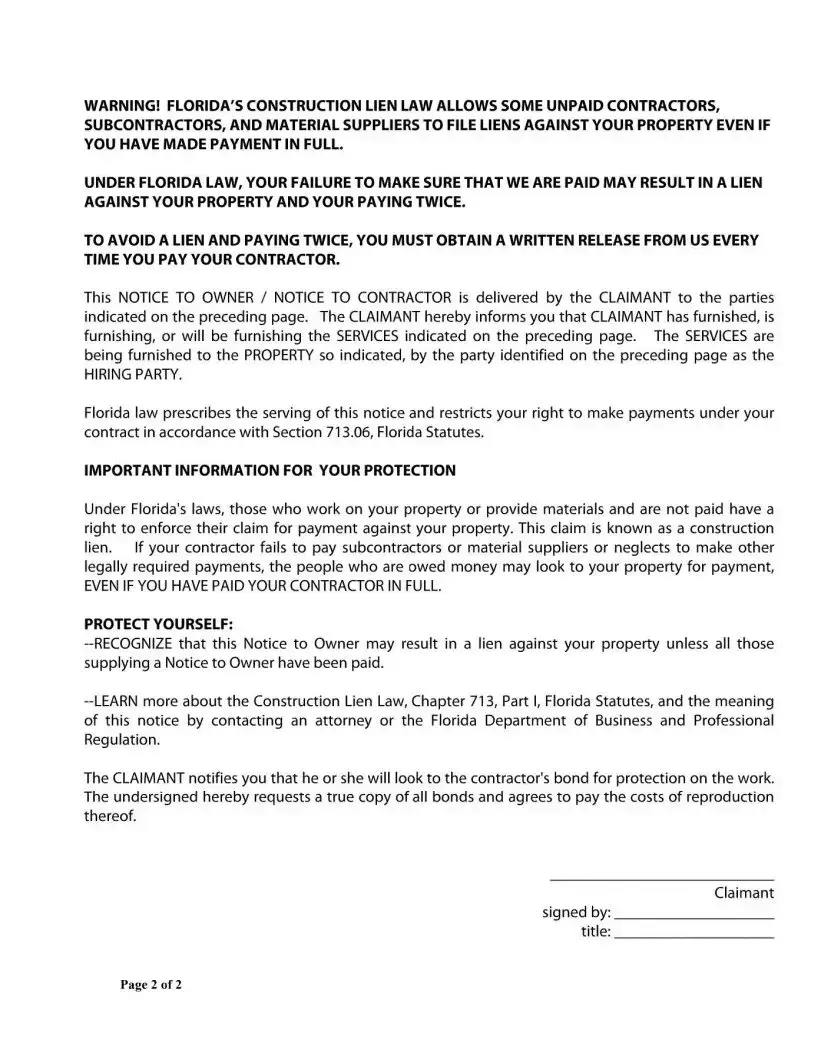
WARNING! FLORIDA'SCONSTRUCTION LIEN LAW ALLOWS SOME UNPAID CONTRACTORS, SUBCONTRACTORS, AND MATERIAL SUPPLIERS TO FILE LIENS AGAINST YOUR PROPERTY EVEN IF YOU HAVE MADE PAYMENT IN FULL.
UNDER FLORIDA LAW, YOUR FAILURE TO MAKE SURE THAT WE ARE PAID MAY RESULT IN A LIEN AGAINST YOUR PROPERTY AND YOUR PAYING TWICE.
TO AVOID A LIEN AND PAYING TWICE, YOU MUST OBTAIN A WRITTEN RELEASE FROM US EVERY TIME YOU PAY YOUR CONTRACTOR.
This NOTICE TO OWNER / NOTICE TO CONTRACTOR is delivered by the CLAIMANT to the parties indicated on the preceding page. The CLAIMANT hereby informs you that CLAIMANT has furnished, is furnishing, or will be furnishing the SERVICES indicated on the preceding page. The SERVICES are being furnished to the PROPERTY so indicated, by the party identified on the preceding page as the
HIRING PARTY.
Florida law prescribes the serving of this notice and restricts your right to make payments under your contract in accordance with Section 713.06, Florida Statutes.
IMPORTANT INFORMATION FOR YOUR PROTECTION
Under Florida'slaws, those who work on your property or provide materials and are not paid have a right to enforce their claim for payment against your property. This claim is known as a construction lien. If your contractor fails to pay subcontractors or material suppliers or neglects to make other legally required payments, the people who are owed money may look to your property for payment,
EVEN IF YOU HAVE PAID YOUR CONTRACTOR IN FULL.
PROTECT YOURSELF:
The CLAIMANT notifies you that he or she will look to the contractor'sbond for protection on the work. The undersigned hereby requests a true copy of all bonds and agrees to pay the costs of reproduction thereof.
Claimant
signed by: ________
title:
Page 2 of2
| Fact Name | Details |
|---|---|
| Purpose of the Form | The Notice to Owner form informs property owners and contractors that services or materials have been provided. It serves to protect the rights of those who supply labor and materials on a construction project. |
| Governing Law | This form is governed by Florida Statutes, specifically Section 713.06, which outlines the requirements and implications of construction liens. |
| Recipients of the Notice | The notice must be sent to various parties, including the property owner, prime contractor, hiring contractor, and any construction lender involved in the project. |
| Warning to Property Owners | Property owners are warned that unpaid contractors, subcontractors, and material suppliers may file a lien against their property, even if they have paid their contractor in full. |
| Importance of Payment Releases | To avoid potential liens, property owners should obtain a written release from contractors each time they make a payment. This protects them from paying twice for the same work. |
| Claimant's Rights | The claimant, who provides the services, has the right to seek payment from the contractor's bond if they are not compensated for their work. |
Filling out the Notice Owner Florida form is an important step in ensuring that all parties involved in a construction project are informed about services provided and potential liens. Follow these steps carefully to complete the form accurately.
Once you have completed the form, ensure that all information is accurate and legible. Keep a copy for your records and send it to the appropriate parties as required by Florida law.
What is the Notice Owner Florida form?
The Notice Owner Florida form is a legal document used in the construction industry. It informs property owners, contractors, and other relevant parties that certain services have been provided to a property. This notice is crucial for protecting the rights of contractors, subcontractors, and suppliers who may not receive payment for their work. It outlines the parties involved, the property in question, and the services rendered.
Who should receive the Notice Owner Florida form?
The Notice Owner Florida form must be sent to multiple parties. These include the property owner, the prime contractor, the hiring contractor, and any construction lenders involved. Additionally, if there are other relevant parties, they should also receive this notice. Ensuring that all parties are notified helps prevent potential liens against the property.
What are the consequences of not responding to the Notice Owner Florida form?
Failure to respond to the Notice Owner Florida form can lead to significant financial consequences. If the contractor does not pay subcontractors or suppliers, they may file a lien against the property, even if the property owner has paid the contractor in full. This situation could result in the property owner having to pay twice for the same services, which is why it is essential to address the notice promptly.
How can property owners protect themselves from liens?
Property owners can protect themselves by obtaining written releases from contractors and suppliers every time a payment is made. This practice ensures that all parties involved have been compensated, reducing the risk of a lien being placed on the property. Additionally, property owners should familiarize themselves with Florida's Construction Lien Law to understand their rights and obligations.
What should be done if a lien is placed on a property?
If a lien is placed on a property, it is crucial to address it immediately. Property owners should review the details of the lien and consult with a legal professional to understand their options. They may need to pay the outstanding amount or negotiate with the claimant to resolve the issue. Timely action is essential to prevent further complications and protect the property.
Failing to include the correct property owner's name and address. This is crucial for ensuring that the notice reaches the right individual.
Not providing a complete legal description of the property. A vague description can lead to confusion and potential disputes.
Omitting the certified mail number for each party listed. This number serves as proof of delivery and is essential for legal purposes.
Using incorrect dates for when the notices were sent. Accurate dates are necessary to establish timelines for potential claims.
Not identifying the hiring contractor if different from the claimant. This can create uncertainty about who is responsible for payment.
Neglecting to specify the services provided clearly. A detailed description helps avoid misunderstandings regarding the work done.
Failing to include the construction lender's information, if applicable. This information is vital for anyone involved in the financing of the project.
Not obtaining a written release from the contractor after payment. This is a key step in protecting against potential liens.
Ignoring the requirement to notify all parties involved. Each party must be informed to ensure compliance with Florida's lien laws.
Not seeking legal advice when in doubt. Understanding the implications of the notice is essential for protecting your rights.
The Notice to Owner form is an essential document in Florida's construction industry, primarily used to inform property owners and other parties about potential liens on a property. Along with this form, several other documents are commonly utilized to ensure compliance with Florida's construction lien laws. Below is a list of these documents, each serving a specific purpose.
Understanding these documents is crucial for property owners and contractors alike. Proper use of these forms can help prevent financial disputes and protect the interests of all parties involved in construction projects in Florida.
The Notice of Intent to Lien serves a similar purpose as the Notice to Owner in Florida. It is a document that informs property owners of a contractor's or subcontractor's intent to file a lien against the property if payment is not received. Both documents aim to protect the rights of those who provide labor or materials by notifying the property owner of potential claims. The Notice of Intent to Lien is typically sent before the actual lien is filed, giving the owner a chance to settle any outstanding payments to avoid further legal action.
The Preliminary Notice is another document that resembles the Notice to Owner. This notice is often utilized in construction projects to inform property owners and general contractors about the involvement of subcontractors and suppliers. Like the Notice to Owner, it serves as a warning that failure to pay may result in a lien on the property. The Preliminary Notice is essential for ensuring that all parties are aware of their responsibilities and the potential consequences of non-payment.
The Mechanic's Lien is closely related to the Notice to Owner as it is the actual claim that can be filed against a property when payment is not made for services rendered. After providing the Notice to Owner, if the contractor or subcontractor does not receive payment, they may proceed to file a Mechanic's Lien. This legal claim can ultimately lead to the sale of the property to satisfy the debt. Both documents emphasize the importance of timely payments in the construction industry.
The Lien Waiver is another important document that works in conjunction with the Notice to Owner. It is used to relinquish the right to file a lien in exchange for payment. When a contractor or subcontractor receives payment, they may issue a Lien Waiver to confirm that they will not pursue a lien against the property for the amount paid. This document provides security to property owners that they have fulfilled their payment obligations and mitigates the risk of future claims.
The Notice of Non-Payment is similar to the Notice to Owner in that it informs the property owner of unpaid bills related to the construction project. This notice is typically sent when a contractor or subcontractor has not received payment from the hiring party. The purpose is to alert the property owner of the potential for a lien if the situation is not resolved. Both documents serve as proactive measures to encourage payment and protect the rights of those involved in the project.
The Certificate of Payment is another document that aligns with the Notice to Owner. This certificate is issued to confirm that payment has been made for services rendered. It provides assurance to the property owner that the contractor or subcontractor has fulfilled their obligations. While the Notice to Owner warns of potential claims, the Certificate of Payment serves as proof that payments have been made, thus reducing the likelihood of disputes over unpaid bills.
The Affidavit of Non-Payment is also similar to the Notice to Owner. This document is used to declare that a contractor or subcontractor has not received payment for their services. It can be filed in conjunction with a Mechanic's Lien to strengthen the claim against the property. Both the Affidavit of Non-Payment and the Notice to Owner emphasize the importance of timely payments and the consequences of failing to meet financial obligations.
Finally, the Release of Lien is a document that relates to the Notice to Owner by providing confirmation that a lien has been satisfied. Once a contractor or subcontractor receives payment, they can issue a Release of Lien to the property owner, indicating that they no longer have a claim against the property. This document is crucial for property owners to ensure that all claims have been resolved and to prevent any future disputes regarding payment.
When filling out the Notice Owner Florida form, it is crucial to ensure accuracy and compliance with state requirements. Here are four essential dos and don'ts to guide you through the process:
Misconceptions about the Notice Owner Florida form can lead to confusion for property owners and contractors alike. Here are seven common misunderstandings:
Understanding these misconceptions can help property owners and contractors navigate the complexities of construction law in Florida more effectively.
When filling out and using the Notice to Owner form in Florida, consider the following key takeaways:
By following these guidelines, you can effectively navigate the complexities of the Notice to Owner form and safeguard your interests in construction projects.