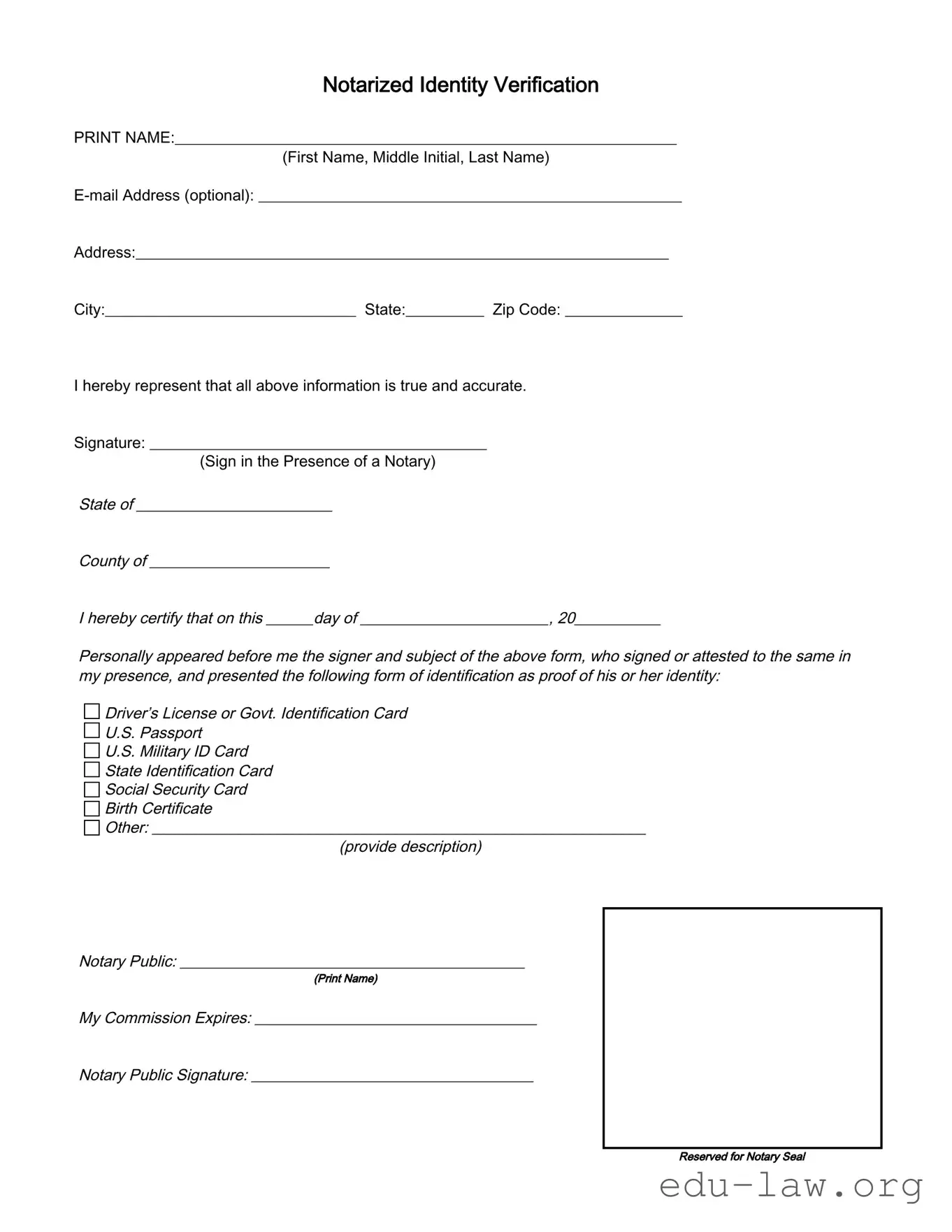
The Notarized Identity Verification form is an essential document that plays a crucial role in confirming an individual's identity. This form requires the person to provide their full name, email address, and home address, ensuring that all information submitted is accurate and truthful. After filling out these details, the individual must sign the form in the presence of a notary public, who then verifies the signer’s identity by witnessing the signature. The notary will also record the date and location of the signing, as well as the type of identification presented, which can include options like a driver’s license, U.S. passport, or even a birth certificate. This verification process helps prevent identity fraud and ensures that the person’s identity is legitimate. Additionally, the notary public’s signature and seal are required to finalize the document, making it legally binding. Overall, the Notarized Identity Verification form is a straightforward yet vital tool for safeguarding personal information in various legal and financial transactions.

Notarized Identity Verification
PRINT NAME:________________________________________________________________
(First Name, Middle Initial, Last Name)
Address:____________________________________________________________________
City:________________________________ State:__________ Zip Code: _______________
I hereby represent that all above information is true and accurate.
Signature: ___________________________________________
(Sign in the Presence of a Notary)
State of _________________________
County of _______________________
I hereby certify that on this ______day of ________________________, 20___________
Personally appeared before me the signer and subject of the above form, who signed or attested to the same in my presence, and presented the following form of identification as proof of his or her identity:
Driver’s License or Govt. Identification Card
U.S. Passport
U.S. Military ID Card
State Identification Card
Social Security Card
Birth Certificate
Other: _______________________________________________________________
(provide description)
Notary Public: ____________________________________________
(Print Name)
My Commission Expires: ____________________________________
Notary Public Signature: ____________________________________
Reserved for Notary Seal
| Fact Name | Description |
|---|---|
| Purpose | The Notarized Identity Verification form is used to confirm an individual's identity through a notary public. |
| Required Information | Individuals must provide their full name, optional email address, and residential address on the form. |
| Signature Requirement | The individual must sign the form in the presence of a notary public to validate the information provided. |
| Identification Proof | A variety of identification forms can be presented, including a driver's license, passport, or military ID. |
| State-Specific Laws | Different states have their own laws governing notarization; for example, California's Notary Public Act outlines specific requirements. |
| Notary Certification | The notary public certifies the identity of the signer and records the date of the notarization on the form. |
| Expiration of Notary Commission | The notary public must indicate the expiration date of their commission, ensuring they are authorized to perform notarizations. |
| Reserved Space | A designated area is included for the notary seal, which adds an official mark of authenticity to the document. |
Once you have your Notarized Identity Verification form ready, you will need to fill it out carefully. This form requires specific information to ensure that your identity is verified accurately. Follow the steps below to complete the form correctly.
After completing the form and having it notarized, keep a copy for your records. The notarized form will be used for identity verification purposes, so ensure it is stored safely.
What is the Notarized Identity Verification form?
The Notarized Identity Verification form is a document used to confirm an individual's identity. It requires the individual to provide personal information, such as their name, address, and a form of identification. A notary public must witness the signing of this form to ensure its validity.
Why is notarization necessary for this form?
Notarization adds a layer of security and authenticity to the identity verification process. It ensures that the person signing the form is indeed who they claim to be. The notary public verifies the identity of the signer through acceptable forms of identification and witnesses the signature, which helps prevent fraud.
What information do I need to provide on the form?
You need to print your full name, email address (optional), and your complete address, including city, state, and zip code. Additionally, you must sign the form in the presence of a notary public. The form also requires the notary to fill in details about the identification you presented.
What forms of identification are acceptable?
Acceptable forms of identification include a driver's license, government identification card, U.S. passport, U.S. military ID card, state identification card, social security card, and birth certificate. If you have another form of ID, you can describe it in the provided space.
How do I find a notary public?
You can find a notary public through various channels. Many banks, law offices, and shipping centers offer notary services. Additionally, you can search online for notaries in your area. Ensure the notary is licensed and authorized to perform notarizations in your state.
What happens if I provide false information on the form?
Providing false information on the Notarized Identity Verification form can lead to serious legal consequences. This may include criminal charges for fraud or perjury. It is crucial to ensure that all information you provide is accurate and truthful.
Is the email address mandatory on the form?
No, providing your email address is optional. However, including it may facilitate communication regarding the verification process or any follow-up actions that may be required.
How long is the notarization valid?
The validity of a notarization can vary by state and the purpose of the document. Generally, notarized documents do not expire but may need to be updated if significant time passes or if the information changes. It is best to check with the relevant authority regarding specific requirements.
Incomplete Name Entry: Some people forget to include their middle initial or only provide a first name and last name. Always ensure you print your full name clearly.
Missing Email Address: While optional, leaving out your email can hinder communication. It’s wise to include it for any follow-up.
Incorrect Address Details: Double-check your address. Errors in the city, state, or zip code can lead to confusion.
Signature Issues: Sign the form in front of the notary. If you sign it beforehand, the notarization may not be valid.
Identification Mistakes: Ensure you present the correct form of identification. Using an unlisted ID can cause delays.
Omitting Notary Information: The notary must fill out their name and commission expiration date. Leaving this blank can invalidate the form.
Notary Seal Absence: Always check for the notary seal. Without it, the document may not be recognized as valid.
The Notarized Identity Verification form is often accompanied by various other documents that help establish and confirm an individual's identity. These documents serve important purposes in legal and official contexts. Below are four common forms and documents that are frequently used alongside the Notarized Identity Verification form.
Understanding these documents can help individuals navigate the identity verification process more effectively. Each document plays a crucial role in ensuring that identity is accurately established and recognized in various legal and administrative settings.
The Affidavit of Identity is a document that serves a similar purpose to the Notarized Identity Verification form. It is a sworn statement where an individual affirms their identity under oath. Like the Notarized Identity Verification form, it requires personal information such as name, address, and sometimes additional identifying details. The key difference lies in its legal weight; an affidavit can be used in court as evidence, while the notarized form is primarily for verification purposes. Both documents involve a notary public who witnesses the signing, adding a layer of authenticity.
The Passport Application form is another document that shares similarities with the Notarized Identity Verification form. When applying for a passport, individuals must provide proof of identity, which often includes notarized documents. The application requires personal details and typically asks for a certified copy of an identity document, just like the notarized form. Both documents are essential for confirming one’s identity, especially when traveling or engaging in legal matters, and both must be completed accurately to avoid delays.
The Driver’s License Application is also comparable to the Notarized Identity Verification form. When applying for a driver's license, individuals must provide proof of identity, residency, and sometimes social security number. Like the notarized form, this application requires the applicant to affirm that the information provided is true. The presence of a notary may not be required for a driver’s license application, but both documents aim to establish a person’s identity for official purposes.
The Social Security Application form functions similarly to the Notarized Identity Verification form by requiring individuals to provide proof of identity. To obtain a Social Security number, applicants must submit identification documents that verify their identity and citizenship. Both forms require accurate personal information and often involve notarization to confirm authenticity. They serve as vital tools for establishing identity in various governmental and financial transactions.
The Voter Registration form is another document that parallels the Notarized Identity Verification form. When registering to vote, individuals must provide personal information, including their name and address, to confirm their identity. Some states require proof of identity, which can be satisfied by a notarized form. Both documents ensure that individuals are who they claim to be, thereby helping to maintain the integrity of the electoral process.
The Employment Verification form is similar in that it often requires an individual to prove their identity for job-related purposes. Employers may ask for a notarized identity verification to confirm the applicant's identity and eligibility to work. Both documents include personal information and may need to be signed in the presence of a notary. They serve as crucial components in the hiring process, ensuring that the identity of potential employees is verified properly.
Lastly, the Lease Agreement often requires a Notarized Identity Verification form or similar documentation to confirm the identity of the tenant. Landlords may ask for notarized identification to ensure that the person signing the lease is indeed who they claim to be. Both documents share the goal of verifying identity, which is essential in establishing legal agreements and protecting the interests of both parties involved in a lease.
When filling out the Notarized Identity Verification form, it is essential to approach the task with care. Here are some important dos and don'ts to keep in mind.
Here are ten common misconceptions about the Notarized Identity Verification form:
When filling out and using the Notarized Identity Verification form, keep these key takeaways in mind: