In North Carolina, the Transfer-on-Death (TOD) deed offers a straightforward and effective way for property owners to transfer their real estate to designated beneficiaries upon their passing, all while avoiding the often complex and costly probate process. This form allows individuals to maintain full control of their property during their lifetime, ensuring they can sell, mortgage, or otherwise manage their assets without interference. Upon the death of the property owner, the designated beneficiaries automatically receive ownership, simplifying the transition and providing peace of mind. Importantly, the TOD deed must be properly executed and recorded to be valid, which underscores the necessity of understanding the legal requirements involved. This form is not just a convenient tool; it reflects a growing trend toward estate planning strategies that prioritize efficiency and clarity for both the property owner and their heirs. With its relatively simple process and clear advantages, the North Carolina Transfer-on-Death deed serves as a valuable option for those looking to secure their legacy while minimizing potential complications for their loved ones.
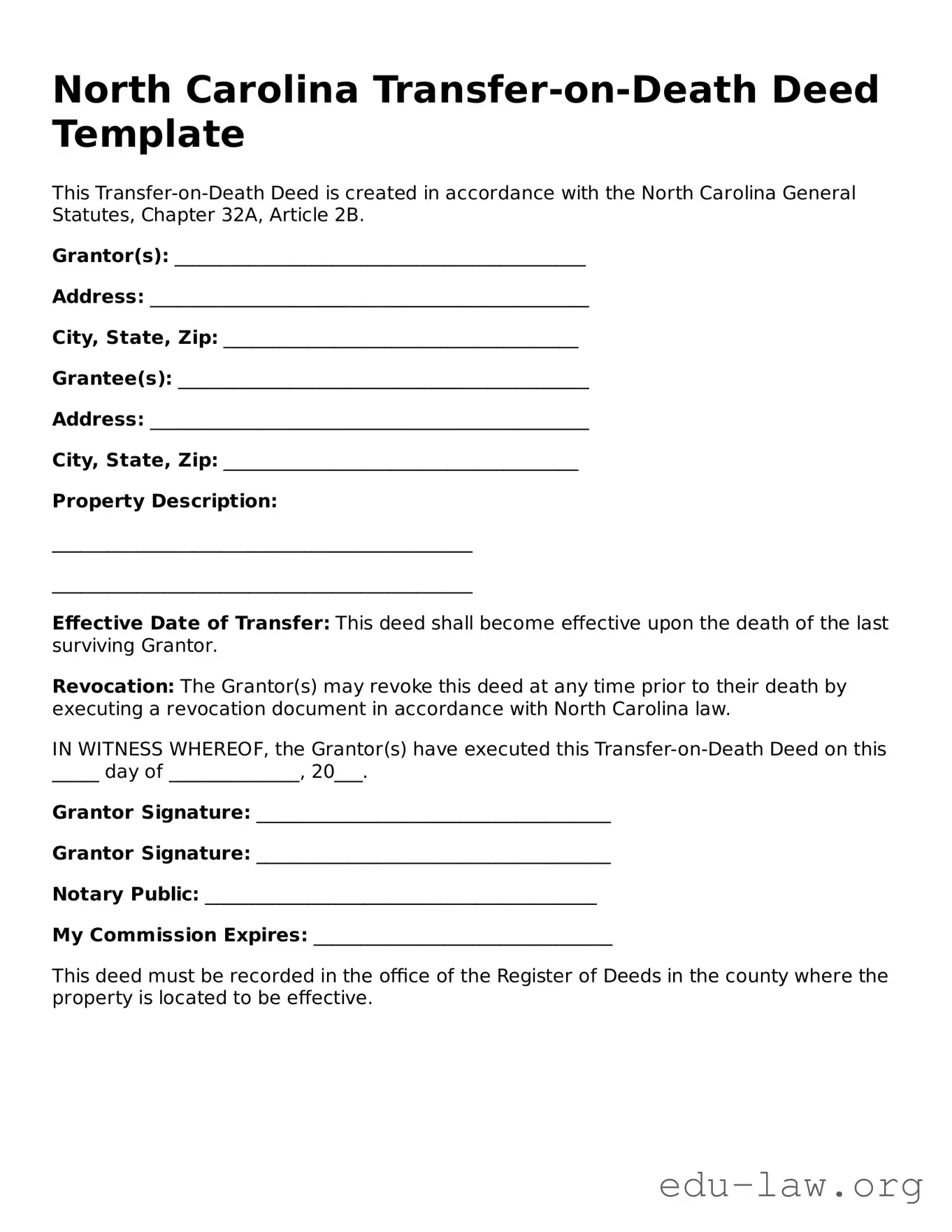
North Carolina Transfer-on-Death Deed Template
This Transfer-on-Death Deed is created in accordance with the North Carolina General Statutes, Chapter 32A, Article 2B.
Grantor(s): ____________________________________________
Address: _______________________________________________
City, State, Zip: ______________________________________
Grantee(s): ____________________________________________
Address: _______________________________________________
City, State, Zip: ______________________________________
Property Description:
_____________________________________________
_____________________________________________
Effective Date of Transfer: This deed shall become effective upon the death of the last surviving Grantor.
Revocation: The Grantor(s) may revoke this deed at any time prior to their death by executing a revocation document in accordance with North Carolina law.
IN WITNESS WHEREOF, the Grantor(s) have executed this Transfer-on-Death Deed on this _____ day of ______________, 20___.
Grantor Signature: ______________________________________
Grantor Signature: ______________________________________
Notary Public: __________________________________________
My Commission Expires: ________________________________
This deed must be recorded in the office of the Register of Deeds in the county where the property is located to be effective.
| Fact Name | Description |
|---|---|
| Definition | A Transfer-on-Death Deed allows an individual to transfer real estate to a beneficiary upon their death without going through probate. |
| Governing Law | The Transfer-on-Death Deed in North Carolina is governed by N.C. Gen. Stat. § 32A-1.1. |
| Eligibility | Any individual who owns real property in North Carolina can create a Transfer-on-Death Deed. |
| Beneficiary Designation | Multiple beneficiaries can be named, and the property can be divided among them as specified in the deed. |
| Revocation | The deed can be revoked at any time by the owner before their death, as long as the revocation is properly executed. |
| Recording Requirement | The Transfer-on-Death Deed must be recorded in the county where the property is located to be effective. |
| Tax Implications | There are no immediate tax implications for the beneficiary until the property is sold or transferred after the owner's death. |
| Limitations | The deed does not apply to jointly owned property or property held in a trust. |
Filling out the North Carolina Transfer-on-Death Deed form is a straightforward process that allows you to designate beneficiaries for your property. Once completed, this form must be filed with the local Register of Deeds office to ensure that your wishes are legally recognized. Follow these steps to fill out the form accurately.
What is a Transfer-on-Death Deed in North Carolina?
A Transfer-on-Death Deed (TOD Deed) allows property owners in North Carolina to transfer their real estate to a designated beneficiary upon their death. This deed is effective immediately upon signing but does not transfer ownership until the owner's death. It helps avoid probate, making the transfer process simpler and quicker for heirs.
Who can use a Transfer-on-Death Deed?
Any property owner in North Carolina can use a TOD Deed. This includes individuals who own real estate solely or as joint tenants. However, if the property is owned by a trust or a business entity, a different method of transfer may be necessary.
How do I create a Transfer-on-Death Deed?
To create a TOD Deed, you must fill out the appropriate form, which is available online or at local government offices. The form requires you to provide your name, the name of the beneficiary, a description of the property, and your signature. It must then be notarized and recorded in the county where the property is located to be legally effective.
Can I change or revoke a Transfer-on-Death Deed?
Yes, you can change or revoke a TOD Deed at any time while you are alive. To do this, you need to create a new deed that specifies the changes or explicitly states that the previous deed is revoked. This new deed must also be notarized and recorded to be valid.
What happens if the beneficiary dies before me?
If the beneficiary named in your TOD Deed dies before you, the deed does not automatically transfer the property to the beneficiary's heirs. Instead, the property will go through probate unless you name an alternate beneficiary in the deed. If no alternate is named, you may want to consider updating the deed to reflect your wishes.
Are there any limitations on who I can name as a beneficiary?
Generally, you can name anyone as a beneficiary in a TOD Deed, including family members, friends, or organizations. However, if you are transferring property that is subject to a mortgage or other liens, it’s essential to consider how those debts will affect the transfer. Consulting with a legal professional can provide clarity on specific situations.
What are the tax implications of using a Transfer-on-Death Deed?
Using a TOD Deed generally does not trigger any immediate tax consequences. The property is not considered part of your estate for tax purposes until your death. However, beneficiaries may face capital gains taxes when they sell the property, depending on the property's value at the time of transfer and the tax laws in effect at that time.
Is a Transfer-on-Death Deed the right choice for everyone?
A TOD Deed can be an excellent option for many individuals, particularly those looking to simplify the transfer of real estate to heirs. However, it may not be suitable for everyone. Factors such as family dynamics, the nature of the property, and personal financial situations should all be considered. Consulting with an attorney can help you determine if a TOD Deed aligns with your estate planning goals.
Incomplete Information: One of the most common mistakes is failing to provide all necessary details. This includes not listing the full names of the property owners or the beneficiaries. Each name must be spelled correctly and match official identification to avoid confusion.
Incorrect Property Description: The property must be described accurately. This includes using the correct legal description found in the property deed. Omitting details or using vague terms can lead to disputes or challenges later.
Not Signing the Deed: A Transfer-on-Death Deed must be signed by the property owner. Failing to sign or having an unauthorized person sign can invalidate the deed. Always ensure that the signature is witnessed or notarized as required.
Improper Filing: After completing the form, it must be filed with the appropriate county register of deeds. Some people mistakenly believe that simply filling out the form is enough. Without proper filing, the deed will not take effect.
Neglecting to Update the Deed: Life changes, such as marriage, divorce, or the birth of children, may necessitate updates to the deed. Failing to revise the deed can lead to unintended consequences regarding who inherits the property.
The North Carolina Transfer-on-Death Deed is a useful tool for individuals looking to pass on property to beneficiaries without going through probate. However, several other documents often accompany this deed to ensure a smooth transfer of ownership and to clarify intentions. Here’s a brief overview of these related forms and documents.
Having these documents prepared and organized can significantly ease the process of transferring property and help avoid potential disputes among beneficiaries. It's always a good idea to consult with a professional for guidance tailored to individual circumstances.
The North Carolina Transfer-on-Death Deed (TODD) form shares similarities with a standard will. Both documents allow individuals to designate how their property will be distributed after their death. A will typically goes through probate, a court process that validates the document and oversees the distribution of assets. In contrast, the TODD allows property to transfer directly to the designated beneficiary without going through probate, simplifying the process and potentially saving time and costs for the heirs.
When filling out the North Carolina Transfer-on-Death Deed form, it's important to ensure accuracy and compliance with state laws. Here are some key do's and don'ts to keep in mind:
Many people have misunderstandings about the North Carolina Transfer-on-Death Deed form. Here are seven common misconceptions and clarifications for each:
The Transfer-on-Death Deed specifically applies to real property, but it does not extend to personal property or financial accounts. It is essential to understand its limitations.
While a Transfer-on-Death Deed allows for the direct transfer of property upon death, it does not eliminate the need for probate in all situations. Other assets may still go through probate.
Although a Transfer-on-Death Deed can be revoked, it must be done through a formal process. Simply changing your mind does not automatically invalidate the deed.
The deed only transfers property to the designated beneficiary. If no beneficiary is named or if they predecease the owner, the property may not go to the heirs as expected.
A Transfer-on-Death Deed is not a substitute for a will. It only addresses the transfer of specific real property and does not cover other estate matters.
The deed is limited to residential real estate. It cannot be used for commercial properties or other types of real estate transactions.
Beneficiaries can be changed or updated after the deed is recorded, but it requires following the proper legal procedures to ensure the changes are valid.
Understanding these misconceptions can help individuals make informed decisions about their estate planning in North Carolina.
When considering the North Carolina Transfer-on-Death Deed form, it's essential to understand its purpose and the steps involved in its use. Here are some key takeaways:
Understanding these key points can help ensure that the Transfer-on-Death Deed is filled out and used correctly, providing peace of mind regarding property transfer after death.