The North Carolina Small Estate Affidavit form serves as a crucial tool for individuals navigating the complexities of settling a deceased person's estate, particularly when the total value of the estate is below a certain threshold. This form streamlines the probate process, allowing heirs to claim assets without the need for formal probate proceedings. By providing a sworn statement, the affiant—typically an heir or a designated representative—affirms their relationship to the deceased and details the estate's assets and liabilities. The form includes essential information such as the decedent’s name, date of death, and a comprehensive list of the estate's property, which may encompass bank accounts, personal belongings, and real estate. Importantly, the Small Estate Affidavit also outlines the legal obligations of the affiant, ensuring that all debts and taxes are addressed before distribution. Utilizing this form can expedite the transfer of assets, offering a more efficient and cost-effective alternative to traditional probate, which can be lengthy and expensive. Understanding the nuances of this affidavit is vital for anyone involved in the estate settlement process in North Carolina.
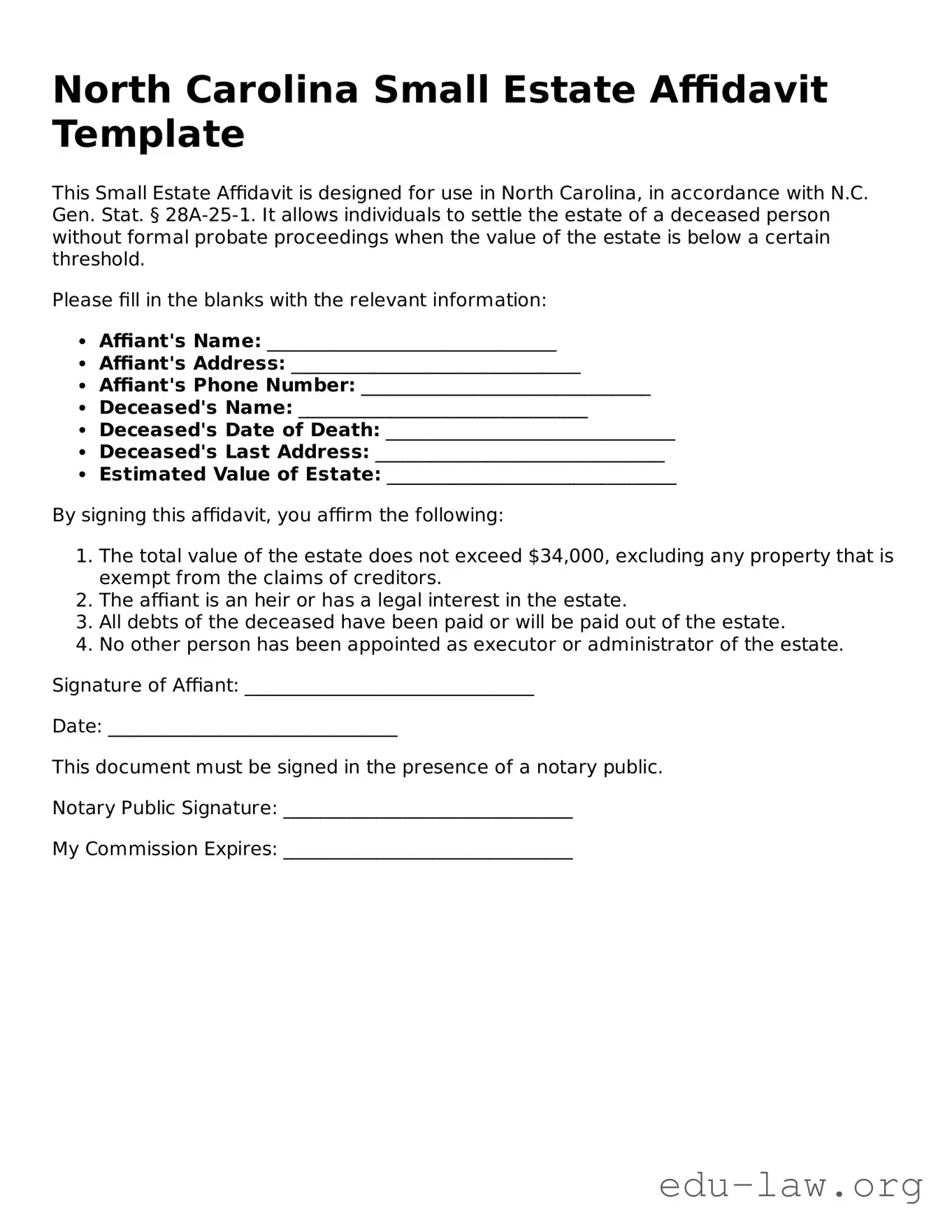
North Carolina Small Estate Affidavit Template
This Small Estate Affidavit is designed for use in North Carolina, in accordance with N.C. Gen. Stat. § 28A-25-1. It allows individuals to settle the estate of a deceased person without formal probate proceedings when the value of the estate is below a certain threshold.
Please fill in the blanks with the relevant information:
By signing this affidavit, you affirm the following:
Signature of Affiant: _______________________________
Date: _______________________________
This document must be signed in the presence of a notary public.
Notary Public Signature: _______________________________
My Commission Expires: _______________________________
| Fact Name | Description |
|---|---|
| Purpose | The North Carolina Small Estate Affidavit is used to simplify the process of settling small estates, allowing heirs to claim assets without going through formal probate. |
| Eligibility | This affidavit can be used when the total value of the estate is less than $31,000 for individuals or $60,000 for married couples, as specified by North Carolina law. |
| Governing Law | The Small Estate Affidavit is governed by North Carolina General Statutes, specifically Chapter 28A, Article 21. |
| Filing Requirements | To use the Small Estate Affidavit, heirs must provide a completed form, proof of death, and a list of the deceased's assets and debts. |
| Use of the Affidavit | Once the affidavit is completed and signed, it can be presented to financial institutions or other entities holding the deceased's assets to facilitate the transfer. |
After gathering the necessary information, you are ready to fill out the North Carolina Small Estate Affidavit form. This form will help you declare the assets of the deceased and facilitate the transfer of those assets without going through probate. Follow these steps carefully to ensure the form is completed correctly.
What is a Small Estate Affidavit in North Carolina?
A Small Estate Affidavit is a legal document that allows heirs to claim assets of a deceased person without going through the formal probate process. In North Carolina, this option is available when the total value of the deceased's estate is less than $34,000, excluding certain exempt property. This streamlined process can save time and reduce costs for families during a difficult period.
Who is eligible to use the Small Estate Affidavit?
To use the Small Estate Affidavit, you must be an heir or a beneficiary of the deceased. This includes spouses, children, grandchildren, parents, and siblings. The estate must meet the value threshold and not include real estate. If you are unsure of your eligibility, consulting with a legal professional can provide clarity.
How do I complete the Small Estate Affidavit form?
Completing the Small Estate Affidavit involves gathering necessary information about the deceased, including their full name, date of death, and details of their assets. You will need to list the assets and their estimated values. The form must be signed in front of a notary public to ensure its validity. Make sure all information is accurate to avoid delays in processing.
Where do I file the Small Estate Affidavit?
The completed Small Estate Affidavit should be filed with the Clerk of Court in the county where the deceased lived at the time of their death. After filing, you can present the affidavit to banks, financial institutions, and other entities holding the deceased's assets to claim what is rightfully yours.
What happens if the estate exceeds the Small Estate limit?
If the estate's value exceeds the $34,000 limit, the Small Estate Affidavit cannot be used. In such cases, you may need to initiate formal probate proceedings. This process is more complex and may require legal representation to navigate the requirements and ensure that the estate is distributed according to the law.
Can I use the Small Estate Affidavit for real property?
No, the Small Estate Affidavit cannot be used to transfer real property, such as land or homes. It is strictly for personal property and assets like bank accounts, vehicles, and personal belongings. If real estate is part of the estate, you will need to go through probate to address those assets.
Failing to include all necessary information: When filling out the North Carolina Small Estate Affidavit, it's crucial to provide complete details about the deceased. Omitting information such as the full name, date of death, or last known address can lead to delays or complications in the process.
Not listing all assets: One common mistake is neglecting to list all assets owned by the deceased. This includes bank accounts, real estate, vehicles, and personal belongings. If certain assets are left out, it may affect the validity of the affidavit.
Incorrectly identifying heirs: The affidavit must accurately identify all heirs entitled to inherit. Misnaming an heir or failing to include a rightful heir can create legal disputes later on.
Using outdated forms: It's essential to use the most current version of the Small Estate Affidavit. Utilizing an outdated form can result in rejection by the court or delays in processing.
Not signing the affidavit: A signature is required to validate the affidavit. Forgetting to sign or having the wrong person sign can lead to the document being deemed invalid.
Ignoring witness requirements: In North Carolina, certain affidavits may require witnesses. Failing to meet these requirements can jeopardize the legitimacy of the affidavit.
Submitting without proper documentation: Supporting documents, such as a death certificate or proof of identity, are often necessary. Submitting the affidavit without these documents can result in delays or denial.
When dealing with the transfer of assets in North Carolina, the Small Estate Affidavit form is often used. However, it is important to understand that this form may accompany other documents to ensure a smooth process. Here are five common forms and documents that are frequently utilized alongside the Small Estate Affidavit.
By gathering these documents, individuals can navigate the estate settlement process more effectively. Each form plays a crucial role in ensuring that assets are distributed according to the law and the deceased's wishes.
The North Carolina Small Estate Affidavit form is somewhat similar to a Will. A Will outlines a person's wishes regarding the distribution of their assets after death. While a Will requires formal probate proceedings, the Small Estate Affidavit allows for a simpler process for estates below a certain value. This means that heirs can claim the deceased’s assets more quickly and with less paperwork, making it a more accessible option for smaller estates.
Another document that shares similarities is the Affidavit of Heirship. This document is used to establish the identity of heirs when someone passes away without a Will. Like the Small Estate Affidavit, the Affidavit of Heirship helps heirs gain access to the deceased's assets without going through lengthy probate. Both documents provide a way to affirm the rightful heirs, but the Affidavit of Heirship focuses more on proving familial relationships.
The Executor's Deed is another related document. When someone dies, their estate may need to be transferred to heirs or beneficiaries. An Executor’s Deed serves this purpose, allowing an executor to transfer property according to the terms of a Will. In contrast, the Small Estate Affidavit facilitates the transfer of assets when no formal probate is necessary, streamlining the process for smaller estates.
A similar document is the Petition for Summary Administration. This is used in some states to simplify the probate process for smaller estates. Like the Small Estate Affidavit, it allows for a quicker resolution and less formal court involvement. However, the Petition for Summary Administration usually requires a court's approval, while the Small Estate Affidavit can often be completed without court intervention.
The Transfer on Death Deed (TOD) is also comparable. This deed allows individuals to designate beneficiaries for real estate, ensuring that property passes directly to heirs upon death without going through probate. While the Small Estate Affidavit is used for various types of assets, the TOD focuses specifically on real estate, providing a direct way to transfer ownership outside of the probate process.
Lastly, the Durable Power of Attorney is worth mentioning. Although it primarily deals with financial decisions while a person is alive, it can impact the handling of an estate after death. If someone has designated a Durable Power of Attorney, that individual may have the authority to manage certain assets before the estate is settled. The Small Estate Affidavit, on the other hand, is specifically for settling an estate after death, but both documents emphasize the importance of clear authority in asset management.
When filling out the North Carolina Small Estate Affidavit form, it is essential to follow certain guidelines to ensure accuracy and compliance. Below are some important dos and don’ts to consider.
By following these guidelines, individuals can navigate the process of filling out the Small Estate Affidavit form more effectively, minimizing the risk of errors or delays.
The North Carolina Small Estate Affidavit is a valuable tool for settling the estates of deceased individuals with limited assets. However, several misconceptions can lead to confusion. Here are ten common misunderstandings about this form:
Understanding these misconceptions can help individuals navigate the process of settling a small estate in North Carolina more effectively.
Filling out and using the North Carolina Small Estate Affidavit can simplify the process of settling a deceased person's estate when it meets certain criteria. Here are key takeaways to keep in mind:
By keeping these points in mind, you can navigate the Small Estate Affidavit process more effectively and ensure that you meet all necessary requirements.