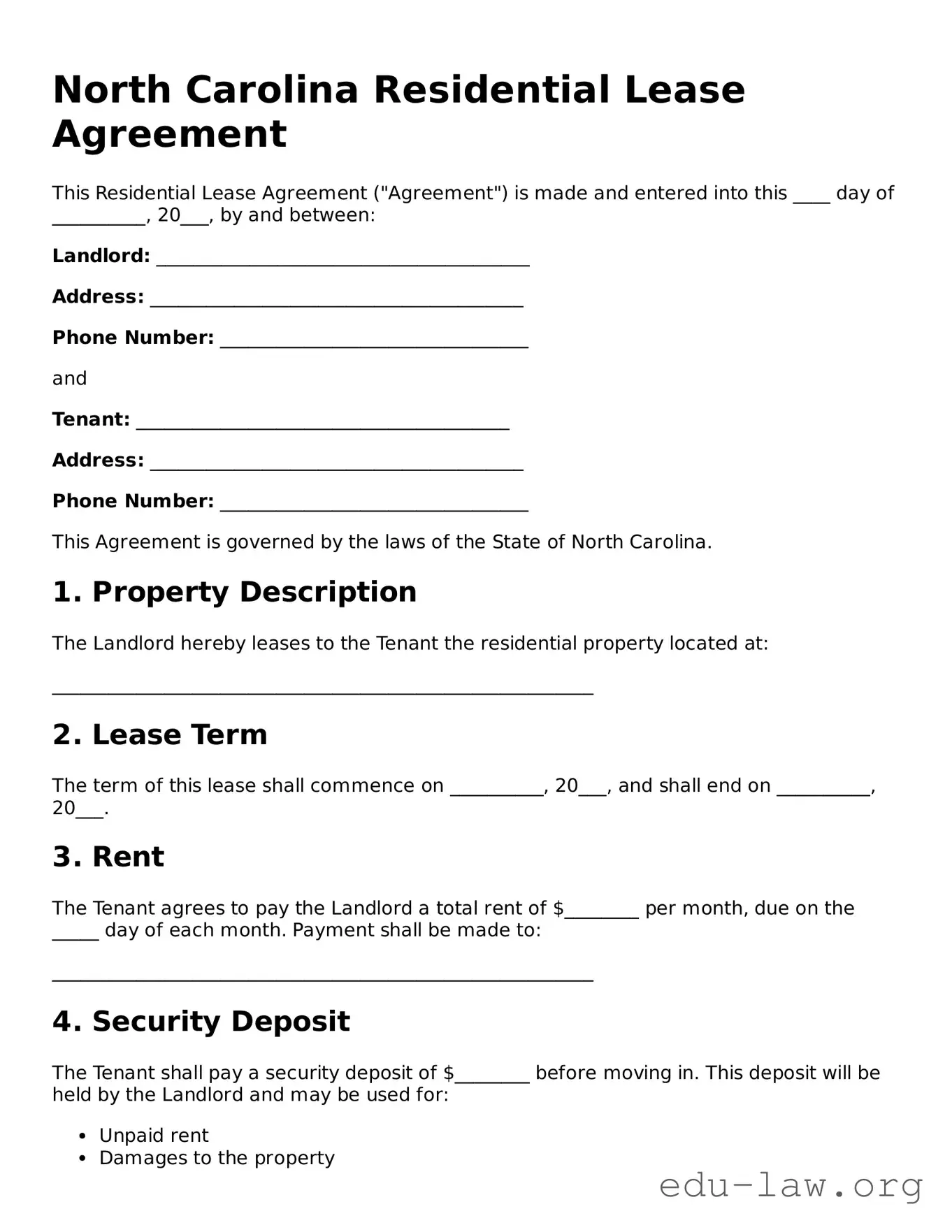
The North Carolina Residential Lease Agreement form serves as a crucial document in the rental process, outlining the terms and conditions between landlords and tenants. This form typically includes essential details such as the rental property’s address, the duration of the lease, and the monthly rent amount. It also specifies the security deposit requirements, maintenance responsibilities, and rules regarding pets or smoking on the premises. Additionally, the agreement often covers the procedures for renewing or terminating the lease, as well as the consequences of breaking the terms. By clearly defining the rights and obligations of both parties, this form aims to prevent disputes and ensure a smooth rental experience. Understanding its components is vital for anyone involved in renting residential property in North Carolina.
North Carolina Residential Lease Agreement
This Residential Lease Agreement ("Agreement") is made and entered into this ____ day of __________, 20___, by and between:
Landlord: ________________________________________
Address: ________________________________________
Phone Number: _________________________________
and
Tenant: ________________________________________
Address: ________________________________________
Phone Number: _________________________________
This Agreement is governed by the laws of the State of North Carolina.
1. Property Description
The Landlord hereby leases to the Tenant the residential property located at:
__________________________________________________________
2. Lease Term
The term of this lease shall commence on __________, 20___, and shall end on __________, 20___.
3. Rent
The Tenant agrees to pay the Landlord a total rent of $________ per month, due on the _____ day of each month. Payment shall be made to:
__________________________________________________________
4. Security Deposit
The Tenant shall pay a security deposit of $________ before moving in. This deposit will be held by the Landlord and may be used for:
5. Utilities
The Tenant is responsible for the payment of the following utilities:
6. Maintenance and Repairs
The Tenant agrees to maintain the property in good condition. The Landlord will be responsible for:
7. Termination
Either party may terminate this Agreement by providing a written notice of _____ days prior to the desired termination date.
8. Governing Law
This Agreement shall be governed by the laws of the State of North Carolina. Any disputes arising from this Agreement will be resolved in the appropriate courts of North Carolina.
9. Signatures
By signing below, both parties agree to the terms and conditions outlined in this Residential Lease Agreement.
Landlord Signature: ____________________________ Date: ____________
Tenant Signature: ____________________________ Date: ____________
| Fact Name | Description |
|---|---|
| Governing Law | The North Carolina Residential Lease Agreement is governed by North Carolina General Statutes Chapter 42, which outlines landlord-tenant laws. |
| Form Purpose | This form is used to establish the terms and conditions of renting a residential property between a landlord and a tenant. |
| Required Information | The agreement typically requires the names of the landlord and tenant, property address, rental amount, and lease duration. |
| Security Deposit | North Carolina law limits the security deposit to a maximum of two months' rent for leases longer than two months. |
| Lease Duration | The lease can be for a fixed term, such as one year, or it can be month-to-month, depending on the agreement between the parties. |
| Termination Notice | For month-to-month leases, either party must provide at least 30 days' notice before terminating the agreement. |
| Habitability Requirement | Landlords are required to maintain the property in a habitable condition, ensuring it meets health and safety standards. |
Filling out the North Carolina Residential Lease Agreement form is an important step in establishing the terms of a rental relationship. Completing this form accurately ensures that both the landlord and tenant have a clear understanding of their rights and responsibilities. Follow the steps below to fill out the form correctly.
What is a North Carolina Residential Lease Agreement?
A North Carolina Residential Lease Agreement is a legal document that outlines the terms and conditions under which a landlord rents property to a tenant. It includes details such as the duration of the lease, rent amount, security deposit requirements, and the responsibilities of both parties. This agreement protects the rights of both landlords and tenants and helps prevent disputes.
What key elements should be included in the lease agreement?
Essential elements of a North Carolina Residential Lease Agreement include the names of the landlord and tenant, the property address, the lease term (length of the rental period), rent amount and payment due dates, security deposit details, maintenance responsibilities, and any rules or restrictions regarding the property. It may also address pet policies, smoking restrictions, and procedures for lease termination.
How long is a typical lease agreement in North Carolina?
Lease agreements in North Carolina can vary in length. Common durations include one year, six months, or even month-to-month arrangements. The duration should be clearly stated in the lease. A longer lease often provides stability for both parties, while a shorter lease may offer flexibility.
What is the process for terminating a lease in North Carolina?
To terminate a lease in North Carolina, either party must provide written notice to the other party. The notice period typically depends on the lease terms. For month-to-month leases, a 30-day notice is standard. For longer leases, the terms of the agreement will dictate the notice requirements. It is crucial to follow the specified procedures to avoid legal complications.
Can a landlord increase rent during the lease term?
Generally, a landlord cannot increase rent during the lease term unless the lease specifically allows for it. If the lease is month-to-month, the landlord can raise the rent with proper notice, usually 30 days. For longer leases, any rent increase must be outlined in the lease agreement itself.
What happens if a tenant fails to pay rent?
If a tenant fails to pay rent, the landlord has the right to initiate eviction proceedings. Before taking legal action, the landlord should provide a written notice of the missed payment. This notice typically gives the tenant a certain number of days to pay the overdue rent. If the tenant does not pay within that timeframe, the landlord can file for eviction in court.
Are there any specific laws governing residential leases in North Carolina?
Yes, North Carolina has specific laws that govern residential leases. These laws cover various aspects, including security deposits, eviction procedures, and tenant rights. Both landlords and tenants should familiarize themselves with these laws to ensure compliance and to understand their rights and responsibilities. The North Carolina General Statutes provide detailed information on these regulations.
Not providing complete tenant information. Tenants often forget to include all required details, such as full names and contact information.
Failing to specify the lease term. Some individuals neglect to clearly indicate the start and end dates of the lease, which can lead to misunderstandings.
Overlooking the security deposit amount. It's crucial to specify the exact amount of the security deposit and any conditions for its return.
Not including maintenance responsibilities. Both landlords and tenants should clearly outline who is responsible for maintenance and repairs to avoid disputes.
Ignoring pet policies. If pets are allowed or prohibited, this should be explicitly stated in the agreement to prevent issues later.
Neglecting to outline late fees. If rent is paid late, specifying the fees can help both parties understand the consequences of late payments.
Failing to include the landlord's contact information. Tenants need to know how to reach the landlord for urgent matters or repairs.
Not reviewing the entire document before signing. It's important for both parties to read through the lease thoroughly to ensure all terms are understood and agreed upon.
When entering into a rental agreement in North Carolina, several other forms and documents may accompany the Residential Lease Agreement. These documents help clarify responsibilities, outline rules, and protect both landlords and tenants. Here’s a list of commonly used forms that can enhance the leasing experience.
Using these forms and documents alongside the Residential Lease Agreement can help create a clear and organized rental process. They protect the interests of both landlords and tenants, ensuring a smoother relationship throughout the lease term.
The North Carolina Residential Lease Agreement form shares similarities with the Rental Agreement. Both documents outline the terms under which a landlord allows a tenant to occupy a property. They detail the duration of the tenancy, rental payment amounts, and responsibilities of both parties. However, a Rental Agreement is often more flexible and can be used for shorter-term arrangements, while a Residential Lease Agreement typically covers longer durations, usually a year or more.
Another document that resembles the Residential Lease Agreement is the Commercial Lease Agreement. This type of lease is used for business properties rather than residential ones. While both agreements cover essential terms like rent and duration, a Commercial Lease Agreement may include additional clauses related to business operations, maintenance responsibilities, and compliance with local zoning laws, which are not typically found in residential leases.
The Sublease Agreement is also similar in that it allows a tenant to rent out their leased property to another person. In both cases, the original lease terms must be respected. However, the Sublease Agreement often requires the original landlord's approval, and it may include specific terms about the subtenant’s rights and responsibilities, which are not usually detailed in a standard Residential Lease Agreement.
A Roommate Agreement is another document that shares characteristics with the Residential Lease Agreement. This agreement is specifically designed for multiple tenants sharing a rental space. While the Residential Lease Agreement is between the landlord and the tenant, a Roommate Agreement outlines the responsibilities and expectations among roommates, such as shared expenses and house rules, which are not typically covered in a standard lease.
The Lease Purchase Agreement also bears similarities to the Residential Lease Agreement. This document allows tenants to rent a property with the option to buy it later. Like a Residential Lease, it specifies rent and duration, but it also includes terms regarding the purchase price and conditions under which the tenant can buy the property, making it a hybrid between leasing and purchasing.
The Month-to-Month Lease Agreement is akin to the Residential Lease Agreement but offers more flexibility. While a standard Residential Lease typically locks tenants into a long-term commitment, a Month-to-Month Lease allows either party to terminate the agreement with notice, usually 30 days. This type of lease still covers rent, security deposits, and maintenance responsibilities, similar to a traditional lease.
The Lease Addendum is another document that complements the Residential Lease Agreement. An addendum is an additional document that modifies or adds terms to the original lease. For example, it might include pet policies or rules about smoking. While the Residential Lease Agreement outlines the main terms, the addendum allows for adjustments without rewriting the entire lease.
A Tenancy at Will Agreement is also similar in that it establishes a rental arrangement without a fixed term. This type of agreement allows either party to end the tenancy at any time, with appropriate notice. While it shares some basic elements with a Residential Lease Agreement, such as rent and property description, it offers much more flexibility regarding the duration of the tenancy.
Finally, the Lease Termination Agreement is closely related to the Residential Lease Agreement. This document is used when either party wishes to end the lease before its expiration. It outlines the terms of termination, including notice periods and any obligations that need to be fulfilled before vacating the property. While the Residential Lease Agreement sets the terms for occupancy, the Lease Termination Agreement provides a clear pathway for ending that arrangement.
When filling out the North Carolina Residential Lease Agreement form, it is important to approach the task with care. The following guidelines can help ensure that the process goes smoothly.
Following these guidelines can help prevent misunderstandings and ensure that both parties are clear about their rights and responsibilities under the lease agreement.
Many people have misunderstandings about the North Carolina Residential Lease Agreement form. Here are four common misconceptions:
Understanding these misconceptions can help tenants and landlords navigate their agreements more effectively.
When filling out and using the North Carolina Residential Lease Agreement form, it is crucial to understand the following key points:
Reviewing these key takeaways will help ensure that both tenants and landlords have a clear understanding of their rights and responsibilities under the lease agreement.