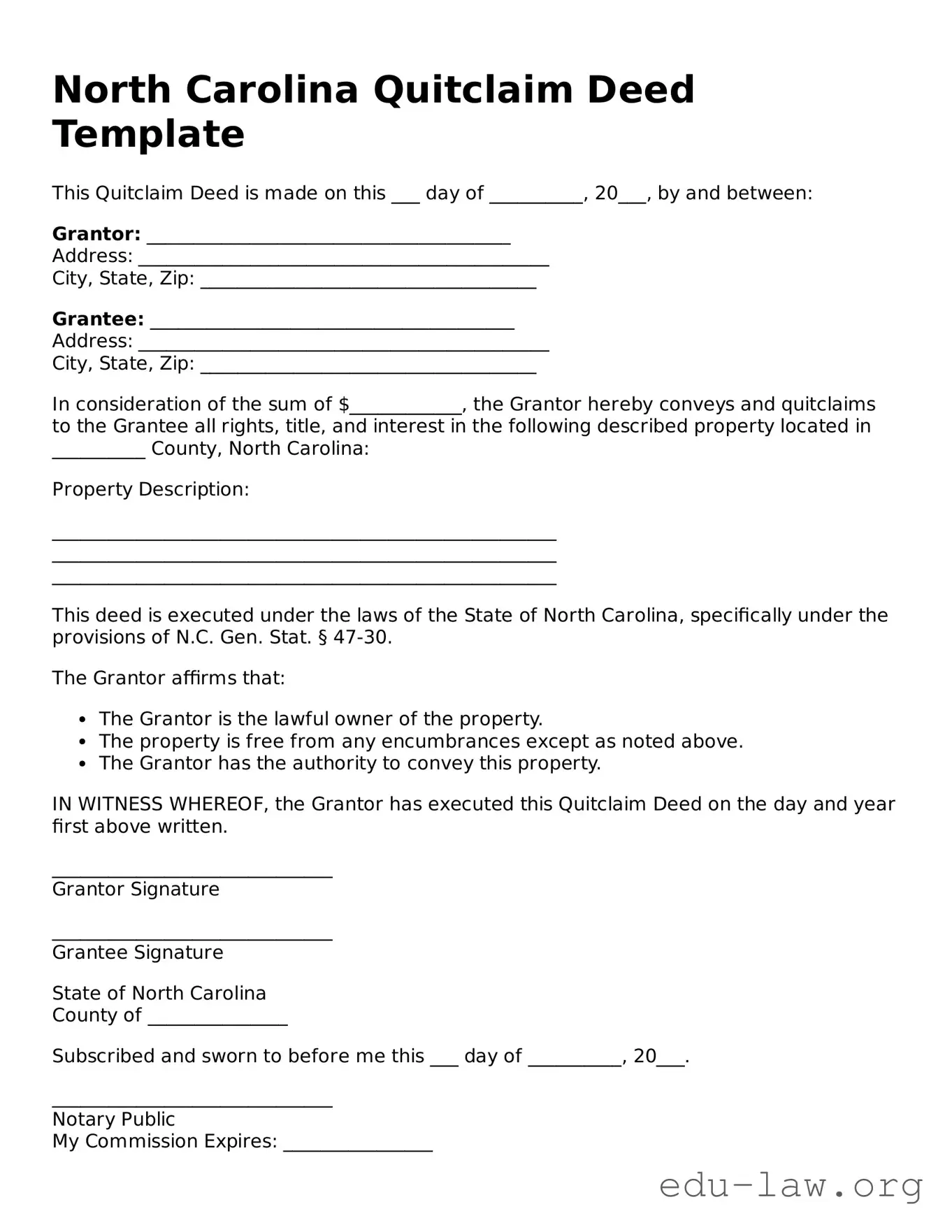
The North Carolina Quitclaim Deed form serves as an essential tool for property owners looking to transfer their interest in real estate without making any guarantees about the title. This form is particularly useful in situations where the transfer is between family members, friends, or in cases of divorce, as it allows for a quick and straightforward conveyance of property rights. Unlike other types of deeds, a quitclaim deed does not provide the buyer with any warranty or assurance regarding the property’s title; it simply conveys whatever interest the seller has at the time of the transfer. This lack of warranty makes it crucial for both parties to understand the implications of the transfer. The form typically includes key information such as the names of the grantor and grantee, a legal description of the property, and the signatures of the involved parties. Additionally, it may require notarization to ensure its validity. Understanding the nuances of the North Carolina Quitclaim Deed form can help individuals navigate property transfers more effectively, making it a valuable resource for anyone involved in real estate transactions in the state.
North Carolina Quitclaim Deed Template
This Quitclaim Deed is made on this ___ day of __________, 20___, by and between:
Grantor: _______________________________________
Address: ____________________________________________
City, State, Zip: ____________________________________
Grantee: _______________________________________
Address: ____________________________________________
City, State, Zip: ____________________________________
In consideration of the sum of $____________, the Grantor hereby conveys and quitclaims to the Grantee all rights, title, and interest in the following described property located in __________ County, North Carolina:
Property Description:
______________________________________________________
______________________________________________________
______________________________________________________
This deed is executed under the laws of the State of North Carolina, specifically under the provisions of N.C. Gen. Stat. § 47-30.
The Grantor affirms that:
IN WITNESS WHEREOF, the Grantor has executed this Quitclaim Deed on the day and year first above written.
______________________________
Grantor Signature
______________________________
Grantee Signature
State of North Carolina
County of _______________
Subscribed and sworn to before me this ___ day of __________, 20___.
______________________________
Notary Public
My Commission Expires: ________________
| Fact Name | Description |
|---|---|
| Definition | A quitclaim deed is a legal document used to transfer ownership of real estate from one party to another without any guarantees regarding the title. |
| Governing Law | The North Carolina Quitclaim Deed is governed by the North Carolina General Statutes, specifically Chapter 47. |
| Parties Involved | The document involves two main parties: the grantor (the person transferring the property) and the grantee (the person receiving the property). |
| No Warranty | Unlike other types of deeds, a quitclaim deed does not provide any warranty or guarantee about the property’s title. The grantee receives whatever interest the grantor has, if any. |
| Use Cases | Quitclaim deeds are often used in situations such as divorce settlements, transferring property between family members, or clearing up title issues. |
| Filing Requirements | In North Carolina, the quitclaim deed must be recorded with the county register of deeds to provide public notice of the property transfer. |
| Tax Implications | While the transfer itself may not incur a tax, it is important to consider potential tax implications related to property ownership, such as capital gains tax in future sales. |
Once you have the North Carolina Quitclaim Deed form ready, you can proceed to fill it out. Make sure you have all necessary information at hand, such as the names of the parties involved and the property details. After completing the form, you will need to have it signed and notarized before it can be filed with the appropriate county office.
What is a Quitclaim Deed in North Carolina?
A Quitclaim Deed is a legal document used to transfer ownership of property from one person to another without making any guarantees about the title. In North Carolina, this means the grantor (the person transferring the property) gives up any claim they have to the property but does not assure the grantee (the person receiving the property) that the title is clear or free of issues.
When should I use a Quitclaim Deed?
Quitclaim Deeds are often used in situations where property is transferred between family members, during divorce settlements, or to clear up title issues. They are also useful for transferring property into a trust or from a trust back to an individual.
What information is required on a Quitclaim Deed?
A Quitclaim Deed in North Carolina typically requires the following information: the names and addresses of the grantor and grantee, a legal description of the property, the date of the transfer, and the signature of the grantor. It may also need to be notarized for it to be valid.
Do I need to have the Quitclaim Deed notarized?
Yes, in North Carolina, the Quitclaim Deed must be notarized to be legally effective. This means that a notary public must witness the signing of the deed and provide their seal on the document.
Is a Quitclaim Deed the same as a Warranty Deed?
No, they are not the same. A Warranty Deed provides a guarantee that the grantor holds clear title to the property and has the right to transfer it. A Quitclaim Deed offers no such guarantees, which is why it is often used in less formal property transfers.
How do I record a Quitclaim Deed in North Carolina?
To record a Quitclaim Deed, you must take the completed and notarized deed to the county register of deeds where the property is located. There may be a small fee for recording the document, and it will then become part of the public record.
Are there any taxes associated with a Quitclaim Deed?
In North Carolina, there may be a documentary tax that applies when a Quitclaim Deed is recorded. This tax is typically based on the value of the property being transferred. It’s advisable to check with your local tax office for specific details.
Can I use a Quitclaim Deed to transfer property to myself?
Yes, you can use a Quitclaim Deed to transfer property from one ownership entity to another, including transferring property from your name to a trust or a business entity you own. However, it’s important to consider the implications for taxes and liability.
What happens if the grantor has outstanding debts?
If the grantor has debts, using a Quitclaim Deed does not protect the property from creditors. Creditors may still pursue the property for unpaid debts, even after the transfer. It’s important to consult with a legal expert if you have concerns about this issue.
Can a Quitclaim Deed be revoked?
Once a Quitclaim Deed is executed and recorded, it generally cannot be revoked unilaterally. However, if both parties agree, they can execute another deed to reverse the transaction. It’s advisable to seek legal guidance to ensure all parties are protected.
Incorrect Names: One common mistake is failing to accurately list the names of the grantor and grantee. It is essential that the names match those on official identification documents to avoid future disputes.
Missing Signatures: A Quitclaim Deed must be signed by the grantor. Omitting this signature can render the document invalid. If there are multiple grantors, all must sign.
Improper Notarization: Notarization is often required for the deed to be legally binding. If the notarization is missing or improperly executed, it may lead to issues during property transfer.
Failure to Include a Legal Description: The deed should contain a clear legal description of the property. Vague or incomplete descriptions can create confusion and complicate future transactions.
Incorrect Filing: After completing the Quitclaim Deed, it must be filed with the appropriate county office. Failing to do so, or filing it in the wrong jurisdiction, can result in the deed not being recognized.
When dealing with property transfers in North Carolina, the Quitclaim Deed is a commonly used document. However, it is often accompanied by other forms and documents that help facilitate the process. Below is a list of additional documents that may be necessary or beneficial when executing a Quitclaim Deed.
These documents play important roles in the property transfer process. They help ensure that both the buyer and seller are protected and that the transaction proceeds smoothly. Understanding these forms can aid in navigating the complexities of real estate transactions in North Carolina.
The North Carolina Quitclaim Deed form is similar to a Warranty Deed. Both documents serve the purpose of transferring property ownership from one party to another. However, a Warranty Deed provides a guarantee that the grantor holds clear title to the property and has the right to sell it. This assurance protects the grantee against potential claims or disputes regarding ownership. In contrast, a Quitclaim Deed offers no such guarantees, making it a more straightforward but riskier option for transferring property rights.
Another document akin to the Quitclaim Deed is the Bargain and Sale Deed. This type of deed also transfers property ownership but does so with fewer assurances than a Warranty Deed. While a Bargain and Sale Deed implies that the grantor has an interest in the property, it does not guarantee that the title is free of encumbrances. Therefore, it is similar to a Quitclaim Deed in its limited warranties, making it essential for buyers to conduct due diligence before proceeding with the transaction.
The Special Warranty Deed is another document that shares similarities with the Quitclaim Deed. This deed transfers property and provides a limited warranty, but only for the period during which the grantor owned the property. Unlike a Quitclaim Deed, which offers no warranties, the Special Warranty Deed assures that the grantor has not encumbered the property during their ownership. This provides some level of protection to the grantee, though it still lacks the full assurances found in a Warranty Deed.
A Deed of Trust is also comparable to a Quitclaim Deed, particularly in the context of securing a loan. While a Quitclaim Deed transfers ownership, a Deed of Trust involves a borrower conveying property to a trustee as security for a loan. In this case, the borrower retains equitable title, while the trustee holds legal title until the debt is repaid. Both documents are essential in real estate transactions but serve different purposes related to ownership and financing.
The Assignment of Contract is another document that can be likened to a Quitclaim Deed. This document allows one party to transfer their rights and obligations under a contract to another party. While a Quitclaim Deed transfers property rights, the Assignment of Contract focuses on the contractual relationship rather than ownership. Both documents facilitate the transfer of interests but in different contexts, highlighting the diverse ways property rights can be managed.
A Leasehold Deed is also similar to a Quitclaim Deed in that it involves the transfer of property rights, though it does so on a temporary basis. A Leasehold Deed grants a tenant the right to use and occupy a property for a specified period. While a Quitclaim Deed provides permanent ownership transfer, a Leasehold Deed allows for the use of property without transferring full ownership rights. This distinction underscores the various methods of property interest conveyance.
The Easement Agreement is another document that shares some characteristics with a Quitclaim Deed. An Easement grants a party the right to use a portion of another party's property for a specific purpose, such as access or utilities. Similar to a Quitclaim Deed, it does not transfer ownership but allows for certain rights to be exercised. Both documents play vital roles in real estate, facilitating the use and enjoyment of property while maintaining ownership rights.
Lastly, a Life Estate Deed is comparable to a Quitclaim Deed in that it involves the transfer of property rights, but with specific limitations. A Life Estate Deed allows an individual to use and benefit from a property during their lifetime, after which the property passes to another designated party. While a Quitclaim Deed transfers full ownership, a Life Estate Deed restricts that ownership based on the life of the grantor, illustrating the various ways property rights can be structured.
When filling out the North Carolina Quitclaim Deed form, it is essential to follow certain guidelines to ensure the document is valid and effective. Below is a list of dos and don’ts to consider.
When it comes to the North Carolina Quitclaim Deed form, several misconceptions can lead to confusion for those looking to transfer property. Understanding these myths can help clarify the true nature of this legal document.
This is not true. A quitclaim deed transfers whatever interest the grantor has in the property, but it does not guarantee that the title is free of defects. If there are liens or claims against the property, the grantee assumes those risks.
While quitclaim deeds are often used among family members, they can be used in various situations, including transferring property between friends, business partners, or even as part of a divorce settlement.
These two types of deeds serve different purposes. A warranty deed provides a guarantee that the grantor holds clear title and has the right to transfer it, while a quitclaim deed does not provide any such assurances.
While a quitclaim deed can transfer interest, it does not automatically remove a person from the title. Proper legal procedures must be followed to ensure that all parties agree to the change.
Filing the quitclaim deed with the appropriate county office is essential. This step ensures that the transfer is officially recorded and provides public notice of the change in ownership.
In reality, a quitclaim deed is relatively straightforward. While it is important to complete it correctly, the form itself is not overly complex and can often be filled out without extensive legal knowledge.
Filling out and using a North Carolina Quitclaim Deed form can be a straightforward process if you keep a few key points in mind. Here are some essential takeaways to consider:
Understanding these points can help ensure a smooth transaction when using a Quitclaim Deed in North Carolina.