In North Carolina, a prenuptial agreement serves as a vital tool for couples looking to establish clear expectations and protect their individual interests before tying the knot. This legal document outlines how assets, debts, and responsibilities will be handled in the event of a divorce or separation, fostering transparency and reducing potential conflicts. Key aspects of the North Carolina prenuptial agreement form include the identification of separate and marital property, provisions for spousal support, and the division of property acquired during the marriage. By addressing these issues upfront, couples can navigate their financial futures with greater confidence. Additionally, the agreement must be executed voluntarily and with full disclosure of assets to ensure its enforceability, highlighting the importance of open communication between partners. As relationships evolve, having a prenuptial agreement can provide a sense of security and peace of mind, allowing couples to focus on building their lives together without the looming uncertainty of what may come later.
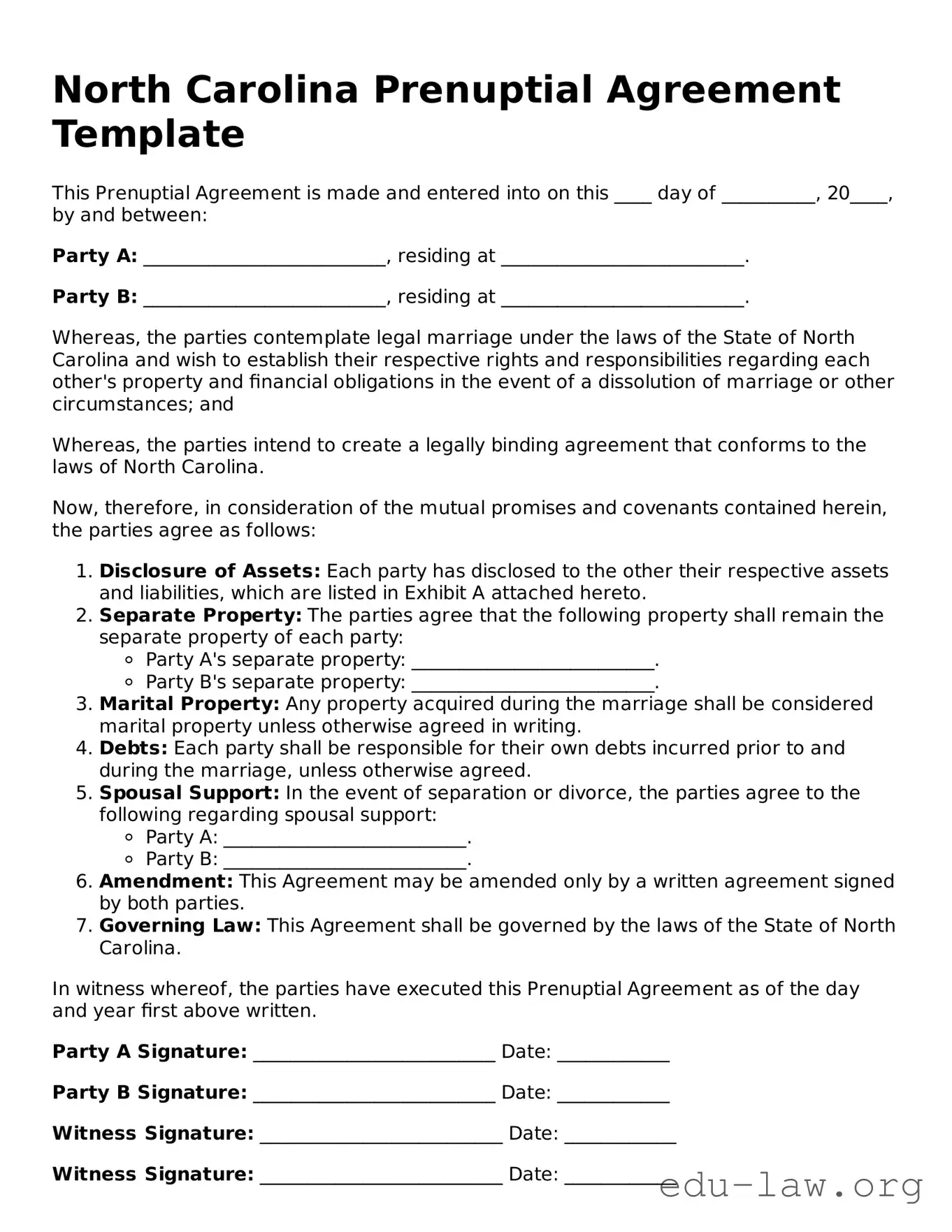
North Carolina Prenuptial Agreement Template
This Prenuptial Agreement is made and entered into on this ____ day of __________, 20____, by and between:
Party A: __________________________, residing at __________________________.
Party B: __________________________, residing at __________________________.
Whereas, the parties contemplate legal marriage under the laws of the State of North Carolina and wish to establish their respective rights and responsibilities regarding each other's property and financial obligations in the event of a dissolution of marriage or other circumstances; and
Whereas, the parties intend to create a legally binding agreement that conforms to the laws of North Carolina.
Now, therefore, in consideration of the mutual promises and covenants contained herein, the parties agree as follows:
In witness whereof, the parties have executed this Prenuptial Agreement as of the day and year first above written.
Party A Signature: __________________________ Date: ____________
Party B Signature: __________________________ Date: ____________
Witness Signature: __________________________ Date: ____________
Witness Signature: __________________________ Date: ____________
This template is designed to help you create a prenuptial agreement that reflects your intentions and complies with North Carolina law. Always consider consulting with a legal professional to ensure your agreement meets all legal requirements.
| Fact Name | Details |
|---|---|
| Governing Law | North Carolina General Statutes, Chapter 52B |
| Definition | A prenuptial agreement is a contract between two individuals before marriage that outlines the division of assets and responsibilities in the event of divorce or separation. |
| Enforceability | For a prenuptial agreement to be enforceable, it must be in writing and signed by both parties. |
| Disclosure Requirement | Full financial disclosure is required from both parties to ensure fairness and transparency. |
| Voluntariness | Both parties must enter into the agreement voluntarily, without coercion or undue pressure. |
| Legal Representation | It is advisable for both parties to seek independent legal counsel to review the agreement before signing. |
| Modification | A prenuptial agreement can be modified or revoked at any time, provided both parties agree to the changes in writing. |
Filling out the North Carolina Prenuptial Agreement form requires careful attention to detail. Once completed, this document can help clarify financial arrangements and expectations before marriage. Here are the steps to follow for filling out the form.
What is a prenuptial agreement in North Carolina?
A prenuptial agreement, often called a prenup, is a legal contract between two individuals before they marry. In North Carolina, this agreement outlines how assets and debts will be divided in the event of divorce or separation. It can also address other matters such as spousal support. The goal is to provide clarity and protect both parties’ interests in the marriage.
What are the requirements for a valid prenuptial agreement in North Carolina?
For a prenuptial agreement to be valid in North Carolina, it must be in writing and signed by both parties. Each individual should have the opportunity to consult with an attorney before signing. Additionally, the agreement should be executed voluntarily, without coercion or undue influence. Full disclosure of assets and debts is essential for the agreement to hold up in court.
Can a prenuptial agreement be modified after marriage?
Yes, a prenuptial agreement can be modified after marriage. Both parties must agree to the changes, and the modifications should be made in writing and signed by both individuals. It’s advisable to consult with legal counsel to ensure that the revised agreement meets all legal requirements and is enforceable.
What can be included in a prenuptial agreement?
A prenuptial agreement can cover a variety of topics, including the division of property, spousal support, and the handling of debts. It can also address how future earnings will be treated and any specific provisions regarding children from previous relationships. However, it cannot include terms related to child custody or child support, as these matters are determined based on the best interests of the child at the time of divorce.
Is a prenuptial agreement enforceable in North Carolina?
Yes, a prenuptial agreement is generally enforceable in North Carolina if it meets the legal requirements. Courts will uphold the agreement unless it can be shown that it was signed under duress, was unconscionable at the time of signing, or if there was a lack of full disclosure of assets. Having both parties seek independent legal advice can strengthen the enforceability of the agreement.
How do I create a prenuptial agreement in North Carolina?
Creating a prenuptial agreement typically involves several steps. First, both parties should openly discuss their financial situations and what they want the agreement to cover. It is advisable to consult with separate attorneys who specialize in family law to draft the agreement. Once drafted, both parties should review the document, make any necessary revisions, and sign it before the wedding. Timing is crucial; the agreement should be finalized well in advance of the wedding date to avoid claims of coercion.
What happens if we don’t have a prenuptial agreement?
If a couple does not have a prenuptial agreement in place, North Carolina law will govern the division of assets and debts in the event of a divorce. This means that marital property will be divided equitably, but not necessarily equally. Without a prenup, couples may face a more complex and lengthy divorce process, as they will need to negotiate the division of property and any potential spousal support without a predetermined agreement.
When preparing a prenuptial agreement in North Carolina, individuals often encounter several common pitfalls. Understanding these mistakes can help ensure that the agreement is valid and enforceable. Below is a list of five mistakes to avoid when filling out the North Carolina Prenuptial Agreement form:
One of the most significant errors is not fully disclosing all assets and liabilities. Both parties must provide complete and honest information about their financial situations. If one party hides assets, it can lead to the agreement being challenged later.
Clarity is crucial in any legal document. Using vague or unclear terms can create confusion and lead to disputes in the future. Each provision should be straightforward and easily understood by both parties.
Life circumstances change, and a prenuptial agreement should account for potential future events, such as the birth of children or significant changes in income. Failing to include provisions for these scenarios can render the agreement less effective.
Many individuals attempt to draft their own agreements without consulting a legal professional. This can lead to mistakes or omissions that could have been avoided with proper guidance. Seeking legal advice is essential to ensure that the agreement meets all legal requirements.
Rushing through the process can lead to mistakes. Both parties should have ample time to review the agreement, ask questions, and make necessary changes. A well-considered agreement is more likely to be respected and upheld.
By being aware of these common mistakes, individuals can take steps to create a prenuptial agreement that is fair, clear, and legally sound. This preparation can provide peace of mind and protect both parties in the event of future disputes.
A prenuptial agreement is an important document that outlines the financial and property rights of each partner before marriage. However, several other forms and documents may be necessary or beneficial to consider alongside a North Carolina Prenuptial Agreement. These documents can help clarify various aspects of the relationship and ensure both parties are on the same page regarding their financial futures.
Considering these documents alongside a prenuptial agreement can help couples navigate their financial and legal responsibilities more effectively. Each form serves a unique purpose and can provide additional clarity and security for both partners as they embark on their life together.
The North Carolina Prenuptial Agreement form shares similarities with the Marital Settlement Agreement. Both documents are designed to outline the terms and conditions of a couple's financial arrangements, either before or during marriage. While a prenuptial agreement is established prior to marriage, a marital settlement agreement is often created during divorce proceedings. Each document aims to protect individual assets and clarify responsibilities, making them essential for couples navigating their financial futures.
Another document akin to the North Carolina Prenuptial Agreement is the Postnuptial Agreement. This agreement is similar in purpose, as it also addresses the distribution of assets and debts. However, a postnuptial agreement is executed after the couple is already married. Both documents require full disclosure of assets and liabilities and can help prevent disputes in the event of separation or divorce.
The North Carolina Prenuptial Agreement also resembles a Cohabitation Agreement. Couples who live together but are not married may use this document to outline financial responsibilities and asset distribution. Like a prenuptial agreement, a cohabitation agreement can help clarify expectations and protect individual interests, especially in the case of separation.
A Financial Disclosure Statement is another document that parallels the prenuptial agreement. This statement is often used in conjunction with a prenuptial agreement to ensure that both parties fully disclose their financial situations. Transparency is crucial in both documents, as it helps prevent misunderstandings and ensures that both parties are making informed decisions.
The North Carolina Prenuptial Agreement is similar to a Trust Agreement, particularly in how both documents manage assets. A trust agreement allows individuals to specify how their assets will be distributed upon death or incapacity. Similarly, a prenuptial agreement can dictate how assets will be divided in the event of divorce, providing a clear plan for asset management and distribution.
Another related document is the Will. While a will primarily addresses the distribution of assets after death, it can also complement a prenuptial agreement by outlining intentions regarding asset division. Both documents serve to clarify the wishes of the individual, ensuring that their preferences are honored in different circumstances.
The North Carolina Prenuptial Agreement is also similar to a Living Will. While a living will focuses on medical decisions and end-of-life care, both documents express the individual's wishes regarding their personal and financial affairs. Each serves as a tool for individuals to assert control over their circumstances, whether in life or in the event of separation or divorce.
Additionally, the Non-Disclosure Agreement (NDA) shares similarities with the prenuptial agreement in terms of confidentiality. An NDA protects sensitive information shared between parties, while a prenuptial agreement may include clauses that ensure financial details remain private. Both documents emphasize the importance of confidentiality in personal and financial matters.
Lastly, the Separation Agreement is akin to the prenuptial agreement, as it outlines the terms of a couple's separation. This document is typically created when a couple decides to separate and addresses issues such as asset division, child custody, and support. Like a prenuptial agreement, it aims to provide clarity and prevent disputes, ensuring both parties understand their rights and responsibilities.
When filling out a North Carolina Prenuptial Agreement form, it’s essential to approach the process with care. Here are ten important dos and don’ts to keep in mind.
By following these guidelines, you can create a prenuptial agreement that protects both parties and fosters a sense of trust as you enter into marriage.
Many people have misconceptions about prenuptial agreements, especially in North Carolina. Understanding these common myths can help couples make informed decisions about their future. Here are nine misconceptions:
Understanding these misconceptions can empower couples in North Carolina to approach prenuptial agreements with a clearer perspective, ultimately leading to better financial planning and relationship health.
When considering a prenuptial agreement in North Carolina, there are several important points to keep in mind. This document can help clarify financial expectations and protect individual assets in the event of a divorce. Below are key takeaways regarding the use of the North Carolina Prenuptial Agreement form.
These key points can help individuals navigate the process of creating and utilizing a prenuptial agreement effectively.