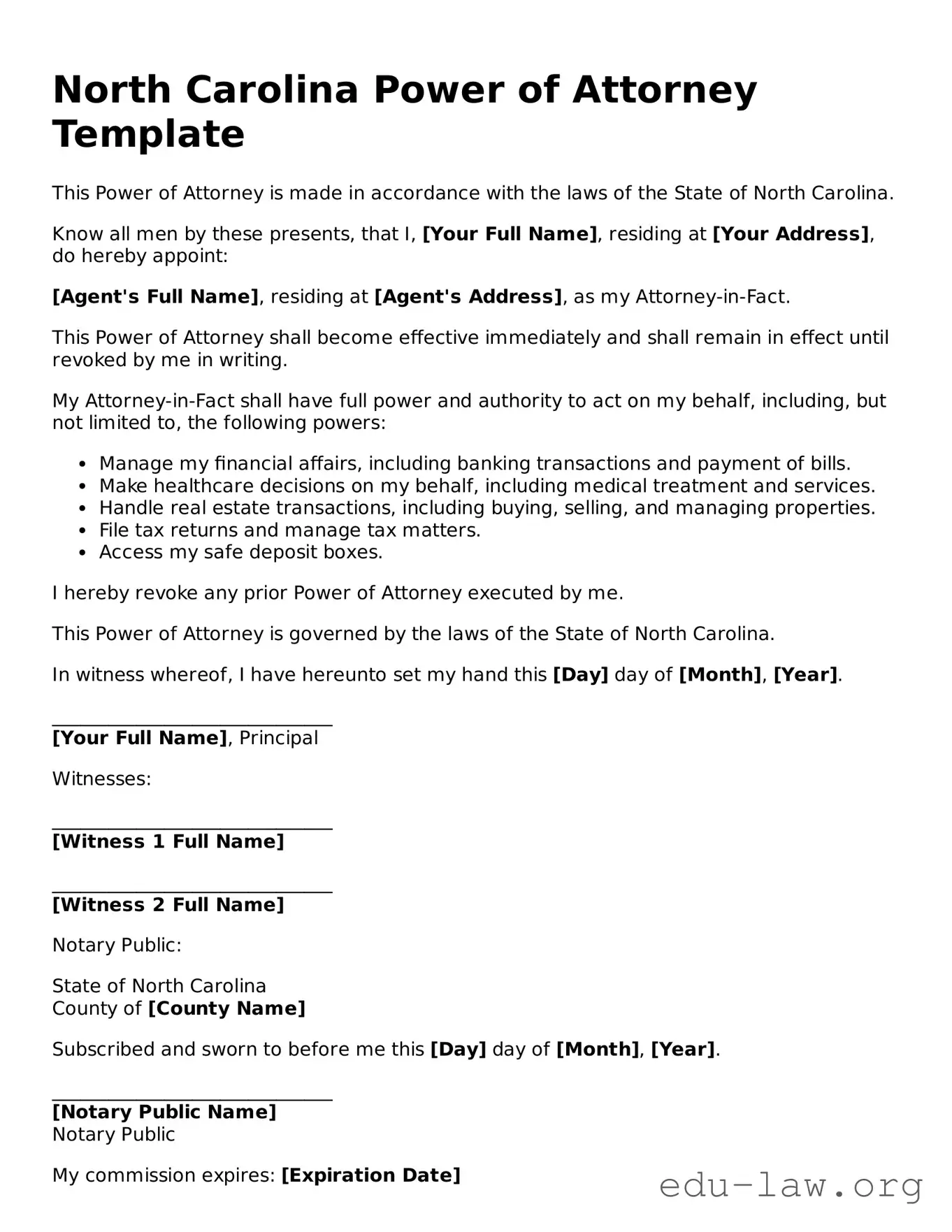
The North Carolina Power of Attorney form is a crucial legal document that allows individuals to appoint someone else to make decisions on their behalf. This form is particularly important for those who may become incapacitated or unable to manage their affairs. It can cover a variety of powers, including financial and healthcare decisions, depending on the specific needs of the individual. The form must be completed with accurate information and signed in the presence of a notary public to ensure its validity. Additionally, the principal, or the person granting authority, can specify the scope of the powers granted, whether they are broad or limited. It is essential to understand the implications of this document, as it enables the designated agent to act in the best interest of the principal, making it a vital tool for planning for the future.
North Carolina Power of Attorney Template
This Power of Attorney is made in accordance with the laws of the State of North Carolina.
Know all men by these presents, that I, [Your Full Name], residing at [Your Address], do hereby appoint:
[Agent's Full Name], residing at [Agent's Address], as my Attorney-in-Fact.
This Power of Attorney shall become effective immediately and shall remain in effect until revoked by me in writing.
My Attorney-in-Fact shall have full power and authority to act on my behalf, including, but not limited to, the following powers:
I hereby revoke any prior Power of Attorney executed by me.
This Power of Attorney is governed by the laws of the State of North Carolina.
In witness whereof, I have hereunto set my hand this [Day] day of [Month], [Year].
______________________________
[Your Full Name], Principal
Witnesses:
______________________________
[Witness 1 Full Name]
______________________________
[Witness 2 Full Name]
Notary Public:
State of North Carolina
County of [County Name]
Subscribed and sworn to before me this [Day] day of [Month], [Year].
______________________________
[Notary Public Name]
Notary Public
My commission expires: [Expiration Date]
| Fact Name | Description |
|---|---|
| Definition | A Power of Attorney (POA) in North Carolina allows one person to grant another the authority to act on their behalf in legal and financial matters. |
| Governing Law | The North Carolina Power of Attorney is governed by the North Carolina General Statutes, specifically Chapter 32A. |
| Types of POA | North Carolina recognizes several types of POA, including General, Durable, and Limited Power of Attorney. |
| Durability | A Durable Power of Attorney remains effective even if the principal becomes incapacitated. |
| Agent Responsibilities | The agent is required to act in the best interest of the principal and follow their instructions. |
| Execution Requirements | The form must be signed by the principal in the presence of a notary public to be valid. |
| Revocation | A Power of Attorney can be revoked at any time by the principal, provided they are mentally competent. |
| Use Cases | Common uses include managing finances, making healthcare decisions, and handling real estate transactions. |
| Healthcare Proxy | A separate document, often called a Healthcare Power of Attorney, is recommended for medical decisions. |
| Legal Advice | While a POA can be created without legal assistance, consulting an attorney is advisable to ensure it meets all legal requirements. |
Completing the North Carolina Power of Attorney form is a straightforward process that requires careful attention to detail. After filling out the form, you will need to ensure that it is signed and witnessed according to state requirements. This will help ensure that your document is valid and can be used effectively when needed.
What is a Power of Attorney in North Carolina?
A Power of Attorney (POA) is a legal document that allows you to appoint someone to make decisions on your behalf. This can include financial decisions, healthcare choices, or other personal matters. In North Carolina, the person you designate is called your "agent" or "attorney-in-fact." The POA can be effective immediately or can be set to activate only under certain conditions, such as if you become incapacitated.
How do I create a Power of Attorney in North Carolina?
To create a Power of Attorney in North Carolina, you must fill out a specific form that meets state requirements. You can find templates online or consult with a lawyer to ensure it meets your needs. Once completed, you must sign the document in front of a notary public. It's also a good idea to inform your chosen agent about their responsibilities and provide them with a copy of the document.
Can I revoke a Power of Attorney in North Carolina?
Yes, you can revoke a Power of Attorney at any time, as long as you are mentally competent. To do this, you should create a written notice of revocation and notify your agent. It is also advisable to inform any institutions or individuals who may have relied on the original POA. This helps prevent any confusion about who has the authority to act on your behalf.
What happens if I become incapacitated and have a Power of Attorney?
If you become incapacitated and have a valid Power of Attorney, your designated agent can step in to make decisions for you. This can include managing your finances, paying bills, or making healthcare decisions, depending on the authority granted in the document. It is crucial that your agent understands your wishes and is willing to act in your best interest.
Is a Power of Attorney valid if I move to another state?
A Power of Attorney created in North Carolina is generally valid in other states, but laws can vary. Some states may have specific requirements for recognition. If you plan to move or spend significant time in another state, it is wise to check that state's laws or consider creating a new POA that complies with their requirements. This ensures that your agent can act without complications.
Failing to specify the powers granted to the agent. It's essential to clearly outline what decisions the agent can make on your behalf.
Not including a date. Leaving the date blank can lead to confusion about when the document becomes effective.
Using ambiguous language. Clear and precise wording helps avoid misunderstandings about the agent's authority.
Neglecting to sign and date the form. Without your signature, the document is not valid, regardless of its contents.
Forgetting to have the document witnessed or notarized. North Carolina law requires either a witness or a notary for the Power of Attorney to be legally binding.
Choosing an inappropriate agent. Selecting someone who is not trustworthy or capable can lead to complications later.
Not considering alternative agents. It's wise to name a backup agent in case the primary agent is unable to fulfill their duties.
Overlooking specific limitations on the agent's powers. If there are certain actions you do not want the agent to take, specify those clearly.
Failing to review the document periodically. Life changes, and so should your Power of Attorney. Regular reviews ensure it reflects your current wishes.
Not discussing the form with the agent beforehand. A conversation can clarify expectations and responsibilities, ensuring everyone is on the same page.
When creating a Power of Attorney (POA) in North Carolina, it is often beneficial to consider additional documents that can complement this legal instrument. These documents can help clarify intentions, provide necessary permissions, or outline specific wishes. Below are several forms and documents that are commonly used alongside a Power of Attorney.
Utilizing these documents in conjunction with a Power of Attorney can provide comprehensive support for an individual's legal and healthcare decisions. It is essential to consider each document's purpose and to consult with a legal professional to ensure that all forms align with personal goals and state requirements.
The North Carolina Power of Attorney form shares similarities with a Living Will. Both documents serve to express an individual's wishes regarding medical treatment and decision-making. A Living Will specifically outlines the types of medical care a person wishes to receive or refuse in the event they become unable to communicate their preferences. While the Power of Attorney designates someone to make decisions on behalf of the individual, the Living Will provides guidance on the individual's own choices regarding life-sustaining treatment. Together, they ensure that personal health care preferences are respected even when one cannot speak for themselves.
Another document comparable to the Power of Attorney is the Healthcare Proxy. Like the Power of Attorney, a Healthcare Proxy allows an individual to appoint someone to make medical decisions on their behalf. This proxy is particularly focused on health care decisions and is activated when the individual is unable to make those decisions themselves. The key difference lies in the scope; while a Power of Attorney can cover a range of financial and legal matters, a Healthcare Proxy is strictly limited to health care choices. This specialized focus can provide peace of mind knowing that a trusted person will advocate for one's medical preferences.
The Durable Power of Attorney is yet another document that parallels the North Carolina Power of Attorney. The term "durable" indicates that this form remains effective even if the individual becomes incapacitated. This is a crucial feature, as it ensures that the designated agent can continue to manage financial and legal affairs during times when the individual may not be able to do so. Both documents empower an agent to act on behalf of the individual, but the Durable Power of Attorney specifically emphasizes the ongoing authority granted to the agent, making it particularly important for long-term planning.
In addition, the Financial Power of Attorney is similar to the North Carolina Power of Attorney, as it specifically grants authority over financial matters. This document allows the appointed agent to handle tasks such as paying bills, managing investments, and filing taxes. While the North Carolina Power of Attorney may encompass both financial and medical decision-making, the Financial Power of Attorney focuses solely on monetary issues. This distinction can be beneficial for individuals who wish to separate their health care decisions from their financial management, allowing for more tailored oversight in each area.
Lastly, the Advance Directive is akin to the North Carolina Power of Attorney in that it combines elements of both the Living Will and the Healthcare Proxy. An Advance Directive allows individuals to outline their preferences for medical treatment and appoint someone to make decisions if they are unable to do so. This dual function provides a comprehensive approach to health care planning. By incorporating both personal wishes and the designation of an advocate, the Advance Directive ensures that individuals have a say in their medical care even in the most challenging circumstances.
When filling out the North Carolina Power of Attorney form, it is important to follow certain guidelines to ensure that the document is valid and meets your needs. Here are four things you should and shouldn't do:
Understanding the North Carolina Power of Attorney form is crucial for ensuring that your legal and financial matters are handled according to your wishes. However, there are several misconceptions that can lead to confusion. Here are four common misunderstandings:
Being aware of these misconceptions can help you make informed decisions about your Power of Attorney in North Carolina. Ensure that your rights and preferences are protected by understanding the nuances of this important legal document.
When filling out and using the North Carolina Power of Attorney form, consider the following key takeaways: