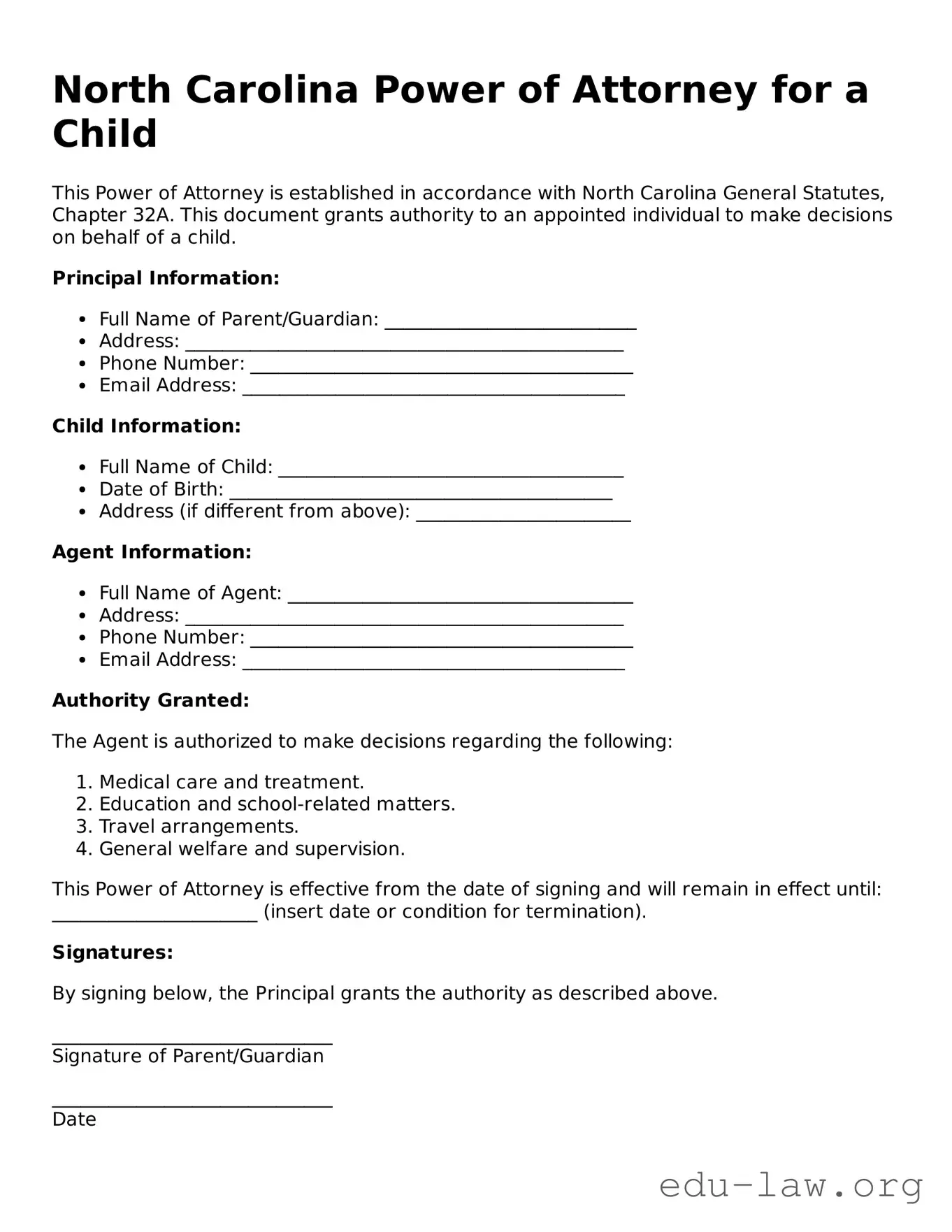
The North Carolina Power of Attorney for a Child form serves as a crucial legal document that allows a parent or guardian to delegate authority over a child’s care to another adult. This form is particularly useful in situations where a parent may be temporarily unavailable, such as during travel, illness, or other circumstances that prevent them from fulfilling their caregiving responsibilities. The form outlines specific powers granted to the designated agent, which can include making decisions related to education, healthcare, and general welfare. It is essential for the parent or guardian to clearly specify the duration of the authority, ensuring that the arrangement is both temporary and appropriate. Additionally, the form requires signatures from both the parent and the agent, as well as a witness, to validate the agreement. Understanding the proper use of this form can help ensure that a child’s needs are met in the absence of their primary caregiver, providing peace of mind for both the parent and the appointed agent.
North Carolina Power of Attorney for a Child
This Power of Attorney is established in accordance with North Carolina General Statutes, Chapter 32A. This document grants authority to an appointed individual to make decisions on behalf of a child.
Principal Information:
Child Information:
Agent Information:
Authority Granted:
The Agent is authorized to make decisions regarding the following:
This Power of Attorney is effective from the date of signing and will remain in effect until: ______________________ (insert date or condition for termination).
Signatures:
By signing below, the Principal grants the authority as described above.
______________________________
Signature of Parent/Guardian
______________________________
Date
______________________________
Signature of Agent
______________________________
Date
| Fact Name | Details |
|---|---|
| Purpose | The North Carolina Power of Attorney for a Child form allows a parent or legal guardian to designate another adult to make decisions on behalf of their child. |
| Governing Law | This form is governed by North Carolina General Statutes, specifically § 32A-1 and § 32A-2. |
| Duration | The power of attorney can remain in effect for up to one year unless revoked earlier by the parent or guardian. |
| Eligibility | Any adult can be designated as the agent, provided they are willing to accept the responsibilities involved. |
| Revocation | A parent or legal guardian can revoke the power of attorney at any time by providing written notice. |
| Notarization | The form must be signed in the presence of a notary public to be considered valid. |
| Limitations | The agent cannot consent to the child's marriage or adoption, or make decisions regarding the child's medical care without additional consent. |
| Use Cases | This form is often used for temporary arrangements, such as when a parent is traveling or unable to care for the child. |
| Access to Records | The agent may have access to the child's educational and medical records, depending on the permissions granted in the form. |
| Legal Advice | While the form is straightforward, it is advisable to seek legal counsel to ensure all aspects are properly understood and executed. |
Filling out the North Carolina Power of Attorney for a Child form is a straightforward process. Once you have completed the form, you will need to ensure that it is properly signed and witnessed. This will help ensure that the document is valid and can be used as intended.
What is a Power of Attorney for a Child in North Carolina?
A Power of Attorney for a Child is a legal document that allows a parent or legal guardian to grant another adult the authority to make decisions on behalf of their child. This can include matters related to education, healthcare, and general welfare. It’s particularly useful for parents who may be temporarily unavailable, such as during travel or work commitments. This document ensures that your child’s needs are met even in your absence.
Who can serve as an agent under this Power of Attorney?
The agent, or the person granted authority, can be a trusted family member, friend, or anyone who is responsible and capable of caring for your child. It is crucial to choose someone who understands your values and is willing to act in your child’s best interest. The selected agent should also be someone who is easily reachable in case of emergencies or important decisions.
How long does the Power of Attorney for a Child last?
The duration of the Power of Attorney can vary based on your specific needs. Generally, it can remain in effect until a specified date or until you revoke it. If you do not set a specific end date, it may last until the child reaches the age of 18. It’s important to communicate clearly with your agent about the intended duration and any conditions that may apply.
Do I need to have the Power of Attorney for a Child notarized?
Yes, in North Carolina, the Power of Attorney for a Child must be signed in the presence of a notary public. This step adds a layer of authenticity and ensures that the document is legally binding. Additionally, having it notarized can help prevent disputes about the validity of the document in the future. Always keep a copy of the notarized document in a safe place and provide copies to your agent and any relevant parties.
Not including the full names of both the parent and the agent. Ensure that both parties are clearly identified.
Failing to specify the duration of the power of attorney. Indicate how long the agent will have authority.
Leaving out important contact information. Include phone numbers and addresses to avoid confusion.
Not signing the document in front of a notary. A notary's signature is often required for the form to be valid.
Using outdated forms. Always check for the most recent version of the Power of Attorney for a Child form.
Neglecting to discuss the arrangement with the child. It's important for the child to understand the situation.
Failing to provide clear instructions to the agent. The agent should know what decisions they can make.
Not reviewing the document after filling it out. Double-check for errors or omissions before submission.
Assuming that the power of attorney is permanent. Understand that this authority can be revoked at any time.
When considering the North Carolina Power of Attorney for a Child form, it's essential to understand that it often works in conjunction with several other important documents. These documents help ensure that the child's needs are met and that the authority granted is clear and comprehensive. Below is a list of commonly used forms that complement the Power of Attorney for a Child.
Each of these documents plays a vital role in ensuring that the child's welfare is prioritized. When combined with the Power of Attorney for a Child, they create a robust framework for care, ensuring that all parties involved understand their rights and responsibilities. Always consider consulting with a legal professional to ensure that all documents are correctly prepared and executed.
The North Carolina Power of Attorney for a Child form shares similarities with the Child Custody Agreement. Both documents address the care and custody of a child, detailing the rights and responsibilities of the parties involved. A Child Custody Agreement is typically used in divorce or separation cases, outlining how parental responsibilities are divided. In contrast, the Power of Attorney for a Child allows a parent to designate another individual to make decisions on behalf of the child temporarily. This can be particularly useful in situations where a parent is unable to care for the child for a limited time.
Another document similar to the North Carolina Power of Attorney for a Child is the Guardianship Agreement. This document establishes a legal relationship where one person is appointed to care for another person, typically a minor. While a Power of Attorney for a Child is often temporary and can be revoked, a Guardianship Agreement is usually more permanent and requires court approval. Both documents serve to ensure that the child’s needs are met, but the Guardianship Agreement provides a more formal and long-term arrangement.
The Temporary Custody Order is another document that bears resemblance to the Power of Attorney for a Child. This order is issued by a court and grants temporary custody of a child to another party, often during legal proceedings. Like the Power of Attorney, it allows someone other than the parent to make decisions for the child. However, a Temporary Custody Order is legally binding and requires judicial oversight, whereas the Power of Attorney is a private agreement between parties.
Additionally, the Medical Power of Attorney for a Child is a closely related document. This form specifically grants an individual the authority to make medical decisions for a child in the event that the parent is unavailable. Similar to the Power of Attorney for a Child, it allows for the delegation of decision-making authority. However, the Medical Power of Attorney is focused solely on healthcare matters, while the broader Power of Attorney encompasses various aspects of a child's welfare.
Lastly, the Authorization for Release of Medical Records is another document that aligns with the North Carolina Power of Attorney for a Child. This authorization allows a designated individual to access a child's medical information. While the Power of Attorney for a Child grants broader decision-making powers, the Authorization for Release is specifically concerned with health-related information. Both documents ensure that the designated individual can act in the best interest of the child, particularly in medical situations.
When filling out the North Carolina Power of Attorney for a Child form, it is important to follow certain guidelines. Here are ten things to keep in mind:
When it comes to the North Carolina Power of Attorney for a Child form, there are several misconceptions that people often have. Understanding the truth can help parents and guardians make informed decisions. Here are five common misconceptions:
Many believe that this form is only for emergency situations. In reality, it can be used for various reasons, including temporary travel or when a parent is unavailable for an extended period.
Some think that signing this form means they are giving up their parental rights. This is not true. The Power of Attorney allows someone else to make decisions temporarily, but it does not terminate parental rights.
While notarization can add an extra layer of authenticity, it is not always required for the Power of Attorney for a Child form to be valid. However, it is advisable to have it notarized for clarity and to avoid potential disputes.
Some people think that only one individual can be designated as the agent. In fact, parents can appoint multiple agents or alternates in case the primary agent is unavailable.
Many assume that this Power of Attorney is a permanent solution. However, it is temporary and can be revoked at any time by the parent or guardian who created it.
Clearing up these misconceptions can help ensure that the Power of Attorney for a Child is used effectively and appropriately.
When considering the North Carolina Power of Attorney for a Child form, it's essential to understand its purpose and how to fill it out correctly. Here are some key takeaways to keep in mind:
Understanding these key points will help ensure that the Power of Attorney for a Child form is filled out correctly and used effectively.