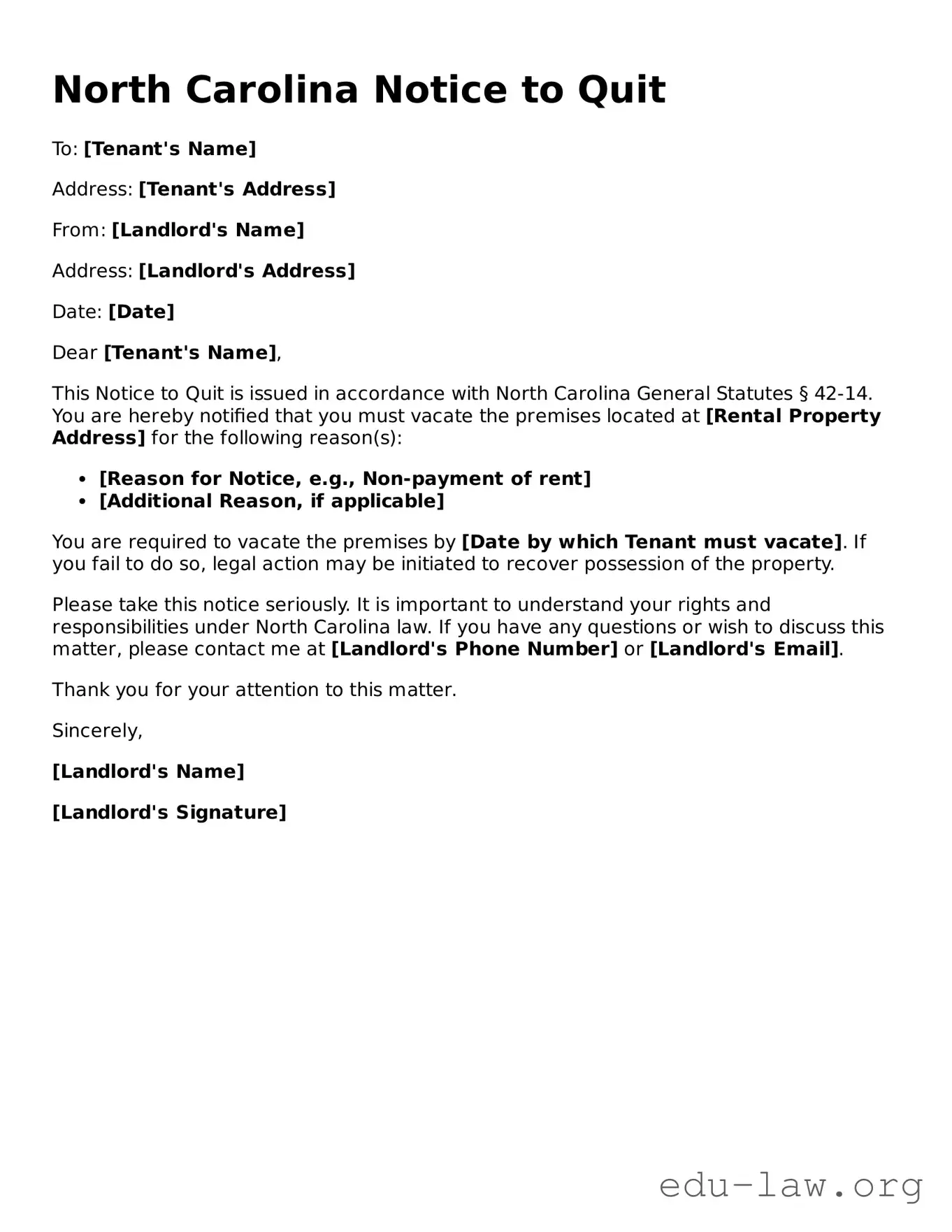
The North Carolina Notice to Quit form serves as a crucial document in the landlord-tenant relationship, particularly when disputes arise over rental agreements. This form notifies tenants of the need to vacate a rental property, often due to non-payment of rent or lease violations. It outlines the specific reasons for the eviction and provides a timeline for the tenant to respond or leave the premises. Understanding the Notice to Quit is essential for both landlords and tenants, as it ensures that the eviction process adheres to state laws. By following the proper procedures outlined in this form, landlords can protect their rights while also giving tenants the opportunity to rectify their situation. The form emphasizes the importance of clear communication and legal compliance, fostering a more respectful and orderly resolution to potential conflicts in housing arrangements.
North Carolina Notice to Quit
To: [Tenant's Name]
Address: [Tenant's Address]
From: [Landlord's Name]
Address: [Landlord's Address]
Date: [Date]
Dear [Tenant's Name],
This Notice to Quit is issued in accordance with North Carolina General Statutes § 42-14. You are hereby notified that you must vacate the premises located at [Rental Property Address] for the following reason(s):
You are required to vacate the premises by [Date by which Tenant must vacate]. If you fail to do so, legal action may be initiated to recover possession of the property.
Please take this notice seriously. It is important to understand your rights and responsibilities under North Carolina law. If you have any questions or wish to discuss this matter, please contact me at [Landlord's Phone Number] or [Landlord's Email].
Thank you for your attention to this matter.
Sincerely,
[Landlord's Name]
[Landlord's Signature]
| Fact Name | Details |
|---|---|
| Purpose | The Notice to Quit form is used by landlords to inform tenants that they must vacate the rental property. |
| Governing Law | The form is governed by North Carolina General Statutes, specifically N.C. Gen. Stat. § 42-14. |
| Delivery Method | Landlords can deliver the Notice to Quit by mail, personal delivery, or posting on the property. |
| Notice Period | Typically, the notice period is at least 10 days for non-payment of rent, but may vary based on the lease terms. |
| Tenant Response | Tenants have the right to respond to the notice and may dispute the eviction if they believe it is unjust. |
| Legal Consequences | Failure to comply with the Notice to Quit can lead to formal eviction proceedings in court. |
After you have gathered the necessary information, you will be ready to fill out the North Carolina Notice to Quit form. This form is an important step in the process of addressing tenancy issues. Follow these steps carefully to ensure that you complete the form accurately.
Once you have completed the form, it is essential to deliver it to the tenant in a manner that complies with local laws. This may involve personal delivery, mailing, or posting the notice on the property. Be sure to keep a record of how and when you delivered the notice.
What is a Notice to Quit in North Carolina?
A Notice to Quit is a formal document that a landlord uses to inform a tenant that they must vacate the rental property. This notice is often issued when a tenant has violated the terms of the lease agreement or has not paid rent. In North Carolina, this notice serves as the first step in the eviction process.
How much notice must a landlord give before a tenant must leave?
In North Carolina, the required notice period depends on the reason for the eviction. For non-payment of rent, landlords typically must provide a 10-day notice. If the eviction is due to lease violations or other reasons, a 30-day notice is generally required. It's essential for landlords to follow these timelines to ensure the eviction process is legally valid.
Can a tenant contest a Notice to Quit?
Yes, tenants have the right to contest a Notice to Quit. If a tenant believes the notice is unjust or incorrect, they can respond by addressing the issues with the landlord. If the matter escalates, the tenant may choose to present their case in court. It's advisable for tenants to gather any relevant documentation to support their position.
What happens if a tenant does not leave after receiving a Notice to Quit?
If a tenant fails to vacate the property after the notice period has expired, the landlord can proceed with filing an eviction lawsuit. This legal action will take place in the local court. The tenant will have an opportunity to defend themselves during the court hearing, where a judge will ultimately decide the outcome.
Is a Notice to Quit required for all evictions in North Carolina?
Not all evictions require a Notice to Quit. For example, if a tenant is engaged in illegal activity or poses a significant threat to the property or other tenants, a landlord may be able to file for immediate eviction without a notice. However, it is often advisable to provide a notice to maintain a clear record of communication.
What should a Notice to Quit include?
A Notice to Quit should clearly state the reason for the eviction, the address of the rental property, and the date by which the tenant must vacate. It should also include the landlord's contact information. Providing this information helps ensure that the notice is understood and legally compliant.
Incomplete Information: One common mistake is failing to provide all required information. This includes the tenant's name, address, and the date of the notice. Omitting any of these details can lead to confusion and may delay the eviction process.
Incorrect Dates: Another frequent error involves using the wrong dates. The notice must specify the correct date by which the tenant must vacate the property. Miscalculating this date can invalidate the notice.
Not Following State Guidelines: Each state has specific laws regarding eviction notices. Failing to adhere to North Carolina's requirements, such as the notice period, can render the form ineffective. It's essential to understand these guidelines before filling out the form.
Signature Issues: Finally, neglecting to sign the form is a critical mistake. The Notice to Quit must be signed by the landlord or their authorized agent. Without a signature, the notice lacks legal validity.
When dealing with rental issues in North Carolina, the Notice to Quit form is often accompanied by other important documents. Each of these forms serves a specific purpose and helps clarify the situation for both landlords and tenants. Here’s a brief overview of five commonly used documents.
Understanding these documents can make the rental process smoother for everyone involved. They provide clarity and help protect the rights of both landlords and tenants.
The North Carolina Notice to Quit form shares similarities with the Eviction Notice. Both documents serve as formal notifications to tenants regarding the termination of their lease agreements. The Eviction Notice typically outlines the reasons for the eviction, such as non-payment of rent or lease violations. Like the Notice to Quit, it requires the landlord to provide a specific timeframe for the tenant to vacate the property. This timeframe varies by state law but is essential for ensuring that the tenant has adequate notice before any legal action is taken.
Another document comparable to the Notice to Quit is the Lease Termination Letter. This letter is often used by landlords to inform tenants that their lease will not be renewed at the end of the current term. Similar to the Notice to Quit, it provides a clear communication channel regarding the end of tenancy. The Lease Termination Letter typically includes the date by which the tenant must vacate the premises, ensuring that both parties are aware of the timeline and can prepare accordingly.
The Demand for Possession is also akin to the Notice to Quit. This document is usually issued after a tenant has failed to comply with the terms of their lease, such as not paying rent. The Demand for Possession formally requests that the tenant vacate the property, often within a specified period. Like the Notice to Quit, it emphasizes the urgency of the situation and the need for the tenant to take immediate action to avoid further legal proceedings.
Lastly, the Notice of Non-Renewal is another document that resembles the Notice to Quit. This notice is typically sent by landlords to inform tenants that their lease will not be extended beyond its current expiration date. It serves a similar purpose by providing tenants with advance notice to make arrangements for moving. Both documents aim to ensure that tenants are aware of their housing status and have sufficient time to secure alternative living arrangements.
When filling out the North Carolina Notice to Quit form, it's essential to approach the task with care. This document is a formal way to notify a tenant that they need to vacate the rental property. Here’s a helpful list of things to do and avoid during this process.
By following these guidelines, you can ensure that your Notice to Quit is filled out correctly and effectively. This can help facilitate a smoother transition for both you and your tenant.
Understanding the North Carolina Notice to Quit form is essential for both landlords and tenants. However, several misconceptions can lead to confusion. Here are four common misunderstandings:
Many people believe that a Notice to Quit automatically means that a tenant is being evicted. In reality, this form is a formal request for a tenant to vacate the property. It serves as a preliminary step before any eviction proceedings can take place.
While landlords have certain rights, they cannot issue a Notice to Quit arbitrarily. The notice must be based on specific grounds, such as non-payment of rent or violation of lease terms. Understanding these grounds is crucial for both parties.
Receiving a Notice to Quit does not mean that tenants have lost their rights. They still have the opportunity to respond and can contest the notice if they believe it is unjust. Legal protections exist to ensure fair treatment.
Some think that the Notice to Quit must be delivered directly to the tenant. In North Carolina, landlords can also send the notice via certified mail or leave it at the tenant's residence. Knowing the acceptable methods of delivery can simplify the process.
When utilizing the North Carolina Notice to Quit form, it is essential to understand its purpose and how to fill it out correctly. Here are some key takeaways to keep in mind:
Being informed and diligent while using the Notice to Quit form can help streamline the process and reduce potential conflicts.