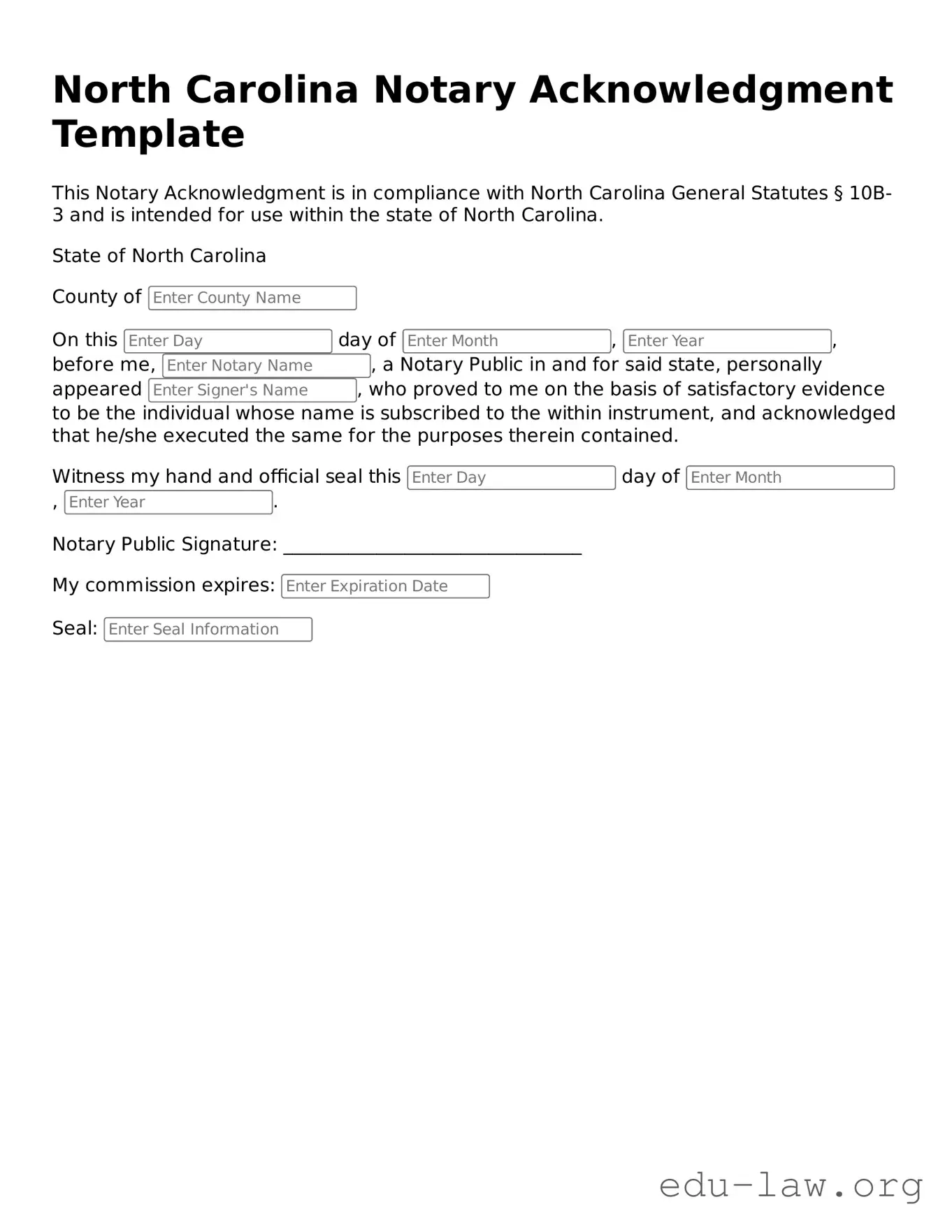
The North Carolina Notary Acknowledgement form serves as a crucial document in the realm of legal transactions, ensuring that signatures on various instruments are verified and authenticated. This form plays a significant role in establishing the identity of the signer and confirming their willingness to engage in the transaction. It is commonly utilized in situations involving deeds, contracts, and other legal documents where proof of acknowledgment is required. By completing this form, a notary public affirms that they have witnessed the signing of the document, which adds an essential layer of credibility and trust. The form itself includes vital information such as the name of the signer, the date of the acknowledgment, and the notary's signature and seal. Understanding the nuances of this form is essential for anyone involved in legal matters in North Carolina, as it helps to protect the interests of all parties involved and ensures compliance with state laws.
North Carolina Notary Acknowledgment Template
This Notary Acknowledgment is in compliance with North Carolina General Statutes § 10B-3 and is intended for use within the state of North Carolina.
State of North Carolina
County of
On this day of , , before me, , a Notary Public in and for said state, personally appeared , who proved to me on the basis of satisfactory evidence to be the individual whose name is subscribed to the within instrument, and acknowledged that he/she executed the same for the purposes therein contained.
Witness my hand and official seal this day of , .
Notary Public Signature: ________________________________
My commission expires:
Seal:
| Fact Name | Description |
|---|---|
| Purpose | The North Carolina Notary Acknowledgement form is used to verify the identity of the signer and confirm that they willingly signed a document. |
| Governing Law | The form is governed by North Carolina General Statutes, specifically G.S. 10B-3 and G.S. 10B-4. |
| Required Elements | The form must include the notary's signature, seal, and the date of the acknowledgment. |
| Signer's Information | The form requires the name of the person signing the document to be clearly printed or typed. |
| Witnesses | Witnesses are not required for a notary acknowledgment in North Carolina. |
| Use Cases | This form is commonly used in real estate transactions, legal documents, and other formal agreements. |
Once you have the North Carolina Notary Acknowledgment form in hand, you'll be ready to fill it out accurately. This form is essential for certifying that a document has been signed in the presence of a notary public. Follow these steps to ensure that you complete the form correctly.
After completing these steps, the form is ready for use. Make sure to keep a copy for your records, as it may be needed for future reference or verification.
What is a North Carolina Notary Acknowledgement form?
The North Carolina Notary Acknowledgement form is a legal document used to verify that a specific individual has signed a document in the presence of a notary public. This form serves as proof that the signer willingly and knowingly executed the document. It is often required for various legal transactions, such as real estate closings, contracts, and other formal agreements.
Who can act as a notary public in North Carolina?
In North Carolina, a notary public must be at least 18 years old, a resident of the state, and have completed the required training and examination. Notaries are appointed by the Governor and must adhere to state laws and regulations regarding their duties. They are responsible for verifying the identity of signers and ensuring that all signatures are made voluntarily.
How do I complete a Notary Acknowledgement form?
To complete a Notary Acknowledgement form, the signer must appear before the notary public. The notary will ask the signer to provide valid identification to confirm their identity. After verifying the signer’s identity, the notary will complete the form by filling in details such as the date, the type of document being acknowledged, and the notary’s signature and seal. It is essential that the signer understands the contents of the document before signing.
Is a Notary Acknowledgement form mandatory for all documents?
No, a Notary Acknowledgement form is not required for every document. However, certain documents, particularly those related to real estate transactions, may require notarization to be legally binding. It is advisable to check with legal counsel or the specific requirements of the transaction to determine if notarization is necessary.
Incomplete Information: One common mistake is failing to provide all required details. This includes the names of the signers, the date of the acknowledgment, and the notary's information. Each section must be filled out completely to ensure validity.
Incorrect Signer Name: Using a name that does not match the identification presented can lead to issues. It's crucial to ensure that the name on the form exactly matches the name on the signer’s ID.
Wrong Date: Entering the wrong date can cause confusion or invalidate the acknowledgment. Double-check the date of the signing to ensure accuracy.
Missing Notary Seal: The absence of a notary seal is a significant oversight. Every notary acknowledgment must be accompanied by the official seal to be considered valid.
Notary Signature Issues: The notary's signature must be clear and consistent with their official signature. Any discrepancies can raise questions about the authenticity of the acknowledgment.
Failure to Verify Identification: Notaries must verify the identity of the signer. Skipping this step can lead to legal complications. Always confirm that proper identification is provided.
Improper Witnesses: In some cases, witnesses may be required. Failing to have the necessary witnesses present can invalidate the acknowledgment. Be sure to understand the requirements for witnesses in your specific situation.
Using an Outdated Form: Notary acknowledgment forms can change. Using an outdated version can lead to legal issues. Always ensure you have the most current form available.
Not Following State-Specific Guidelines: Each state has its own rules regarding notary acknowledgments. Ignoring North Carolina's specific requirements can result in the form being rejected.
Assuming All Forms Are the Same: Notary acknowledgment forms vary by purpose and jurisdiction. Assuming that a form used in another state or for another purpose is acceptable can lead to serious mistakes.
When engaging in legal transactions or formal agreements in North Carolina, individuals often find themselves needing various forms and documents to accompany the Notary Acknowledgement form. Each of these documents plays a crucial role in ensuring that the process is smooth and legally binding. Below is a list of commonly used forms that may be utilized alongside the Notary Acknowledgement.
Understanding these documents can significantly enhance your ability to navigate legal requirements in North Carolina. Each form serves a distinct purpose, and together with the Notary Acknowledgement, they help create a comprehensive legal framework for various transactions.
The North Carolina Notary Acknowledgment form is similar to the Affidavit. An affidavit is a written statement confirmed by oath or affirmation, used as evidence in court. Like the notary acknowledgment, an affidavit requires the presence of a notary public who verifies the identity of the affiant and ensures that the statement is made voluntarily. Both documents serve to authenticate the identity of the signer and the legitimacy of the statements made within the document.
Another document that shares similarities is the Jurat. A jurat is a certification that a signer has sworn to the truth of the contents of a document. In both the notary acknowledgment and the jurat, a notary public must be present to witness the signing. The key difference lies in the purpose; while a notary acknowledgment affirms the signing of a document, a jurat confirms the truthfulness of the content within the document.
The Power of Attorney (POA) form also resembles the North Carolina Notary Acknowledgment form. A POA allows one person to act on behalf of another in legal matters. Notarization is often required for a POA to ensure that the principal's identity is verified and that they are granting authority willingly. Both documents involve notarization to prevent fraud and to confirm the authenticity of the signatures involved.
The Deed is another document that requires a notary acknowledgment. A deed transfers ownership of real property from one party to another. In North Carolina, a notary public must acknowledge the signatures on the deed to ensure that the transfer is legally binding. Both documents require the notary to verify the identity of the parties involved and to confirm that they are signing willingly.
When filling out the North Carolina Notary Acknowledgment form, it’s important to follow certain guidelines to ensure the process goes smoothly. Here are five things you should and shouldn't do:
Misconceptions about the North Carolina Notary Acknowledgment form can lead to confusion and mistakes. Understanding the facts can help individuals navigate the notary process more effectively. Here are eight common misconceptions:
Understanding these misconceptions can help individuals make informed decisions when seeking notary services in North Carolina.
Filling out and using the North Carolina Notary Acknowledgement form is an important process that ensures documents are properly verified and authenticated. Here are some key takeaways to keep in mind:
Understanding these key aspects can help ensure that the notary process is smooth and effective, providing peace of mind for all parties involved.