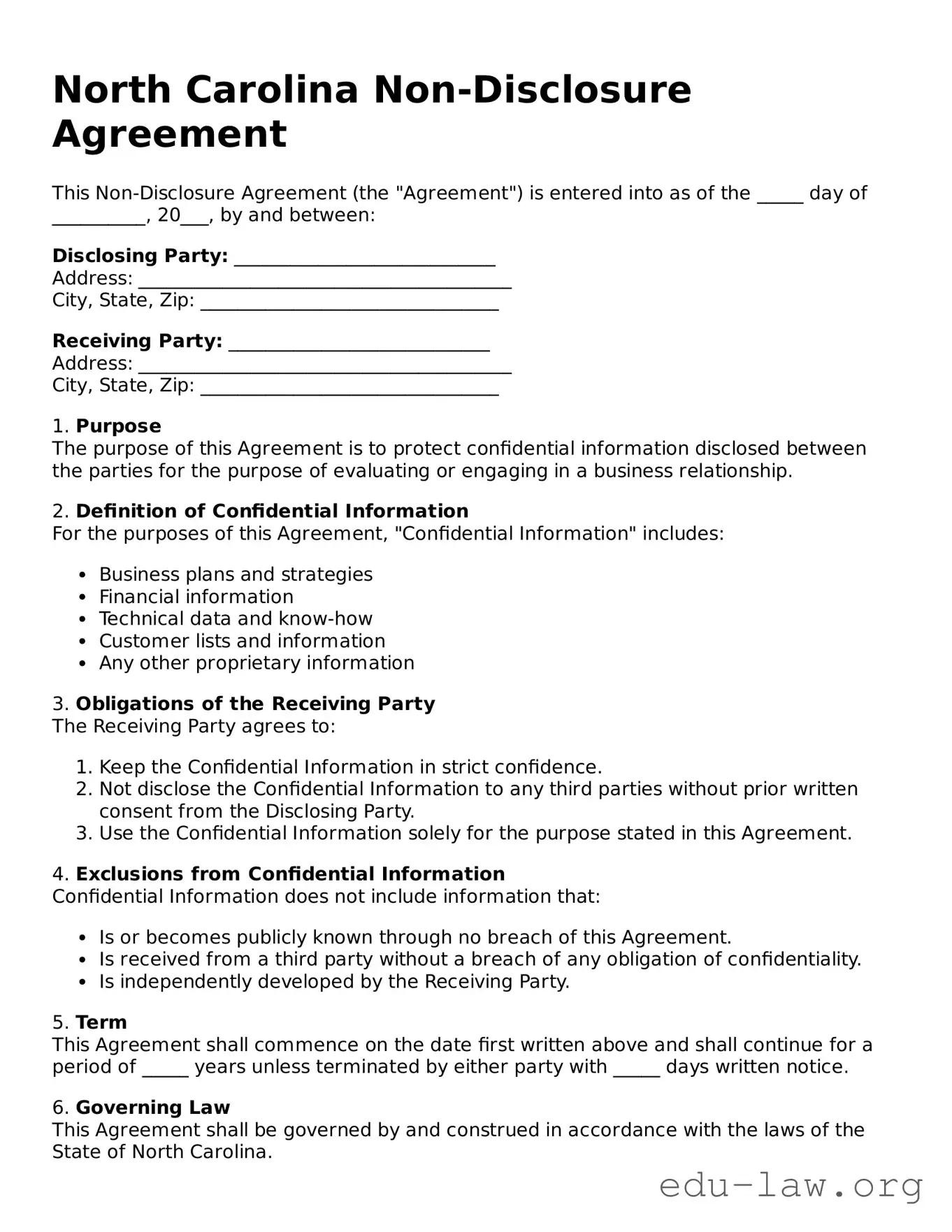
In the realm of business and professional relationships, confidentiality is paramount. The North Carolina Non-disclosure Agreement (NDA) serves as a vital tool for protecting sensitive information shared between parties. This legally binding document outlines the terms under which confidential information can be disclosed, ensuring that proprietary data, trade secrets, and other private information remain secure. Key components of the NDA include definitions of what constitutes confidential information, the obligations of the receiving party, and the duration of confidentiality. Additionally, the agreement may specify the consequences of unauthorized disclosure, providing a clear framework for enforcement. By establishing trust and clarity, the North Carolina NDA not only safeguards intellectual property but also fosters a collaborative environment where innovation can thrive without the fear of information leakage.
North Carolina Non-Disclosure Agreement
This Non-Disclosure Agreement (the "Agreement") is entered into as of the _____ day of __________, 20___, by and between:
Disclosing Party: ____________________________
Address: ________________________________________
City, State, Zip: ________________________________
Receiving Party: ____________________________
Address: ________________________________________
City, State, Zip: ________________________________
1. Purpose
The purpose of this Agreement is to protect confidential information disclosed between the parties for the purpose of evaluating or engaging in a business relationship.
2. Definition of Confidential Information
For the purposes of this Agreement, "Confidential Information" includes:
3. Obligations of the Receiving Party
The Receiving Party agrees to:
4. Exclusions from Confidential Information
Confidential Information does not include information that:
5. Term
This Agreement shall commence on the date first written above and shall continue for a period of _____ years unless terminated by either party with _____ days written notice.
6. Governing Law
This Agreement shall be governed by and construed in accordance with the laws of the State of North Carolina.
7. Entire Agreement
This Agreement constitutes the entire understanding between the parties regarding the subject matter herein and supersedes all prior discussions and agreements.
IN WITNESS WHEREOF, the parties have executed this Non-Disclosure Agreement as of the date first above written.
______________________________
Disclosing Party Signature
______________________________
Receiving Party Signature
| Fact Name | Description |
|---|---|
| Purpose | The North Carolina Non-disclosure Agreement (NDA) is designed to protect confidential information shared between parties. |
| Governing Law | This agreement is governed by the laws of the State of North Carolina. |
| Parties Involved | Typically, the NDA involves at least two parties: the disclosing party and the receiving party. |
| Duration of Confidentiality | The NDA can specify a time frame during which the information must remain confidential, often ranging from one to five years. |
| Exclusions | Common exclusions from confidentiality include information that is publicly available or independently developed by the receiving party. |
| Enforcement | If a party breaches the NDA, the other party may seek legal remedies, including injunctive relief and damages. |
Filling out the North Carolina Non-disclosure Agreement form requires careful attention to detail. After completing the form, it is essential to ensure that all parties involved understand the terms outlined within. This agreement helps to protect sensitive information shared between parties.
What is a Non-disclosure Agreement (NDA) in North Carolina?
A Non-disclosure Agreement (NDA) is a legally binding contract designed to protect confidential information shared between parties. In North Carolina, this document ensures that sensitive information, such as trade secrets, business plans, or proprietary data, remains confidential. By signing an NDA, the parties agree not to disclose the specified information to unauthorized individuals or entities.
Who typically uses a Non-disclosure Agreement?
NDAs are commonly used by businesses, entrepreneurs, and individuals who need to share confidential information. For instance, a startup might require potential investors to sign an NDA before discussing its business model. Similarly, companies may ask employees or contractors to sign NDAs to protect sensitive information they may access during their work. Essentially, anyone who wishes to safeguard confidential information can benefit from using an NDA.
What should be included in a Non-disclosure Agreement?
An effective NDA should clearly outline the parties involved, define what constitutes confidential information, and specify the obligations of each party regarding that information. It should also include the duration of confidentiality, any exclusions (such as information already in the public domain), and the consequences of breaching the agreement. Clarity and specificity are crucial to ensure that all parties understand their rights and responsibilities.
Is a Non-disclosure Agreement enforceable in North Carolina?
Yes, NDAs are generally enforceable in North Carolina, provided they meet certain legal requirements. The agreement must be reasonable in scope and duration, and it should not impose undue restrictions on the parties involved. Courts will typically uphold NDAs as long as they protect legitimate business interests and do not violate public policy. However, it's always wise to consult with a legal professional to ensure that the NDA is properly drafted and enforceable.
What happens if someone breaches a Non-disclosure Agreement?
If a party breaches an NDA, the injured party may seek legal remedies. This can include monetary damages for any losses incurred due to the breach, as well as injunctive relief to prevent further disclosure of confidential information. The specific consequences will depend on the terms outlined in the agreement and the nature of the breach. Legal action can be complex, so it's advisable to consult with an attorney to explore options and navigate the process effectively.
Not clearly defining confidential information: One common mistake is failing to specify what constitutes confidential information. Without clear definitions, misunderstandings can arise, leading to potential disputes.
Omitting the duration of the agreement: Another frequent error is neglecting to state how long the non-disclosure obligations will last. It’s important to establish a timeframe to ensure both parties understand their commitments.
Not including all parties involved: Sometimes, individuals forget to list all parties who will have access to the confidential information. This can create gaps in protection and leave sensitive information vulnerable.
Failing to review the terms: Lastly, many people rush through the process and do not take the time to thoroughly review the terms of the agreement. This can lead to unintended consequences or agreements that don’t fully protect their interests.
A Non-disclosure Agreement (NDA) is a vital tool for protecting sensitive information in various business relationships. When drafting or signing an NDA in North Carolina, several other forms and documents may also be relevant. Here’s a list of commonly used documents that often accompany an NDA.
Understanding these related documents can enhance your ability to safeguard sensitive information effectively. Each serves a specific purpose and can complement the Non-disclosure Agreement, ensuring comprehensive protection in various business scenarios.
The North Carolina Non-disclosure Agreement (NDA) is similar to a Confidentiality Agreement. Both documents serve the primary purpose of protecting sensitive information shared between parties. A Confidentiality Agreement often covers a broader range of information and can be used in various contexts, such as employment or business partnerships. Like an NDA, it legally binds the parties to maintain secrecy regarding the disclosed information. However, while NDAs are typically more focused on trade secrets and proprietary information, Confidentiality Agreements may also encompass personal data and other sensitive materials.
Another document comparable to the NDA is the Non-compete Agreement. While an NDA restricts the sharing of confidential information, a Non-compete Agreement limits a party's ability to engage in business activities that could compete with another party. This agreement is often used in employment contexts to prevent employees from joining rival firms or starting competing businesses after leaving a company. Both documents aim to protect the interests of a business, but they do so through different mechanisms and focus areas.
The Mutual Non-disclosure Agreement is also closely related to the North Carolina NDA. Unlike a unilateral NDA, where only one party discloses information, a Mutual NDA involves both parties sharing confidential information. This type of agreement is particularly common in joint ventures or partnerships where both sides need to exchange sensitive information for collaboration. The legal obligations to protect the information are reciprocal, ensuring that both parties are held to the same standard of confidentiality.
Lastly, a Proprietary Information Agreement (PIA) shares similarities with the NDA. A PIA specifically addresses the protection of proprietary information, which can include trade secrets, business strategies, and other unique business elements. Like an NDA, a PIA creates a legal obligation for the receiving party to keep the information confidential. However, a PIA may also include provisions regarding the use of the proprietary information, outlining how it can or cannot be utilized by the receiving party, which adds an extra layer of protection for the disclosing party.
When filling out the North Carolina Non-disclosure Agreement form, it’s important to ensure that you complete it correctly to protect your confidential information. Here are some guidelines to follow:
Understanding the North Carolina Non-disclosure Agreement (NDA) can be tricky. Here are ten common misconceptions that often lead to confusion:
By clearing up these misconceptions, individuals and businesses can better navigate the complexities of NDAs in North Carolina.
When filling out and using the North Carolina Non-disclosure Agreement (NDA) form, there are several important considerations to keep in mind. These points can help ensure that the document serves its intended purpose effectively.
By keeping these key takeaways in mind, parties can navigate the process of filling out and utilizing the North Carolina Non-disclosure Agreement more effectively.