In the competitive landscape of North Carolina's job market, businesses often seek to protect their interests through various legal agreements, one of which is the Non-compete Agreement. This form serves as a crucial tool for employers aiming to prevent employees from engaging in activities that could undermine their business after leaving the company. Key aspects of the Non-compete Agreement include the duration of the restriction, the geographic area it covers, and the specific activities that are limited. Employers must ensure that the terms are reasonable and not overly broad, as North Carolina courts will assess the enforceability of these agreements based on their fairness and necessity to protect legitimate business interests. Employees, on the other hand, should understand the implications of signing such an agreement, as it can significantly impact their future employment opportunities. Overall, the Non-compete Agreement is a vital document that balances the needs of businesses with the rights of employees, making it essential for both parties to navigate its terms carefully.
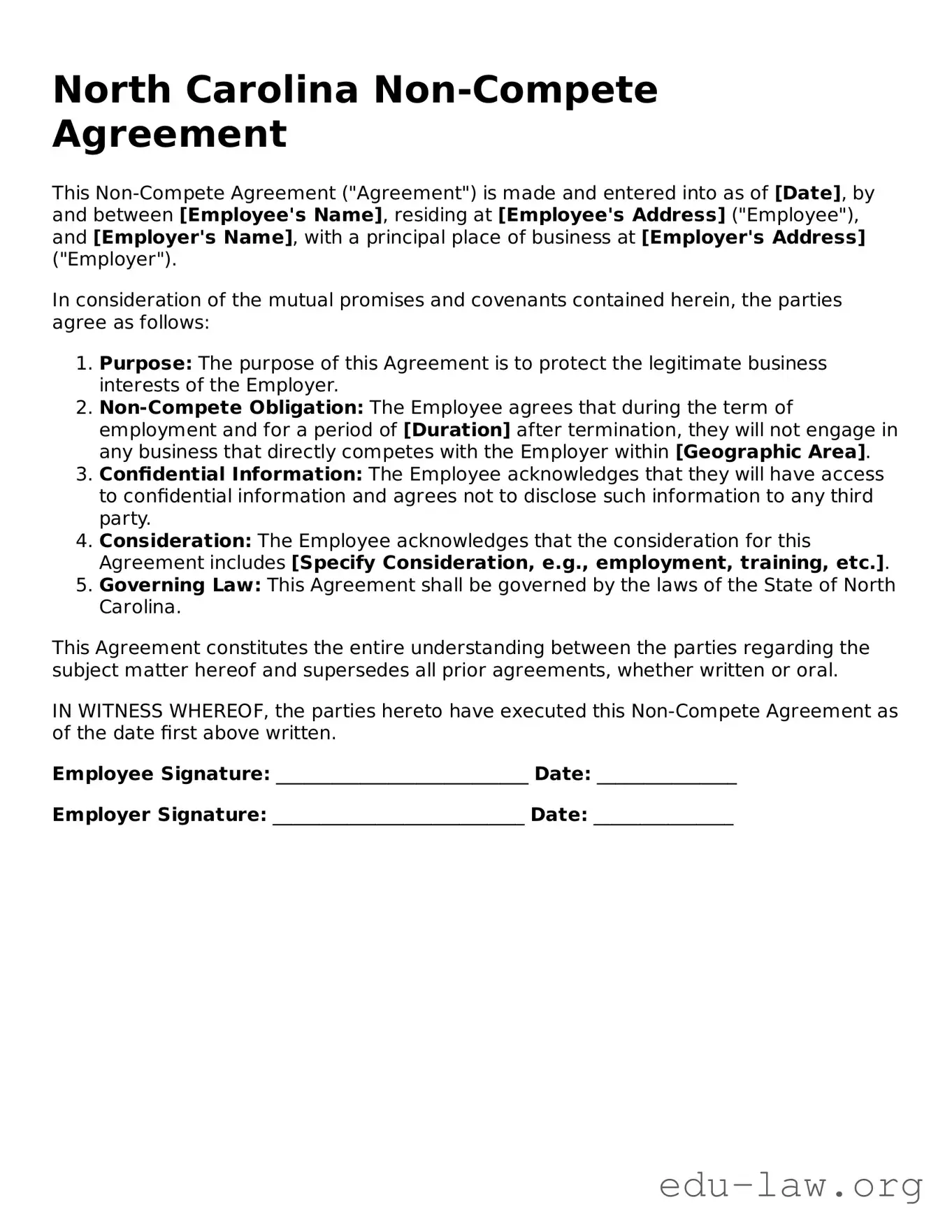
North Carolina Non-Compete Agreement
This Non-Compete Agreement ("Agreement") is made and entered into as of [Date], by and between [Employee's Name], residing at [Employee's Address] ("Employee"), and [Employer's Name], with a principal place of business at [Employer's Address] ("Employer").
In consideration of the mutual promises and covenants contained herein, the parties agree as follows:
This Agreement constitutes the entire understanding between the parties regarding the subject matter hereof and supersedes all prior agreements, whether written or oral.
IN WITNESS WHEREOF, the parties hereto have executed this Non-Compete Agreement as of the date first above written.
Employee Signature: ___________________________ Date: _______________
Employer Signature: ___________________________ Date: _______________
| Fact Name | Description |
|---|---|
| Purpose | The North Carolina Non-compete Agreement is designed to protect a business's interests by restricting an employee's ability to work for competitors after leaving the company. |
| Governing Law | This agreement is governed by North Carolina General Statutes, specifically Chapter 75-4, which outlines the enforceability of non-compete clauses. |
| Enforceability | In North Carolina, non-compete agreements are enforceable only if they are reasonable in duration, geographic area, and scope of activity. |
| Duration | Typically, a duration of six months to two years is considered reasonable, but this can vary based on the nature of the business and the employee's role. |
| Consideration | For a non-compete agreement to be valid, there must be consideration, such as a job offer or a promotion, provided to the employee at the time of signing. |
| Legal Review | It is advisable for both employers and employees to seek legal counsel before entering into a non-compete agreement to ensure that the terms are fair and enforceable. |
Filling out the North Carolina Non-compete Agreement form requires careful attention to detail. After completing the form, it will need to be signed by all parties involved, and it may require witnesses or notarization depending on specific circumstances.
What is a Non-compete Agreement in North Carolina?
A Non-compete Agreement is a contract between an employer and an employee that restricts the employee from working for competitors or starting a competing business for a specified period after leaving the company. In North Carolina, these agreements must be reasonable in scope, duration, and geographic area to be enforceable.
Are Non-compete Agreements enforceable in North Carolina?
Yes, Non-compete Agreements can be enforceable in North Carolina, but they must meet certain criteria. They should protect legitimate business interests, such as trade secrets or customer relationships. The agreement must also be reasonable in terms of time and geographic restrictions. Courts will evaluate each case individually.
How long can a Non-compete Agreement last in North Carolina?
The duration of a Non-compete Agreement in North Carolina should be reasonable. Typically, agreements lasting six months to two years are more likely to be upheld. However, the specific circumstances of each case can influence the court's decision regarding the length of the restriction.
What happens if I violate a Non-compete Agreement?
If you violate a Non-compete Agreement, your former employer may take legal action against you. This could result in an injunction to prevent you from working for a competitor, as well as potential monetary damages. It is advisable to consult with a legal professional if you are concerned about the implications of your agreement.
Can I negotiate the terms of a Non-compete Agreement?
Yes, you can negotiate the terms of a Non-compete Agreement before signing it. It is important to discuss any concerns you have with your employer. You may want to consider seeking legal advice to ensure that the terms are fair and reasonable before agreeing to them.
Not Clearly Defining the Scope of Activities: Individuals often fail to specify which activities are restricted. A vague description can lead to misunderstandings and disputes later on.
Ignoring Geographic Limitations: Many overlook the importance of clearly stating the geographic area where the non-compete applies. A poorly defined area can render the agreement unenforceable.
Overly Long Duration: Some people set the duration of the non-compete too long. Courts may reject agreements that impose unreasonable time limits, so it's crucial to choose a reasonable timeframe.
Failing to Consider State Laws: Not all states enforce non-compete agreements in the same way. Ignoring North Carolina's specific laws can lead to an ineffective agreement.
Neglecting to Include Consideration: The agreement must include something of value exchanged between the parties. Without this, the non-compete may not hold up in court.
When entering into a Non-compete Agreement in North Carolina, several additional documents may be necessary to support the agreement and clarify the terms between the parties involved. Below is a list of common forms and documents that often accompany a Non-compete Agreement.
Understanding these additional documents can help ensure that both employers and employees are clear about their rights and responsibilities. Proper documentation fosters a transparent relationship and can prevent potential disputes in the future.
The North Carolina Non-compete Agreement shares similarities with the Non-disclosure Agreement (NDA). Both documents aim to protect sensitive information. While a non-compete restricts an individual from working with competitors after leaving a job, an NDA prevents the sharing of confidential information during and after employment. Both agreements foster trust between employers and employees, ensuring that proprietary information remains secure and that competitive advantages are maintained.
Another document that closely resembles the Non-compete Agreement is the Employment Contract. An employment contract outlines the terms of employment, including job responsibilities, salary, and benefits. Often, it includes clauses that address non-compete stipulations. This ensures that employees are aware of their obligations regarding competition and confidentiality from the outset of their employment, thereby reducing the risk of misunderstandings later on.
The Non-solicitation Agreement is also similar to the Non-compete Agreement. This document specifically prevents an employee from soliciting clients or employees from their former employer after leaving the company. While a non-compete restricts where one can work, a non-solicitation agreement focuses on protecting the business's relationships and preventing the poaching of clients or staff, thereby safeguarding the company’s interests.
A Confidentiality Agreement, often used interchangeably with NDAs, is another related document. This agreement emphasizes the importance of keeping sensitive information private. While the Non-compete Agreement limits employment opportunities, the Confidentiality Agreement focuses on the obligation to protect trade secrets and proprietary information. Both documents are essential for maintaining a competitive edge in the marketplace.
The Partnership Agreement shares some common ground with the Non-compete Agreement as well. This document governs the relationship between partners in a business, outlining responsibilities, profit sharing, and other critical aspects. Often, it includes non-compete clauses to protect the business from partners who might leave and start competing ventures, ensuring that the interests of the partnership are upheld even after a partner departs.
Lastly, the Severance Agreement can be compared to the Non-compete Agreement. A severance agreement is often provided when an employee is laid off or terminated, detailing the terms of their departure, including any compensation. These agreements may include non-compete clauses as part of the terms, ensuring that the departing employee does not engage in competitive activities for a specified time, thus protecting the employer's interests during the transition.
When filling out the North Carolina Non-compete Agreement form, it’s important to approach the process with care and consideration. Here’s a list of things you should and shouldn’t do to ensure that your agreement is clear and enforceable.
Understanding non-compete agreements in North Carolina can be challenging. Here are seven common misconceptions that people often have:
Not true. In North Carolina, these agreements must be reasonable in scope, duration, and geography to be enforceable.
This is a misconception. Employers can choose to require non-compete agreements for certain positions, but not all employees are obligated to sign one.
Incorrect. The restrictions typically only apply to specific industries or roles, and the agreement must clearly outline these limitations.
This is misleading. While non-compete agreements restrict certain activities, they do not necessarily prevent you from working in your field altogether.
These are different. A non-compete focuses on restricting employment, while a non-disclosure agreement protects confidential information.
This is not accurate. Most non-compete agreements have a specified duration, after which the restrictions no longer apply.
This is a misconception. Non-compete agreements can apply to various levels of employees, depending on the employer's needs and the nature of the work.
When filling out and using the North Carolina Non-compete Agreement form, consider the following key takeaways: