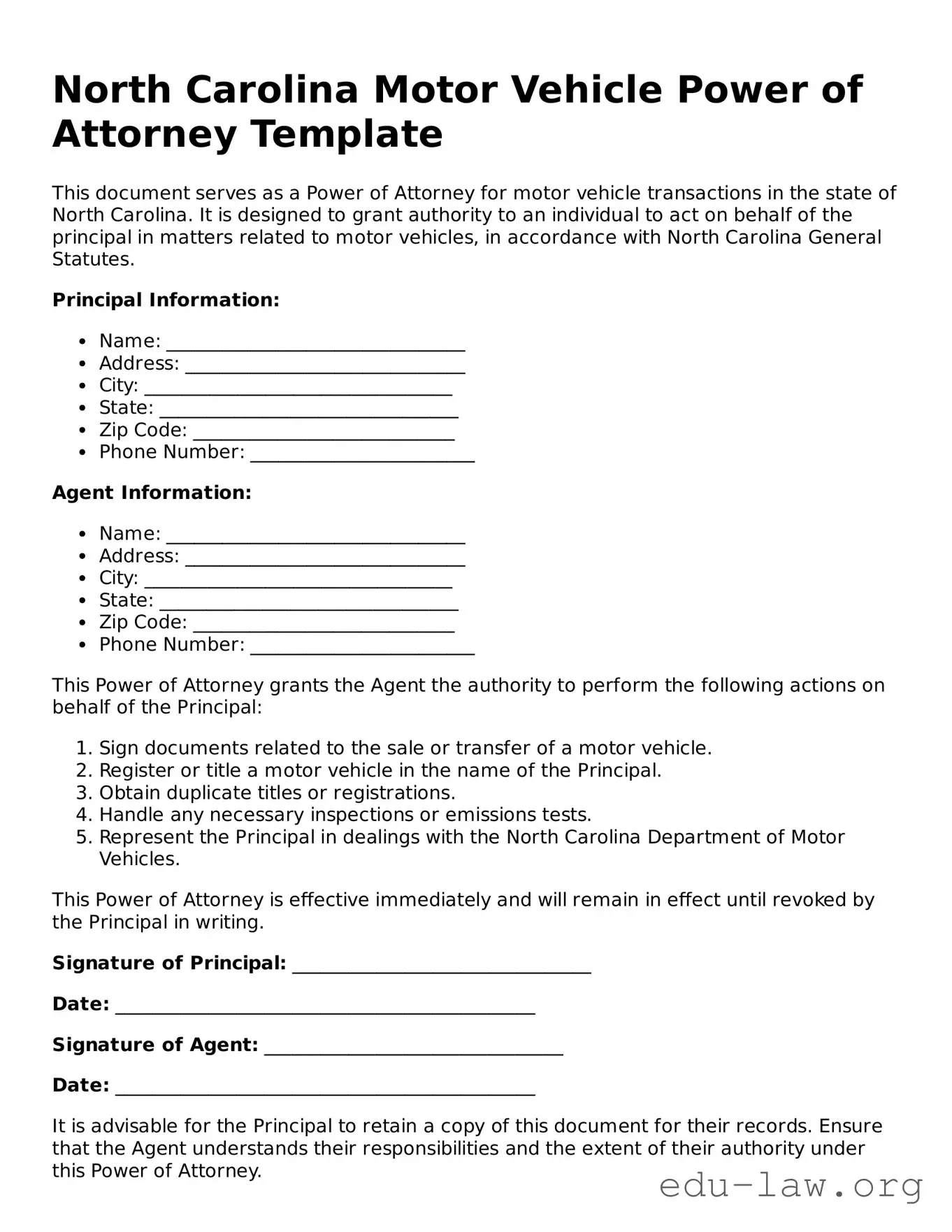
The North Carolina Motor Vehicle Power of Attorney form is a crucial document for individuals who need to delegate authority regarding their motor vehicle transactions. This form allows a designated agent to act on behalf of the vehicle owner in matters such as title transfers, registration, and other related activities. It simplifies the process of handling vehicle-related affairs, especially when the owner cannot be present. By completing this form, the vehicle owner grants specific powers to the agent, ensuring that all necessary actions can be taken efficiently. It’s essential to provide accurate information, including the names and addresses of both the owner and the agent, as well as details about the vehicle involved. Additionally, the form requires signatures from both parties to validate the agreement. Understanding the importance and proper use of this form can save time and prevent complications in managing vehicle ownership responsibilities.
North Carolina Motor Vehicle Power of Attorney Template
This document serves as a Power of Attorney for motor vehicle transactions in the state of North Carolina. It is designed to grant authority to an individual to act on behalf of the principal in matters related to motor vehicles, in accordance with North Carolina General Statutes.
Principal Information:
Agent Information:
This Power of Attorney grants the Agent the authority to perform the following actions on behalf of the Principal:
This Power of Attorney is effective immediately and will remain in effect until revoked by the Principal in writing.
Signature of Principal: ________________________________
Date: _____________________________________________
Signature of Agent: ________________________________
Date: _____________________________________________
It is advisable for the Principal to retain a copy of this document for their records. Ensure that the Agent understands their responsibilities and the extent of their authority under this Power of Attorney.
| Fact Name | Description |
|---|---|
| Purpose | The North Carolina Motor Vehicle Power of Attorney form allows an individual to designate another person to handle motor vehicle transactions on their behalf. |
| Governing Law | This form is governed by the North Carolina General Statutes, specifically § 20-4.01. |
| Signature Requirement | The form must be signed by the person granting the power of attorney, also known as the principal. |
| Notarization | While notarization is not strictly required, it is highly recommended to enhance the form's validity. |
| Revocation | The principal can revoke the power of attorney at any time, as long as they provide notice to the agent. |
| Agent's Authority | The agent can perform various tasks, including signing titles, registering vehicles, and handling transactions related to motor vehicles. |
| Expiration | The power of attorney remains effective until the principal revokes it or until the principal's death. |
| Usage | This form is commonly used for vehicle sales, transfers, and registration processes in North Carolina. |
After obtaining the North Carolina Motor Vehicle Power of Attorney form, you will need to complete it accurately to ensure it is valid. This process allows you to designate someone to act on your behalf regarding motor vehicle transactions.
What is a Motor Vehicle Power of Attorney in North Carolina?
A Motor Vehicle Power of Attorney (POA) in North Carolina is a legal document that allows an individual, known as the principal, to authorize another person, called the agent, to act on their behalf in matters related to motor vehicles. This can include tasks such as transferring vehicle titles, registering vehicles, or handling other vehicle-related transactions. The POA is particularly useful when the principal is unable to be present for these transactions due to various reasons, such as being out of state or having health issues.
Who can be designated as an agent in a Motor Vehicle Power of Attorney?
In North Carolina, the agent can be any competent adult. This means the person should be at least 18 years old and capable of understanding the responsibilities involved. Many people choose family members or trusted friends as their agents. However, it is essential to select someone who is reliable and trustworthy, as they will have the authority to make decisions regarding the principal's vehicle.
How do I complete the Motor Vehicle Power of Attorney form?
To complete the Motor Vehicle Power of Attorney form, you will need to provide specific information about both the principal and the agent. This includes names, addresses, and possibly identification numbers. You must clearly outline the powers being granted to the agent, which can be broad or limited, depending on your needs. After filling out the form, both parties should sign it in the presence of a notary public to ensure its validity.
Is notarization required for the Motor Vehicle Power of Attorney?
Yes, notarization is required for the Motor Vehicle Power of Attorney in North Carolina. Having the document notarized adds a layer of authenticity and helps prevent potential disputes regarding its legitimacy. The notary public will verify the identities of the principal and the agent, ensuring that the document is signed willingly and without any coercion.
Can I revoke a Motor Vehicle Power of Attorney?
Yes, you can revoke a Motor Vehicle Power of Attorney at any time, as long as you are mentally competent. To do this, you should create a written revocation document that states your intention to cancel the POA. It is advisable to notify the agent and any relevant parties, such as the Department of Motor Vehicles, to prevent any unauthorized actions by the agent after the revocation.
What happens if the principal becomes incapacitated?
If the principal becomes incapacitated, the Motor Vehicle Power of Attorney remains in effect unless it was specifically stated that it would terminate upon such an event. This means the agent can continue to act on behalf of the principal regarding motor vehicle matters. However, if the principal had a different arrangement, such as a durable power of attorney, that document would govern the agent's authority.
Can I use a Motor Vehicle Power of Attorney for multiple vehicles?
Yes, a Motor Vehicle Power of Attorney can be used for multiple vehicles. When completing the form, you can specify each vehicle by providing details such as the make, model, and Vehicle Identification Number (VIN). This clarity ensures that the agent has the authority to manage transactions for all specified vehicles without confusion.
Are there any limitations to the powers granted in a Motor Vehicle Power of Attorney?
Yes, the powers granted in a Motor Vehicle Power of Attorney can be limited based on the principal's preferences. The principal can specify which actions the agent is authorized to take, such as only transferring titles or handling registrations. It is crucial to be clear about these limitations in the document to avoid any misunderstandings about the agent's authority.
Where can I obtain the Motor Vehicle Power of Attorney form?
The Motor Vehicle Power of Attorney form can typically be obtained from the North Carolina Division of Motor Vehicles (NCDMV) website or local DMV offices. Additionally, legal stationery stores may carry the form. It is essential to use the most current version of the form to ensure compliance with state laws.
Failing to provide complete information about the principal. This includes not filling in the full name, address, and contact details.
Not clearly identifying the agent. The agent's name and relationship to the principal should be specified, as well as their contact information.
Omitting the specific powers granted. The form should clearly outline what powers the agent has regarding the motor vehicle, such as selling, transferring, or registering the vehicle.
Neglecting to sign the form. The principal must sign the document for it to be valid. Without a signature, the form holds no legal weight.
Not dating the form. The date of signing is crucial as it establishes when the powers take effect.
Using outdated forms. It is important to ensure that the most current version of the North Carolina Motor Vehicle Power of Attorney form is used.
Failing to have the form notarized. While not always required, notarization can add an extra layer of authenticity and may be necessary for certain transactions.
Not keeping a copy of the completed form. It is essential to retain a copy for personal records and to provide to the agent.
Ignoring state-specific requirements. Each state may have unique stipulations regarding the power of attorney; it is vital to be aware of North Carolina's specific rules.
When dealing with vehicle transactions in North Carolina, the Motor Vehicle Power of Attorney form is often accompanied by several other important documents. These forms help ensure that all legal requirements are met and that the process runs smoothly. Below is a list of commonly used forms and documents that you might encounter.
Having these documents ready can significantly ease the process of vehicle transactions in North Carolina. Each form plays a vital role in ensuring that all legalities are addressed, providing peace of mind for both buyers and sellers.
The North Carolina Motor Vehicle Power of Attorney form is similar to a general Power of Attorney (POA) document. Both allow one person to grant another individual the authority to act on their behalf. In a general POA, the scope can cover a wide range of decisions, including financial and healthcare matters. However, the Motor Vehicle POA is specifically tailored for tasks related to vehicle transactions, such as registering a vehicle, transferring title, or handling other motor vehicle-related issues. This specificity makes it a useful tool for individuals who need to delegate vehicle-related responsibilities without extending authority to other areas of their lives.
Another document that shares similarities is the Durable Power of Attorney. Like the Motor Vehicle POA, a Durable Power of Attorney allows someone to act on behalf of another person. The key difference is that a Durable POA remains effective even if the person granting the power becomes incapacitated. This is particularly important for individuals who want to ensure that their financial and legal affairs are managed in case they are unable to do so themselves. While the Durable POA can cover various aspects of life, it can also be used to delegate vehicle-related decisions, making it versatile.
The Limited Power of Attorney is also comparable to the Motor Vehicle POA. A Limited POA grants authority for specific tasks or a defined period. This can be useful when someone needs assistance with a particular transaction, such as selling a car or handling a title transfer. The Motor Vehicle POA is essentially a type of Limited POA, as it focuses exclusively on motor vehicle matters. This targeted approach can simplify the process for both the person granting the authority and the individual acting on their behalf.
The Vehicle Title Transfer form is another document that relates closely to the Motor Vehicle Power of Attorney. When someone sells or transfers ownership of a vehicle, this form is typically required to officially change the title. While the Motor Vehicle POA allows someone to complete this transaction on behalf of another, the Vehicle Title Transfer form documents the actual change of ownership. Both forms work together to facilitate the smooth transfer of vehicle ownership, ensuring that all legal requirements are met.
Lastly, the Vehicle Registration Application shares similarities with the Motor Vehicle POA. This application is necessary for registering a vehicle with the state. When someone cannot be present to register their vehicle, the Motor Vehicle POA allows another individual to complete the registration process on their behalf. Both documents ensure that the vehicle is legally recognized and compliant with state laws, making them essential for vehicle ownership and operation.
When filling out the North Carolina Motor Vehicle Power of Attorney form, it is essential to follow specific guidelines to ensure the document is completed correctly. Below is a list of things you should and shouldn't do.
Understanding the North Carolina Motor Vehicle Power of Attorney form can be challenging due to various misconceptions. Here are seven common misunderstandings that people often have:
Many believe that this form is exclusively for selling vehicles. However, it can also be used for other purposes, such as transferring title, registering a vehicle, or handling repairs.
While legal assistance can be helpful, individuals can complete the form themselves. As long as they understand the requirements and instructions, they can fill it out without legal representation.
Some think that notarization is mandatory for the form to be valid. In North Carolina, notarization is not a requirement for this specific power of attorney, although it can provide an extra layer of authenticity.
There is a misconception that the power of attorney has a built-in expiration date. In reality, it remains effective until the principal revokes it or passes away, unless a specific expiration date is stated in the document.
While a North Carolina Motor Vehicle Power of Attorney is valid in North Carolina, it may not be recognized in other states. Individuals should verify the requirements in the state where they plan to use it.
People often assume that only the vehicle owner can execute this document. However, authorized representatives can also create it on behalf of the owner if they have the necessary authority.
Some believe that granting power of attorney is a permanent decision. In fact, the principal can revoke the power of attorney at any time, as long as they are mentally competent to do so.
By dispelling these misconceptions, individuals can better understand the North Carolina Motor Vehicle Power of Attorney form and its potential uses.
Filling out and using the North Carolina Motor Vehicle Power of Attorney form can be straightforward if you keep a few key points in mind. Here are some important takeaways:
By keeping these points in mind, you can effectively navigate the process of using the Motor Vehicle Power of Attorney form in North Carolina.