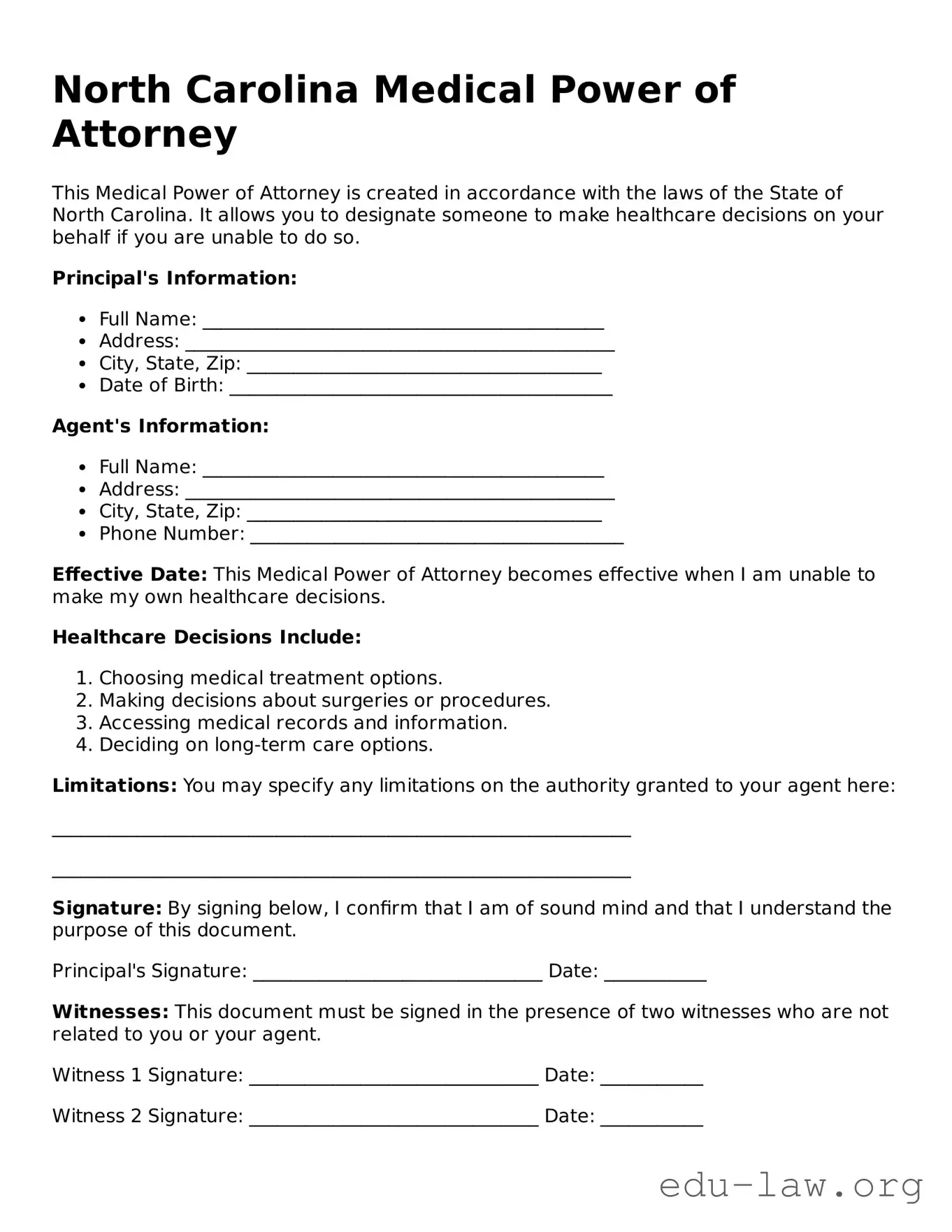
The North Carolina Medical Power of Attorney form is an essential legal document that allows individuals to designate a trusted person to make healthcare decisions on their behalf in the event they become unable to do so. This form is particularly important for ensuring that a person's medical preferences are honored when they cannot communicate their wishes. It outlines the authority granted to the appointed agent, which can include decisions about medical treatment, surgical procedures, and end-of-life care. Additionally, the form requires the signature of the principal, the person granting the authority, and must be witnessed by at least two individuals or notarized to be valid. Understanding the implications of this document is crucial, as it provides clarity and direction during challenging times, ensuring that healthcare decisions align with the individual’s values and preferences. Furthermore, the form can be tailored to include specific instructions or limitations, allowing for a more personalized approach to healthcare decision-making.
North Carolina Medical Power of Attorney
This Medical Power of Attorney is created in accordance with the laws of the State of North Carolina. It allows you to designate someone to make healthcare decisions on your behalf if you are unable to do so.
Principal's Information:
Agent's Information:
Effective Date: This Medical Power of Attorney becomes effective when I am unable to make my own healthcare decisions.
Healthcare Decisions Include:
Limitations: You may specify any limitations on the authority granted to your agent here:
______________________________________________________________
______________________________________________________________
Signature: By signing below, I confirm that I am of sound mind and that I understand the purpose of this document.
Principal's Signature: _______________________________ Date: ___________
Witnesses: This document must be signed in the presence of two witnesses who are not related to you or your agent.
Witness 1 Signature: _______________________________ Date: ___________
Witness 2 Signature: _______________________________ Date: ___________
Notary Public: If you wish to have this document notarized, please complete the following:
State of North Carolina, County of ________________
Subscribed and sworn to before me on this ______ day of __________, 20__.
Notary Public Signature: ____________________________
My Commission Expires: ____________________________
| Fact Name | Details |
|---|---|
| Definition | A Medical Power of Attorney allows an individual to designate another person to make healthcare decisions on their behalf if they become unable to do so. |
| Governing Law | The North Carolina Medical Power of Attorney is governed by Chapter 32A of the North Carolina General Statutes. |
| Eligibility | Any adult who is of sound mind can create a Medical Power of Attorney in North Carolina. |
| Agent Selection | The individual creating the document (the principal) can choose any competent adult as their agent. |
| Signature Requirement | The document must be signed by the principal in the presence of two witnesses or a notary public. |
| Revocation | A Medical Power of Attorney can be revoked at any time by the principal as long as they are competent. |
| Healthcare Provider Obligations | Healthcare providers must honor the decisions made by the designated agent, provided the document is valid. |
| Durability | This type of power of attorney remains effective even if the principal becomes incapacitated. |
Filling out the North Carolina Medical Power of Attorney form is an important step in designating someone to make healthcare decisions on your behalf if you are unable to do so. It is essential to ensure that the form is completed accurately to reflect your wishes. Below are the steps to help you fill out the form properly.
What is a North Carolina Medical Power of Attorney?
A North Carolina Medical Power of Attorney is a legal document that allows you to appoint someone to make medical decisions on your behalf if you are unable to do so. This could be due to illness, injury, or any situation where you cannot communicate your wishes regarding medical treatment.
Who can be appointed as my agent?
You can choose anyone you trust to be your agent, as long as they are at least 18 years old and mentally competent. This could be a family member, friend, or even a trusted advisor. It’s important to select someone who understands your values and wishes regarding medical care.
What types of decisions can my agent make?
Your agent can make a wide range of medical decisions on your behalf. This includes decisions about surgeries, medications, and other treatments. They can also decide whether to continue or stop treatment if you are in a terminal condition or permanently unconscious.
Do I need to have a lawyer to create this document?
No, you do not need a lawyer to create a Medical Power of Attorney in North Carolina. However, it is a good idea to consult with one if you have specific concerns or complex situations. You can find templates and forms online to help you get started.
How do I ensure my Medical Power of Attorney is valid?
To ensure your Medical Power of Attorney is valid, you must sign the document in the presence of two witnesses or a notary public. The witnesses cannot be your agent or related to you by blood, marriage, or adoption. This helps to prevent any conflicts of interest.
Can I change or revoke my Medical Power of Attorney?
Yes, you can change or revoke your Medical Power of Attorney at any time as long as you are mentally competent. To do this, you should create a new document or write a statement revoking the previous one. Make sure to inform your agent and any healthcare providers about the change.
What happens if I don’t have a Medical Power of Attorney?
If you do not have a Medical Power of Attorney and become unable to make decisions for yourself, your family may have to go to court to appoint a guardian. This process can be lengthy and may not reflect your wishes, which is why it’s important to have this document in place.
Not Selecting an Agent: One of the most common mistakes is failing to choose a specific agent to make medical decisions. Without an appointed person, the document lacks effectiveness.
Inadequate Agent Information: Providing incomplete or incorrect information about the agent can lead to confusion. Ensure that the agent's full name, address, and phone number are clearly stated.
Failing to Sign and Date: A common oversight is neglecting to sign and date the form. This step is crucial for the document to be legally binding.
Not Notarizing or Witnessing: In North Carolina, the form must be either notarized or signed by two witnesses. Skipping this step can invalidate the document.
Using Outdated Forms: Utilizing an old version of the Medical Power of Attorney form can lead to complications. Always ensure you are using the most current form available.
Vague Instructions for the Agent: Leaving the instructions for the agent unclear can create confusion during critical moments. Specific guidance helps the agent make informed decisions aligned with your wishes.
Not Reviewing the Document Regularly: Life circumstances change, and so do preferences. Failing to review and update the document can result in outdated directives.
Ignoring State-Specific Requirements: Each state has unique requirements for medical power of attorney documents. Not adhering to North Carolina's specific regulations can render the form ineffective.
When preparing a Medical Power of Attorney in North Carolina, it’s essential to consider additional documents that may complement your healthcare planning. These forms can help clarify your wishes, designate decision-makers, and ensure that your healthcare preferences are respected. Below is a list of commonly used documents that often accompany a Medical Power of Attorney.
Utilizing these documents alongside your Medical Power of Attorney can help ensure that your healthcare and personal wishes are clearly communicated and respected. It is advisable to review these forms periodically and discuss your preferences with your designated agents and family members. This proactive approach can provide peace of mind for you and your loved ones.
The North Carolina Medical Power of Attorney form shares similarities with the Durable Power of Attorney. Both documents allow individuals to designate someone to make decisions on their behalf. However, while the Durable Power of Attorney can cover a broad range of decisions, including financial matters, the Medical Power of Attorney is specifically focused on healthcare decisions. This distinction is important for ensuring that the appointed agent has the authority to make medical choices when the individual is unable to do so.
Another document similar to the North Carolina Medical Power of Attorney is the Living Will. A Living Will outlines an individual's preferences regarding medical treatment in end-of-life situations. While the Medical Power of Attorney allows someone to make decisions on behalf of the individual, the Living Will communicates the individual's wishes directly. Both documents work together to ensure that healthcare decisions align with the individual’s values and desires.
The Advance Healthcare Directive is also comparable to the Medical Power of Attorney. This document combines elements of both the Medical Power of Attorney and the Living Will. It allows individuals to appoint a healthcare agent while also specifying their medical treatment preferences. Like the Medical Power of Attorney, it serves to guide healthcare decisions when the individual cannot express their wishes.
The Healthcare Proxy is another document that functions similarly to the Medical Power of Attorney. It allows a person to appoint someone to make healthcare decisions on their behalf. The key difference lies in the terminology and specific legal requirements, which can vary by state. Nevertheless, both documents aim to ensure that a trusted individual can make crucial healthcare choices when needed.
The Do Not Resuscitate (DNR) Order also shares some similarities with the Medical Power of Attorney, although it serves a different purpose. A DNR order specifically instructs medical personnel not to perform cardiopulmonary resuscitation (CPR) in the event of cardiac arrest. While the Medical Power of Attorney grants authority for a range of medical decisions, the DNR focuses solely on resuscitation preferences. Both documents are essential for ensuring that medical care aligns with an individual’s wishes.
Lastly, the Physician Orders for Life-Sustaining Treatment (POLST) form is comparable to the Medical Power of Attorney. The POLST is a medical order that outlines a patient’s preferences for life-sustaining treatments. While the Medical Power of Attorney designates someone to make decisions, the POLST provides specific instructions for healthcare providers. Both documents aim to communicate and uphold the individual’s healthcare preferences effectively.
When filling out the North Carolina Medical Power of Attorney form, it’s important to approach the process with care. Here’s a list of things you should and shouldn’t do to ensure that your document is valid and reflects your wishes.
By following these guidelines, you can ensure that your Medical Power of Attorney accurately reflects your healthcare decisions and is legally sound.
Understanding the North Carolina Medical Power of Attorney form is crucial for making informed healthcare decisions. Here are six common misconceptions about this important document:
Many people believe that a Medical Power of Attorney is only relevant when a person is near death. In reality, this document allows someone to make healthcare decisions on your behalf whenever you are unable to do so, not just in end-of-life situations.
Some think that a Medical Power of Attorney must be drafted by an attorney. However, in North Carolina, individuals can fill out the form themselves as long as it meets the state’s requirements.
While both documents deal with healthcare decisions, they serve different purposes. A Living Will outlines your wishes regarding medical treatment in specific situations, whereas a Medical Power of Attorney designates someone to make decisions for you.
Many believe that once a Medical Power of Attorney is signed, it is set in stone. In fact, you can revoke or update the document at any time, as long as you are mentally competent to do so.
Some individuals think that a Medical Power of Attorney is only valid within North Carolina. While it is primarily governed by state law, many states recognize documents created in other states, provided they meet certain criteria.
There is a misconception that only relatives can serve as your healthcare agent. In reality, you can choose anyone you trust, whether they are a family member or a friend, as long as they are willing to take on that responsibility.
Here are some important points to consider when filling out and using the North Carolina Medical Power of Attorney form: