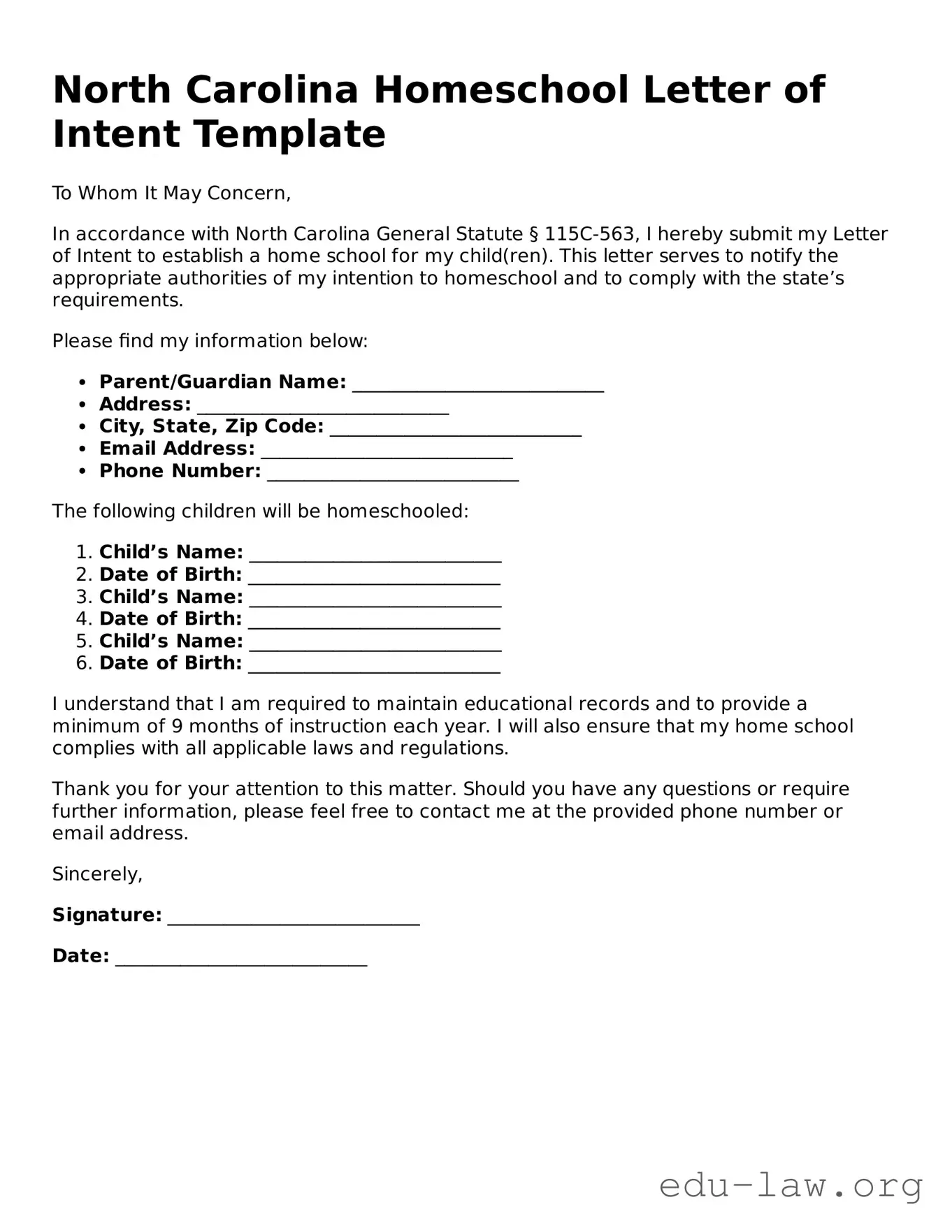
For families in North Carolina considering the homeschooling route, understanding the necessary paperwork is crucial. One of the first steps in this journey is the completion of the Homeschool Letter of Intent form. This form serves as a formal notification to the state that a parent or guardian intends to educate their child at home. It requires essential information, including the names and ages of the children being homeschooled, as well as the address of the primary residence. Additionally, the form prompts parents to declare their commitment to adhere to the state's educational requirements, ensuring that they are aware of the responsibilities that come with homeschooling. By submitting this form, parents not only initiate the homeschooling process but also affirm their dedication to providing a structured learning environment tailored to their child's unique needs. Understanding these components helps families navigate the initial steps of homeschooling with confidence and clarity.
North Carolina Homeschool Letter of Intent Template
To Whom It May Concern,
In accordance with North Carolina General Statute § 115C-563, I hereby submit my Letter of Intent to establish a home school for my child(ren). This letter serves to notify the appropriate authorities of my intention to homeschool and to comply with the state’s requirements.
Please find my information below:
The following children will be homeschooled:
I understand that I am required to maintain educational records and to provide a minimum of 9 months of instruction each year. I will also ensure that my home school complies with all applicable laws and regulations.
Thank you for your attention to this matter. Should you have any questions or require further information, please feel free to contact me at the provided phone number or email address.
Sincerely,
Signature: ___________________________
Date: ___________________________
| Fact Name | Description |
|---|---|
| Purpose | The North Carolina Homeschool Letter of Intent form is used to officially notify the state of a family's decision to homeschool their children. |
| Governing Law | This form is governed by North Carolina General Statutes, specifically § 115C-563 and § 115C-564. |
| Submission Timeline | Parents must submit the Letter of Intent within 30 days of beginning their homeschooling journey. |
| Information Required | The form typically requires basic information, such as the names and ages of the children being homeschooled. |
| Annual Updates | Families must submit an annual update to maintain their homeschooling status, ensuring compliance with state regulations. |
Once you have decided to homeschool in North Carolina, you will need to fill out the Homeschool Letter of Intent form. This form is a straightforward way to notify the state of your intention to homeschool your child. Completing it accurately and submitting it on time is important for compliance with state regulations.
What is the North Carolina Homeschool Letter of Intent form?
The North Carolina Homeschool Letter of Intent is a formal document that parents or guardians must submit to notify the state of their intention to homeschool their children. This letter is a crucial step in establishing a homeschool program and must be filed with the North Carolina Division of Non-Public Education (DNPE). It serves as an official declaration that the family will be providing educational instruction at home.
Who needs to submit the Letter of Intent?
Any parent or guardian who wishes to homeschool their child in North Carolina must submit the Letter of Intent. This includes families with children who are of compulsory school age, typically between the ages of 7 and 16. If you have recently moved to North Carolina and wish to continue homeschooling, you will also need to file this letter to comply with state regulations.
What information is required on the Letter of Intent?
The Letter of Intent must include specific information about the homeschooling family. This typically includes the names and addresses of the parents or guardians, the name of the child or children being homeschooled, and the date when homeschooling will begin. Additional details, such as the educational curriculum planned for the year, may also be beneficial, although not strictly required.
When should the Letter of Intent be submitted?
The Letter of Intent should be submitted at least 30 days before the start of the homeschooling program. For families planning to begin homeschooling at the start of the school year, it is advisable to submit the letter during the summer months. This ensures that all necessary paperwork is processed in time for the new academic year.
Is there a fee associated with submitting the Letter of Intent?
No, there is no fee required for submitting the North Carolina Homeschool Letter of Intent. The process is designed to be accessible to families who choose to educate their children at home. However, families should be aware of any additional costs associated with curriculum materials or educational resources that they may choose to purchase.
What happens after the Letter of Intent is submitted?
Once the Letter of Intent is submitted, the DNPE will process the document and confirm the family's homeschooling status. Parents can expect to receive a confirmation letter acknowledging the submission. From that point forward, families are responsible for maintaining educational records and ensuring that they meet state educational requirements throughout the homeschooling period.
Can I withdraw my child from public school before submitting the Letter of Intent?
Yes, parents can withdraw their child from public school before submitting the Letter of Intent. However, it is advisable to do so in accordance with the school's policies. Some schools may require a formal withdrawal process, and it is wise to communicate with school officials to ensure a smooth transition to homeschooling.
What should I do if I have more questions about the Letter of Intent?
If you have additional questions about the North Carolina Homeschool Letter of Intent or the homeschooling process in general, you can contact the North Carolina Division of Non-Public Education directly. Their website also provides a wealth of resources, including guidelines and frequently asked questions, to help families navigate the homeschooling landscape effectively.
Not including all required information: Many people forget to provide essential details, such as the child's name, age, and address. Omitting this information can lead to delays in processing the application.
Incorrectly stating the educational plan: Some applicants fail to clearly outline their educational approach. A vague description can raise questions about the legitimacy of the homeschool program.
Missing the submission deadline: It’s crucial to submit the letter of intent by the required date. Late submissions can result in penalties or the inability to homeschool for that school year.
Not signing the form: A common oversight is forgetting to sign the form. Without a signature, the document is not valid and cannot be processed.
Failing to update the form when necessary: If there are changes in the homeschooling situation, such as moving to a new address or a change in curriculum, the form must be updated. Neglecting to do so can cause issues later on.
Ignoring local regulations: Each county may have specific requirements. Some people overlook these local rules, which can lead to complications in the homeschooling process.
Not keeping a copy of the submitted form: After sending the letter of intent, it’s wise to keep a copy for personal records. This can be helpful if any questions arise later.
When families decide to homeschool in North Carolina, they often complete the Homeschool Letter of Intent form to officially notify the state of their educational plans. However, several other forms and documents may also be necessary or helpful in the homeschooling process. Below is a list of commonly used documents alongside the Homeschool Letter of Intent.
By being aware of these additional documents, homeschooling families can better prepare for the educational journey ahead. Staying organized and informed not only helps ensure compliance with state laws but also enhances the overall learning experience for students.
The North Carolina Homeschool Letter of Intent form is similar to the Notice of Intent to Operate a Private School form. Both documents serve as official notifications to the state that an educational entity is being established. In the case of the private school form, it informs the state about a school that will operate independently, while the Homeschool Letter of Intent indicates that parents are choosing to educate their children at home. Each form requires specific information about the educational setup, ensuring that the state is aware of the educational options available to families.
Another document that resembles the Homeschool Letter of Intent is the Application for a Charter School. Like the Homeschool Letter of Intent, this application must be submitted to the state education department. Both documents outline the educational philosophy and structure of the learning environment. However, the charter school application is more detailed and involves a formal approval process, whereas the Homeschool Letter of Intent is a straightforward declaration of intent to homeschool.
The Individualized Education Program (IEP) also shares similarities with the Homeschool Letter of Intent. An IEP is created for students with disabilities and outlines specific educational goals and services tailored to their needs. While the Homeschool Letter of Intent focuses on the overall intent to homeschool, the IEP provides a roadmap for how a child’s education will be customized. Both documents highlight the importance of meeting educational requirements and ensuring that children receive appropriate instruction.
Lastly, the Affidavit of Parental Intent to Homeschool is another document closely related to the Homeschool Letter of Intent. This affidavit is often required in various states to confirm that parents are committed to providing a home education. Similar to the Letter of Intent, it serves as a formal declaration and includes essential information about the educational approach. Both documents emphasize parental responsibility in ensuring that children receive a quality education, reflecting the commitment to uphold educational standards.
When filling out the North Carolina Homeschool Letter of Intent form, it is essential to follow specific guidelines to ensure a smooth process. Here are eight important do's and don'ts to keep in mind:
Many people hold misconceptions about the North Carolina Homeschool Letter of Intent form. Understanding the facts can help clarify the process for families considering homeschooling. Here are nine common misconceptions:
This is not true. Homeschooling is legal in North Carolina, provided families follow the required guidelines, including submitting a Letter of Intent.
Actually, once a family submits the Letter of Intent, it remains valid as long as they continue to homeschool. A new letter is only necessary if the family changes their address or decides to stop homeschooling.
While there are certain elements that must be included, there is no strict format. Families can write it in their own style as long as the required information is present.
This is a common myth. In North Carolina, parents do not need a teaching degree to homeschool their children. They simply need to be responsible for their child's education.
In reality, parents have the freedom to choose their own curriculum. The state does not dictate what materials must be used.
This is misleading. Many public schools allow homeschool students to participate in extracurricular activities, but policies may vary by district.
While submitting this letter is important, families must also keep attendance records and maintain educational progress documentation.
Homeschooling is chosen by families for various reasons, including academic flexibility, personalized learning, and safety concerns. It is not limited to any one belief system.
This is incorrect. Children can transition back to public school if desired, but they may need to meet certain requirements or assessments depending on the school district.
Addressing these misconceptions can help families make informed decisions about homeschooling in North Carolina.
Filling out the North Carolina Homeschool Letter of Intent form is a crucial step for parents who wish to educate their children at home. Here are some key takeaways to consider:
Following these guidelines can help make the homeschooling process smoother and more effective for both parents and students.