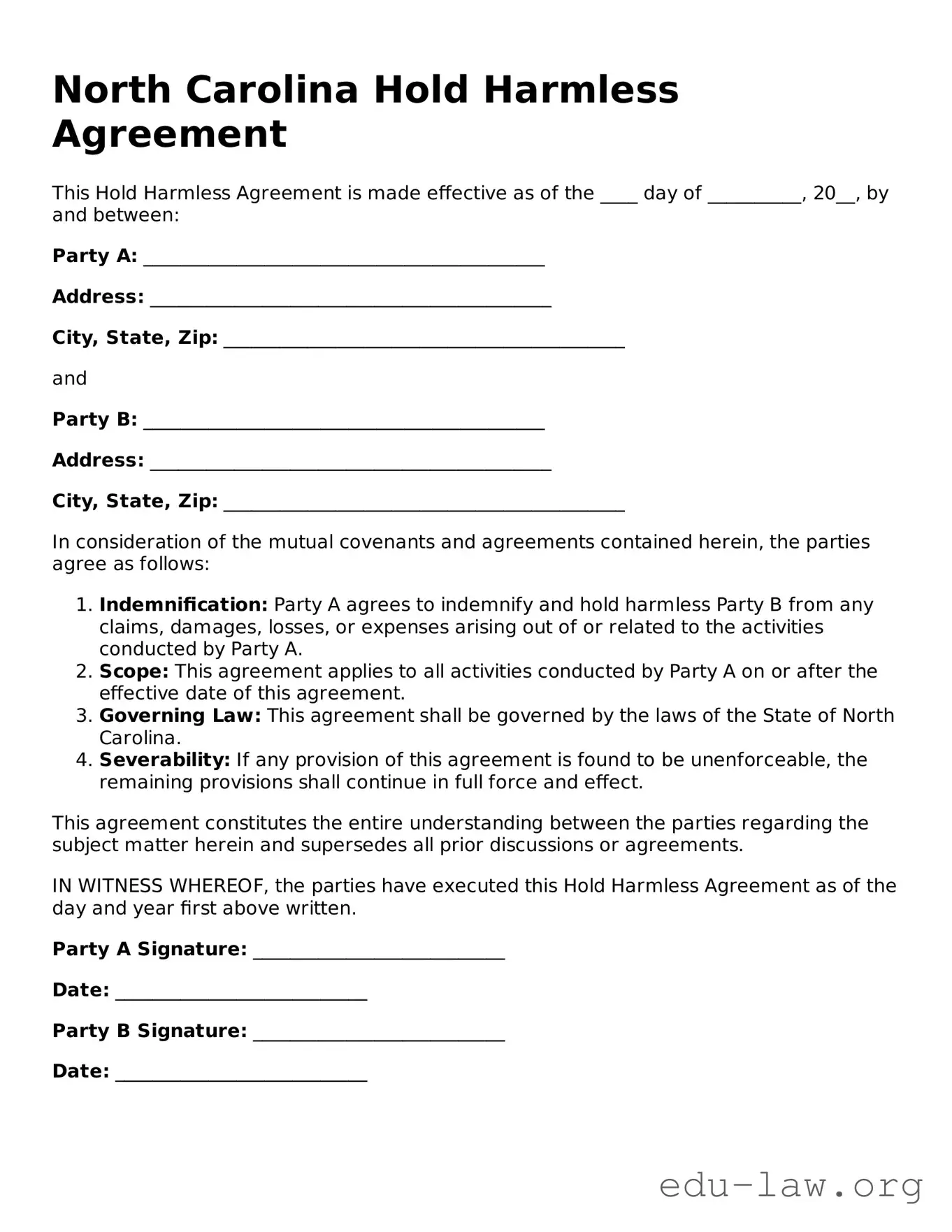
The North Carolina Hold Harmless Agreement form serves as a crucial document in various transactions and interactions, ensuring that one party agrees to assume liability for certain risks associated with an activity or agreement. This form is commonly utilized in contexts such as rental agreements, construction projects, and event planning, where the potential for accidents or damages exists. By signing this agreement, one party effectively protects the other from legal claims or financial losses that may arise during the specified activities. The form outlines the responsibilities of each party, detailing the scope of the hold harmless provision, and often includes indemnification clauses that further clarify the extent of liability. Additionally, it typically requires both parties to provide their consent through signatures, making it a legally binding document. Understanding the nuances of the Hold Harmless Agreement is essential for anyone engaging in activities that carry inherent risks, as it helps to delineate responsibilities and safeguard interests.
North Carolina Hold Harmless Agreement
This Hold Harmless Agreement is made effective as of the ____ day of __________, 20__, by and between:
Party A: ___________________________________________
Address: ___________________________________________
City, State, Zip: ___________________________________________
and
Party B: ___________________________________________
Address: ___________________________________________
City, State, Zip: ___________________________________________
In consideration of the mutual covenants and agreements contained herein, the parties agree as follows:
This agreement constitutes the entire understanding between the parties regarding the subject matter herein and supersedes all prior discussions or agreements.
IN WITNESS WHEREOF, the parties have executed this Hold Harmless Agreement as of the day and year first above written.
Party A Signature: ___________________________
Date: ___________________________
Party B Signature: ___________________________
Date: ___________________________
| Fact Name | Description |
|---|---|
| Purpose | The North Carolina Hold Harmless Agreement is designed to protect one party from legal liability for any injuries or damages that may occur during a specified activity. |
| Parties Involved | This agreement typically involves two parties: the indemnitor (the party agreeing to hold harmless) and the indemnitee (the party being protected). |
| Governing Law | The agreement is governed by the laws of the State of North Carolina, ensuring that it complies with local legal standards. |
| Enforceability | For the agreement to be enforceable, it must be clear, specific, and voluntarily signed by both parties. |
| Limitations | North Carolina law may impose limitations on the extent to which liability can be waived, especially in cases of gross negligence or willful misconduct. |
| Common Uses | This form is commonly used in contexts such as events, construction projects, and recreational activities where risks are present. |
After obtaining the North Carolina Hold Harmless Agreement form, individuals will need to provide specific information to complete it accurately. The following steps outline the process to ensure all necessary details are filled in correctly.
What is a Hold Harmless Agreement in North Carolina?
A Hold Harmless Agreement is a legal document designed to protect one party from liability for certain risks or damages that may arise during a specific activity or event. In North Carolina, this agreement is often used in various contexts, such as construction projects, events, or recreational activities. By signing this agreement, one party agrees not to hold the other party responsible for injuries or damages that may occur, provided that those injuries or damages are not due to gross negligence or willful misconduct.
Who typically uses a Hold Harmless Agreement?
Various individuals and organizations utilize Hold Harmless Agreements. For example, event organizers often require participants to sign this document to mitigate risks associated with activities. Similarly, contractors may use it when working on a project to ensure that property owners do not hold them liable for accidents that may occur on the job site. Additionally, recreational facilities, such as gyms or sports clubs, may ask members to sign this agreement to limit their liability for injuries sustained during activities.
What should be included in a Hold Harmless Agreement?
A comprehensive Hold Harmless Agreement should clearly outline the parties involved, the specific activities covered, and the scope of liability being waived. It is essential to include language that specifies the types of risks being assumed and any limitations on liability. Additionally, the agreement should address whether it covers both parties or just one. Clear and concise language helps ensure that all parties understand their rights and responsibilities, reducing the potential for disputes later on.
Is a Hold Harmless Agreement enforceable in North Carolina?
Yes, Hold Harmless Agreements are generally enforceable in North Carolina, provided they meet certain legal standards. For the agreement to be valid, it must be written, signed by both parties, and should not violate public policy. Courts typically uphold these agreements unless they find that the language is ambiguous or overly broad. However, it's important to note that these agreements cannot protect a party from liability for gross negligence or intentional misconduct. Therefore, individuals should carefully consider the implications before signing such a document.
One common mistake is failing to read the entire agreement before signing. Many individuals rush through the document, missing critical details that could affect their rights and responsibilities.
Another frequent error involves not providing accurate personal information. Incorrect names, addresses, or contact details can lead to complications in the enforcement of the agreement.
Some people neglect to understand the scope of the agreement. It is essential to grasp what risks or liabilities are being waived. Without this understanding, one may inadvertently accept more risk than intended.
Many individuals overlook the importance of including all relevant parties in the agreement. Failing to list all individuals or entities involved may result in disputes later on.
Another mistake is not dating the document. A date is crucial for establishing when the agreement takes effect and can be important in legal contexts.
People often forget to sign in the correct places. Missing signatures can render the agreement invalid, leading to potential legal issues.
Some individuals do not consult with a legal professional before completing the form. This oversight can lead to misunderstandings about the legal implications of the agreement.
Finally, many fail to keep a copy of the signed agreement. Having a personal copy is vital for future reference and can be crucial in case of disputes.
When working with a North Carolina Hold Harmless Agreement, several other forms and documents may be necessary to ensure all parties are protected and informed. Each of these documents plays a specific role in the overall agreement process.
Using these documents alongside the North Carolina Hold Harmless Agreement can help clarify responsibilities and protect all parties involved. Each form serves a unique purpose, contributing to a comprehensive approach to risk management.
The North Carolina Hold Harmless Agreement is similar to a Release of Liability form. Both documents aim to protect one party from legal claims or damages arising from specific activities or events. In a Release of Liability, the individual acknowledges the risks involved and agrees not to hold the other party responsible for any injuries or losses that may occur. This agreement is often used in recreational activities or events where the risk of injury is present, ensuring that participants understand and accept the inherent dangers.
Another document akin to the Hold Harmless Agreement is the Indemnity Agreement. While both documents serve to protect a party from legal claims, an Indemnity Agreement often involves one party agreeing to compensate another for any losses or damages incurred. This could include legal fees or settlement costs. The key difference lies in the financial responsibility; an Indemnity Agreement may require one party to take on more liability than a Hold Harmless Agreement typically would.
The Waiver of Liability is also comparable to the Hold Harmless Agreement. This document allows individuals to voluntarily relinquish their right to sue for injuries or damages that may arise from certain activities. While a Hold Harmless Agreement primarily focuses on protecting one party, a Waiver of Liability emphasizes the individual's acceptance of risk. Both documents are essential for organizations that want to mitigate their legal exposure during events or activities.
The Consent to Participate form shares similarities with the Hold Harmless Agreement in that it ensures participants are informed about the risks associated with an activity. This document often requires participants to acknowledge their understanding of potential hazards before engaging in the activity. While it does not provide the same level of legal protection as a Hold Harmless Agreement, it still serves to limit liability by ensuring that participants are aware of the risks involved.
A Service Agreement may also resemble the Hold Harmless Agreement in certain contexts, especially when it includes clauses that limit liability for services rendered. In this case, the agreement outlines the responsibilities of each party and may include provisions that protect one party from claims arising from the other party's actions or negligence. While primarily focused on service delivery, these agreements can incorporate elements that echo the protective nature of a Hold Harmless Agreement.
The Liability Insurance Waiver is another document that aligns with the principles of a Hold Harmless Agreement. This waiver often requires individuals to acknowledge that they are aware of the limitations of their insurance coverage during specific activities. By signing this document, individuals agree not to hold the organization liable for any injuries or damages that may occur, similar to the protections offered by a Hold Harmless Agreement.
The Non-Disclosure Agreement (NDA) can also share some common ground with a Hold Harmless Agreement, particularly in protecting sensitive information. While NDAs focus on confidentiality and the protection of proprietary information, they can include clauses that limit liability for the misuse of shared information. Both agreements aim to safeguard interests, albeit in different contexts.
The Employment Agreement may contain elements similar to a Hold Harmless Agreement, especially when it includes indemnification clauses. These clauses can protect employers from claims arising from employee actions during the course of their employment. By outlining the responsibilities and liabilities of both parties, such agreements can help mitigate potential legal risks.
Finally, the Partnership Agreement may also echo the principles of a Hold Harmless Agreement. This document outlines the roles, responsibilities, and liabilities of each partner in a business venture. It may include clauses that protect partners from claims arising from the actions of other partners, similar to how a Hold Harmless Agreement seeks to shield one party from liability. Both documents emphasize the importance of clearly defined roles and responsibilities to minimize legal exposure.
When filling out the North Carolina Hold Harmless Agreement form, it's essential to approach the task with care. This document is designed to protect one party from liability, and accuracy is crucial. Here are some important dos and don'ts to consider:
By following these guidelines, you can help ensure that the Hold Harmless Agreement serves its intended purpose effectively.
Many individuals and organizations encounter the North Carolina Hold Harmless Agreement form, but several misconceptions can lead to confusion about its purpose and implications. Below are six common misunderstandings:
Many believe that signing a Hold Harmless Agreement completely protects them from any legal consequences. However, while it can limit liability in certain situations, it does not cover all forms of negligence or misconduct.
Some think that only businesses or commercial entities use Hold Harmless Agreements. In reality, individuals, non-profits, and various organizations can also utilize this form to protect themselves in specific situations.
People often assume that once a Hold Harmless Agreement is signed, it is enforceable in all circumstances. However, courts may not uphold these agreements if they are deemed unconscionable or if they violate public policy.
Some individuals feel that Hold Harmless Agreements are only needed for high-risk activities. However, even low-risk activities can benefit from this form to clarify responsibilities and expectations.
A common misconception is that a Hold Harmless Agreement can substitute for insurance coverage. While it may provide additional protection, it does not eliminate the need for appropriate insurance policies.
Many assume that a standard Hold Harmless Agreement will suffice for any situation. In reality, these agreements should be tailored to fit the specific circumstances and parties involved to ensure effectiveness.
Understanding these misconceptions can help individuals and organizations make informed decisions regarding the use of Hold Harmless Agreements in North Carolina.
When considering the North Carolina Hold Harmless Agreement form, there are several important points to keep in mind. Here are key takeaways to help you navigate this process:
By keeping these takeaways in mind, you can better understand and utilize the North Carolina Hold Harmless Agreement form effectively.