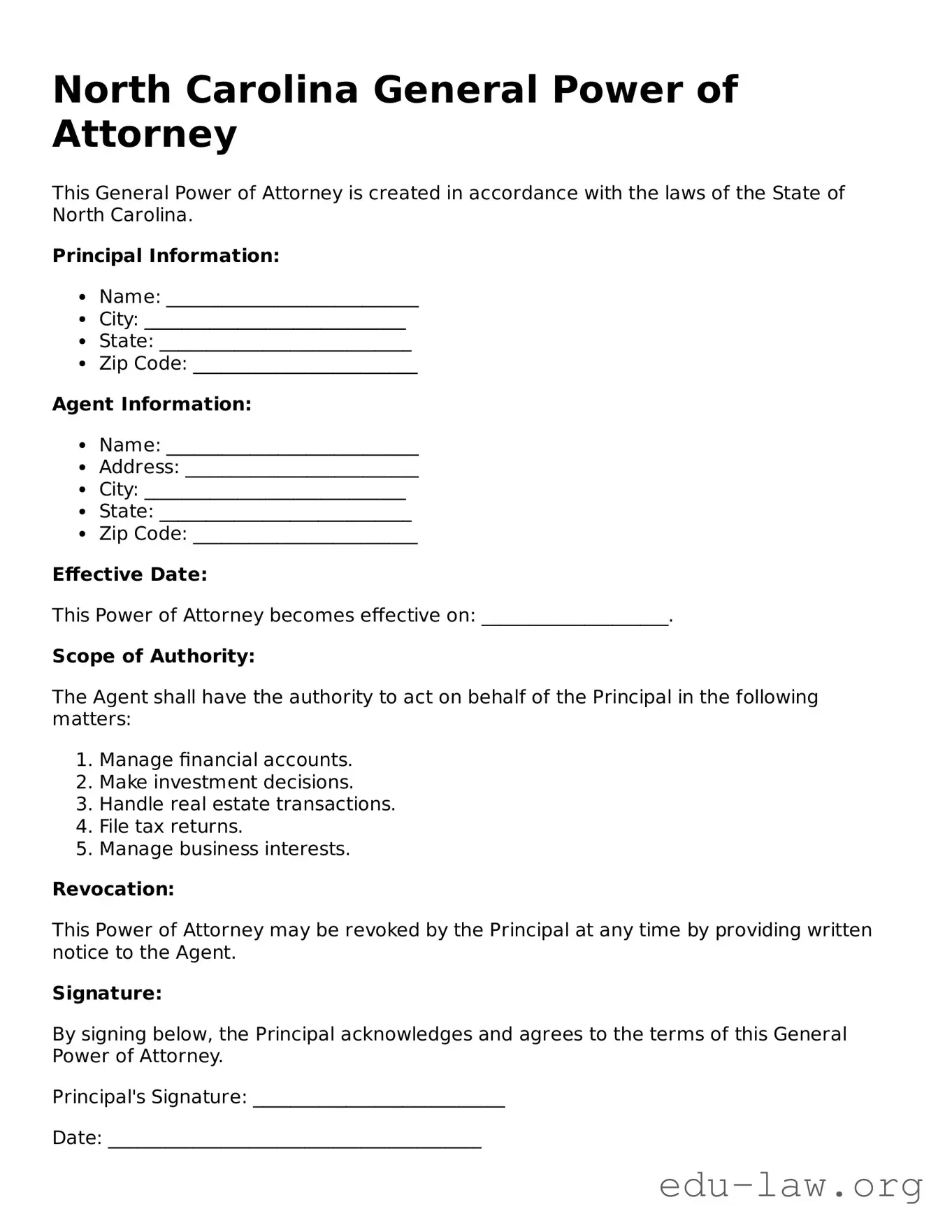
In North Carolina, a General Power of Attorney (GPOA) is a crucial legal document that allows one person, known as the principal, to appoint another person, called the agent, to make decisions on their behalf. This form is particularly useful for managing financial matters, such as handling bank accounts, paying bills, and making investments. It grants broad authority to the agent, enabling them to act in the best interests of the principal when they are unable to do so themselves, whether due to illness, absence, or other reasons. The GPOA remains effective until revoked by the principal or until their death, making it a powerful tool for estate planning. Understanding the specific powers granted, as well as the limitations and responsibilities of the agent, is essential for anyone considering this option. Additionally, it is important to ensure that the form is properly executed according to North Carolina laws to avoid any potential legal issues in the future. This article will guide you through the key components of the General Power of Attorney form, its benefits, and the steps necessary to create one that meets your needs.
North Carolina General Power of Attorney
This General Power of Attorney is created in accordance with the laws of the State of North Carolina.
Principal Information:
Agent Information:
Effective Date:
This Power of Attorney becomes effective on: ____________________.
Scope of Authority:
The Agent shall have the authority to act on behalf of the Principal in the following matters:
Revocation:
This Power of Attorney may be revoked by the Principal at any time by providing written notice to the Agent.
Signature:
By signing below, the Principal acknowledges and agrees to the terms of this General Power of Attorney.
Principal's Signature: ___________________________
Date: ________________________________________
Witness Signature: ____________________________
Date: ________________________________________
Notary Public Signature: ______________________
Date: ________________________________________
| Fact Name | Detail |
|---|---|
| Definition | A General Power of Attorney allows an individual (the principal) to designate another person (the agent) to make decisions on their behalf. |
| Governing Law | The General Power of Attorney in North Carolina is governed by the North Carolina General Statutes, specifically Chapter 32A. |
| Durability | This form can be made durable, meaning it remains effective even if the principal becomes incapacitated. |
| Agent's Authority | The agent can manage financial matters, make healthcare decisions, and handle other personal affairs as specified in the document. |
| Revocation | The principal can revoke the General Power of Attorney at any time, provided they are mentally competent. |
| Witness Requirement | In North Carolina, the General Power of Attorney must be signed by the principal in the presence of two witnesses. |
| Notarization | While notarization is not required, it is recommended for added validity and to avoid disputes. |
| Limitations | Some powers, such as making a will or certain types of healthcare decisions, cannot be delegated through this form. |
| Effective Date | The General Power of Attorney can be effective immediately upon signing or can be set to activate upon a specific event, such as incapacitation. |
Filling out the North Carolina General Power of Attorney form is a straightforward process. Once you have completed the form, you can present it to the relevant parties to ensure they understand your designated agent's authority. This document will help facilitate your financial and legal decisions when you are unable to make them yourself.
What is a General Power of Attorney in North Carolina?
A General Power of Attorney (GPOA) in North Carolina is a legal document that allows one person, known as the principal, to appoint another person, called the agent or attorney-in-fact, to act on their behalf. This authority can cover a wide range of decisions, including financial matters, property transactions, and other personal affairs. The principal can specify the powers granted to the agent, making it a flexible tool for managing one’s affairs.
Why would someone need a General Power of Attorney?
Individuals often choose to create a General Power of Attorney to ensure that their financial and legal matters can be handled when they are unable to do so themselves. This could be due to illness, absence, or incapacity. By having a GPOA in place, you can ensure that someone you trust will make decisions in your best interest, thereby reducing stress for both you and your loved ones during difficult times.
How does one create a General Power of Attorney in North Carolina?
To create a General Power of Attorney in North Carolina, you need to complete a specific form that outlines the powers granted to your agent. This document must be signed by you, the principal, in the presence of a notary public. It is advisable to discuss your intentions with a legal professional to ensure that the document meets your needs and complies with state laws.
Can a General Power of Attorney be revoked?
Yes, a General Power of Attorney can be revoked at any time as long as you are mentally competent. To revoke the GPOA, you must create a written notice stating your intention to revoke it and inform your agent. Additionally, it is wise to notify any institutions or individuals who may have relied on the original document to avoid confusion.
What happens if the principal becomes incapacitated?
If the principal becomes incapacitated, the General Power of Attorney typically remains effective unless it is specifically stated that it is only valid while the principal is competent. This means that the agent can continue to act on behalf of the principal, making it crucial to choose someone trustworthy. However, if the principal has concerns about their future capacity, they may also consider establishing a Durable Power of Attorney, which remains effective even if they become incapacitated.
Are there any limitations to the powers granted in a General Power of Attorney?
Yes, there can be limitations to the powers granted in a General Power of Attorney. The principal can specify certain actions that the agent is not allowed to take. For example, the principal may choose to limit the agent's authority over specific assets or decisions. It is important to clearly outline these limitations in the document to avoid any misunderstandings or misuse of authority.
Not specifying the powers granted: Many individuals fail to clearly outline the specific powers they wish to grant to their agent. This can lead to confusion and limit the agent's ability to act effectively on behalf of the principal.
Forgetting to date the document: It is crucial to include the date when the General Power of Attorney is signed. Without a date, it can be difficult to determine when the powers take effect, potentially causing issues later on.
Neglecting to sign in front of a notary: A General Power of Attorney must be signed in front of a notary public to be legally valid. Skipping this step can render the document ineffective.
Not considering a successor agent: In some cases, people forget to name a successor agent. If the primary agent is unable to perform their duties, having a backup can ensure that the principal's affairs are managed without interruption.
Overlooking state-specific requirements: Each state has its own rules regarding Power of Attorney documents. Failing to adhere to North Carolina's specific requirements can lead to complications and invalidation of the form.
Assuming the form is permanent: Some individuals mistakenly believe that a General Power of Attorney is permanent and cannot be revoked. In reality, the principal has the right to revoke or modify the document at any time, as long as they are mentally competent.
A North Carolina General Power of Attorney form allows an individual to designate another person to manage their financial and legal affairs. This document is often used alongside several other forms and documents to ensure comprehensive management of personal and financial matters. Below is a list of related documents that may be beneficial to have in conjunction with the General Power of Attorney.
Having these documents prepared and organized can help ensure that personal and financial affairs are managed according to one's wishes, providing peace of mind for both the individual and their loved ones.
The North Carolina General Power of Attorney form shares similarities with the Durable Power of Attorney. Both documents allow an individual, known as the principal, to designate another person, called the agent, to make decisions on their behalf. The key difference lies in durability; a Durable Power of Attorney remains effective even if the principal becomes incapacitated, while a General Power of Attorney may not. This durability is crucial for long-term planning, especially in healthcare or financial matters.
Another related document is the Medical Power of Attorney. This form specifically grants an agent the authority to make healthcare decisions for the principal when they are unable to do so. Like the General Power of Attorney, it requires clear communication of the principal's wishes. The Medical Power of Attorney focuses solely on health-related decisions, while the General Power of Attorney encompasses a broader range of financial and legal matters.
The Financial Power of Attorney is also similar, as it allows an agent to manage the principal's financial affairs. This document can be tailored to grant specific powers, such as handling bank transactions, managing investments, or filing taxes. While the General Power of Attorney can cover these areas, the Financial Power of Attorney is more focused and may be used in situations where the principal wants to limit the agent's authority to financial matters only.
A Limited Power of Attorney is another document that bears resemblance. This form grants an agent authority to act on behalf of the principal for a specific task or a limited period. Unlike the General Power of Attorney, which provides broad powers, the Limited Power of Attorney is precise in its scope. This can be useful for situations like signing documents for a real estate transaction when the principal cannot be present.
The Springing Power of Attorney is similar in that it becomes effective only under certain conditions, typically when the principal becomes incapacitated. This document allows the principal to maintain control over their affairs until a specific event occurs, making it a more cautious option compared to the General Power of Attorney, which is effective immediately upon signing.
Another document to consider is the Revocation of Power of Attorney. While not a power of attorney itself, it serves to cancel any previously granted powers. This is important for individuals who wish to change their agent or revoke authority for any reason. The process of revocation can be straightforward, but it must be done in writing to ensure clarity and legal effectiveness.
The Advance Directive is also relevant. It combines elements of a Medical Power of Attorney and a Living Will. While the Medical Power of Attorney appoints an agent for healthcare decisions, the Advance Directive outlines the principal's wishes regarding medical treatment in situations where they cannot express their desires. This document complements the General Power of Attorney by addressing specific healthcare preferences.
Lastly, the Trust Agreement is similar in that it allows an individual to designate a trustee to manage their assets. While a General Power of Attorney grants authority to act on behalf of the principal, a Trust Agreement creates a separate legal entity to hold and manage assets. This can provide additional protections and benefits, particularly in estate planning, but it serves a different purpose compared to the General Power of Attorney.
When filling out the North Carolina General Power of Attorney form, it's crucial to approach the task with care. This document grants someone the authority to act on your behalf, so clarity and accuracy are essential. Here are six important dos and don'ts to keep in mind:
By following these guidelines, you can ensure that your General Power of Attorney form is filled out correctly and serves its intended purpose effectively.
Understanding the North Carolina General Power of Attorney form is crucial for anyone considering this legal document. However, there are several misconceptions that can lead to confusion. Here are five common misunderstandings:
Many people believe that a General Power of Attorney is limited to financial decisions. In reality, it can also cover health care decisions and other personal matters, depending on how it is drafted.
Some think that once a General Power of Attorney is signed, it remains in effect indefinitely. However, the principal can revoke it at any time, as long as they are mentally competent.
While consulting a lawyer is recommended for complex situations, a General Power of Attorney can be created without legal assistance. There are templates available that meet North Carolina's requirements.
This is a common misconception. A General Power of Attorney becomes invalid if the principal becomes incapacitated, whereas a Durable Power of Attorney remains in effect under such circumstances.
People often think that a General Power of Attorney is only valid within the state where it was created. However, it may be recognized in other states, but it's essential to check local laws.
Being informed about these misconceptions can help individuals make better decisions regarding their legal needs. Always consider seeking professional advice for personalized guidance.
Filling out and using the North Carolina General Power of Attorney form requires careful consideration. Here are some key takeaways to keep in mind: