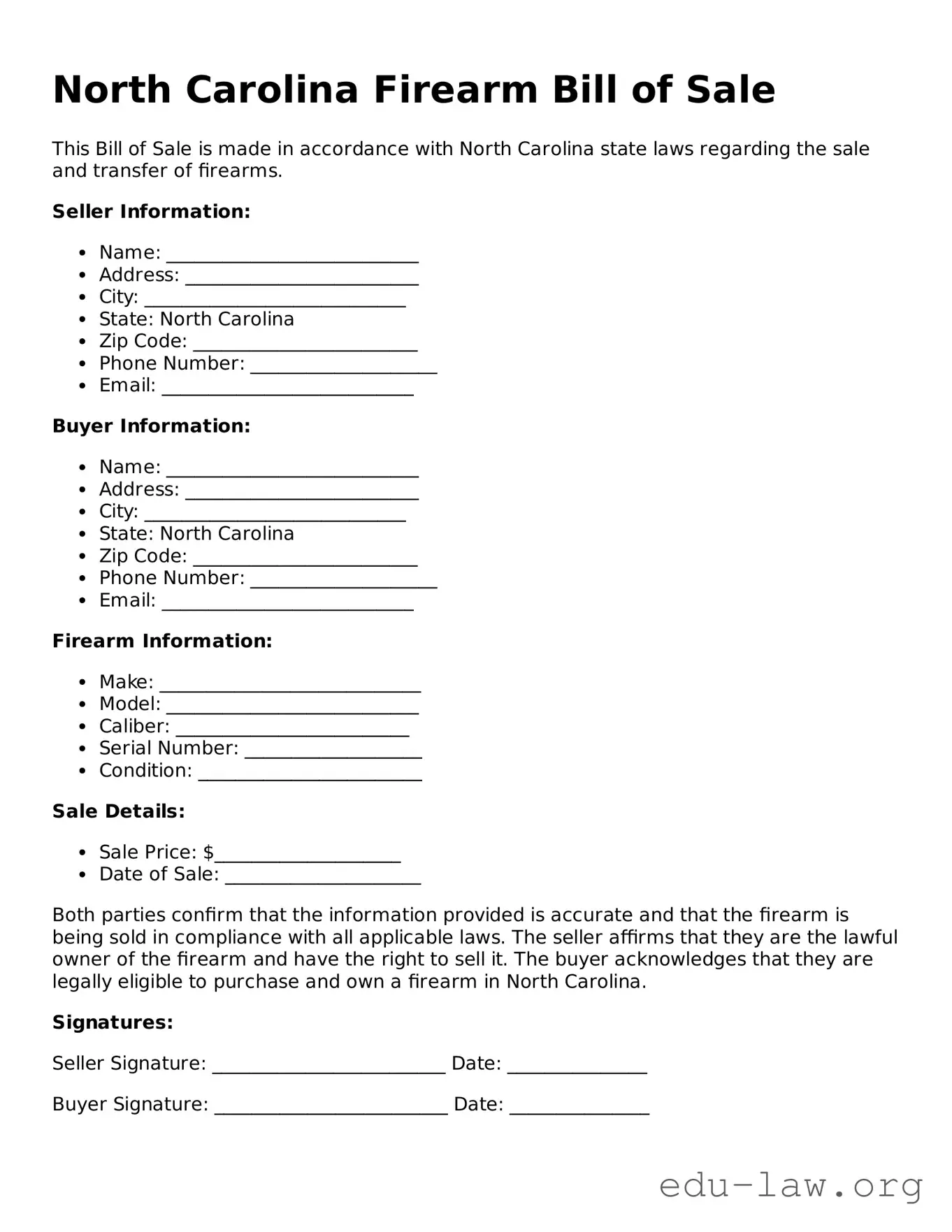
In North Carolina, the process of transferring ownership of a firearm involves several important steps, one of which is the completion of a Firearm Bill of Sale form. This document serves as a legal record of the transaction between the seller and the buyer, ensuring that both parties have a clear understanding of the terms involved. The form typically includes essential information such as the names and addresses of both the buyer and seller, a detailed description of the firearm being sold, and the date of the transaction. It may also require the seller to affirm that they are legally allowed to sell the firearm and that the buyer is legally eligible to purchase it. This form not only provides protection for both parties but also helps to maintain accountability in firearm sales, a crucial aspect in promoting responsible ownership. By understanding the significance of the Firearm Bill of Sale, individuals can navigate the legal landscape of firearm transactions with greater confidence and clarity.
North Carolina Firearm Bill of Sale
This Bill of Sale is made in accordance with North Carolina state laws regarding the sale and transfer of firearms.
Seller Information:
Buyer Information:
Firearm Information:
Sale Details:
Both parties confirm that the information provided is accurate and that the firearm is being sold in compliance with all applicable laws. The seller affirms that they are the lawful owner of the firearm and have the right to sell it. The buyer acknowledges that they are legally eligible to purchase and own a firearm in North Carolina.
Signatures:
Seller Signature: _________________________ Date: _______________
Buyer Signature: _________________________ Date: _______________
| Fact Name | Description |
|---|---|
| Purpose | The North Carolina Firearm Bill of Sale form is used to document the sale of a firearm between private parties. |
| Governing Law | The sale of firearms in North Carolina is governed by N.C. Gen. Stat. § 14-402 et seq. |
| Parties Involved | The form requires the details of both the seller and the buyer, including names and addresses. |
| Firearm Details | It must include specific information about the firearm being sold, such as make, model, and serial number. |
| Legal Age | Both parties must be at least 18 years old to legally complete the sale of a firearm in North Carolina. |
| Background Checks | While private sales do not require background checks, they are recommended to ensure compliance with federal laws. |
| Notarization | The form does not require notarization, but having it notarized can add an extra layer of protection. |
| Record Keeping | Both the buyer and seller should keep a copy of the completed bill of sale for their records. |
| State-Specific Requirements | North Carolina does not require a specific form, but using a bill of sale is highly recommended for legal clarity. |
Filling out the North Carolina Firearm Bill of Sale form is a straightforward process. After completing the form, ensure that both the buyer and seller retain a copy for their records. This document serves as proof of the transaction.
What is a Firearm Bill of Sale in North Carolina?
A Firearm Bill of Sale is a legal document that records the sale or transfer of a firearm between two parties. In North Carolina, this form serves as proof of ownership and details the transaction, including the buyer's and seller's information, firearm description, and sale price. While it is not a requirement by law, having a bill of sale can protect both parties in the event of disputes or legal issues later on.
Is a Firearm Bill of Sale required in North Carolina?
North Carolina does not legally require a bill of sale for private firearm transactions. However, it is highly recommended to create one for your records. This document can provide evidence of ownership and the circumstances surrounding the sale, which can be helpful in case of theft, legal inquiries, or disputes.
What information should be included in a Firearm Bill of Sale?
A comprehensive Firearm Bill of Sale should include the following details: the names and addresses of both the buyer and seller, the date of the transaction, a detailed description of the firearm (including make, model, caliber, and serial number), the sale price, and any additional terms agreed upon by both parties. Both parties should sign the document to validate the transaction.
Can I sell a firearm to someone from another state?
Yes, you can sell a firearm to someone from another state, but there are specific regulations to follow. Federal law requires that the transaction must go through a licensed dealer in the buyer's state. It’s crucial to understand both federal and state laws regarding interstate firearm sales to ensure compliance and avoid legal complications.
Do I need to have a background check for private sales in North Carolina?
In North Carolina, private sales between individuals do not require a background check. However, it is advisable to conduct a background check voluntarily to ensure that the buyer is legally eligible to purchase a firearm. This step can provide peace of mind and help prevent potential legal issues in the future.
What if the firearm is stolen after the sale?
If a firearm sold is later discovered to be stolen, the seller may face legal repercussions if they did not take proper precautions. Keeping a Firearm Bill of Sale can help demonstrate that the firearm was legally sold and can protect the seller from liability. Always check the firearm's history before selling to avoid complications.
Can I use a generic bill of sale template for firearms?
While you can use a generic bill of sale template, it is best to use one specifically designed for firearms transactions. A tailored form will include all necessary details pertinent to firearm sales and ensure compliance with state laws. Customizing the document helps safeguard both the buyer and seller.
What should I do if I lose my Firearm Bill of Sale?
If you lose your Firearm Bill of Sale, it is advisable to recreate the document as soon as possible. Both parties should agree on the details again, sign the new document, and retain copies for their records. Keeping a digital copy in a secure location can also help prevent future loss.
Are there any age restrictions for buying or selling firearms in North Carolina?
Yes, there are age restrictions in place. In North Carolina, individuals must be at least 18 years old to purchase a rifle or shotgun and at least 21 years old to buy a handgun. Sellers should verify the buyer's age to comply with state laws and avoid legal issues during the transaction.
Incomplete Information: Many individuals fail to fill out all required fields, such as the buyer's and seller's full names, addresses, and contact information. This can lead to delays or issues with the transaction.
Incorrect Firearm Details: Errors in the description of the firearm, including the make, model, and serial number, can cause significant problems. Ensuring accuracy is crucial for proper identification.
Not Signing the Form: A common mistake is neglecting to sign the Bill of Sale. Without signatures from both parties, the document may not be legally binding.
Failure to Date the Document: Omitting the date can create confusion regarding when the sale took place. Including the date is essential for record-keeping purposes.
Not Providing a Copy: After completing the form, some forget to give a copy to the buyer. Both parties should retain a copy for their records to avoid future disputes.
Ignoring State Laws: Individuals often overlook specific state regulations regarding firearm sales. It’s important to be aware of any legal requirements that may apply to the transaction.
When buying or selling a firearm in North Carolina, the Firearm Bill of Sale form is an essential document. However, several other forms and documents may also be useful in this process. Below is a list of some commonly used forms that can accompany the Firearm Bill of Sale.
Having these documents ready can make the buying or selling process smoother and help ensure that all legal requirements are met. Always consider consulting with a legal expert if you have questions about the process or specific forms.
The North Carolina Firearm Bill of Sale form shares similarities with a Vehicle Bill of Sale. Both documents serve as proof of transfer of ownership from one party to another. They typically include details such as the buyer's and seller's names, addresses, and signatures. Additionally, both forms often require a description of the item being sold, including identification numbers or other unique identifiers, ensuring clarity in the transaction.
Another document akin to the Firearm Bill of Sale is the Boat Bill of Sale. Like the firearm transaction, a boat bill of sale provides a legal record of the sale. It includes essential information such as the buyer and seller's contact details, the boat's make and model, and the purchase price. This document protects both parties by documenting the agreement and facilitating the transfer of ownership.
The Equipment Bill of Sale is also similar in nature. This document is used when selling or buying equipment, whether for personal or business use. It contains pertinent details about the equipment, such as its condition and serial number. Just like the firearm bill, it serves to protect both parties and ensures a clear record of the transaction.
The Personal Property Bill of Sale is another relevant document. It covers the sale of various personal items, from furniture to electronics. This form includes information about the item sold, the buyer and seller, and the sale price. Its purpose mirrors that of the firearm bill, providing legal protection and clarity for both parties involved in the transaction.
A Lease Agreement shares similarities with the Firearm Bill of Sale in that both documents outline the terms of a transfer, albeit temporary in the case of a lease. The lease agreement specifies the rights and responsibilities of the landlord and tenant. It includes details such as the duration of the lease, rental amount, and property description, ensuring that both parties understand their obligations.
The Rental Agreement is another document that serves a similar purpose. It governs the rental of personal property, such as tools or equipment. Like the firearm bill, it includes details about the item, rental terms, and contact information for both parties. This agreement helps prevent disputes by clearly defining the terms of use and responsibilities.
The Warranty Deed is also comparable, particularly in real estate transactions. While it primarily deals with property ownership, it serves to transfer rights from one party to another. Both documents require signatures and may need to be notarized to be legally binding. They provide a clear record of the transfer, protecting the interests of both parties.
The Power of Attorney document can be seen as similar in that it grants authority to another individual to act on one's behalf. While it does not involve a sale, it may be used in transactions involving firearms or other property. This document outlines the powers granted and ensures that the designated individual can legally make decisions regarding the property.
Finally, the Affidavit of Ownership is relevant when proving ownership of an item. This document can accompany a Firearm Bill of Sale to establish that the seller is the rightful owner. It includes a sworn statement detailing the ownership history and may be used in conjunction with the sale to provide additional legal assurance.
When filling out the North Carolina Firearm Bill of Sale form, it is important to follow certain guidelines to ensure the process goes smoothly. Below are five things you should and shouldn't do.
By adhering to these guidelines, you can help ensure that the firearm transfer is documented properly and complies with state regulations.
Misconceptions about the North Carolina Firearm Bill of Sale form can lead to confusion and potential legal issues. Here are ten common misunderstandings:
Many believe that a Bill of Sale is optional for private firearm sales. However, having a written record is crucial for both parties to prove the transaction took place legally.
While federal law mandates background checks for sales through licensed dealers, private sales in North Carolina do not require them. However, it is still advisable to conduct one.
This form applies to all types of firearms, including rifles and shotguns, not just handguns. Misunderstanding this can lead to improper documentation.
In reality, completing the Bill of Sale form is typically straightforward and can be done in a matter of minutes.
While the signed form does indicate a completed transaction, it does not absolve the seller of liability if the firearm is used in a crime.
Any individual can create and use a Bill of Sale for a firearm transaction. This is a common misconception that limits individuals' understanding of their rights.
Notarization is not a requirement for the Bill of Sale in North Carolina. However, having it notarized can add an extra layer of legitimacy.
While it is recommended to include certain information, there is no mandated format for the Bill of Sale. Flexibility exists as long as essential details are covered.
The Bill of Sale provides some protection, but it does not shield the seller from all potential legal ramifications related to the firearm.
Both parties should retain a copy of the Bill of Sale for their records. This can be important for future reference or in case of disputes.
Understanding these misconceptions is vital for anyone engaging in firearm transactions in North Carolina. Clarity can help ensure compliance with the law and protect the rights of both buyers and sellers.
When engaging in the purchase or sale of a firearm in North Carolina, utilizing the Firearm Bill of Sale form is essential for both parties involved. Here are some key takeaways to consider:
By adhering to these key points, individuals can navigate the process of buying or selling a firearm in North Carolina more effectively and with greater peace of mind.