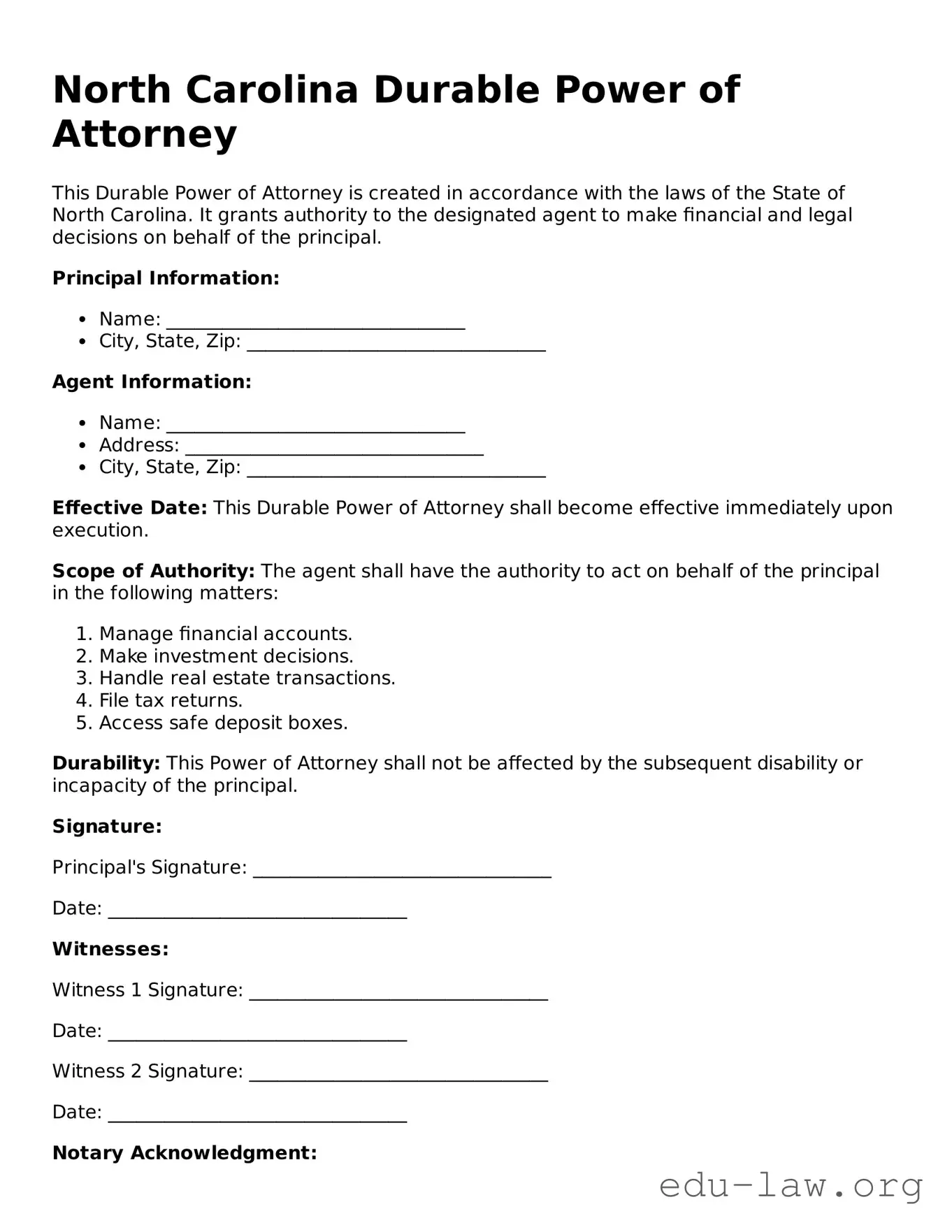
In North Carolina, a Durable Power of Attorney (DPOA) is an essential legal document that allows an individual, known as the principal, to designate another person, referred to as the agent or attorney-in-fact, to make decisions on their behalf. This authority remains in effect even if the principal becomes incapacitated. The DPOA can cover a wide range of decisions, including financial matters, healthcare choices, and property management. It is important for the principal to choose someone they trust, as this person will have significant power to act in their best interest. The form must be completed and signed according to state guidelines to ensure its validity. Additionally, it is advisable to discuss the responsibilities and limitations of this role with the appointed agent, as clear communication can prevent misunderstandings in the future. Understanding the DPOA is vital for anyone looking to plan for unforeseen circumstances, providing peace of mind that their wishes will be respected when they cannot voice them themselves.
North Carolina Durable Power of Attorney
This Durable Power of Attorney is created in accordance with the laws of the State of North Carolina. It grants authority to the designated agent to make financial and legal decisions on behalf of the principal.
Principal Information:
Agent Information:
Effective Date: This Durable Power of Attorney shall become effective immediately upon execution.
Scope of Authority: The agent shall have the authority to act on behalf of the principal in the following matters:
Durability: This Power of Attorney shall not be affected by the subsequent disability or incapacity of the principal.
Signature:
Principal's Signature: ________________________________
Date: ________________________________
Witnesses:
Witness 1 Signature: ________________________________
Date: ________________________________
Witness 2 Signature: ________________________________
Date: ________________________________
Notary Acknowledgment:
State of North Carolina
County of ________________________________
Subscribed and sworn to before me on this ______ day of __________, 20__.
Notary Public Signature: ________________________________
My Commission Expires: ________________________________
| Fact Name | Details |
|---|---|
| Definition | A Durable Power of Attorney allows an individual to appoint someone to manage their financial and legal affairs. |
| Durability | This form remains effective even if the principal becomes incapacitated. |
| Governing Law | The Durable Power of Attorney is governed by North Carolina General Statutes Chapter 32A. |
| Principal | The person who creates the Durable Power of Attorney is known as the principal. |
| Agent | The individual appointed to act on behalf of the principal is referred to as the agent or attorney-in-fact. |
| Signing Requirements | The form must be signed by the principal and witnessed by at least one individual who is not the agent. |
| Revocation | The principal can revoke the Durable Power of Attorney at any time as long as they are competent. |
| Limitations | Certain powers, such as making medical decisions, may require a separate document. |
| Notarization | While notarization is not required, it is recommended for added legal validity. |
| Use Cases | This form can be used for financial transactions, property management, and legal matters. |
Filling out the North Carolina Durable Power of Attorney form is an important step in ensuring that your financial and legal affairs are managed according to your wishes, especially if you become unable to make decisions for yourself. After completing the form, you will need to have it signed and notarized to ensure its validity.
What is a Durable Power of Attorney in North Carolina?
A Durable Power of Attorney (DPOA) is a legal document that allows you to appoint someone else, known as your agent or attorney-in-fact, to make decisions on your behalf. This authority remains in effect even if you become incapacitated. In North Carolina, a DPOA can cover a wide range of financial and legal matters, including managing bank accounts, paying bills, and making investment decisions. It is important to choose a trustworthy individual, as they will have significant control over your affairs.
How do I create a Durable Power of Attorney in North Carolina?
Creating a Durable Power of Attorney in North Carolina involves several steps. First, you need to complete the DPOA form, which can be obtained online or through legal resources. It’s essential to specify the powers you want to grant your agent clearly. After filling out the form, you must sign it in front of a notary public. This step is crucial, as it helps validate the document. Additionally, it’s advisable to provide copies of the signed DPOA to your agent, financial institutions, and healthcare providers to ensure they are aware of your designated representative.
Can I revoke a Durable Power of Attorney in North Carolina?
Yes, you can revoke a Durable Power of Attorney at any time, as long as you are mentally competent. To do so, you should create a written revocation document stating your intention to cancel the DPOA. It is wise to notify your agent and any institutions that had relied on the original document about the revocation. Destroying the original DPOA is also a good practice to prevent any confusion. Keep in mind that once you revoke the DPOA, your agent will no longer have the authority to act on your behalf.
What happens if I do not have a Durable Power of Attorney?
If you do not have a Durable Power of Attorney in place and become incapacitated, your loved ones may need to go through a court process to obtain guardianship or conservatorship. This process can be lengthy, costly, and emotionally taxing for your family. Having a DPOA allows you to choose someone you trust to handle your affairs without the need for court intervention. It provides peace of mind, knowing that your financial and legal matters will be managed according to your wishes, even if you are unable to communicate them yourself.
Not Specifying Powers Clearly: One common mistake is failing to clearly outline the specific powers granted to the agent. Without clarity, the agent may not understand their authority, leading to confusion and potential disputes.
Neglecting to Date the Document: It is crucial to date the Durable Power of Attorney form. An undated document may create issues regarding its validity and when the powers actually take effect.
Ignoring Witness and Notary Requirements: In North Carolina, the form requires signatures from witnesses and a notary public. Skipping these steps can render the document invalid.
Not Updating the Form: Life circumstances change. Failing to update the Durable Power of Attorney when significant life events occur—such as marriage, divorce, or the birth of a child—can lead to outdated or irrelevant powers.
Choosing the Wrong Agent: Selecting an agent who may not act in the best interest of the principal can have serious consequences. It’s essential to choose someone trustworthy and reliable.
Overlooking Revocation of Previous Powers: If there are previous Durable Power of Attorney documents, it’s important to revoke them formally. Failing to do so can create conflicts between old and new powers.
When creating a Durable Power of Attorney (DPOA) in North Carolina, it is often helpful to consider additional documents that can complement this legal tool. Each of these documents serves a unique purpose and can provide further clarity or support in managing one's affairs. Below is a list of commonly used forms and documents that may accompany a DPOA.
Considering these documents when establishing a Durable Power of Attorney can provide a comprehensive approach to managing one's affairs, both during life and after death. Each form plays a vital role in ensuring that an individual's wishes are respected and that their interests are protected.
The North Carolina Durable Power of Attorney form is similar to a General Power of Attorney. Both documents allow one person to grant another the authority to make decisions on their behalf. However, the General Power of Attorney typically becomes invalid if the principal becomes incapacitated. In contrast, the Durable Power of Attorney remains effective even if the principal is unable to make decisions due to illness or injury. This distinction makes the Durable Power of Attorney a more reliable option for long-term planning.
Another similar document is the Medical Power of Attorney. This form specifically allows an individual to appoint someone to make healthcare decisions for them if they cannot do so. While the Durable Power of Attorney can cover financial and legal matters, the Medical Power of Attorney focuses solely on medical care. Both documents ensure that a person's wishes are honored when they are unable to communicate them directly.
A Living Will is also comparable to the Durable Power of Attorney, but it serves a different purpose. A Living Will outlines an individual's preferences regarding medical treatment in situations where they cannot express their wishes. Unlike the Durable Power of Attorney, which grants authority to another person, a Living Will is a direct statement of the individual’s wishes regarding end-of-life care. Both documents are essential for comprehensive healthcare planning.
The Advance Healthcare Directive shares similarities with the Durable Power of Attorney. This document combines elements of both a Medical Power of Attorney and a Living Will. It allows an individual to appoint a healthcare agent and also provides specific instructions about medical treatment preferences. Like the Durable Power of Attorney, it is designed to guide decision-making when the individual is incapacitated.
A Revocable Trust can be likened to the Durable Power of Attorney in that both can help manage an individual’s assets. A Revocable Trust allows a person to place their assets into a trust for management during their lifetime and distribution after death. While the Durable Power of Attorney grants authority to someone to manage assets on behalf of the principal, the Revocable Trust provides a structured way to handle assets directly, ensuring they are managed according to the individual's wishes.
Lastly, a Guardianship document is similar in that it involves decision-making for someone who cannot make decisions for themselves. In a Guardianship, a court appoints an individual to make decisions for a person deemed incapacitated. The Durable Power of Attorney, on the other hand, allows individuals to choose their own agent without court intervention. Both documents aim to protect the interests of individuals who are unable to manage their affairs.
When filling out the North Carolina Durable Power of Attorney form, it’s important to follow some best practices. Here’s a simple list of things to do and avoid.
Things You Should Do:
Things You Shouldn't Do:
Understanding the North Carolina Durable Power of Attorney form is essential for effective estate planning. However, several misconceptions can lead to confusion. Here are four common misconceptions:
Many people believe that a Durable Power of Attorney (DPOA) is strictly for financial decisions. In reality, it can also grant authority for health care decisions, depending on how it is structured. This flexibility allows individuals to designate someone to make important choices in various areas of their life.
This is a common misunderstanding. A Durable Power of Attorney remains effective even if the principal becomes incapacitated. This is what distinguishes it from a regular power of attorney, which typically ceases to be effective under such circumstances.
Not all powers of attorney are created equal. The Durable Power of Attorney is specifically designed to remain in effect during the principal's incapacity, while other forms may not have this provision. Understanding the differences is crucial for making informed decisions.
This misconception can lead to unnecessary worry. A Durable Power of Attorney can be revoked at any time by the principal, as long as they are mentally competent. It’s important to communicate any changes clearly to all parties involved.
Clearing up these misconceptions can help individuals make better decisions regarding their legal and financial planning. Always consider consulting a professional for personalized guidance.
Filling out and using the North Carolina Durable Power of Attorney form is an important step in planning for the future. Here are some key takeaways to keep in mind:
Being informed about these aspects will help ensure that your Durable Power of Attorney serves its intended purpose effectively.